

Cybersecurity acronyms show up everywhere in small business operations. They appear in government contracts, cyber insurance applications, supplier audits, and compliance checklists. Yet many small business owners in manufacturing, aerospace, and professional services treat these terms as background noise. That is a costly mistake. Misreading a single term like CUI (Controlled Unclassified Information) or misapplying AC (Access Control) during a NIST audit can delay contracts, trigger compliance failures, or expose your network to preventable breaches. The NIST Cybersecurity Glossary aggregates over 10,000 terms from federal standards, giving U.S. businesses a trusted reference point. This guide breaks down the most critical terms, explains why context matters, and shows you how to apply them.
Table of Contents
- Why cybersecurity terminology matters for small businesses
- Decoding essential cybersecurity terms, acronyms, and frameworks
- Risk, threats, vulnerabilities, and security controls: What they really mean
- Putting terminology into practice: Application for SMBs
- Why context is everything: Our lessons learned
- Strengthen your cybersecurity language with Symmetry
- Frequently asked questions
Key Takeaways
| Point | Details |
|---|---|
| Terminology clarity | Understanding precise definitions curbs confusion during audits and security incidents. |
| Framework alignment | Adopting NIST and CMMC terminology ensures your business meets regulatory and supply chain standards. |
| Practical application | Applying terms correctly enables better risk management and more effective security controls. |
| Context awareness | Always verify term meaning in contracts and regulations, as definitions can shift by context. |
Why cybersecurity terminology matters for small businesses
Imagine submitting a cyber insurance renewal form and misidentifying your "access controls" as "authentication policies." These terms overlap but carry distinct legal meanings. Insurers notice. Auditors notice. And increasingly, your supply chain partners notice too. For small businesses in manufacturing and aerospace, terminology errors are not just embarrassing. They can disqualify you from federal contracts or delay CMMC (Cybersecurity Maturity Model Certification) assessments.
The challenge is real. Most SMBs encounter terminology confusion during audits, contract reviews, or when filling out compliance documentation. The NIST glossary serves as the gold standard for resolving these conflicts, offering context-specific definitions that acknowledge how the same term can carry different meanings across frameworks.
Here are common terms that trip up SMB leaders:
- CUI (Controlled Unclassified Information): Data that requires protection under federal law but is not classified. Misidentifying CUI in your systems can expose you to contract violations.
- AC (Access Control): A family of security requirements controlling who can access systems and data. Confusing AC with simple password policies is a frequent audit gap.
- AU (Audit and Accountability): Requirements for logging and monitoring system activity. Skipping this creates blind spots in your security posture.
- IR (Incident Response): The plan and process for handling breaches. Without a documented IR plan, breaches linger longer and cost more.
- SIEM (Security Information and Event Management): A system that aggregates and analyzes log data to detect threats in real time.
NIST SP 800-171 Rev. 2 defines 110 security requirements across 14 families for protecting CUI in non-federal systems, directly affecting manufacturing and aerospace suppliers. These requirements are not optional. They are contract conditions for working with the Department of Defense and other federal agencies.
For businesses pursuing cybersecurity compliance in manufacturing, getting terminology right is step one. You cannot implement what you do not clearly understand. The critical security controls framework offers another layer of practical reference for SMBs looking to operationalize these definitions.
"Precision in language is precision in security. When your team uses the same definitions as your auditors and partners, compliance becomes a process rather than a guessing game."
Having set the scene, let's clarify the core terms you'll encounter and why precision matters.
Decoding essential cybersecurity terms, acronyms, and frameworks
The language of cybersecurity can feel like alphabet soup. But each acronym represents a distinct function, and understanding the distinction helps you allocate budget, assign responsibilities, and satisfy auditors. The NIST Cybersecurity Glossary maintains over 10,000 defined terms drawn from NIST standards, CNSSI 4009, and federal regulations.
Here is a quick reference table for the terms most relevant to SMBs in manufacturing, aerospace, and professional services:
| Term | Definition | Example scenario |
|---|---|---|
| CUI | Controlled Unclassified Information requiring federal protection | A defense supplier stores engineering drawings that qualify as CUI |
| AC | Access Control: policies restricting system and data access | Role-based login permissions for shop floor vs. management |
| AU | Audit and Accountability: logging user and system activity | Tracking who accessed a CUI folder and when |
| IR | Incident Response: structured process for handling breaches | Activating a response plan after ransomware detection |
| MFA | Multi-factor Authentication: requiring two or more verification steps | Staff must enter a password plus a mobile code to log in |
| SIEM | Security Information and Event Management: centralized log analysis | Flagging unusual login attempts from an unfamiliar IP address |
Beyond the table, a few distinctions are worth spelling out clearly. MFA is not the same as strong passwords. It adds a second verification layer entirely. SIEM is not just logging. It analyzes patterns across logs to surface threats that individual tools would miss. Understanding your endpoint security definition is equally important, since endpoints are the most common entry points for attackers.
Frameworks to know:
- NIST CSF (Cybersecurity Framework): A voluntary framework organizing security into five functions: Identify, Protect, Detect, Respond, Recover.
- CMMC (Cybersecurity Maturity Model Certification): A DoD requirement for defense contractors, with Level 2 mapping directly to NIST 800-171.
- NIST SP 800-53: A broader control catalog used for federal systems and referenced for moderate baselines in commercial settings.
Pro Tip: Always verify a term's definition within the specific framework or contract where it appears. The word "incident" in your IR plan may differ from how your cyber insurer defines it in your policy. Checking the term's context within NIST, CMMC, and your contract language prevents costly misalignment. Network segmentation is one area where definitions diverge significantly between frameworks.
Now that you see the importance, let's break down the exact language you'll encounter when terms interact in real decisions.
Risk, threats, vulnerabilities, and security controls: What they really mean
These four terms are used interchangeably in casual conversation. In cybersecurity practice, they mean entirely different things. Conflating them leads to misguided investments and overlooked gaps.
Threat is a potential cause of harm. A phishing email in your inbox is a threat. It has not done anything yet.

Vulnerability is a weakness in your system that a threat could exploit. An unpatched operating system is a vulnerability.
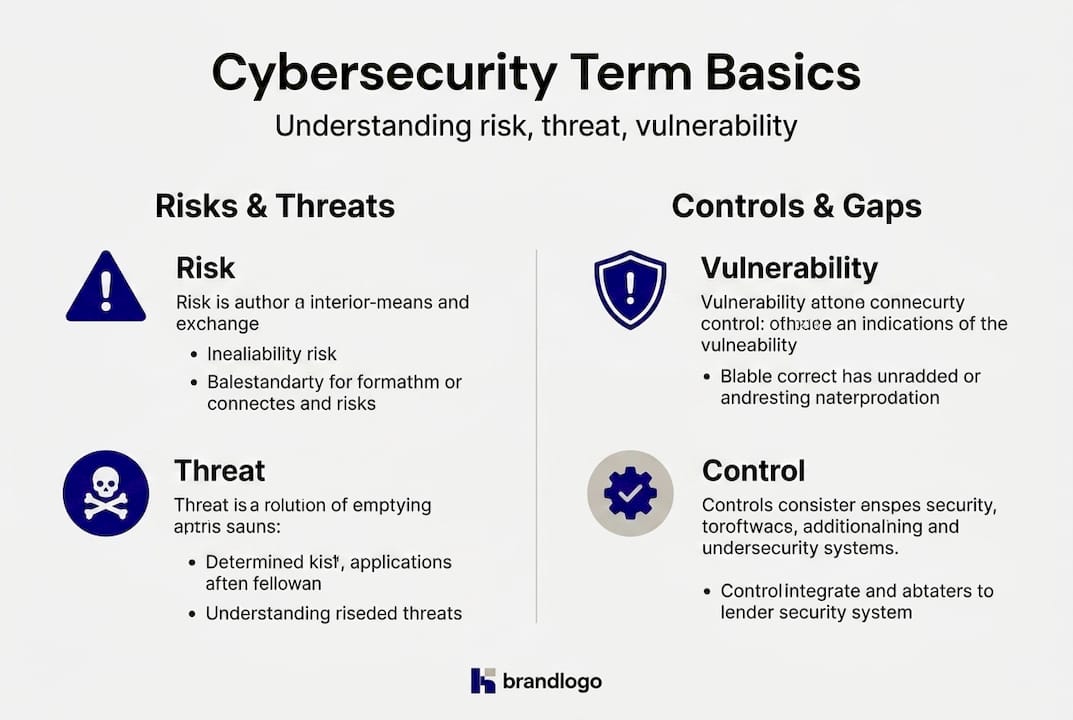
Attack is an active, intentional attempt to exploit a vulnerability. When a threat actor sends that phishing email and your employee clicks it, that is an attack.
Risk is the intersection of all three. The standard formula is:
- Identify the threat: A ransomware group targeting manufacturers.
- Assess the vulnerability: Your systems have not been patched in 90 days.
- Estimate the impact: A successful attack could halt production for a week.
- Calculate risk: High threat likelihood, high vulnerability, high impact = critical risk.
This Risk = Threat × Vulnerability × Impact model, supported by security information concepts, helps you prioritize where to act first rather than trying to fix everything simultaneously.
Security controls are the actions you take to reduce risk. They fall into three categories:
| Control type | Function | Example |
|---|---|---|
| Preventive | Stop threats before they cause harm | Firewalls, MFA, access control policies |
| Detective | Identify threats in progress | SIEM logging, intrusion detection systems |
| Corrective | Restore systems after an incident | Backups, incident response plans |
A critical truth: risk cannot be eliminated. It can only be managed to an acceptable level based on your tolerance. For aerospace suppliers, that tolerance is often very low given the regulatory stakes. Delayed patching and misconfigurations drive over 60% of supply chain attacks in this sector. Review your security control examples to identify which preventive and detective controls your current environment is missing.
"A firewall without a SIEM is a locked front door with no security camera. You stop what you can see coming, but miss what slips through."
Putting terminology into practice: Application for SMBs
Understanding these terms in isolation is useful. Knowing how to apply them in your daily operations is what drives real security improvement and contract wins.
Here is a practical step-by-step approach:
- Start with the NIST glossary during every risk assessment. Before labeling a finding as a "vulnerability" or a "risk," verify the term against the NIST Cybersecurity Glossary. This keeps your documentation consistent with what auditors and partners expect.
- Map your systems to CUI boundaries first. Identify where CUI lives, who can access it, and which AC and AU controls apply. This is the foundation of NIST 800-171 and CMMC Level 2 compliance.
- Review contracts for terminology mismatches. Pull the cybersecurity sections of your supplier agreements and compare definitions with your internal policies. Gaps between contract language and your actual practices are audit findings waiting to happen.
- Build an IR plan using standardized language. Your incident response plan should use NIST-defined terms for "incident," "breach," and "containment" so that every team member and external partner is operating from the same playbook.
- Use SP 800-53 moderate baseline as a control roadmap. For professional services firms handling sensitive client data, this baseline provides a practical list of controls aligned with real-world risk tolerance.
Pro Tip: Audit your contracts for misunderstood terms before your next supplier review. Pay special attention to how CUI, incident, and access control are defined. Misalignment in these three areas causes the most friction during supply chain certification.
A practical example: a small aerospace parts manufacturer found that its supplier questionnaire asked whether it had "SIEM capabilities." The operations manager thought their basic antivirus counted. It did not. After reviewing the term and implementing proper SIEM logging, the company passed its supply chain audit. Applying correct terminology in manufacturing security practices starts with knowing exactly what each requirement actually means.
Why context is everything: Our lessons learned
Here is the part most cybersecurity guides skip. Definitions are not fixed. They shift based on the legal, contractual, and regulatory context in which they appear. Working with U.S. manufacturing and aerospace clients, we have seen businesses build entire compliance programs around a glossary definition, only to discover their DoD contract used a narrower or broader interpretation of the same term.
The word "incident," for example, means one thing in NIST SP 800-61 and something slightly different in a commercial cyber insurance policy. Building your IR plan without reconciling those definitions creates gaps that surface at the worst possible moment, during an actual breach.
The harder truth is about risk tolerance in practice. Many SMB owners treat cybersecurity as a binary problem: either you are secure or you are not. But real security is about managing risk to a level your business can accept, given your resources and regulatory obligations. Preventive controls reduce likelihood. Detective controls reduce dwell time. Corrective controls reduce impact. None of them eliminate risk entirely.
For manufacturing and aerospace firms, explicitly defining CUI in your documentation before any audit is non-negotiable. We have seen supply chain security assessments stall simply because two parties used different definitions of the same term. Context is not a footnote. It is the foundation.
Strengthen your cybersecurity language with Symmetry
Understanding cybersecurity terminology is the first step. Applying it correctly across your IT environment, compliance documentation, and supply chain communications is where most SMBs need a knowledgeable partner.
Symmetry Network Management works directly with small businesses in manufacturing, aerospace, and professional services to translate complex frameworks like NIST 800-171 and CMMC into practical, implemented controls. From managed IT services built around your sector's requirements to a clear security controls guide for identifying gaps, we help you move from terminology confusion to documented compliance. We also support backup testing for business continuity, a corrective control that too many SMBs overlook. Reach out for a free assessment and find out exactly where your security language and your security practice need to align.
Frequently asked questions
Where is the best place to find authoritative cybersecurity definitions?
Start with the NIST Cybersecurity Glossary, which is the recognized standard for U.S. businesses and aggregates definitions from federal regulations and NIST publications.
What's the difference between a threat and an attack?
A threat vs. attack distinction is simple: a threat is a potential cause of harm, while an attack is an active, intentional attempt to exploit a specific vulnerability in your systems.
Which cybersecurity standards apply to U.S. manufacturing suppliers?
Most defense-related manufacturers must implement NIST SP 800-171 and CMMC Level 2 to protect CUI and qualify for federal contracts.
How does understanding cybersecurity terminology improve risk management?
Clear definitions let you apply the Risk = Threat × Vulnerability × Impact model accurately, which leads to better prioritized controls and fewer compliance surprises.
Recommended
- How to Secure Manufacturing Networks: A Practical SMB Guide | Symmetry Network Management
- 5 Critical Security Controls Every Small Business Needs | Symmetry Network Management
- Symmetry Network Management | Managed IT Services
- Top 10 IT Infrastructure Mistakes Small Businesses Make - Symmetry Network Management
- Sécurité informatique : Un pilier pour les PME françaises - IT-Pascaud
- What Is Cyber Security and Why It Matters | Security Jobs Board