

A single data breach can end a small business. That is not an overstatement. 60% of SMBs close within six months of a serious breach, with recovery costs ranging from $120,000 to over $3 million depending on the scope. For small businesses in manufacturing, aerospace, and professional services, the stakes are even higher. These sectors handle controlled technical data, client records, and regulated information that attackers actively target. This article walks through the real financial and operational costs of breaches, the compliance frameworks you cannot afford to ignore, the threat landscape in 2026, and the practical steps that protect your business without requiring a large internal IT team.
Table of Contents
- The real cost of a data breach for small businesses
- Key regulatory requirements for manufacturing, aerospace, and professional services
- Top threats and vulnerabilities facing SMBs in 2026
- Proven methodologies and practical steps for data protection
- The uncomfortable truth: Resilience over perfection in SMB data protection
- Get expert support for your data protection needs
- Frequently asked questions
Key Takeaways
| Point | Details |
|---|---|
| Breaches threaten business survival | Up to 60% of small businesses shut down after a major cyber incident. |
| Compliance is non-negotiable | Sector-specific regulations like NIST CSF, CMMC, ITAR, and FTC rules carry steep penalties for non-compliance. |
| New threats are evolving rapidly | Ransomware, supply chain vulnerabilities, and AI data risks demand updated defenses. |
| Pragmatic protection beats perfection | Building resilience and practical controls is more realistic and cost-effective than exhaustive prevention. |
| Expert support maximizes ROI | Managed IT and cybersecurity professionals help ensure both compliance and robust protection for SMBs. |
The real cost of a data breach for small businesses
Numbers tell the clearest story here. Data breach costs for SMBs range from $120,000 to $3.31 million per incident, and manufacturing ransomware attacks average $2.3 million in total damages. Those figures cover ransom payments, forensic investigations, legal fees, regulatory fines, and lost revenue during recovery. What they do not fully capture is the operational paralysis that follows.
When a manufacturing facility gets hit, production lines stop. Supply chain partners get notified, contracts get reviewed, and some clients walk. The disruption does not end when systems come back online. For companies doing work for defense contractors or government agencies, a breach can trigger an audit that freezes new contracts entirely. The operational ripple effect is severe and often underestimated by business owners who view cybersecurity purely as an IT budget line.
Professional services firms face a different but equally serious version of this problem. Professional services breaches average $4.67 million, and 43% of all breaches target SMBs. Law firms, accounting practices, and engineering consultancies hold sensitive client data that, once exposed, damages the trust that took years to build. Clients do not separate the firm from the breach. To them, the firm is the breach.
The table below breaks down where breach costs actually go:
| Cost category | Typical SMB impact |
|---|---|
| Incident response and forensics | $20,000–$150,000 |
| Legal fees and regulatory fines | $15,000–$500,000 |
| Business downtime and lost revenue | $30,000–$1,000,000+ |
| Reputational damage and client loss | Difficult to quantify |
| Notification and remediation costs | $10,000–$100,000 |
Key insight: For small businesses, downtime is often the biggest killer. A manufacturing firm losing two weeks of production does not just lose revenue. It loses client confidence and competitive position simultaneously.
Key financial and operational risks from a breach include:
- Immediate cash flow disruption from halted operations
- Long-term revenue loss from client departures
- Regulatory penalties layered on top of recovery costs
- Increased insurance premiums post-incident
- Difficulty winning new contracts after a disclosed breach
For guidance on securing manufacturing networks, understanding your specific infrastructure vulnerabilities is the first step toward preventing these costs entirely.
Key regulatory requirements for manufacturing, aerospace, and professional services
Beyond the immediate financial damage, non-compliance with sector-specific regulations creates a second wave of liability. Knowing which frameworks apply to your business is not optional. Regulators expect documented, demonstrable compliance, and penalties for falling short are substantial.
Aerospace and defense manufacturers must comply with CMMC (Cybersecurity Maturity Model Certification), NIST SP 800-171, and ITAR (International Traffic in Arms Regulations). CMMC, in particular, is now a gating requirement for Department of Defense contracts. If you cannot demonstrate the required maturity level, you cannot bid. ITAR imposes strict controls on who can access technical data related to defense articles, including criminal penalties for violations.
Professional services businesses face their own set of requirements. The FTC Safeguards Rule applies broadly to financial services and related firms, requiring a formal written information security program. NIST CSF (Cybersecurity Framework) provides the structural backbone for most compliance programs across industries. GDPR and CCPA apply whenever your firm collects personal data from European or California-based individuals, regardless of where your offices are.
Here is a quick comparison of the major frameworks:
| Framework | Who it applies to | Key requirement |
|---|---|---|
| CMMC | Defense contractors | Tiered certification for DoD contracts |
| NIST SP 800-171 | Manufacturers handling CUI | 110 security requirements |
| ITAR | Aerospace and defense exporters | Access controls for defense-related data |
| FTC Safeguards | Financial and professional services | Written security program |
| CCPA/GDPR | Any SMB with covered consumer data | Privacy rights and breach notification |
Statistic: Breach compliance findings show that non-compliant organizations pay significantly higher fines and face longer recovery timelines than compliant ones.
Steps to build a compliance baseline:
- Identify which frameworks apply to your specific contracts and data types
- Conduct a gap assessment against the relevant standard
- Document your existing controls, even informal ones
- Prioritize gaps by risk level and regulatory deadline
- Implement controls and establish a review cycle
Pro Tip: Do not try to achieve compliance in every framework simultaneously. Start with the one tied to your most critical contracts or revenue, then expand your program systematically.
If you are unsure where your organization stands, a cybersecurity compliance guide can help clarify which controls are non-negotiable for your industry. Solid endpoint security and compliance controls are usually the most practical first layer for SMBs starting from scratch.
Top threats and vulnerabilities facing SMBs in 2026
Regulatory awareness alone does not stop attackers. The threat environment in 2026 has grown more sophisticated, and SMBs in manufacturing, aerospace, and professional services are consistently in the crosshairs.
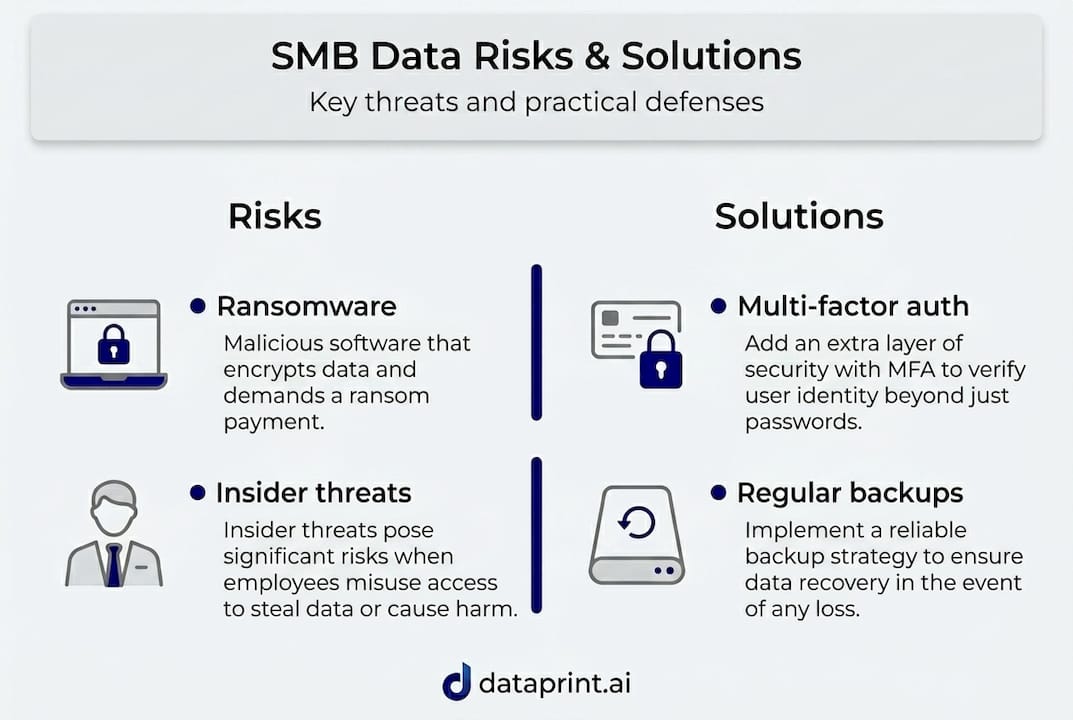
Ransomware remains the dominant threat. Manufacturing is the top ransomware target, with between 50% and 72% of manufacturers reporting attacks. Supply chain compromises are the method of choice because attackers know that hitting a smaller supplier disrupts the larger prime contractor downstream. Critically, 67% of manufacturers lack adequate supply chain visibility, meaning they often do not know a compromise has occurred until damage is done.
Legacy operational technology (OT) systems are a major vulnerability layer. Many manufacturers run equipment that was never designed for internet connectivity, and when IT and OT networks converge without proper segmentation, a single email phishing click can propagate through the entire facility. OT and IT convergence creates gaps that traditional security tools were not built to detect, especially when AI-related risks like data poisoning and model memorization introduce unpredictable new attack surfaces.
On expertise gaps: An estimated 42.5% of cybersecurity positions remain unfilled globally, which means most SMBs simply cannot hire their way out of this problem. The skills shortage is structural, not temporary.
Current top threats for SMBs in these sectors:
- Ransomware via supply chain: Attackers compromise a vendor to reach your network
- Phishing and social engineering: Still the most common initial access method
- Unpatched legacy OT systems: Equipment running outdated firmware with no security updates
- Insider threats: Disgruntled employees or accidental data exposure
- AI-driven attacks: Automated reconnaissance and credential stuffing at scale
- Third-party software vulnerabilities: Compromised updates delivered through trusted channels
Pro Tip: Apply segmentation best practices to isolate your OT environment from your general IT network. Even basic segmentation dramatically limits the blast radius of a successful attack.
For a deeper look at protecting your production environment, the manufacturing network security strategies outlined in our guide address these gaps directly. Staying current on breach vulnerability statistics also helps benchmark your risk posture against industry averages.
Proven methodologies and practical steps for data protection
Knowing the risks is useful. Acting on them is what keeps your business operational. The good news is that you do not need enterprise-level resources to build solid protection. You need a structured approach and consistent execution.
The NIST Cybersecurity Framework organizes protection into six core functions. FTC guidance for small businesses aligns closely with this model and provides a practical starting point for SMBs:
- Govern: Establish accountability and set cybersecurity policy
- Identify: Catalog your assets, data, and third-party connections
- Protect: Apply access controls, encryption, and employee training
- Detect: Implement monitoring to catch anomalies early
- Respond: Document an incident response plan before you need it
- Recover: Maintain tested backups and a clear restoration process
Zero-trust architecture is a practical shift in how SMBs approach access control. Instead of trusting anyone already inside the network, zero-trust requires continuous verification of every user and device. For a small business, this translates to enforcing multi-factor authentication (MFA), limiting user privileges to the minimum needed, and reviewing access logs regularly.
Prevention costs SMBs between $15,000 and $40,000 per year, while breach costs run 10 to 50 times higher. That arithmetic is unambiguous.
| Control | Cost range | Risk it addresses |
|---|---|---|
| MFA across all accounts | Low | Credential theft |
| Encrypted backups (offsite) | Low to moderate | Ransomware and data loss |
| Employee security training | Low | Phishing and social engineering |
| Supply chain vendor audits | Moderate | Third-party compromise |
| 24/7 monitoring (MDR/MSSP) | Moderate | Early threat detection |
Pro Tip: Test your backups quarterly. Most SMBs assume their backup system works until they need it and discover it has not been running correctly for months.
For a prioritized action plan, the critical security controls framework gives SMBs a clear sequence based on actual risk reduction. Pairing that with cybersecurity best practices specific to aerospace and defense closes the most significant gaps quickly.
The uncomfortable truth: Resilience over perfection in SMB data protection
Here is a perspective that most cybersecurity vendors will not offer: perfect prevention is a goal you will never reach, and pursuing it can actually leave you more exposed. SMBs that pour every dollar into prevention controls often have nothing left when an incident occurs, and incidents will occur.

The businesses that survive breaches are rarely the ones with the most elaborate technical defenses. They are the ones with tested response plans, clean backups, and a team that knows what to do at 2 a.m. on a Tuesday. Supply chain resilience research consistently shows that over-reliance on prevention, without equivalent investment in recovery capability, amplifies the damage when a breach occurs.
Resilience means accepting that some attacks will succeed and building your business to absorb and recover from them quickly. For small manufacturers and professional services firms, a practical SMB security guide focused on recovery speed and operational continuity often delivers more real-world protection than a theoretical control framework that never gets fully implemented.
Pragmatic controls, consistently applied and regularly tested, beat elaborate systems that no one maintains.
Get expert support for your data protection needs
Data protection in manufacturing, aerospace, and professional services requires more than general IT knowledge. It demands sector-specific experience, familiarity with CMMC, ITAR, and FTC Safeguards, and the operational depth to keep your business running securely without constant disruption.
Symmetry Network Management provides managed IT services built specifically for small businesses in these industries. From 24/7 monitoring and backup management to compliance support and endpoint protection, the team delivers fixed-price, U.S.-based support that scales with your needs. If you want to know where your current gaps are, start with the essential security controls assessment and take a clear-eyed look at what your business actually needs to stay protected, compliant, and operational.
Frequently asked questions
What is the biggest risk for small businesses if data protection fails?
The biggest risk is business closure. Up to 60% of SMBs fail within six months of a major breach, driven by a combination of financial losses, destroyed client trust, and regulatory penalties that compound quickly.
Which data protection frameworks are essential for manufacturing and aerospace businesses?
NIST CSF, CMMC, ITAR, and supply chain visibility protocols are the core requirements. Aerospace and defense firms specifically need CMMC certification to remain eligible for Department of Defense contracts.
How can SMBs defend against ransomware targeting supply chains?
Assess vendors before granting network access, enforce security requirements in contracts, and implement network segmentation. Manufacturing faces ransomware more than any other sector, making supply chain visibility and tested backups non-negotiable.
What is the ROI for investing in data protection versus dealing with a breach?
Prevention runs $15,000 to $40,000 per year. A breach costs 10 to 50 times more, making proactive investment the only financially rational choice for any SMB handling sensitive data.
What is zero-trust, and why does it matter for SMB cybersecurity?
Zero-trust means continuously verifying every user and device rather than assuming internal users are safe. The FTC recommends this approach because it limits how far an attacker can move inside your network after gaining initial access.
Recommended
- 5 Critical Security Controls Every Small Business Needs | Symmetry Network Management
- Securing Microsoft 365 for Small Business | Symmetry Network Management
- Symmetry Network Management | Managed IT Services
- Top 10 IT Infrastructure Mistakes Small Businesses Make - Symmetry Network Management
- Datenschutz – Informationen nach DSGVO | BIAX
- Why data security matters in short-term rentals