

Small businesses are not flying under the radar of cybercriminals. According to the Identity Theft Resource Center, small businesses experience security incidents at alarming rates, with financial and operational consequences that can threaten their survival. The idea that data protection is a concern reserved for large enterprises with deep pockets is dangerously outdated. For small manufacturers, aerospace suppliers, and professional services firms, the stakes are just as high, and the IT systems that run your operations sit at the center of every risk and every defense worth building.
Table of Contents
- Understanding IT's expanding responsibility in data protection
- How leading frameworks structure IT-driven data protection
- Must-have IT controls: what works in the real world
- From plans to practice: integrating IT data protection across your organization
- What most IT guides miss about data protection for small businesses
- How Symmetry Network Management helps you build real data protection
- Frequently asked questions
Key Takeaways
| Point | Details |
|---|---|
| IT leads data protection | Modern IT manages risk using frameworks that cover prevention, detection, and recovery. |
| Frameworks drive action | NIST CSF 2.0 and SP 800-171 organize protection tasks for specific industries such as manufacturing and aerospace. |
| Practical controls matter | Implementing phishing-resistant MFA, secure backups, and incident response plans is critical for real-world protection. |
| Breach costs are high | Most small businesses suffer breaches that carry heavy financial and operational consequences. |
| Protection is ongoing | Data protection isn't a one-time fix but a continual process of improvement and organizational culture. |
Understanding IT's expanding responsibility in data protection
The role of IT in a small business has shifted well beyond keeping the network running and the printers online. Today, IT carries organization-wide responsibility for identifying risks, enforcing controls, detecting threats, and coordinating recovery when something goes wrong. This is not just a bigger workload. It is a fundamentally different job.
The NIST CSF 2.0 guidance formalizes this shift by framing cybersecurity as a six-function risk management program that applies equally to small businesses and large enterprises. Those functions are: Govern, Identify, Protect, Detect, Respond, and Recover. Each one represents an operational discipline, not just a technology setting.
What this looks like in practice for regulated industries:
- A small aerospace parts manufacturer must inventory every system that touches Controlled Unclassified Information (CUI) and apply specific access controls, not just a firewall.
- A professional services firm handling legal, financial, or health-related records must demonstrate that it manages third-party access and monitors for anomalous behavior.
- A contract manufacturer working in a defense supply chain needs documented incident response procedures, not just antivirus software.
The common misstep across all three sectors is over-investing in tools while under-investing in process. Buying a next-generation firewall or endpoint detection platform is not the same as knowing what to do when an alert fires at 2 a.m. on a Sunday. For small businesses in securing manufacturing networks or aerospace, the gap between having tools and having working processes is where breaches actually happen.
"Cybersecurity risk management is not a technology problem. It is a business management problem that happens to involve a great deal of technology."
Here is a snapshot of the regulatory drivers shaping IT's data protection responsibilities across three key sectors:
| Industry | Key regulation or standard | Core IT requirement |
|---|---|---|
| Manufacturing | NIST CSF 2.0, CMMC | Asset inventory, access control, incident response |
| Aerospace | NIST SP 800-171, CMMC | CUI protection, audit logging, media protection |
| Professional services | SOC 2, HIPAA, state privacy laws | Identity management, third-party risk, data classification |
Understanding which rules apply to your specific business is the foundation for making IT investment decisions that actually reduce risk rather than just fill a checkbox.
How leading frameworks structure IT-driven data protection
Frameworks exist because reinventing data protection from scratch is slow, expensive, and error-prone. The two most relevant frameworks for U.S. small businesses in regulated sectors are NIST CSF 2.0 and NIST SP 800-171.
NIST CSF 2.0 organizes every data protection activity under six functions. Govern sets the strategy and accountability structure. Identify maps assets, data flows, and risk exposures. Protect deploys the controls that prevent or limit incidents. Detect monitors for signs of compromise. Respond defines how you act when something goes wrong. Recover restores normal operations and learns from the event.
For aerospace and defense supply chain participants, protecting CUI under NIST SP 800-171 is not optional. It is a contractual requirement tied directly to the ability to win and retain government contracts. The 110 controls in SP 800-171 cover everything from user authentication and system auditing to incident reporting and media sanitization. Many small businesses in this space treat compliance as a point-in-time audit event. That approach consistently fails.
Pro Tip: Before investing in any new security tool, map the purchase to a specific NIST CSF 2.0 function and a documented gap in your current controls. If you cannot make that connection, the purchase is probably not your most urgent priority.
Here is a practical comparison showing how the two frameworks align and where they diverge for small business operators:
| Feature | NIST CSF 2.0 | NIST SP 800-171 |
|---|---|---|
| Primary audience | All organizations | CUI-handling contractors |
| Structure | Six functions, categories, subcategories | 14 control families, 110 requirements |
| Flexibility | High (risk-based, scalable) | Prescriptive (specific controls required) |
| Compliance driver | Voluntary or contractual | Federal contract requirement |
| Best use | Overall security program design | Defense supply chain compliance |
Small businesses that need to secure Microsoft 365 environments will find that both frameworks address identity and access management prominently. Multifactor authentication, conditional access policies, and privileged account controls appear as requirements across both NIST CSF 2.0 and SP 800-171, which makes these controls an efficient place to start.
The numbered steps below outline a practical starting sequence for small businesses applying these frameworks:
- Complete an asset inventory that includes all hardware, software, data stores, and cloud services your business uses.
- Classify your data by sensitivity level, identifying what would cause the most damage if exposed or lost.
- Map your existing controls to NIST CSF 2.0 functions to find the gaps.
- Prioritize remediation based on risk level and regulatory obligation.
- Document your incident response procedures before an incident occurs, not during one.
- Test your backups and recovery procedures on a defined schedule.
The NIST incident response roles guidance reinforces that structured incident response is not a luxury for large organizations. It is a core operating requirement for any business that wants to survive a serious security event and also satisfy the documentation obligations that come with industry regulations.
A cybersecurity compliance guide for regulated industries makes clear that compliance and security are not competing goals. A well-executed compliance program builds genuine security capability, and genuine security capability makes compliance defensible.
Must-have IT controls: what works in the real world
Understanding frameworks is essential, but the real test is which IT controls make practical impact in daily operations. The answer from both government guidance and real incident data is remarkably consistent.
The controls that consistently prevent and limit breaches:
- Phishing-resistant multifactor authentication (MFA). Traditional MFA using SMS codes or authenticator apps is better than passwords alone, but it remains vulnerable to real-time phishing attacks. Phishing-resistant MFA, including FIDO2 hardware keys and passkeys, requires physical presence at the device and cannot be intercepted by a fake login page. For more detail on understanding multi-factor authentication options and how they compare, review your implementation against current guidance.
- Secure, offline, regularly tested backups. Backups that remain connected to the network are not protection against ransomware. They are additional targets. A backup strategy that works must include offline or immutable copies, defined recovery time objectives, and documented test results showing successful restoration.
- Network segmentation. Flat networks allow ransomware and malicious actors to move laterally from a single compromised endpoint to every system in the building. Network segmentation best practices separate critical systems, limit the blast radius of any single incident, and make monitoring more effective.
- Endpoint detection and response (EDR). Basic antivirus software detects known malware signatures. EDR tools monitor endpoint behavior, detect anomalies, and enable rapid containment. For small businesses without a 24/7 internal security team, EDR combined with managed monitoring fills a critical gap.
- Privileged access management. Limiting who can access critical systems, under what conditions, and with what level of rights reduces the damage any single account compromise can cause.
According to CISA ransomware guidance, phishing-resistant MFA and secure, regularly tested backups are the two most consistently emphasized controls for preventing and recovering from ransomware attacks. Both are achievable for small businesses without enterprise-level budgets.

Statistic callout: The CISA Rhysida ransomware advisory confirms that ransomware actors frequently gain initial access through exposed remote services that lack MFA. Professional services firms using remote desktop tools, VPNs, or cloud collaboration platforms without MFA enforcement are providing attackers with a direct path to sensitive client data.
Pro Tip: Run a monthly audit of all remote access accounts. Deactivate any account that has not been used in 30 days, enforce MFA on every active account, and log all remote sessions for review. This single practice eliminates one of the most common ransomware entry points.
Reviewing your essential security controls against these government-validated priorities is a practical way to prioritize your next investment and confirm that what you already have is actually configured correctly.
From plans to practice: integrating IT data protection across your organization
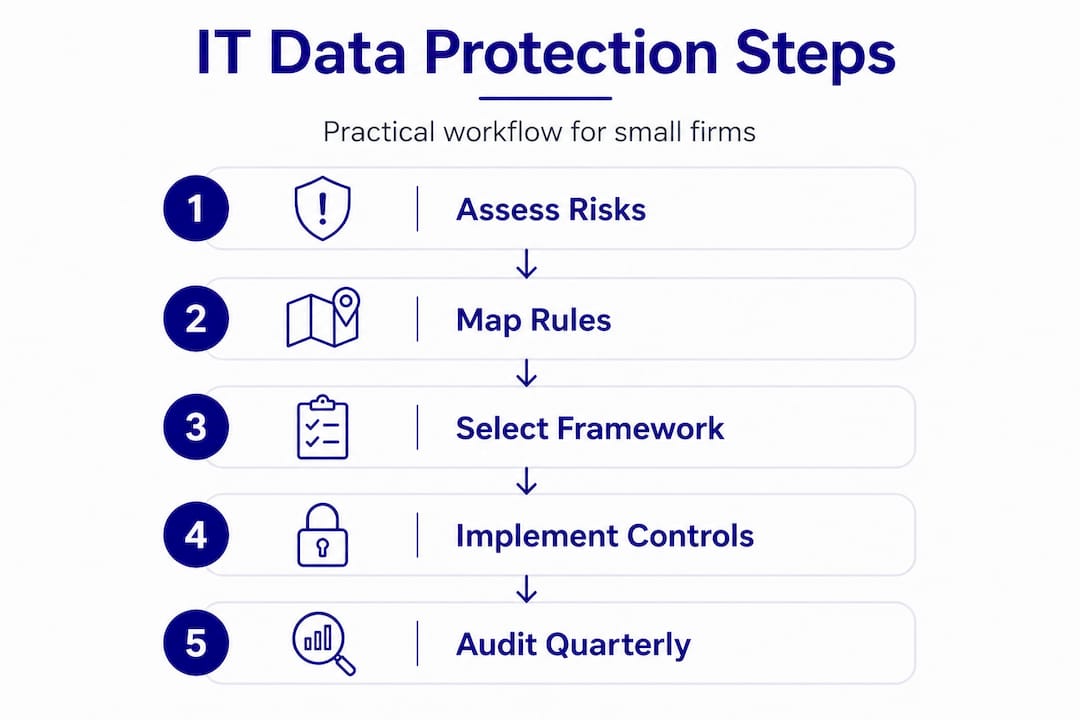
Having covered the technical controls, it is time to translate these strategies into actionable habits that drive real resilience for your business. The gap between a documented policy and an organization that actually behaves securely is where most small businesses get stuck.
Here is a practical sequence for operationalizing IT data protection across your organization:
- Assign clear ownership. Every control needs an accountable person. If nobody owns the backup testing schedule, it will not get done.
- Schedule quarterly reviews. Threat landscapes and business operations change. Your security program should reflect current reality, not the environment you had 18 months ago.
- Train staff regularly and practically. Phishing simulations, tabletop incident response exercises, and brief monthly security reminders build habits that tools alone cannot create.
- Document lessons learned after every incident. Even minor events, a failed login attempt, a lost device, a misconfigured permission, are learning opportunities that strengthen your program if you capture and act on them.
- Integrate IT risk into business planning. When your business adds a new vendor, opens a remote office, or deploys a new application, IT security review should be part of that process from the start.
"Incident response planning and execution is a core part of IT-driven data protection, not an afterthought." This perspective, grounded in NIST SP 800-61r3, reflects what regulators and auditors consistently confirm: businesses that treat response planning as a living operational function recover faster and suffer less damage than those that treat it as documentation.
The Identity Theft Resource Center's 2025 Business Impact Report makes the financial case plain. Small businesses that experienced data breaches reported losses in the hundreds of thousands of dollars, with many forced to raise prices to cover remediation costs. Those are not hypothetical numbers. They represent real businesses that had to choose between absorbing catastrophic losses or passing costs to their customers.
For manufacturers looking to maintain competitive positioning in their supply chains, learning how to approach securing manufacturing networks as a continuous operational priority rather than a one-time project is one of the most valuable investments available. It protects the business, satisfies customer and regulatory requirements, and supports long-term growth.
What most IT guides miss about data protection for small businesses
Most articles about IT data protection for small businesses follow a predictable pattern: list the threats, recommend some tools, and advise you to "stay vigilant." That advice is not wrong, but it misses the real limiting factor.
The businesses that consistently defend themselves well are not the ones with the best tools. They are the ones with clear processes, trained people, and leaders who treat IT security as an ongoing business function rather than a cost center. The tools matter. But the tools are only as effective as the process that surrounds them.
Here is the uncomfortable truth: a small manufacturing firm or aerospace supplier that runs disciplined quarterly security reviews and consistent staff training will outperform a competitor with twice the security budget but no operational discipline. Culture and process are the multipliers that make tools effective.
The regulated sectors set the pace on this. Defense supply chain partners, whether they handle CUI directly or sit a layer removed, face customer-driven expectations for security maturity that are reshaping what "good" looks like for all small businesses. That pressure is a competitive signal worth heeding. The businesses that build genuine security programs today are positioning themselves as preferred vendors and partners tomorrow.
There is also a persistent myth that small businesses should wait until they are bigger before investing seriously in IT security. The breach data does not support that view. Attackers target small businesses precisely because they often have valuable data and fewer defenses. The time to build the program is before you need it.
Our experience supporting businesses across IT services for aerospace and manufacturing confirms that the most resilient organizations are the ones where leadership treats security as a strategic priority and empowers their IT function, whether internal or outsourced, to execute against a clear risk-based plan.
How Symmetry Network Management helps you build real data protection
Putting these strategies into practice takes more than reading a guide. It takes consistent execution, tested tools, and expertise that scales with your business needs.
Symmetry Network Management works directly with small businesses in manufacturing, aerospace, and professional services to operationalize the frameworks and controls covered in this article. From deploying phishing-resistant MFA and managing secure backup systems to supporting NIST CSF 2.0 alignment and regulatory compliance, Symmetry's managed IT services are designed to give your business enterprise-grade protection without the overhead of a full internal IT team. Review Symmetry's critical security controls approach to see how these protections map to your specific industry requirements, then schedule a free assessment to identify your current gaps and the most impactful next steps.
Frequently asked questions
How does IT help small businesses comply with complex cybersecurity regulations?
IT enables compliance by deploying structured frameworks like NIST CSF 2.0, mapping requirements to everyday operations, and applying specific controls suited to the relevant industry standards. This turns regulatory obligations into operational habits rather than one-time documentation exercises.
What's the most important IT defense against ransomware for small businesses?
Phishing-resistant MFA and secure, regularly tested backups are the most effective and consistently recommended defenses against ransomware, according to U.S. government guidance. Both controls limit an attacker's ability to encrypt your data and eliminate your ability to recover without paying.
How serious are the financial consequences of a data breach for a small business?
The ITRC's 2025 Business Impact Report shows that many small businesses lost between $250,000 and $1 million following a data breach, with over 40% forced to raise prices to offset recovery costs. These are operational-level financial shocks, not background noise.
Can IT help with third-party and supply chain data risks?
Yes. Effective IT governance extends access controls and monitoring to cover vendors, contractors, and remote users. As CISA's Rhysida advisory confirms, enforcing MFA on all remote access and limiting third-party privileges are among the most effective controls for reducing supply chain risk.