

Most small business owners assume their off-the-shelf router is enough to keep attackers out. That assumption gets tested hard after a breach. The reality is that standard routers and basic firewalls were never designed to handle today's threats: ransomware, phishing campaigns, and IoT vulnerabilities that evolve daily. A managed firewall fills the gap by combining enterprise-grade hardware with continuous expert oversight. This article explains what managed firewalls are, why small businesses are uniquely at risk, how managed solutions compare to traditional approaches, and how to choose the right provider for your situation.
Table of Contents
- What is a managed firewall and how does it work?
- Why your small business needs a managed firewall
- Managed firewall vs. traditional firewall: What's the difference?
- How to choose the right managed firewall for your business
- Perspective: What most small businesses get wrong about firewalls
- Take your business security further with expert-managed firewalls
- Frequently asked questions
Key Takeaways
| Point | Details |
|---|---|
| Managed firewalls explained | A managed firewall provides ongoing expert monitoring, fast response, and tailored security for small businesses. |
| Why small businesses need them | They protect against evolving threats and help prevent costly breaches or compliance failures. |
| Not just a set-and-forget tool | Without regular updates and expert oversight, even the best hardware firewalls can leave vulnerabilities. |
| Choosing a provider | Select managed firewall services aligned to your industry, monitoring needs, and compliance requirements. |
| Proactive protection pays off | Investing in managed firewalls reduces downtime, legal risk, and business disruption. |
What is a managed firewall and how does it work?
A basic firewall is a filter. It sits between your internal network and the internet, allowing or blocking traffic based on rules someone set up during installation. The problem? Those rules rarely change after day one. A managed firewall is fundamentally different. It's a firewall solution where a team of cybersecurity professionals handles configuration, continuous monitoring, policy updates, and threat response on your behalf.
Think of it this way: a basic firewall is a lock on your front door. A managed firewall is a lock plus a 24/7 security team that changes the combination when new threats appear, watches the cameras, and responds when something looks wrong.
Professional firewall management includes real-time monitoring, rule management, and expert response to threats, meaning your defenses evolve alongside the threat landscape rather than sitting static. The experts managing your firewall review logs, investigate anomalies, apply patches promptly, and adjust access policies as your business grows or changes.
Here's a quick comparison of the three most common setups small businesses use:
| Feature | DIY Firewall | Basic Appliance | Managed Firewall Service |
|---|---|---|---|
| Monitoring | None | Limited alerts | 24/7 professional monitoring |
| Configuration | Self-managed | Vendor defaults | Expert-configured policies |
| Threat response | Manual | Automated block | Active human response |
| Compliance support | None | Minimal | Industry-specific guidance |
| Patching & updates | Owner's responsibility | Infrequent | Scheduled and verified |
Key benefits of a managed firewall service include:
- 24/7 monitoring that catches threats outside business hours
- Compliance support tailored to healthcare, manufacturing, and finance regulations
- Access to certified cybersecurity experts without hiring full-time staff
- Centralized policy management across multiple sites or remote workers
- Faster incident response that limits damage when an attack occurs
For businesses operating across multiple locations, network segmentation best practices become much easier to implement when a managed provider handles policy enforcement.
Pro Tip: Never trust default firewall settings as adequate protection. Defaults are designed to be broad and compatible, not secure. An expert review consistently closes hidden gaps that most business owners never knew existed.
Why your small business needs a managed firewall
Small businesses are not flying under the radar of cybercriminals. They are increasingly the primary target. Attackers understand that small firms often lack the internal IT resources to detect or respond to intrusions quickly, making them easier and more profitable to exploit than larger enterprises.
The threat landscape your business faces today includes:
- Ransomware that encrypts critical files and demands payment to restore access
- Phishing attacks targeting employees through convincing fake emails
- IoT vulnerabilities from connected devices like printers, cameras, and HVAC systems
- Compliance violations that result in regulatory fines even when no breach occurs
- Supply chain attacks that enter through trusted vendor connections
60% of small businesses close within six months of a major data breach, revealing just how catastrophic an unmanaged security gap can become.
Beyond the financial threat, regulated industries face additional pressure. Healthcare organizations must meet HIPAA standards. Manufacturers serving aerospace or defense clients often deal with CMMC or ITAR requirements. Financial services firms face SOC 2 and PCI DSS obligations. A managed firewall isn't just a security tool in those contexts, it's a compliance asset.

If you operate in a regulated sector, learning how to secure manufacturing networks or meet specific requirements outlined in a solid cybersecurity compliance guide shows just how tightly security and compliance are linked. Managed IT services for security can help bridge both obligations simultaneously.
The consequences of operating without proper firewall protection are severe:
- Extended downtime that disrupts operations and revenue
- Regulatory fines that accumulate daily during an investigation
- Loss of customer trust that takes years to rebuild
- Legal liability from exposed client or patient data
- Permanent reputational damage in a competitive market
For small businesses where margins are tight and reputation is everything, these consequences are not recoverable for many firms.
Managed firewall vs. traditional firewall: What's the difference?
The distinction between managed and traditional firewalls isn't just about features. It's about responsibility, expertise, and outcomes. A traditional firewall, sometimes called a firewall appliance or on-premises box, is a piece of hardware your team installs and then largely leaves alone. Managed firewalls shift that entire burden to specialists.
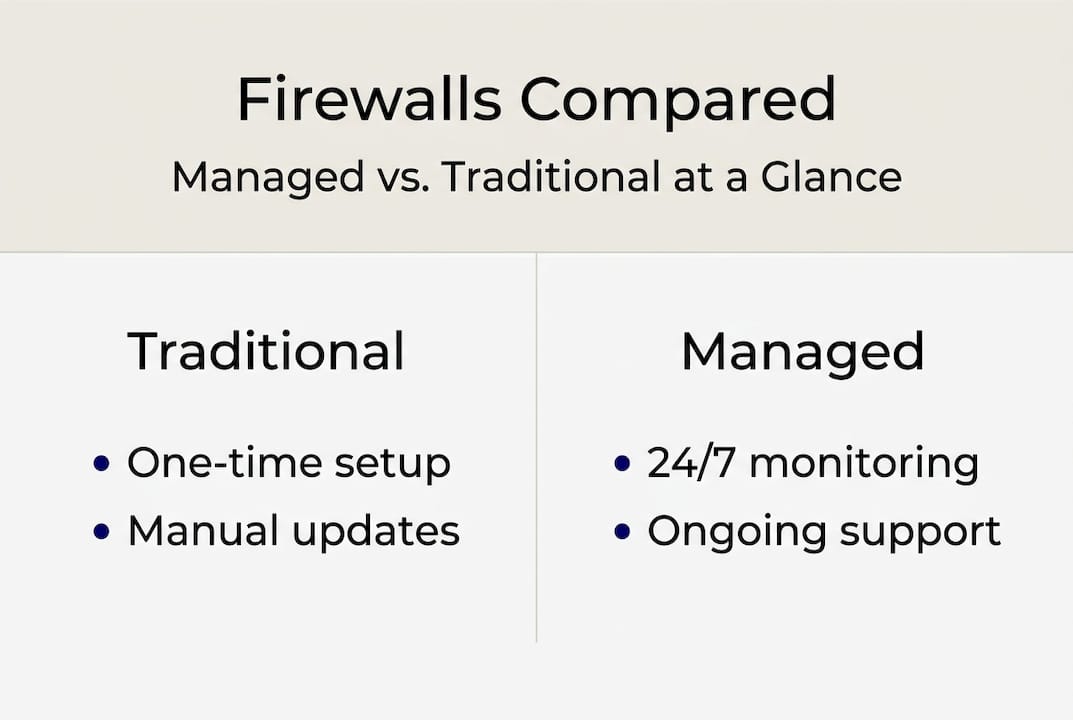
Here's how the two approaches compare directly:
| Category | Traditional Firewall | Managed Firewall |
|---|---|---|
| Setup | One-time configuration | Ongoing expert configuration |
| Updates | Owner initiates patches | Provider applies automatically |
| Monitoring | Reactive or none | Proactive 24/7 |
| Expertise required | High internal knowledge | Handled by provider |
| Scalability | Manual adjustments | Managed scaling as you grow |
| Compliance alignment | Self-managed | Provider-supported |
Traditional firewalls often go unpatched or misconfigured, leaving gaps for attackers to slip through undetected. That's not a flaw of the hardware. It's a reality of how small businesses operate when IT isn't a core function.
Here are the most common pitfalls of sticking with a traditional, self-managed firewall:
- Missed patches: Firmware updates address known vulnerabilities. Without regular patching, your firewall becomes a known weak point.
- Outdated rule sets: Traffic patterns and threat types change. Old rules may allow traffic that would be blocked under a current policy.
- No alert management: Firewalls generate logs and alerts constantly. Without someone reviewing them, attacks go unnoticed for weeks or months.
- Misconfiguration risk: A single incorrect rule can open your entire network to unauthorized access.
- No incident response plan: When something goes wrong, a traditional setup offers no coordinated response.
Learning about the critical security controls that top security frameworks recommend makes clear why ongoing management matters as much as the hardware itself.
Pro Tip: Switching to managed firewall services doesn't just close existing gaps. It builds a security posture that improves continuously as your provider learns your network and your business.
How to choose the right managed firewall for your business
Not all managed firewall providers are built the same. Choosing the wrong one can leave you with false confidence and real exposure. The right provider aligns with your business size, your industry's regulations, and your day-to-day IT patterns.
Start by evaluating providers against these critical criteria:
- Monitoring capabilities: Does the provider offer true 24/7 monitoring with human review, or just automated alerts?
- Compliance expertise: Do they understand the regulations specific to your industry, not just generic cybersecurity standards?
- Reporting quality: Can they provide clear, regular reports that help you understand your security posture without requiring a technical background?
- Integration with your current IT: Will the managed firewall work alongside your existing tools, cloud services, and remote work setup?
- Incident response: What happens when a threat is detected? What's the response time, and who handles it?
Firewalls should align with business size, compliance needs, and remote work patterns. A provider that offers one-size-fits-all policies is almost never the best fit for a small manufacturing or professional services firm.
Ask potential providers these specific questions before signing any agreement:
- How quickly do you respond to an active threat alert?
- Who handles patching, and how often does it happen?
- What reporting will I receive, and how often?
- Have you worked with businesses in my industry before?
- What happens if my business grows or changes significantly?
If you operate in manufacturing, reviewing manufacturing IT security tips can help you identify industry-specific questions to add to that list. Understanding tools your operation already uses, including insights from resources like manufacturing software essentials, also helps frame what your firewall policy needs to protect.
Pro Tip: Prioritize providers that offer flexible, tailored policies over rigid templates. Your industry's specific compliance obligations require customization, not cookie-cutter configurations.
Perspective: What most small businesses get wrong about firewalls
Here's the uncomfortable truth most vendors won't tell you: buying a great firewall is only the beginning. The real protection comes from what happens after installation, and that's where most small businesses fail completely.
The dominant mindset treats a firewall as a box you check. You buy the hardware, install it, and move on. Attackers count on this. They study how long businesses wait between patches. They probe for outdated rule sets. They know that most small firms won't notice unusual traffic for weeks.
We've seen businesses avoid costly intrusions not because their hardware was exceptional, but because someone was actively watching and adjusting. Ongoing management is what separates a firewall that functions from one that actually protects. Reviewing common infrastructure mistakes reveals just how frequently this passive approach creates the breaches that follow.
A managed firewall is a living line of defense. Threats evolve, your network changes, and your protection needs to move with both. Treating it as anything less is the most expensive mistake a small business can make.
Take your business security further with expert-managed firewalls
Understanding managed firewalls is the first step. Acting on that knowledge is what actually protects your business, your clients, and your revenue.
At Symmetry Network Management, we provide managed IT services built specifically for small U.S.-based businesses in regulated industries. Our firewall management is part of a broader security strategy that includes 24/7 monitoring, compliance support, and proactive threat response. Whether you're in manufacturing, aerospace, or professional services, we tailor our approach to your specific risks and regulatory obligations. Schedule a free security assessment today and find out exactly where your current setup leaves you exposed.
Frequently asked questions
How does a managed firewall differ from a regular firewall?
A managed firewall is professionally monitored, regularly updated, and adjusted by experts, unlike standard firewalls that are often configured once and never revisited. Managed firewalls provide ongoing updates and active management that keeps your defenses current.
Can managed firewalls help with compliance requirements?
Yes, managed firewalls are specifically configured to support industry regulations such as HIPAA, CMMC, and PCI DSS. Managed firewalls support industry compliance by aligning firewall policies with the specific requirements of your regulatory framework.
Are managed firewalls cost-effective for small businesses?
Managed firewalls reduce the risk of costly breaches and compliance fines, making them a highly cost-effective investment for small firms. Given that 60% of small businesses close after a major breach, proactive protection delivers clear financial value.
What should I look for in a managed firewall provider?
Look for providers with 24/7 monitoring, verified compliance expertise, clear and regular reporting, and a track record serving your specific industry. Firewalls should fit your unique compliance needs and risk posture, not a generic template.
Recommended
- 5 Critical Security Controls Every Small Business Needs | Symmetry Network Management
- Symmetry Network Management | Managed IT Services
- Network Segmentation Best Practices | Symmetry Network Management
- Securing Microsoft 365 for Small Business | Symmetry Network Management
- What is cybersecurity? Essential guide for business resilience