

Encryption is the process of converting readable manufacturing data into a coded, unreadable format that only authorized parties can access. In manufacturing, this means protecting everything from proprietary design files and production schedules to supplier contracts and customer records. Mitsubishi's 2026 best practices identify encryption as a core security control alongside VPNs and multi-factor authentication. The role of encryption in manufacturing has never been more urgent: manufacturing accounted for over two-thirds of ransomware victims in industrial organizations in 2025, making data security in manufacturing a board-level concern, not just an IT task.
How encryption protects manufacturing data in transit and at rest
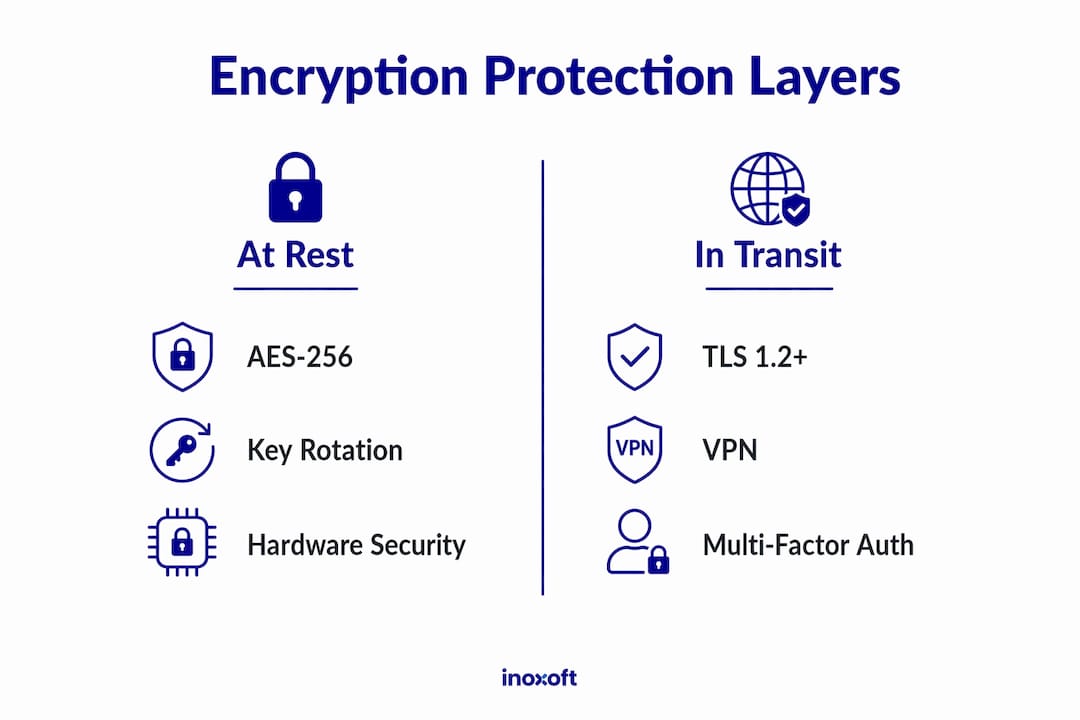
Manufacturing data exists in two states, and each carries distinct risk. Data at rest includes files stored on servers, PLCs, historian databases, and engineering workstations. Data in transit includes any information moving across a network, whether between a factory floor sensor and a SCADA system, or between your facility and a cloud-based ERP platform. Encrypting only one state leaves the other exposed, which is a vulnerability attackers actively exploit.

The standard for transit encryption is TLS 1.2 or higher. For stored data, strong key-managed encryption with automated key rotation is the accepted baseline. Key rotation matters because a compromised key without rotation gives an attacker indefinite access to historical data. Industry guidance stresses that key lifecycle management, including generation, storage, rotation, and revocation, is as critical as the encryption algorithm itself.
Practical examples of encryption in manufacturing include:
- VPN tunnels protecting remote access connections between engineers and plant systems
- Encrypted gateways sitting between legacy OT equipment and corporate networks
- TLS-secured APIs connecting cloud-based MES or ERP platforms to shop-floor data
- Encrypted storage volumes on engineering workstations holding CAD files and IP
Pro Tip: Set automated key rotation schedules rather than relying on manual processes. A 90-day rotation cycle for symmetric keys is a widely accepted starting point, and automation removes the human error that manual rotation introduces.
The combination of at-rest and in-transit protection creates a full lifecycle defense. Without both layers, a single network interception or a stolen hard drive can expose months of production data.
Why manufacturing environments face unique cybersecurity challenges
Manufacturing sits at the intersection of information technology and operational technology, and that convergence creates attack surfaces that most other industries do not face. IT systems handle business data; OT systems control physical processes. When these networks share infrastructure, a ransomware infection that starts in an email attachment can reach a programmable logic controller within hours. Dragos reports shared IT/OT domains in nearly half of manufacturing assessments, the highest rate across all sectors. That statistic explains why manufacturing leads ransomware victim counts.
Remote access compounds the risk. Maintenance engineers, OEM vendors, and third-party contractors routinely connect to plant systems from outside the facility. Each remote session is a potential entry point. Mitsubishi's 2026 guidance specifically calls out VPNs with strong encryption and multi-factor authentication as non-negotiable controls for remote access. MFA alone blocks the vast majority of credential-based attacks, and pairing it with encrypted tunnels closes the channel entirely.
Network segmentation works alongside encryption to limit blast radius. The logic is straightforward: if an attacker breaches one segment, encryption and access controls prevent lateral movement into adjacent systems. Practical segmentation for manufacturers includes:
- Separating corporate IT from OT networks with a demilitarized zone
- Isolating individual production lines or cells from each other
- Restricting vendor remote access to specific, time-limited network zones
- Applying ICS-aware monitoring to detect anomalous traffic crossing segment boundaries
Pro Tip: Treat every remote access pathway as a potential breach point. Require MFA for all vendor and contractor connections, log every session, and use multi-factor authentication tools that integrate with your existing identity management system.
Incident response planning is the third pillar. NIST SP 1800-41 emphasizes that encryption and segmentation reduce the probability of a breach, but a documented recovery plan determines how quickly production resumes after one. Manufacturers without tested incident response plans face significantly longer downtime when attacks succeed.
Is encryption alone enough to protect manufacturing operations?
Encryption is necessary but not sufficient. BlackBerry's supply chain security research states that encrypting file content alone fails to prevent subversion if the communication path lacks integrity and identity verification. An attacker who compromises a supplier's identity can send encrypted but malicious data, and your systems will accept it because the encryption is valid. The data is protected in transit; the data itself is the threat.
This distinction matters most in supply chain security. Manufacturers exchange design specifications, quality records, and firmware updates with dozens of suppliers. Encryption protects those files from interception, but signed data flows and authenticated channels verify that the file actually came from the expected source and has not been altered. The two controls serve different purposes and must work together.
The table below compares what encryption alone provides versus encryption paired with complementary controls:
| Security Layer | Encryption Only | Encryption Plus Complementary Controls |
|---|---|---|
| Data confidentiality | Protected | Protected |
| Data integrity | Not verified | Verified via digital signatures |
| Identity of sender | Not confirmed | Confirmed via authenticated channels |
| Incident recovery speed | Unchanged | Improved with documented response plans |
| Regulatory audit readiness | Partial | Full, with documented key management evidence |
NIST SP 1800-41 reinforces this point by framing incident response and recovery as essential companions to encryption in OT environments. Encryption reduces the damage of a breach; recovery plans determine whether a plant restarts in hours or weeks. Trusted hardware modules, such as hardware security modules (HSMs), add another layer by storing cryptographic keys in tamper-resistant hardware rather than software, removing a common attack vector.
How to implement encryption across manufacturing and IIoT environments
Legacy OT protocols present the most common implementation barrier. Protocols like Modbus and DNP3 were designed for reliability, not security, and they carry no native encryption. The practical solution is deploying encryption gateways at the edge, devices that encrypt traffic leaving legacy equipment before it enters the broader network. This approach protects data streams without requiring a full protocol replacement, which would be operationally disruptive and expensive.
Industrial encryption algorithms in active use include AES for symmetric encryption and ECC for asymmetric key exchange. Hardware acceleration via FPGA or ASIC chips allows these algorithms to run at the speeds manufacturing environments demand without introducing latency that disrupts real-time control systems. For most small manufacturers, the practical starting point is not custom hardware but rather encrypted VPNs, TLS-enabled industrial gateways, and encrypted storage on engineering systems.
Key implementation priorities for manufacturers include:
- Vendor management: Require suppliers to demonstrate encryption controls in contracts and security assessments
- Supply chain cryptography: Apply signed and authenticated data exchanges for firmware updates and design file transfers
- Post-quantum readiness: Cryptographic choices in embedded assets are difficult to change once deployed, so evaluate post-quantum algorithms now during any new equipment procurement
- Compliance evidence: Auditors require documented proof of encryption implementation, key management procedures, and update pathways, not just a checkbox confirming TLS is enabled
The compliance dimension deserves specific attention. Demonstrable encryption evidence means maintaining records of which systems use which cryptographic standards, how keys are managed, and how the organization will migrate to stronger algorithms when current ones are deprecated. Frameworks like NIST CSF and CMMC for defense contractors explicitly require this documentation.
| Encryption Method | Use Case | Performance Consideration |
|---|---|---|
| AES-256 | Data at rest, storage volumes | High speed with hardware acceleration |
| TLS 1.3 | Data in transit, network communications | Minimal latency on modern hardware |
| ECC | Key exchange, device authentication | Efficient on constrained IIoT devices |
| HSM | Key storage and management | Hardware-based, tamper-resistant |
For manufacturers using network segmentation alongside encryption, the combination produces measurable reductions in attack surface. Segmentation limits where an attacker can move; encryption limits what they can read if they get there. Neither control is optional in a modern connected factory.
Key takeaways
Encryption protects manufacturing data in both storage and transit, but its full value requires pairing with identity verification, network segmentation, and documented incident response plans.
| Point | Details |
|---|---|
| Encrypt both data states | Apply TLS 1.2+ for transit and key-managed encryption for stored data to close all exposure gaps. |
| Pair encryption with identity controls | Use digital signatures and authenticated channels to verify data integrity alongside confidentiality. |
| Address legacy OT protocols | Deploy encryption gateways at the edge to protect legacy industrial equipment without replacing it. |
| Plan for post-quantum migration | Evaluate post-quantum algorithms during new equipment procurement, as embedded cryptography is hard to update later. |
| Maintain compliance documentation | Keep records of encryption standards, key management procedures, and update paths to satisfy security audits. |
Why encryption strategy is the wrong place to cut corners
From where I sit, the most common mistake manufacturers make is treating encryption as a one-time configuration rather than an ongoing program. I have seen facilities that enabled TLS on their ERP integration years ago and never revisited it. By 2026, that configuration may be running TLS 1.0 on a server that has not been patched since the initial deployment. The encryption is technically present; the protection is not.
The second pattern I see is overconfidence in encryption alone. A plant manager hears that data is encrypted and assumes the operation is secure. What they often miss is that encryption does nothing to stop an attacker who has valid credentials. That is why the combination of encryption with MFA, segmentation, and continuous monitoring is the only architecture that holds up under real attack conditions. Encryption is the lock on the door; segmentation is the wall around the building; MFA is the guard checking IDs.
The Smart Factory trend accelerates all of this. As more sensors, robots, and edge devices connect to plant networks, the encrypted attack surface grows. Every new IIoT device is a potential entry point, and many ship with weak default cryptographic settings. The manufacturers who will manage this well are the ones who build encryption requirements into procurement contracts today, before those devices are installed and integrated into production systems. Reviewing your manufacturing IT security practices regularly is not optional in this environment. It is the baseline.
— Michael
How Symmnet helps manufacturers build encryption-ready security
Manufacturing cybersecurity requires more than a firewall and good intentions. Symmnet provides managed IT services built specifically for small manufacturers who need enterprise-grade security without an internal IT department to run it.
Symmnet's team handles network segmentation, multi-factor authentication deployment, endpoint encryption, and 24/7 monitoring across your IT and OT environments. If your facility relies on legacy equipment, remote vendor access, or cloud-connected production systems, Symmnet can assess your current encryption posture and identify gaps before attackers do. The process starts with a free security assessment. Contact Symmnet to schedule yours and get a clear picture of where your manufacturing data protection stands today.
FAQ
What is the role of encryption in manufacturing?
Encryption converts sensitive manufacturing data, including IP, production records, and supplier communications, into a coded format that unauthorized parties cannot read. It protects data both in storage and during transmission across plant and corporate networks.
Why is encryption in the supply chain important?
Encryption protects file content during transfer between manufacturers and suppliers, but it must be paired with digital signatures and identity verification to confirm that data has not been altered and came from a legitimate source.
What encryption standards should manufacturers use?
AES-256 is the standard for data at rest, and TLS 1.2 or higher is required for data in transit. Hardware security modules provide tamper-resistant key storage for environments with strict compliance requirements.
How does encryption support regulatory compliance in manufacturing?
Compliance frameworks like NIST CSF and CMMC require documented evidence of encryption controls, key management procedures, and update pathways. Enabling encryption is not sufficient; manufacturers must maintain records proving how cryptography is implemented and managed.
What are the biggest challenges of encryption in manufacturing?
Legacy OT protocols like Modbus lack native encryption, requiring gateway or tunnel solutions to protect industrial data streams. Long asset lifecycles also make cryptographic migration difficult, which is why post-quantum readiness planning should begin during new equipment procurement.