

For small U.S. manufacturers, aerospace suppliers, FDA-regulated co-packers, and professional services firms, a fixed-price enterprise managed services bundle — covering 24/7 monitoring, endpoint detection and response (EDR/MDR), backup and disaster recovery, MFA/identity controls, and compliance support — is the clearest path to enterprise-grade security at a predictable monthly cost.
Here is what that recommendation means in practice:
- Fixed pricing removes the guesswork of per-incident billing and lets you budget IT like any other operating expense.
- Regulatory alignment with NIST CSF, NIST SP 800-171, DFARS, and FDA-relevant controls is built into the service, not bolted on later.
- 24/7 response capability means a threat at 2 AM on a production line gets the same attention as one during business hours.
Symmnet (Symmetry Network Management) is the recommended SMB-focused option for this model. Their 5 critical security controls resource is a good starting point before your first vendor conversation. Request a free security assessment to get a gap analysis mapped to your specific regulatory obligations and a prioritized remediation roadmap.
Key Takeaways
Fixed-price, compliance-first enterprise managed services give small U.S. manufacturers, aerospace suppliers, and regulated co-packers predictable costs, 24/7 protection, and audit-ready documentation without building an internal IT team.
| Point | Details |
|---|---|
| Vet MSPs on three questions | Ask where data lives, who has access, and how it is managed before evaluating price. |
| Require contractual RTO/RPO | Verbal recovery promises are not SLAs — get documented commitments and restore test records. |
| Compliance support is non-negotiable | Your MSP should deliver gap analysis, SSP/POA&M assistance, and evidence collection, not just mention NIST. |
| Onboarding typically runs several weeks | Prepare an asset list and nominate an internal stakeholder to keep the timeline on track. |
| Symmnet offers a free assessment | The assessment delivers a NIST/DFARS-mapped gap analysis and a fixed-price SLA-backed proposal. |
Table of Contents
- What do enterprise managed services actually include for small businesses?
- Which small businesses genuinely need this kind of managed service?
- How do you vet an MSP before signing anything?
- What does fixed-price coverage actually cost, and what traps should you watch for?
- What compliance support should your MSP actually deliver?
- What does onboarding actually look like, and how long does it take?
- What real-world MSP failures look like — and what should have happened instead
- How Symmnet delivers SMB-focused enterprise managed services
- Why compliance-first managed services exist for small manufacturers
- Get your free security assessment and SLA-backed proposal
- Sources
What do enterprise managed services actually include for small businesses?
The phrase "enterprise managed services" gets used loosely. For an SMB in a regulated industry, it refers to a specific bundle of outsourced IT and cybersecurity functions delivered under a fixed-price retainer, not a large-enterprise cloud transformation program.
The core services and what they deliver:
| Service | Typical SLA Metric | Compliance Relevance |
|---|---|---|
| 24/7 system monitoring and alerting | Mean time to detect is rapid | NIST CSF DE.CM; CMMC AC/AU |
| Endpoint security (EDR/MDR) | Threat containment within 1 hour | NIST SP 800-171 SI-3; CMMC SI |
| Firewall management and patching | Critical patches within 24–72 hours | NIST CSF PR.IP; DFARS 252.204-7012 |
| Backup and disaster recovery | Documented RTO/RPO per SLA | NIST SP 800-171; FDA 21 CFR Part 11 |
| Helpdesk support | Response within 1–4 hours by tier | General operational continuity |
| Microsoft 365 management | Uptime and configuration per SLA | CMMC IA; NIST AC controls |
| MFA and identity management | Admin and remote-access coverage | NIST SP 800-171 IA-3; CMMC IA |
| Vulnerability scanning | Monthly or quarterly cadence | NIST CSF ID.RA; CISA Cyber Hygiene |
| Network segmentation | Documented segment map | NIST SP 800-171 SC-7; CMMC SC |
| Vendor and third-party risk management | Annual review cycle | DFARS supply-chain requirements |
What fixed-price coverage typically excludes: major infrastructure projects, hardware refresh, custom OT/SCADA integration changes, and emergency on-site labor beyond a defined threshold. NIST IR 8183A-1 maps these control categories to practical, accessible implementations for small manufacturers — a useful benchmark when comparing what an MSP's scope actually covers.
Which small businesses genuinely need this kind of managed service?
Not every small business needs a compliance-first managed services package. The buyers who get the most value share a few specific characteristics.
Small manufacturers and DoD suppliers handling Controlled Unclassified Information (CUI) face DFARS 252.204-7012 obligations and, increasingly, CMMC assessment requirements. Without documented controls, they risk losing contracts. Aerospace subcontractors operate under similar pressures, often with tighter audit timelines and prime-contractor flow-down requirements. FDA-regulated co-packers need audit-ready documentation, access controls, and backup integrity that maps to 21 CFR Part 11 and food-safety IT requirements. Professional services firms handling sensitive client data, financial records, or health information face their own regulatory exposure.
You should buy now if any of these apply to your situation:
- You handle CUI or export-controlled data and lack a documented System Security Plan (SSP).
- You have experienced recurring outages or a security incident in the past 18 months.
- You have no dedicated internal IT staff, or your IT person wears multiple hats.
- A customer, prime contractor, or auditor has asked for documented SLAs or an incident response plan.
- You cannot answer "where does our data live and who has access to it?" in under 60 seconds.
When NOT to buy: if your organization already has an internal enterprise-grade IT team that manages OT, compliance documentation, and security operations in-house, a full managed services retainer may duplicate effort. A targeted compliance consulting engagement is likely a better fit.
How do you vet an MSP before signing anything?
The ND-ISAC SMB Working Group MSP Shopping Questionnaire frames the vetting process around three core premises: where is your data located, who has access to it, and how is it managed, tracked, and protected. Their 30+ question checklist is the most practical due-diligence tool available for SMBs in regulated industries.
Use these questions in every MSP interview:
- Data residency: "Where exactly is our data stored — on-premises, in a U.S.-based cloud region, or offshore? Do any subcontractors have access?"
- Access controls: "Do your own technicians use MFA for admin and remote access to client environments? Can you show us your access policy?"
- Incident response: "Do you have a documented IRP? Can you share a sanitized summary of a recent incident response or a tabletop exercise scenario?"
- Shared responsibility: "Will you provide a Shared Responsibility Matrix (SRM) that defines what you own versus what we own?"
- Subcontracting: "Do you use third-party NOC or SOC providers? If so, where are they located and what data do they access?"
- Offboarding: "What is your data handback process if we terminate the contract? What is the timeline?"
- Certifications: "Do you hold SOC 2 Type II, ISO 27001, or have experience with DIBCAC or CMMC assessments? Can you provide references in manufacturing or aerospace?"
Also consult the Securing SMB Manufacturing Supply Chains handbook from ND-ISAC, which documents real-world MSP failures in manufacturing and recommends specific mitigations. Pair it with the manufacturing cybersecurity checklist to build your interview scorecard.
Pro Tip: Ask the MSP for a sanitized incident response summary or a tabletop exercise example before signing. An MSP that cannot produce either has likely never run a formal IR process — and that gap will show up when you need them most.
What does fixed-price coverage actually cost, and what traps should you watch for?
Fixed-price managed services for SMBs typically follow one of three pricing shapes: per-user, per-device, or a full-network retainer. Per-user pricing works well for office-centric businesses; per-device pricing fits manufacturers with many endpoints and few users; a retainer covers a defined network scope regardless of headcount changes.
Contract red flags to reject before signing: vague scope language with no line-item SLA, missing SRM/CRM defining who owns what, onboarding fees with no defined end date, RTO/RPO stated as targets rather than contractual commitments, termination clauses that do not specify a data handback timeline, and incident response SLAs measured in "best effort" rather than documented hours. IT outsourcing guidance for manufacturers consistently highlights that a missing offboarding procedure is one of the most common and costly contract oversights.
What compliance support should your MSP actually deliver?
NIST MEP notes that many small manufacturers must navigate DFARS 252.204-7012 and FAR 52.204-21 requirements, and points them to the NIST SP 800-171 Self-Assessment Handbook for structured guidance. A competent MSP should be able to help you apply those controls, not just mention them.
Concrete compliance deliverables your MSP should provide:
- Gap analysis mapped to NIST CSF or SP 800-171, with findings prioritized by risk level.
- SSP and POA&M assistance — drafting and maintaining your System Security Plan and Plan of Action and Milestones.
- Evidence collection for audits: configuration screenshots, patch logs, access review records, backup test reports.
- Network segmentation separating IT from OT/production environments, with a documented segment map.
- MFA enforcement for all admin accounts and remote access sessions.
- Vulnerability scanning on a defined cadence, with remediation tracking.
- IRP aligned to reporting obligations — including the 72-hour reporting window under DFARS 252.204-7012.
NIST CSF is voluntary but functions as the practical roadmap most MSPs use to sequence controls. DFARS and FAR 52.204-21 are mandatory for government contractors. CISA's Critical Manufacturing Sector guidance recommends framework-based, flexible approaches that apply across IT and OT environments — ask your MSP whether their service maps to that guidance. For deeper implementation detail, the IT compliance guide for manufacturing walks through control mapping for common regulatory scenarios.
What does onboarding actually look like, and how long does it take?
A realistic onboarding sequence for a small manufacturer or regulated co-packer runs six to ten weeks, depending on network complexity and how prepared the buyer is on day one.

Weeks 1–2: Discovery and asset inventory. The MSP catalogs every endpoint, server, network device, and cloud account. Buyers who prepare an asset list in advance cut this phase by several days. Nominate an internal point of contact with authority to grant access and schedule walkthroughs.
Weeks 2–3: Risk and compliance gap analysis. The MSP maps findings to NIST CSF or SP 800-171 and produces a prioritized remediation list. This is also when the SRM is drafted.
Weeks 3–5: Segmentation, identity baseline, and EDR/MFA rollout. Network segmentation separating production from office traffic is configured. EDR agents are deployed to all endpoints. MFA is enforced for admin and remote access. This phase often requires a scheduled maintenance window.
Weeks 5–7: Backup and DR configuration and verification. Backup policies are set, retention schedules documented, and a restore test is performed and recorded. RTO/RPO commitments in the SLA should be validated against actual test results here, not assumed.
Weeks 7–10: Documentation, SRM finalization, and handoff. The SSP, IRP, and SRM are completed. The buyer receives a final documentation package and the engagement moves to steady-state managed operations.
Schedule OT walkthroughs early. Access to production environments often requires coordination with plant managers and shift schedules, and delays here push every subsequent milestone.
What real-world MSP failures look like — and what should have happened instead
These anonymized scenarios reflect patterns documented in the ND-ISAC manufacturing supply-chain handbook.
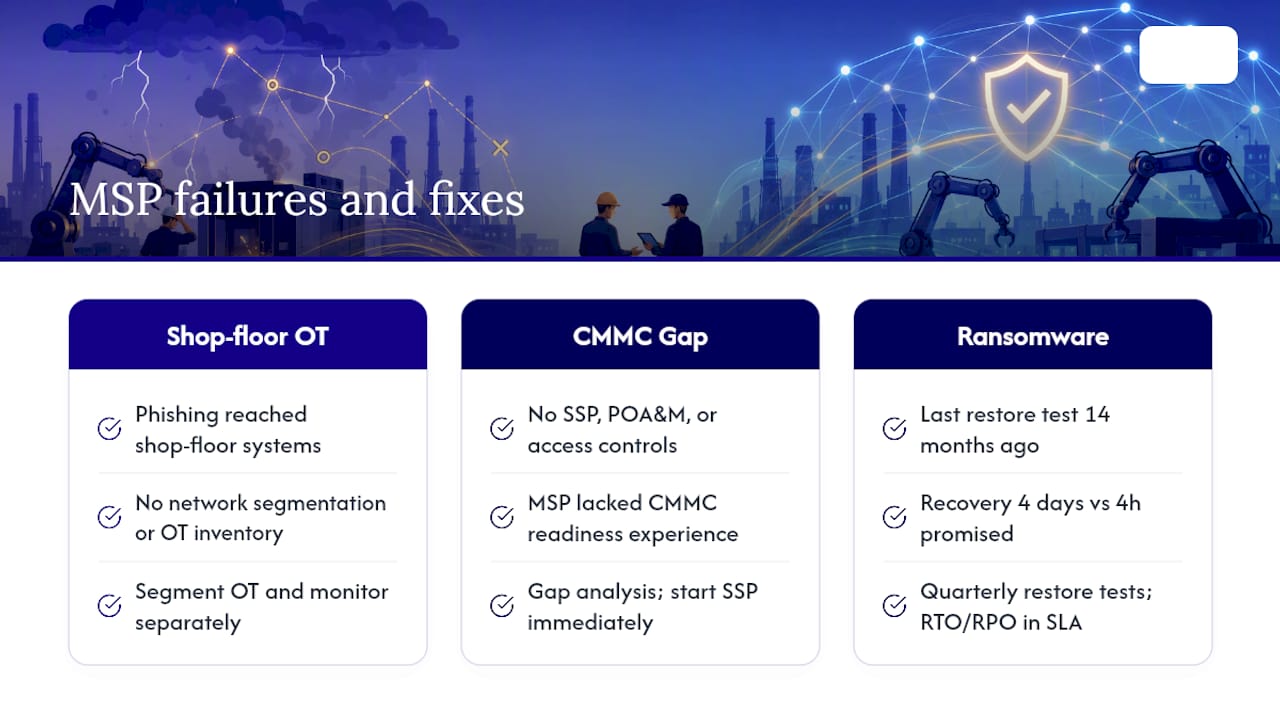
Scenario 1: The shop-floor workstation running Windows 7. A small precision parts manufacturer had a legacy CNC workstation on the same flat network as its office systems. The MSP had installed antivirus and a perimeter firewall but never segmented the network or inventoried OT assets. A phishing email on an office machine gave attackers lateral movement to the shop floor. What should have happened: network segmentation on day one of onboarding, with the OT segment isolated and monitored separately. Add "show me your segmentation diagram" to every vendor interview.
Scenario 2: The CMMC control gap discovered at audit time. A DoD supplier's MSP had no CMMC or NIST SP 800-171 experience. When a prime contractor requested a self-assessment score, the supplier had no SSP, no POA&M, and no documented access controls. The MSP had never asked about CUI handling. What should have happened: a compliance gap analysis in week two of onboarding, with SSP drafting starting immediately. Ask every MSP candidate: "Have you supported a CMMC readiness assessment? Can you provide a reference?"
Scenario 3: The ransomware event where backups weren't tested. A co-packer suffered a ransomware infection. Backups existed, but the last verified restore test was 14 months old. Recovery took four days instead of the four hours the MSP had verbally promised. What should have happened: quarterly backup restore tests with written results, and RTO/RPO stated as contractual commitments, not estimates. Require documented restore test reports before signing any managed services agreement.
How Symmnet delivers SMB-focused enterprise managed services
Symmnet maps directly to the buyer checklist above. Their managed IT services include 24/7 monitoring and alerting, EDR/MDR, firewall management, network segmentation, backup and DR with documented RTO/RPO, Microsoft 365 management, helpdesk support, and compliance documentation assistance for NIST CSF, NIST SP 800-171/DFARS, CMMC readiness, and FDA-relevant controls.
A free Symmnet security assessment delivers a gap analysis mapped to your applicable regulatory framework, an asset inventory baseline, and a prioritized remediation roadmap. The follow-up SLA-backed proposal specifies fixed-price scope, measurable RTO/RPO commitments, onboarding milestones, and a documented transition and offboarding plan. Contact Symmnet to schedule your assessment and receive a proposal built around your industry's specific requirements.
Why compliance-first managed services exist for small manufacturers
Small manufacturers and regulated co-packers have always faced the same problem: enterprise-grade compliance requirements with SMB-sized IT budgets and headcount. Symmnet was built specifically to close that gap — fixed pricing, compliance-first engineering, and U.S.-based support from a team with direct experience in manufacturing, aerospace, and FDA-regulated environments. The goal is predictable costs and audit-ready documentation, not a generic IT contract that leaves compliance as your problem.
Market analysis forecasts that SMB buyers will expect security, compliance support, and AI governance as standard MSP offerings within the next few years. The MSPs that cannot deliver those capabilities today will not be able to catch up when your next audit arrives.
Get your free security assessment and SLA-backed proposal
Fixed-price managed IT and cybersecurity without the compliance guesswork — that is the concrete difference Symmnet offers small manufacturers and regulated businesses compared to a generic IT support contract.
A free Symmnet assessment includes a gap analysis mapped to NIST CSF or NIST SP 800-171/DFARS where applicable, a prioritized remediation roadmap, and an asset inventory baseline. The SLA-backed proposal that follows specifies fixed-price scope, documented RTO/RPO, onboarding milestones, and a clear transition plan if you are moving off an incumbent MSP. Visit Symmnet's services page to request your assessment and get a proposal built for your industry.
Sources
These are the primary resources cited throughout this article. Use them for vendor vetting, compliance follow-up, and sector-specific implementation guidance.
- National Defense-ISAC SMB Working Group MSP Shopping Questionnaire v7.1
- Cybersecurity Framework Manufacturing Profile Low Impact Level: Example Implementations Guide (NIST IR 8183A-1)
- Compliance with cybersecurity and privacy laws and regulations | NIST MEP
- Critical Manufacturing Sector | CISA