

A cybersecurity checklist for aerospace organizations defines the essential controls and practices required to protect sensitive systems, Controlled Unclassified Information (CUI), and operational technology from threats that grow more sophisticated each year. Aerospace firms operating in the Defense Industrial Base (DIB) must satisfy frameworks including CMMC, NIST SP 800-171, and DFARS 252.204-7012 while defending against adversaries who target intellectual property and procurement data as aggressively as financial assets. Multifactor authentication, zero trust architecture, and continuous risk assessments are no longer optional additions. They are the baseline. This guide walks through every critical control your organization needs to implement, document, and maintain in 2026.
1. Cybersecurity checklist for aerospace: core components
The foundation of any aerospace security program starts with defining what you are protecting. CUI includes technical drawings, contract data, and export-controlled information. Federal Contract Information (FCI) covers data generated under a government contract. Every control in your checklist must map back to one of these categories, or you risk spending resources defending the wrong assets.
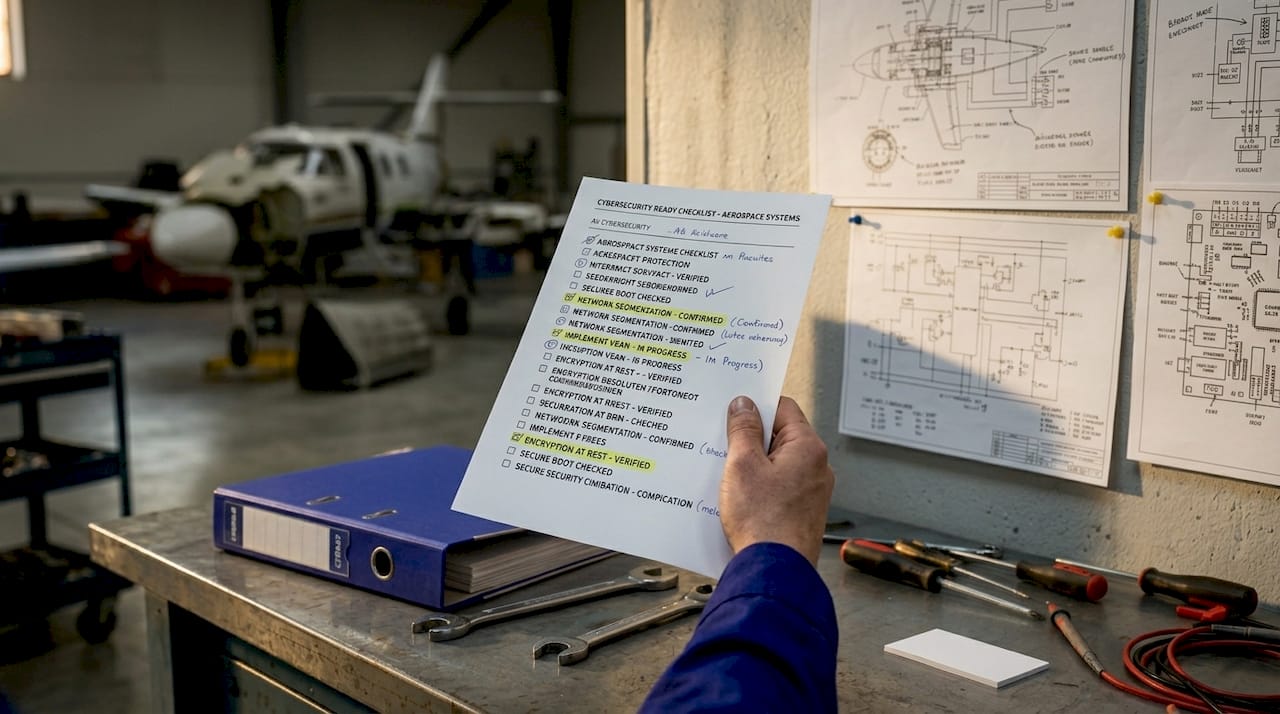
Access control is the first line of defense once scope is defined. Multifactor authentication (MFA) must be applied to every system that touches CUI or FCI, without exception. Pair MFA with a least-privilege model, where users receive only the access their role requires and nothing more. Focusing only on new tech leaves hundreds of legacy vulnerabilities unpatched, which means disciplined application of MFA and least privilege consistently outperforms chasing the latest security tool.
Continuous vulnerability management closes the gap that access controls alone cannot cover. Your team should run authenticated scans at least monthly, prioritize patches by CVSS score and asset criticality, and track remediation timelines in a documented register. Unpatched systems in aerospace environments are not just a compliance failure. They are an open door.
- Define CUI and FCI asset inventory before any other control
- Enforce MFA on all systems handling sensitive data
- Apply least-privilege access across all user accounts and service accounts
- Run monthly vulnerability scans with documented remediation timelines
- Integrate threat intelligence feeds to prioritize emerging risks
- Maintain a tested incident response plan with defined roles and escalation paths
- Validate backup integrity and recovery time objectives (RTOs) quarterly
Pro Tip: Map every checklist control directly to a NIST SP 800-171 control number. This single habit reduces documentation time during a CMMC assessment by a significant margin and prevents gaps from appearing at the worst possible moment.
2. Regulatory compliance requirements in aerospace cybersecurity
CMMC Level 2 is the compliance threshold most aerospace manufacturers in the DIB must meet. It requires full implementation of all 110 NIST SP 800-171 controls, supported by a System Security Plan (SSP) and a Plan of Action and Milestones (POA&M). The SSP documents how each control is implemented. The POA&M tracks every gap and the timeline for closing it. Both documents are reviewed by a Certified Third-Party Assessment Organization (C3PAO) before certification is granted.
DFARS clause 252.204-7012 predates CMMC but remains in force. It requires contractors to report cyber incidents to the Department of Defense within 72 hours, preserve forensic evidence, and submit a damage assessment. CMMC builds on DFARS by adding a formal certification layer. Contractors who hold DFARS obligations but have not yet pursued CMMC certification are operating with incomplete compliance coverage.
The table below compares the three primary frameworks aerospace organizations must understand:
| Framework | Scope | Key Requirement |
|---|---|---|
| NIST SP 800-171 | CUI protection in non-federal systems | 110 security controls across 14 families |
| CMMC Level 2 | DIB contractors handling CUI | Third-party assessment, SSP, POA&M |
| DFARS 252.204-7012 | DoD contractors | 72-hour incident reporting, forensic preservation |
Third-party assessments deserve more preparation than most small aerospace firms allocate. A C3PAO will interview staff, review configurations, and test controls. Organizations that treat the SSP as a living document, updated after every change, consistently perform better in assessments than those who write it once and file it away.
- Identify which CMMC level applies to your contracts
- Complete a gap analysis against all 110 NIST SP 800-171 controls
- Draft or update your SSP to reflect current system configurations
- Open a POA&M for every identified gap with realistic remediation dates
- Engage a C3PAO at least six months before your contract renewal deadline
3. Aerospace-specific operational and supply chain risks
Aerospace intellectual property is a high-value target. Attackers exfiltrate data including NDAs and procurement strategies to map a competitor's or adversary's future initiatives, making the long-term strategic damage far worse than any immediate financial loss. A breach of your supplier's system can expose your own program data just as effectively as a direct attack on your network.
Zero trust architecture addresses this risk by treating every connection as untrusted until verified, regardless of whether it originates inside or outside your perimeter. Micro-segmentation takes this further by dividing your network into isolated zones, so a compromised workstation in one segment cannot reach manufacturing control systems or engineering file servers in another. For aerospace environments that mix IT and operational technology (OT), segmentation is not optional. It is the control that limits blast radius when a breach occurs.
Supply chain risk management requires extending your checklist beyond your own walls. Every third-party vendor with access to your systems or data should complete a security questionnaire, provide evidence of their own controls, and agree to contractual security requirements. Protecting sensitive procurement data from exfiltration through a supplier's compromised account is a scenario your incident response plan must explicitly address.
- Implement micro-segmentation between IT and OT environments
- Apply zero trust principles to all remote access and third-party connections
- Require security questionnaires from all vendors with system access
- Classify and encrypt intellectual property files at rest and in transit
- Deploy a Security Operations Center (SOC) or managed detection and response (MDR) service for continuous monitoring
- Conduct role-specific security awareness training for engineers, operators, and procurement staff
Pro Tip: When evaluating supply chain security for aerospace, prioritize vendors who can provide SOC 2 Type II reports or equivalent third-party attestations. Self-reported questionnaires alone are insufficient for high-risk supplier relationships.
4. Testing and maintaining cybersecurity readiness
Consistent security awareness training reduces phishing vulnerability from 31.4% to 4.8% over 12 months. That is a reduction of more than 80%, achieved through a control that costs far less than most technical solutions. Phishing simulations should run monthly, with targeted follow-up training for employees who click. Aerospace roles require scenario-specific content. A simulation relevant to an engineer receiving a fake CAD file request lands differently than a generic banking phishing test.
Red teaming and penetration testing validate whether your documented controls actually work under real attack conditions. A lifecycle security approach that includes architecture review, static code audits, and realistic red team exercises builds the kind of resilience that compliance documentation alone cannot demonstrate. Schedule penetration tests at least annually and after any significant infrastructure change.
Backup validation is a control that organizations document but rarely test with the rigor it deserves. The following table outlines a practical testing schedule:
| Test Type | Frequency | Success Criteria |
|---|---|---|
| Phishing simulation | Monthly | Click rate below 5% |
| Backup restoration test | Quarterly | Full recovery within defined RTO |
| Penetration test | Annually | No critical findings unresolved after 30 days |
| Incident response tabletop | Bi-annually | All roles execute assigned tasks without gaps |
| Vulnerability scan | Monthly | Critical patches applied within 14 days |
- Run monthly phishing simulations with role-specific scenarios for aerospace staff
- Schedule annual penetration tests and red team exercises
- Test backup restoration quarterly against your documented RTO
- Conduct bi-annual incident response tabletop exercises with all key stakeholders
- Review and update threat intelligence subscriptions to reflect current adversary tactics
Heightened threat environments require dynamic, risk-based defensive controls that go beyond static compliance baselines. This means your checklist should be a living document, reviewed after every significant threat intelligence update, not just at annual audit time. Geopolitical shifts and AI-assisted attack tools change the threat picture faster than annual review cycles can track.
Key takeaways
A complete aerospace cybersecurity checklist combines CMMC and NIST SP 800-171 compliance controls with operational defenses against intellectual property theft, supply chain compromise, and AI-assisted attacks.
| Point | Details |
|---|---|
| Define CUI and FCI scope first | Every control must map to a specific asset category before implementation begins. |
| CMMC Level 2 requires 110 controls | SSP and POA&M documentation are mandatory for DoD contract eligibility. |
| Supply chain is a primary attack vector | Require third-party security attestations from all vendors with system access. |
| Training cuts phishing risk by over 80% | Monthly simulations with role-specific content deliver the strongest results. |
| Test every control, not just document it | Penetration tests, backup restores, and tabletop exercises validate real-world readiness. |
Why cybersecurity and aerospace safety are the same conversation
I have worked with enough aerospace organizations to say this plainly: the firms that treat cybersecurity as a separate IT function from their safety and operations programs are the ones who get caught off guard. Aerospace cybersecurity is inseparable from aviation safety, and that is not a philosophical statement. It is an operational reality. A compromised flight control software update or a manipulated maintenance record is a safety event, not just a data breach.
What I find underappreciated is how much the interdisciplinary gap costs organizations. Engineers know the systems. Security teams know the threats. But the two groups rarely sit in the same room until something goes wrong. The most resilient aerospace organizations I have seen build joint working groups where engineers, operators, and security staff review threat scenarios together. That collaboration surfaces risks that neither group would identify alone.
The other thing I want to push back on is the tendency to chase AI-powered security tools while leaving basic hygiene incomplete. 97% of AI-assisted cyberattacks use automated common techniques, not exotic zero-day exploits. That means your MFA deployment, your patch cadence, and your access reviews are doing more protective work than any advanced detection platform you could buy. Get the fundamentals right first. The advanced tools are multipliers, not substitutes.
— Michael
How Symmnet supports aerospace cybersecurity compliance
Aerospace organizations that need to close compliance gaps without building a full internal security team have a practical path forward with Symmnet.
Symmnet's managed IT security services are built for small and mid-sized aerospace firms that must meet CMMC, NIST, and DFARS requirements without the overhead of an in-house team. Symmnet provides 24/7 monitoring, endpoint security, MFA deployment, network segmentation, and compliance documentation support including SSP and POA&M assistance. For aerospace manufacturers navigating their first C3PAO assessment or tightening controls ahead of a contract renewal, Symmnet offers a free security assessment to identify gaps and prioritize remediation. You can also review the manufacturing cybersecurity checklist Symmnet publishes for firms in adjacent regulated industries.
FAQ
What is a cybersecurity checklist for aerospace?
A cybersecurity checklist for aerospace is a structured set of controls and documentation requirements that aerospace organizations use to protect CUI, FCI, and operational systems while meeting frameworks like CMMC Level 2 and NIST SP 800-171. It covers access control, vulnerability management, incident response, supply chain security, and compliance documentation.
What CMMC level do most aerospace contractors need?
Most aerospace contractors in the Defense Industrial Base handling CUI must achieve CMMC Level 2, which requires implementing all 110 NIST SP 800-171 controls and passing a third-party assessment by a C3PAO.
How often should aerospace firms conduct penetration testing?
Penetration testing should occur at least annually and after any major infrastructure change. A full lifecycle approach that includes static code audits and red team exercises provides the most reliable picture of actual security posture.
What is the biggest cybersecurity risk specific to aerospace?
Intellectual property theft is the primary aerospace-specific risk. Attackers target NDAs, procurement strategies, and engineering data to gain long-term strategic advantage, often through supply chain compromise rather than direct network intrusion.
Does security awareness training actually reduce risk in aerospace?
Consistent training reduces phishing vulnerability from 31.4% to 4.8% over 12 months, making it one of the highest-return controls available. Role-specific simulations tailored to aerospace scenarios produce stronger results than generic training programs.