

Most small business owners assume cybersecurity training means sending employees an annual video and calling it done. That assumption is exactly why breaches keep happening. What is cybersecurity training, really? It is a structured, ongoing program designed to change how your team thinks and acts when they encounter real threats. Human error drives a significant share of security incidents, and your employees are both your biggest vulnerability and your strongest potential defense. This guide walks through how security training actually works, what it includes, and how to make it count for your business.
Key takeaways
| Point | Details |
|---|---|
| Training changes behavior | Cybersecurity training builds real skills and habits, not just awareness of threats. |
| It follows a repeatable lifecycle | Effective programs cycle through assessment, design, deployment, measurement, and improvement. |
| Role-specific content performs better | Tailoring training to executives, remote workers, or ops staff increases relevance and results. |
| Simulations cut phishing risk | Regular phishing drills can reduce phishing vulnerability from 31.4% to 4.8%. |
| Metrics matter more than certificates | Measuring behavior change, not completion rates, is what drives lasting risk reduction. |
What cybersecurity training actually is
Security awareness training, which is the more formal industry term for what most people call cybersecurity training, is a structured program that builds employee knowledge and security behavior so they can recognize threats and respond correctly. It goes well beyond handing someone a policy document to read.

There is an important distinction worth drawing early. Security awareness means employees can recognize a suspicious email or spot a social engineering attempt. Security training goes one step further. It means employees know what to do next. They report the email. They do not click the link. They flag the unauthorized multi-factor authentication request instead of approving it. That response piece is where real protection happens.
For small businesses, the scope of training typically covers:
- Phishing recognition: Spotting fake sender addresses, urgency tactics, and deceptive links in emails or text messages
- Social engineering defense: Recognizing manipulation tactics used over the phone or in person to extract credentials or access
- Credential safety: Using strong passwords, avoiding password reuse, and understanding why multi-factor authentication matters
- Safe device habits: Locking screens, avoiding unsecured Wi-Fi, and handling personal devices used for work
- Incident reporting: Knowing who to call and what to do when something looks wrong
The goal is operational readiness, not theoretical knowledge. Training framed around real decision points employees face, such as an unexpected password reset email or a vendor requesting a wire transfer, gives people practical frameworks they can apply immediately.
Pro Tip: When you introduce training to your team, frame it as a tool that protects them personally, not just the business. Employees who understand that the same threats they face at work also target their personal accounts tend to engage more seriously.
The training lifecycle: why it never really ends
One of the most common mistakes small businesses make is treating cybersecurity training as a project with a finish line. It is not. The threat environment changes constantly, and so does your workforce. Security awareness is an ongoing discipline that must adapt as both threats and employees evolve.
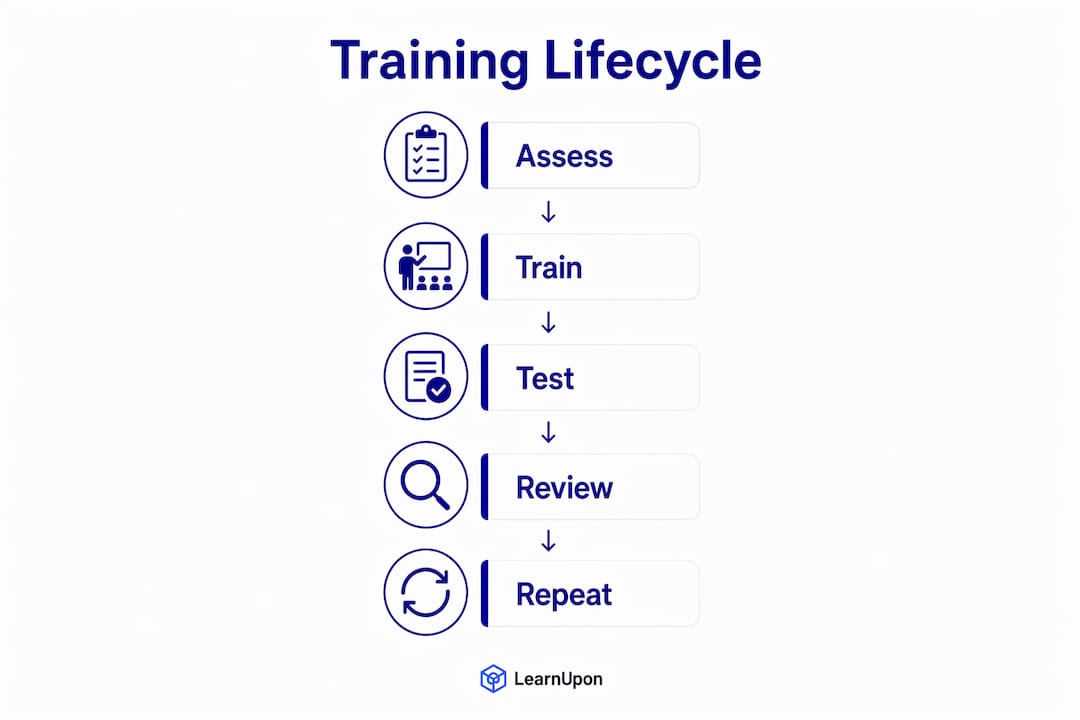
Effective cybersecurity training programs follow a repeatable six-phase lifecycle:
- Assess: Identify your current risk exposure. Which employees have access to sensitive data? Where are knowledge gaps? What threats are most relevant to your industry?
- Plan: Set clear objectives and determine what content, format, and schedule will best serve your team.
- Design: Build or select training content that reflects real scenarios your employees are likely to encounter.
- Deploy: Roll out the training in a format your team can actually complete, whether that is online modules, group sessions, or phishing simulations.
- Measure: Track behavior-based metrics, not just completion rates. Are employees reporting suspicious emails more often? Are they failing simulated phishing tests less frequently?
- Improve: Use measurement data to refine the program, address weak spots, and introduce new content as threats shift.
The table below shows how this lifecycle maps to outcomes small businesses care about:
| Lifecycle phase | What it produces |
|---|---|
| Assess | Clear picture of your highest-risk people and processes |
| Plan | A training schedule aligned to actual business risk |
| Design | Relevant content employees will recognize from real work situations |
| Deploy | Consistent security habits forming across the team |
| Measure | Data showing whether behavior is actually changing |
| Improve | A program that gets stronger over time instead of going stale |
Pro Tip: Schedule a brief quarterly review of your training program. Even 30 minutes looking at phishing simulation results and any new threat trends can tell you whether your content needs updating before the next round.
Types of cybersecurity training for small business teams
Not all training formats work equally well for every employee. A receptionist, a plant floor supervisor, and a company executive face different threats and have different technology habits. Tailoring training to specific roles significantly improves both engagement and effectiveness.
Here is a breakdown of the most common training types and where each fits best:
- Simulated phishing campaigns: Automated fake phishing emails sent to employees to test their response. Employees who click receive immediate coaching. This format is highly effective for building recognition habits across all roles.
- Interactive e-learning modules: Short, scenario-based courses employees complete at their own pace. Works well for distributed teams or employees with limited availability for live training.
- Live labs and hands-on exercises: Employees work through real attack scenarios in a controlled environment. This approach, used in programs like SANS SEC301, gives non-technical professionals practical security fluency without requiring coding or deep IT knowledge.
- Role-specific modules: Focused content built for particular job functions. An executive module might cover business email compromise and financial fraud. A remote worker module would focus on home network risks and personal device security.
- Tabletop exercises: Group walkthroughs of breach scenarios to test how your team would respond collectively. Useful for managers and leadership teams.
| Training type | Best suited for | Primary benefit |
|---|---|---|
| Simulated phishing | All employees | Builds real recognition habits fast |
| Interactive e-learning | Distributed or part-time staff | Flexible, scalable delivery |
| Live labs | Technical and ops staff | Hands-on, scenario-based fluency |
| Role-specific modules | Executives, remote workers | Highly relevant content per risk profile |
| Tabletop exercises | Leadership and managers | Tests collective incident response |
For small businesses operating in manufacturing or industrial environments, cybersecurity training for manufacturers often needs to address operational technology risks alongside standard IT threats, which standard off-the-shelf programs frequently miss.
Benefits your business will actually see
The business case for investing in security training comes down to one number. Human error contributes to roughly 60% of breaches, which means most of your security risk is sitting in your employees' inboxes and habits right now. Reducing that risk does not require a massive technology investment. It requires consistent behavioral change.
Here is what well-executed training delivers in practice:
- Fewer successful phishing attacks: Regular simulation and training have shown phishing vulnerability drop from 31.4% to 4.8% with consistent testing and reinforcement.
- Faster, more accurate incident reporting: Employees who have been trained know what a threat looks like and who to tell. Early reporting dramatically reduces the cost and severity of incidents.
- Stronger security culture: When security becomes a regular part of how people work, it stops being an IT department problem and becomes a shared team responsibility.
- Reduced compliance risk: For businesses in regulated industries, documented training programs satisfy auditor requirements and demonstrate due diligence.
- Lower long-term costs: A breach typically costs small businesses far more than prevention ever would. Training is one of the highest-return security investments available.
The metric that matters most is not how many employees completed the training module. Measuring behavioral change through indicators like phishing recognition rates, reporting frequency, and response speed gives you an accurate picture of whether your program is actually reducing risk. Completion certificates without behavioral data are a false sense of security.
Understanding the full range of cybersecurity threats your employees need to recognize is a useful starting point before designing any training program.
How to implement training in your small business
Getting a training program off the ground does not require a dedicated security team or a large budget. It requires a clear starting point and consistent follow-through.
- Start with a risk and needs assessment. Before choosing any training program, identify which employees handle the most sensitive data, what threats are most relevant to your industry, and where your biggest knowledge gaps are. This shapes every decision that follows.
- Build training into onboarding. Every new hire should receive security training before they have full access to your systems. Setting expectations from day one builds better habits than trying to correct bad ones later.
- Run phishing simulations on a regular schedule. Quarterly simulations give you real data on how your team is doing and keep awareness sharp between formal training sessions. Behavioral reinforcement through simulations significantly enhances employee readiness over time.
- Keep content current. Threats evolve. Ransomware delivery methods change. New scam tactics emerge regularly. Review your training content at least twice a year and update scenarios to reflect what is actually happening in the threat environment.
- Measure what matters. Track phishing simulation failure rates, reporting rates, and how quickly employees flag suspicious activity. Use those numbers to decide where to invest additional training time. Practical guidance on proven security steps can help you build measurement frameworks that fit small business operations.
- Avoid one-size-fits-all content. Generic training frustrates employees and misses real risk. Segment your training by role or access level so the content feels directly relevant to how each person uses technology at work.
Pro Tip: If you are not sure where to start, a brief security assessment can reveal which employee groups and processes carry the highest risk. Many managed IT providers offer this as a first step before recommending any training investment.
My honest take on why most small business training fails
I've worked with enough small businesses to know that most of their security training problems are not about budget or technology. The problem is mindset. Training gets treated like a compliance task: something to check off before an audit, not something built to actually change behavior.
I've seen teams complete annual training modules in under 10 minutes, clicking through every screen without reading a word. The completion certificate gets filed. Nothing changes. When a phishing email shows up three months later, the same employee clicks the same kind of link they clicked before.
What I've learned is that the businesses with the strongest security posture are not the ones with the most expensive tools. They are the ones where managers treat training as an ongoing conversation, not an annual event. They talk about threats in team meetings. They share real examples when a phishing campaign hits their industry. They celebrate when an employee catches and reports a suspicious email correctly.
The other thing I'd push back on is the idea that small businesses are too small to be targeted. In my experience, the opposite is often true. Smaller organizations are frequently seen as easier targets precisely because they lack the dedicated security resources that larger companies have. That makes training even more critical, not less.
If you take nothing else from this article, take this: measure behavior, not completion. If your training is not changing how employees respond to real threats, it is not doing its job.
— Michael
How Symmnet helps small businesses build real security habits
Building and maintaining a cybersecurity training program takes time and expertise that most small business owners simply do not have in-house. Symmnet's managed IT and security services are built specifically for small U.S.-based businesses that need dependable protection without the overhead of a full IT team. Symmnet helps clients assess their security gaps, implement role-appropriate training, and maintain continuous monitoring so that protection does not lapse between training cycles. For businesses using Microsoft 365, Symmnet offers specialized support through Microsoft 365 security services that integrate directly with your training efforts. If you want to know exactly where your business stands, start with a free security assessment and get a clear picture of your risk before a breach makes that decision for you.
FAQ
What does cybersecurity training involve?
Cybersecurity training teaches employees to recognize threats like phishing and social engineering, respond correctly when they spot suspicious activity, and practice safe habits with credentials and devices. It goes beyond theory to build behavioral readiness through simulations, scenario-based learning, and regular reinforcement.
How often should small businesses run security training?
Most security experts recommend a continuous model: formal training at onboarding and annually, supplemented by quarterly phishing simulations and brief updates whenever new threats emerge. Ongoing reinforcement is what keeps skills sharp between formal sessions.
What types of cybersecurity training work best for small teams?
Simulated phishing campaigns, role-specific e-learning modules, and short scenario-based exercises tend to work best for small teams. Hands-on formats like live labs are effective for staff with technical responsibilities, while tabletop exercises help managers prepare for incident response.
How do you measure whether training is working?
Track behavioral metrics rather than completion rates. Phishing simulation failure rates, the frequency with which employees report suspicious emails, and response times to potential incidents are the indicators that show whether training is reducing real risk.
Is cybersecurity training worth it for very small businesses?
Yes, and arguably more so than for larger organizations. Small businesses are frequently targeted because they are seen as less protected. Training is one of the most cost-effective defenses available, and even a small, consistent program can dramatically reduce the likelihood of a successful attack.