

Most small business owners don't realize they're a target until after the breach. Cyberattacks hit small businesses hard, and without a clear step by step cybersecurity compliance process, the consequences go beyond data loss. You risk regulatory fines, lost customer trust, and operational shutdowns. The good news is that compliance doesn't require a dedicated IT department. With the right framework, even a one-person shop can build a defensible, auditable security program. This guide walks you through every stage, from initial preparation to ongoing monitoring, using proven frameworks that scale with your business.
Table of Contents
- Key Takeaways
- Step by step cybersecurity compliance basics
- Preparing your organization for compliance
- Executing compliance controls step by step
- Verifying and maintaining compliance over time
- Common challenges small businesses face
- My take on compliance after years in the field
- How Symmnet helps small businesses stay compliant
- FAQ
Key Takeaways
| Point | Details |
|---|---|
| Start with a risk assessment | Identify your biggest vulnerabilities before implementing any controls. |
| Use NIST frameworks as your foundation | NIST CSF 2.0 and NIST RMF offer scalable, small-business-friendly compliance structures. |
| Separate implementation from assessment | Installing controls is not the same as verifying they work. Always test. |
| Treat compliance as a program | Regulations change and threats evolve, so your compliance efforts must be continuous. |
| Document everything | Evidence of your security posture protects you during audits and after incidents. |
Step by step cybersecurity compliance basics
Before you execute anything, you need to understand what cybersecurity compliance actually means for a small business. Compliance is not simply installing antivirus software and calling it done. It means demonstrating, with evidence, that your organization identifies risks, applies appropriate controls, and monitors those controls over time.
Two frameworks stand out for small businesses in particular. The first is the NIST Cybersecurity Framework 2.0, which organizes cybersecurity activity into six functions: Govern, Identify, Protect, Detect, Respond, and Recover. It was designed with minimal IT complexity in mind, making it one of the most practical cybersecurity compliance frameworks available to smaller organizations. The second is NIST SP 800-37, the Risk Management Framework, which provides a continuous 7-step process covering the full lifecycle of your systems and data.
Here's why these two frameworks matter for your business:
- NIST CSF 2.0 uses plain language and scales from a solo operator to a 50-person company
- NIST RMF gives you a structured, auditable methodology that satisfies regulators and insurers
- Both frameworks treat compliance as a growing program, not a checklist you complete once
- Industry-specific regulations (HIPAA, CMMC, SOC 2) often map directly onto these frameworks
The most important mindset shift you can make is treating compliance as an ongoing program. Small businesses benefit most when they build on cybersecurity fundamentals first and mature their program over time. That approach is more realistic, more affordable, and more defensible than trying to check every box at once.
Preparing your organization for compliance
Getting ready is not glamorous, but it determines whether your compliance effort succeeds or stalls. Most small businesses skip this stage and then wonder why their controls don't hold up under scrutiny.
Start by identifying which regulations apply to your business. A medical billing firm faces HIPAA requirements. A defense subcontractor needs CMMC alignment. A general retailer processing credit cards must meet PCI DSS standards. Knowing your specific obligations shapes every decision that follows.

Next, assign ownership. Even if you're a team of three, designate one person as responsible for compliance activities. This doesn't have to be a full-time role, but someone needs to own it. Then conduct an initial gap analysis, comparing your current security posture against the requirements you've identified. This tells you where you stand before you spend a dollar on tools or services.
Pro Tip: Before purchasing any security software, document your current state with a written inventory of all devices, software, and data you handle. This asset inventory becomes the foundation for every compliance decision you make later.
The preparation phase also includes gathering baseline documentation. You'll need:
- A written security policy covering acceptable use, access control, and incident response
- An inventory of all hardware and software in your environment
- A list of data types you collect, store, or transmit and where they live
- Clear scope definition, meaning which systems and processes fall under compliance requirements
The following comparison gives you a quick reference for what preparation looks like at different organizational sizes:
| Preparation area | Solo operator | Small team (2-15 employees) |
|---|---|---|
| Compliance owner | Owner handles directly | Designated staff member |
| Asset inventory | Spreadsheet-based | IT asset management tool |
| Policy documentation | One-page written policy | Formal policy set reviewed annually |
| Gap analysis | Self-assessment | Structured audit with outside review |
| Scope definition | All business systems | Critical systems prioritized first |
Executing compliance controls step by step
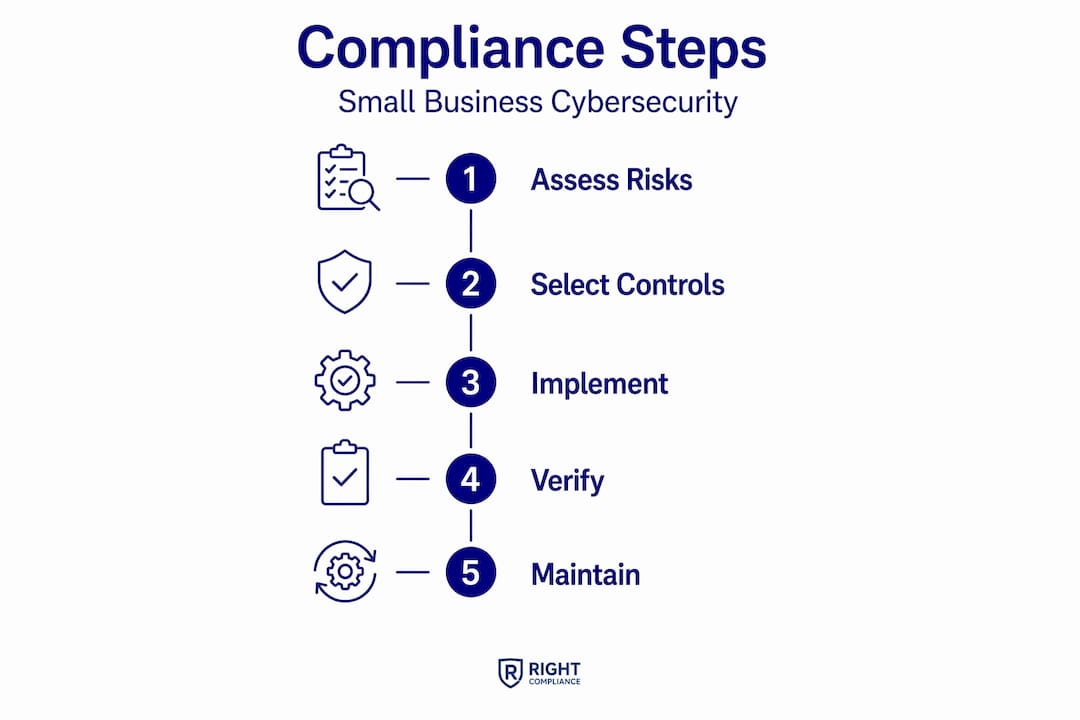
This is where the work happens. The NIST RMF's 7-step framework (Prepare, Categorize, Select, Implement, Assess, Authorize, Monitor) gives you a repeatable structure. Here's what each step looks like in practice for a small business:
-
Prepare. Define your compliance context. Document your goals, identify stakeholders, and confirm which regulations apply. This is the setup work from the previous section, formalized.
-
Categorize. Classify your systems and data by sensitivity. Customer payment data is high risk. Internal scheduling software is low risk. This categorization determines how much protection each system needs.
-
Select. Choose the security controls appropriate for each category. A cybersecurity best practices checklist for small businesses includes strong unique passwords, multi-factor authentication (MFA), encrypted backups, secured Wi-Fi, and a documented incident response plan.
-
Implement. Deploy your selected controls. Enable MFA on all business accounts. Configure your firewall. Set up automated backups. Apply software updates consistently. For configuration specifics, the NIST National Checklist Program provides authoritative, product-specific guidance that helps you configure systems to the right security baseline and generate evidence of compliance at the same time.
-
Assess. Test whether your controls actually work. This is the step most small businesses skip entirely. Running a step by step cybersecurity audit at this stage reveals gaps between what you think you've implemented and what's actually functioning. Penetration testing, vulnerability scanning, and configuration reviews all count as assessment activities.
-
Authorize. A decision-maker, whether that's you as the owner or a designated manager, formally accepts the residual risk remaining after controls are applied. This authorization should be documented in writing.
-
Monitor. Deploy ongoing monitoring tools and processes. Automated alerts, log reviews, and scheduled check-ins keep your compliance posture current.
Pro Tip: The most common mistake in step-by-step IT compliance is treating "Implement" and "Assess" as the same step. Turning on MFA is implementation. Confirming every employee account requires MFA and testing a bypass attempt is assessment. Both are required.
Here's a summary of the full process with key actions for each step:
| RMF step | Key action | Common small business tool |
|---|---|---|
| Prepare | Document scope and policies | Written policy template |
| Categorize | Classify data and systems by risk | Data inventory spreadsheet |
| Select | Choose controls for each risk tier | NIST CSF control catalog |
| Implement | Deploy controls across all systems | Endpoint security, MFA, firewall |
| Assess | Test and verify control effectiveness | Vulnerability scanner, audit checklist |
| Authorize | Document risk acceptance by owner | Signed authorization memo |
| Monitor | Ongoing alerts and periodic reviews | SIEM or managed monitoring service |
For small manufacturers or professional services firms, proven cybersecurity steps follow this same structure and can be adapted to your industry's specific regulatory requirements.
Verifying and maintaining compliance over time
Getting compliant once is an achievement. Staying compliant is the actual goal. Continuous monitoring replaces periodic assessments in modern compliance programs, enabling near real-time risk awareness at a fraction of the cost of annual-only reviews.
Your verification and maintenance activities should include:
- Annual policy reviews. Your security policies should be reviewed and updated at least once a year, or whenever regulations or your business operations change.
- Regular access control audits. Remove access for departed employees immediately. Review all privileged accounts quarterly.
- Scheduled vulnerability scans. Run automated scans monthly and act on findings within a defined remediation window.
- Incident response testing. Test your incident response plan at least once a year through tabletop exercises or simulated scenarios.
- Staff training updates. Phishing awareness and security policy training should happen at onboarding and at least annually thereafter. Annual security training is among the most cost-effective controls small businesses can adopt.
- Backup validation. Verify that backups complete successfully and that restoration works. A backup you've never tested is not a backup.
Pro Tip: Configuration verification checklists do two jobs at once: they help you document your security posture and they flag unauthorized changes that could indicate a breach or a misconfiguration. Set aside 30 minutes each month to review your checklist outputs.
Common challenges small businesses face
Compliance programs stall for predictable reasons. Recognizing these obstacles early helps you work around them rather than into them.
- Underestimating time and resources. Compliance takes consistent effort. If you treat it as a one-week project, it will fall apart within a month.
- Skipping the assessment phase. Many businesses implement controls and assume they work. Verification is not optional.
- Choosing overly complex tools. A security information and event management (SIEM) platform built for enterprise environments can overwhelm a small team. Start with tools that match your actual capacity to manage them.
- No single owner. When everyone is responsible, no one is responsible. Assign a compliance lead, even informally.
- Stalling after the first audit. Compliance momentum often fades after the initial push. Build quarterly reviews into your calendar as recurring appointments.
"The biggest compliance failure I see with small businesses isn't a lack of tools. It's a lack of follow-through after the initial setup. Policies get written, controls get enabled, and then nobody checks whether any of it still applies six months later."
When technical expertise is limited, external help is not a weakness. It's a practical choice. Managed IT providers who specialize in compliance can close the gap without requiring you to hire a full-time security analyst.
My take on compliance after years in the field
I've worked with small businesses across manufacturing, professional services, and aerospace. The pattern I see over and over is this: business owners know they need to be compliant, they take a first pass at it, and then compliance drifts because nobody owns it consistently.
What I've learned is that the difference between businesses that maintain compliance and those that don't is not budget. It's structure. The businesses that succeed treat compliance the same way they treat payroll: as a recurring operational responsibility, not a project with a finish line.
The NIST RMF's emphasis on separating implementation from assessment was a genuine insight for me. I used to assume that if a control was enabled, it was working. That assumption is wrong more often than you'd think. Testing matters. Evidence matters. The authorization step, where someone formally accepts residual risk, matters more than most people expect because it forces accountability.
My honest recommendation to any small business owner starting this process: pick one framework, work through the preparation steps before touching any technology, and get external verification on your first assessment. You'll learn more from one well-executed audit than from six months of self-assessment. The goal is a defensible program, not a perfect one.
— Michael
How Symmnet helps small businesses stay compliant
For small businesses that want expert guidance on step by step cybersecurity compliance without building an internal IT team, Symmnet delivers exactly that. Symmnet's managed IT and cybersecurity services are built for businesses in manufacturing, aerospace, and professional services that need reliable, compliant, and monitored infrastructure.
Symmnet provides 24/7 monitoring, endpoint security, firewall management, and compliance assistance aligned with NIST frameworks. Their team helps you identify gaps, implement controls, verify effectiveness, and maintain documentation for audits. If you want to know precisely which critical security controls your business needs to meet compliance standards, Symmnet offers a free assessment to get you started with a clear, prioritized roadmap. No guesswork, just a practical plan built for your size and industry.
FAQ
What is step by step cybersecurity compliance?
Step by step cybersecurity compliance is the structured process of identifying risks, selecting controls, implementing them, verifying they work, and monitoring them continuously. It follows frameworks like NIST RMF or NIST CSF 2.0 to produce auditable, evidence-based security programs.
Which cybersecurity framework works best for small businesses?
NIST CSF 2.0 is designed specifically for organizations with minimal IT complexity, using plain language and a scalable six-function structure. For businesses subject to federal regulations, NIST RMF adds a more formal seven-step authorization process.
How often should a small business run a cybersecurity audit?
At minimum, a step by step cybersecurity audit should be conducted annually, with continuous monitoring tools running throughout the year. Access control reviews and vulnerability scans should happen more frequently, ideally on a quarterly and monthly basis respectively.
What controls should every small business have in place?
A core compliance checklist for cybersecurity includes MFA on all accounts, strong unique passwords, encrypted offsite backups, network segmentation, and a documented incident response plan. These foundational controls address the most common attack vectors.
When should a small business hire outside compliance help?
When internal staff lack the time or technical knowledge to conduct proper assessments and maintain documentation, external managed IT or cybersecurity services become the practical choice. The cost of a managed provider is almost always lower than the cost of a compliance failure.