

Cybercrime is no longer a problem confined to Fortune 500 boardrooms or headline-grabbing breaches at major banks. The FBI IC3 reported $16.6 billion in losses from cybercrime complaints in 2024 alone, a staggering 33% increase from the year before, with losses climbing further to $20.9 billion in 2025 as complaint volumes crossed one million for the first time. For small business owners in manufacturing, aerospace, and professional services, these numbers carry a direct warning. This guide breaks down why cybersecurity deserves serious attention, what specific risks your business faces, and how to take affordable, practical action starting today.
Table of Contents
- The real cost of cyber threats for small businesses
- Why small businesses are prime targets
- Simple frameworks: what effective cybersecurity looks like
- Business benefits beyond breach prevention
- Why most guidance on cybersecurity misses the mark
- Take the next step in protecting your business
- Frequently asked questions
Key Takeaways
| Point | Details |
|---|---|
| Cyber threats are costly | Small businesses face escalating losses as cyberattacks surge each year. |
| Proactive steps matter | Even basic cybersecurity actions reduce risk and support business continuity. |
| Right frameworks fit any size | The NIST CSF 2.0 framework adapts cybersecurity best practices to small business realities. |
| Security opens business doors | Strong cybersecurity helps win customer trust and meet contract and compliance requirements. |
The real cost of cyber threats for small businesses
With the scale of losses now on the table, it's tempting to assume those figures belong to large enterprises with complex systems. The reality is quite different. Small and mid-sized businesses absorb a disproportionate share of the damage, partly because they rarely have the resources to recover quickly, and partly because attackers know it.
The financial toll extends well beyond the initial ransom payment or stolen funds. Consider what a single successful attack actually costs:
- Direct losses: Ransom payments, wire fraud, and stolen funds transferred out before anyone notices
- Operational downtime: Factories standing still, contracts delayed, and service desks going dark while systems are restored
- Customer attrition: Clients who quietly walk away after learning their data was exposed
- Regulatory fines: Penalties tied to HIPAA, CMMC, or state-level data privacy laws that apply regardless of business size
- Legal exposure: Breach notification requirements, potential lawsuits, and forensic investigation costs
- Lost contract eligibility: Losing the ability to bid on government or enterprise supply chain work
The FBI IC3's 2024 data shows that the three most financially damaging attack categories were business email compromise, investment fraud, and ransomware. Small businesses are particularly vulnerable to business email compromise, where attackers impersonate executives or vendors to redirect payments. Ransomware, meanwhile, can lock every file on your network within minutes.
"A cyberattack on a small business isn't just an IT problem. It's a business continuity crisis that affects payroll, client relationships, and the ability to operate at all."
Understanding small business data risks means looking beyond the obvious. Hidden costs like reputation damage, lost supplier relationships, and the time leadership spends managing a breach instead of running the business rarely show up in insurance claims. For manufacturers and aerospace firms, where precision and reliability define your brand, even a hint of a security incident can cost future bids. Learn more about manufacturing cyber threats that are specific to your industry environment.
| Attack type | Primary impact | Most common target |
|---|---|---|
| Ransomware | Operational shutdown | Manufacturers, healthcare |
| Business email compromise | Financial theft | All small businesses |
| Phishing | Credential theft | Professional services |
| IP theft | Competitive damage | Aerospace, tech firms |
| Supply chain attacks | Data exposure | Any firm with vendor access |
Why small businesses are prime targets
Knowing that small businesses are in the crosshairs leads to an obvious question: why? The answer is more systematic than most owners realize.
The outdated belief that small firms are "too small to target" is genuinely dangerous. Modern attackers do not manually browse the internet looking for interesting prey. They use automated scanning tools that probe millions of IP addresses simultaneously, flagging any system with a known vulnerability, an unpatched router, or a weak password. The size of your business is irrelevant to a script running on a server overseas.
Small businesses also lack dedicated security teams. In a 50-person manufacturing shop, the person who handles IT is often wearing three other hats. There is no one watching logs at 2 AM when an attacker tests your remote desktop protocol. There is no incident response plan posted on the wall. And there is often no budget allocated specifically for security tools beyond a basic antivirus subscription.

Industries like manufacturing, aerospace, and professional services carry additional risk because of what they hold. Intellectual property, controlled unclassified information, defense contract data, and proprietary process documentation are all high-value targets. Supply chain access makes the situation more complex. A small aerospace parts supplier with access to a prime contractor's procurement system becomes an entry point into a much larger network.
NIST research on proactive cybersecurity confirms that protecting data and IP while ensuring DoD contract eligibility and reducing ransomware exposure does not require enterprise-scale budgets. It requires a risk-based approach that fits your actual environment. Review IT security essentials for manufacturers to see how that translates to the shop floor, and look at real-world data breach lessons to understand patterns that repeat across industries.
Pro Tip: You do not need to achieve perfect security overnight. Even implementing the top three or four controls, like multi-factor authentication, regular patching, and tested backups, dramatically reduces your exposure and demonstrates good faith to regulators and clients.
Simple frameworks: what effective cybersecurity looks like
Equipped with context about who is targeting you and why, the next practical question is: what should you actually do? The answer lies in adopting a structured framework rather than reacting to individual threats one at a time.
The NIST Cybersecurity Framework 2.0 (NIST CSF 2.0) is the most practical starting point for small businesses. NIST stands for the National Institute of Standards and Technology, a U.S. government agency. The CSF is voluntary, meaning no law currently forces you to adopt it unless you are pursuing specific contracts. What makes it valuable is its flexibility. It scales to your size, your industry, and your budget.
NIST CSF 2.0 organizes cybersecurity into six core functions. Here is how each one translates to a concrete action for a small business:
- Govern: Define who is responsible for security decisions, document your risk tolerance, and establish basic policies. Even a one-page acceptable use policy is a starting point.
- Identify: Create an inventory of every device, software application, and data type your business relies on. You cannot protect what you cannot see.
- Protect: Put safeguards in place, including access controls that limit who can reach sensitive data, and enable multi-factor authentication on all accounts.
- Detect: Set up monitoring so that unusual activity generates an alert. Many managed service tools do this automatically and flag threats before they escalate.
- Respond: Write a simple incident response plan. Who gets called first? Who communicates with clients? Who contacts law enforcement? A basic checklist prevents panic-driven mistakes.
- Recover: Test your backups regularly. Know exactly how long it will take to restore your systems and whether your data is actually recoverable.
The difference between NIST CSF 2.0 and CMMC (Cybersecurity Maturity Model Certification) matters for your planning. CMMC is a formal certification program required for companies in the Defense Industrial Base. It involves third-party assessments and carries significant compliance costs.
| Framework | Mandatory | Cost | Best for |
|---|---|---|---|
| NIST CSF 2.0 | No (voluntary) | Low to moderate | All small businesses |
| CMMC Level 1 | Yes (DoD contracts) | Moderate | Small defense contractors |
| CMMC Level 2 | Yes (CUI handling) | High | Established defense suppliers |
For businesses outside the defense supply chain, NIST CSF 2.0 provides a structured, affordable path. For those pursuing or holding DoD contracts, CMMC compliance is non-negotiable. Review proven cybersecurity steps for SMBs to see how these frameworks translate to daily practice, and explore guidance on securing manufacturing networks if your production environment presents unique exposure points.
Pro Tip: Most of the risk reduction benefit from NIST CSF 2.0 comes from completing the Identify and Protect functions thoroughly. Start there before worrying about the more advanced Detect and Respond functions.
Business benefits beyond breach prevention
Despite these frameworks and protections, it is easy to view cybersecurity purely as a cost center. That framing misses the genuine competitive advantages strong security delivers.
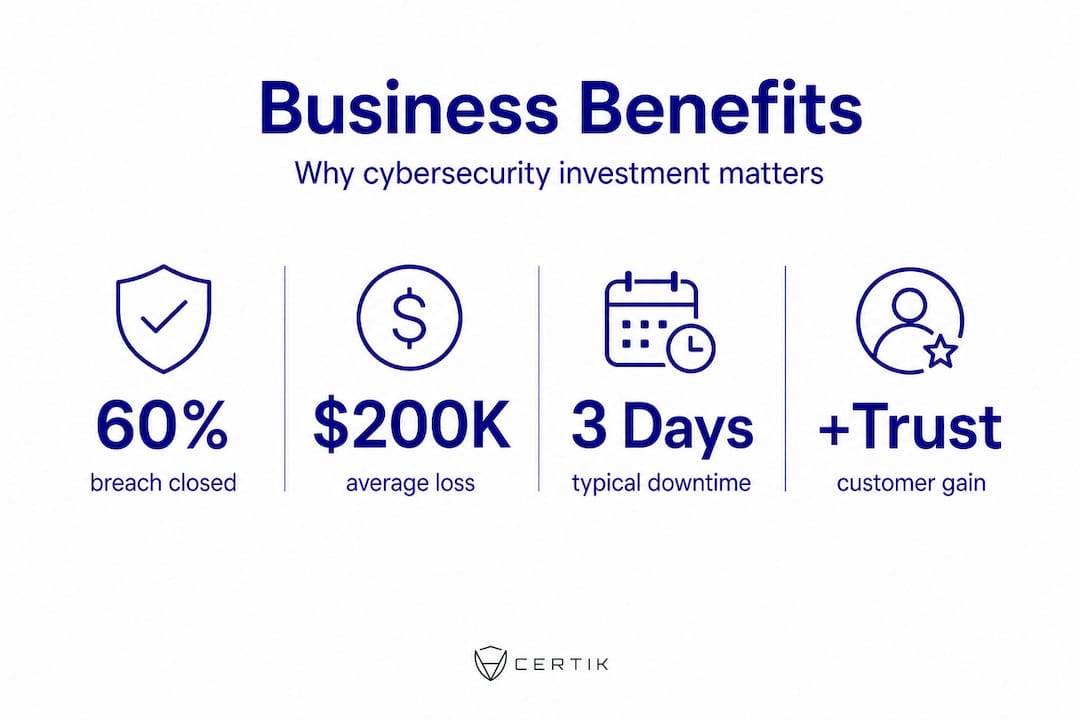
Contract eligibility is increasingly tied to security posture. Federal agencies and large prime contractors now require suppliers to demonstrate measurable cybersecurity controls before awarding work. Proactive cybersecurity ensures DoD contract eligibility and keeps you in the running for lucrative government and enterprise supply chain opportunities that competitors without documentation simply cannot access.
Downtime reduction has a direct dollar value. Ransomware attacks that paralyze operations for three to five days cost far more than any security investment would have. Manufacturers lose production runs. Professional services firms miss deadlines. Aerospace suppliers miss delivery windows that trigger contract penalties. Security controls that prevent or contain ransomware pay for themselves quickly.
Customer trust is a measurable business asset. Clients in regulated industries, including healthcare, financial services, and government contracting, ask about security posture before signing agreements. Having documented controls, tested incident response plans, and clear breach notification procedures turns a potential conversation risk into a confidence builder.
Regulatory compliance becomes manageable rather than overwhelming. For manufacturers handling export-controlled data or professional service firms storing client information, state and federal rules carry real penalties. An organization that builds security into operations year-round faces audits with evidence already organized, rather than scrambling to reconstruct documentation.
The financial math is stark. Unprotected businesses face a 33% annual increase in losses year over year based on recent FBI IC3 trend data. Prevention costs a fraction of recovery costs, and that gap widens every year as attacks become more automated and more aggressive. Explore the full picture of cybersecurity services for SMBs to understand how professional support structures this value.
Key benefits at a glance:
- Maintain eligibility for DoD and enterprise supply chain contracts
- Reduce ransomware-related downtime and its cascading operational costs
- Build demonstrable client trust that supports sales conversations
- Simplify compliance audits with year-round documentation practices
- Lower cyber insurance premiums through verified security controls
Why most guidance on cybersecurity misses the mark
Here is the uncomfortable truth that most cybersecurity content avoids: compliance is not the same as security.
Small businesses in the Defense Industrial Base are under growing pressure to achieve CMMC certification. That pressure is real and legitimate. But CMMC imposes high compliance costs on small firms while largely ignoring emerging threats like AI-driven attacks and post-quantum cryptography vulnerabilities. The risk is that small defense suppliers spend enormous resources checking boxes for a certification that was designed around yesterday's threat landscape.
At the same time, CMMC does end the era of self-reported compliance where businesses filled out questionnaires and called themselves secure without any verification. That is genuinely valuable. The problem is that for a 15-person aerospace components manufacturer, the cost of a Level 2 assessment can be prohibitive without subsidies or tiered relief programs.
The smarter approach blends compliance requirements with genuine operational resilience. For firms outside the defense supply chain, NIST CSF 2.0 offers a practical, continuous improvement model that grows with the business. For defense contractors, pairing CMMC compliance work with NIST CSF principles creates a security program that satisfies auditors and actually reduces real-world risk.
What we consistently see in the small business space is that organizations which treat security as a one-time project fail. A single penetration test or annual policy review does not account for the pace at which attackers evolve. Real protection requires ongoing monitoring, regular testing, and honest risk assessment, not just a certificate on the wall.
Understanding the importance of cyber insurance rounds out this perspective. Insurance does not replace security controls but works alongside them, providing a financial backstop when events that slip through still cause damage.
Take the next step in protecting your business
Small business cybersecurity does not have to be a solo effort, and it should not be.
Symmetry Network Management works directly with small businesses in manufacturing, aerospace, and professional services to implement frameworks like NIST CSF 2.0 and fill the skill gaps that leave organizations exposed. Our managed IT services include 24/7 monitoring, endpoint security, firewall management, and compliance support, all at a fixed price that fits a small business budget. Start with the 5 critical security controls every small business needs, and make sure your recovery plan is real by reviewing our guidance on backup testing. Reach out today for a free assessment to identify exactly where your exposure lies and what it takes to close those gaps.
Frequently asked questions
What is the first step a small business should take to improve cybersecurity?
Identify your key assets and risks, then prioritize basic protections like strong passwords, multi-factor authentication, and tested backups. The NIST CSF 2.0 framework provides a clear, voluntary starting structure for businesses of any size.
Is cybersecurity only important for businesses that store customer data?
No. Attackers also target intellectual property, supply chain access credentials, and operational systems in businesses that hold no customer records at all. Proactive cybersecurity protects DoD contract eligibility, proprietary data, and production continuity across all small business types.
How does cybersecurity affect eligibility for government contracts?
Meeting specific cybersecurity standards is now a prerequisite for many DoD and federal supply chain contracts, and that bar is rising. DoD contract eligibility requires demonstrated security controls, not just verbal assurances.
Are government frameworks like CMMC or NIST CSF mandatory for all small businesses?
CMMC is required for companies holding defense contracts, while NIST CSF remains a voluntary but widely recommended framework. NIST CSF offers a flexible alternative for professional services and non-DoD firms that want structure without mandatory certification costs.