

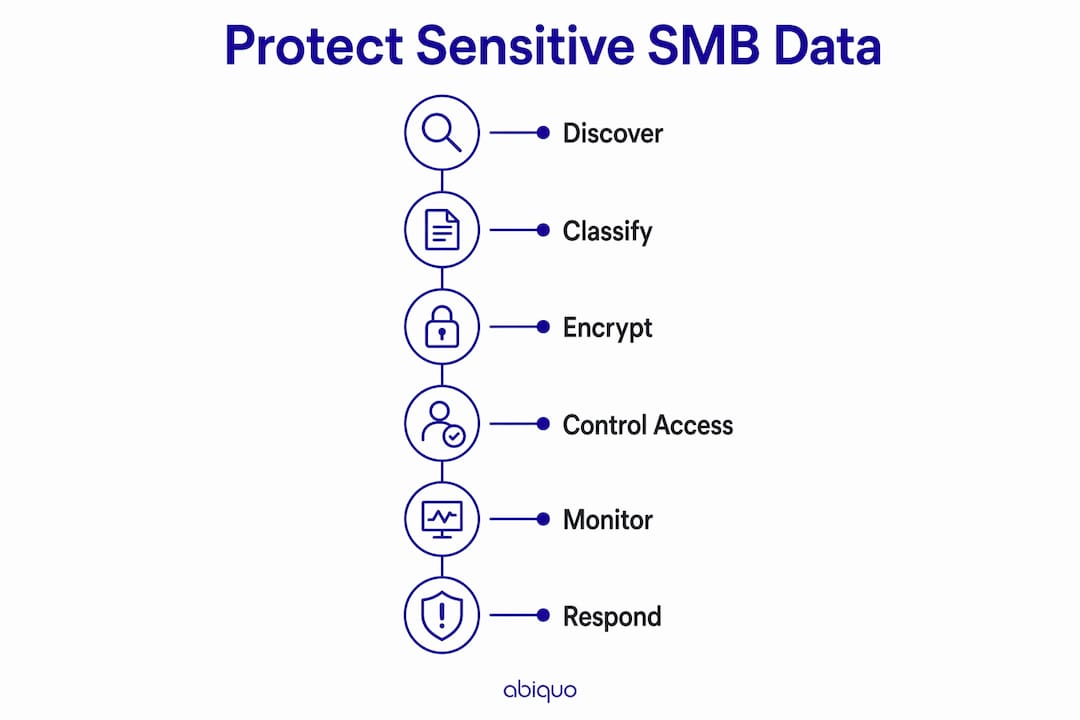
Protecting sensitive information means securing data consistently across its entire lifecycle using encryption, access management, and continuous threat monitoring. For small and medium-sized businesses, the stakes are high. Customer records, financial data, employee files, and proprietary processes all qualify as sensitive data, and a single breach can trigger regulatory penalties, client loss, and reputational damage that takes years to recover from. The industry term for this discipline is data security, and it encompasses every control you apply from the moment data enters your systems to the moment it is deleted. This guide covers the most effective ways to safeguard information, with practical steps sized for SMB budgets and teams.
How to protect sensitive information: start with discovery and classification
You cannot protect data you do not know exists. Shadow data, meaning undiscovered or unmonitored sensitive information, dramatically increases breach risk in SMBs. Before applying any control, you need a complete inventory of where sensitive data lives across on-premises servers, cloud storage, SaaS platforms, and API-connected services.
Automated discovery tools scan your environment continuously and flag new data stores as they appear. This matters because manual audits go stale within weeks. Tools like Microsoft Purview, Varonis, and Nightfall are built to identify sensitive content at scale, applying classification labels automatically based on content patterns such as Social Security numbers, credit card data, or contract language.
A practical classification scheme uses four tiers:
- Public: Information approved for external sharing, such as marketing materials.
- Internal: Data meant for employees only, such as internal policies or org charts.
- Confidential: Customer records, financial reports, and vendor contracts that require access controls.
- Restricted: The highest sensitivity tier, covering regulated data like HIPAA-protected health records or export-controlled technical drawings under ITAR.
Once classified, data should carry metadata tags that travel with the file. These tags allow downstream systems, including your DLP tools and cloud storage policies, to enforce the right controls automatically without relying on human judgment at every step.
Pro Tip: Run your first discovery scan before purchasing any new security tool. You may find sensitive data sitting in unprotected file shares or personal cloud accounts that require immediate remediation at zero additional cost.
What are the best practices for encrypting sensitive data?
Effective data protection requires encrypting data at rest, in transit, and in use consistently. Each state presents a distinct risk profile, and gaps in any one of them can expose your entire dataset.

Data at rest refers to stored data on servers, laptops, backup drives, and cloud buckets. AES-256 is the current standard for symmetric encryption at rest. Microsoft BitLocker and Apple FileVault handle full-disk encryption for endpoints. Cloud providers like AWS and Microsoft Azure offer native encryption for storage services, but you must verify it is enabled. Default settings are not always secure.
Data in transit is data moving across networks. The standard practice is enforcing HTTPS for all web traffic and mutual TLS for internal service-to-service communication. Mutual TLS requires both parties in a connection to authenticate, which prevents man-in-the-middle attacks on internal microservices or API calls that standard HTTPS does not cover.
Data in use is the hardest state to protect because data must be decrypted to be processed. Technologies like Intel SGX and AMD SEV create hardware-isolated memory enclaves where sensitive computations occur without exposing plaintext to the operating system. For most SMBs, the practical answer is limiting which processes and users can access decrypted data at all.
The numbered steps below cover the encryption fundamentals every SMB should implement:
- Enable full-disk encryption on all endpoints and confirm it is active via your endpoint management platform.
- Enforce HTTPS across all web applications and internal portals. Use tools like Let's Encrypt or your CDN provider to automate certificate renewal.
- Configure mutual TLS for any internal API traffic between services.
- Use a dedicated secrets manager such as HashiCorp Vault or AWS Secrets Manager to store and rotate encryption keys.
- Rotate encryption keys on a defined schedule, at minimum annually, and immediately after any suspected compromise.
Key management is where most encryption strategies fail. Storing keys alongside the data they protect is the equivalent of leaving a safe key taped to the safe door. Use hardware security modules (HSMs) or managed secrets engines to keep keys physically and logically separate from the data they secure.
How do access controls reduce sensitive data exposure?
Role-based access control combined with contextual factors like device health and location significantly reduces the risk of unauthorized access to sensitive data. The principle of least privilege is the foundation: every user and system account should have access only to the data required for their specific function, and nothing more.
Two access control models are worth understanding:
| Model | How it works | Best use case |
|---|---|---|
| RBAC (Role-Based Access Control) | Assigns permissions based on job role | Stable environments with defined job functions |
| ABAC (Attribute-Based Access Control) | Grants access based on user attributes, device posture, location, and time | Dynamic environments requiring contextual decisions |
RBAC is simpler to implement and works well for most SMBs. ABAC adds granularity that becomes valuable as your environment grows or as you handle regulated data that requires context-aware decisions.
Multi-factor authentication (MFA) is non-negotiable. Least privilege enforced with MFA reduces account takeover risk significantly. Phishing-resistant methods like FIDO2 passkeys and hardware tokens such as YubiKey are more secure than SMS-based codes, which remain vulnerable to SIM-swapping attacks.
Zero-trust is not merely a network model. It is an access strategy built on identity verification, device posture, and context. Under zero-trust, no user or device is trusted by default, even inside your network perimeter. Implementing just-in-time privileged access, where elevated permissions are granted only for a defined task window and then revoked automatically, limits the window of exposure for your most sensitive systems.
Privileged access management (PAM) platforms like CyberArk or BeyondTrust automate this process, recording privileged sessions and alerting on anomalous behavior. For SMBs without a dedicated PAM platform, Microsoft Entra ID Privileged Identity Management offers a cost-effective starting point within the Microsoft 365 ecosystem.
Pro Tip: Audit your Active Directory or Entra ID groups quarterly. Overpermissive group memberships, where users retain access from previous roles, are one of the most common and easily fixed vulnerabilities in SMB environments.
How should SMBs monitor for data breaches and respond to incidents?
Monitoring tools that detect anomalies in data access patterns enable early breach detection and rapid response. Centralized logging is the prerequisite. Every access event, file download, permission change, and authentication attempt should feed into a SIEM (Security Information and Event Management) platform such as Microsoft Sentinel, Splunk, or the more SMB-accessible Elastic Security.
Data loss prevention (DLP) systems add a critical enforcement layer. DLP monitors endpoints, network egress, and cloud applications, using classification labels to block or alert on unauthorized data movement. Microsoft Purview DLP, for example, can prevent an employee from emailing a file tagged as "Restricted" to a personal Gmail account, regardless of whether the action was intentional.
Key monitoring practices for SMBs include:
- Centralized audit trails: Log all access to sensitive data stores with timestamps, user identities, and actions taken.
- Behavioral analytics: Use tools like Microsoft Defender for Identity or Varonis to flag unusual patterns, such as a user downloading 500 files at 2 a.m.
- Misconfiguration scanning: Misconfiguration such as overly permissive cloud bucket policies is the leading cause of data breaches in 2026. Run weekly scans using tools like Wiz or Prisma Cloud to catch these before attackers do.
- Vulnerability assessments: Schedule quarterly external and internal scans using platforms like Tenable Nessus or Qualys.
An incident response plan is not optional. Without a documented plan, teams waste critical hours during a breach deciding who does what. Your plan should define roles, communication chains, containment steps, and recovery procedures. Test it with a tabletop exercise at least once per year. The data protection strategies that hold up under pressure are the ones practiced before an incident occurs.
For manufacturing and aerospace firms handling export-controlled data, aligning your monitoring program with CMMC or ITAR requirements adds a compliance dimension that makes the investment doubly justified. Symmnet's guidance on manufacturing IT security covers these industry-specific monitoring requirements in detail.
Key takeaways
Protecting sensitive information requires a layered strategy combining data discovery, encryption across all three data states, least-privilege access controls, and continuous monitoring to detect and contain threats before they escalate.
| Point | Details |
|---|---|
| Discover before you defend | Use automated tools to find all sensitive data across cloud, SaaS, and on-premises stores before applying controls. |
| Encrypt all three data states | Apply AES-256 at rest, enforce HTTPS and mutual TLS in transit, and restrict decryption access for data in use. |
| Separate keys from data | Store encryption keys in a dedicated secrets manager or HSM, never alongside the data they protect. |
| Enforce least privilege with MFA | Combine RBAC or ABAC with phishing-resistant MFA to reduce account takeover and limit data exposure. |
| Monitor and rehearse response | Deploy DLP and behavioral analytics, and test your incident response plan with annual tabletop exercises. |
Why data security is a business decision, not just an IT task
I have worked with enough small businesses to recognize a consistent pattern: the companies that get breached are rarely the ones that ignored security entirely. They are the ones that treated it as a checklist rather than a strategy. They bought a firewall, enabled antivirus, and assumed the job was done.
The uncomfortable truth is that data security must be treated as a board-level imperative, aligned to the actual value and risk profile of your data. That means the CEO and the CFO need to understand what your most sensitive data is, where it lives, and what it would cost if it were exposed. IT cannot make that case alone.
What I consistently recommend to SMB owners is a phased approach. Start with discovery and classification. You cannot prioritize what you have not mapped. Then layer in encryption and access controls for your highest-risk data first, rather than trying to secure everything simultaneously with a limited budget. Managed services and automated tools close the gap that a small internal team cannot cover on their own.
The other pitfall I see repeatedly is weak key management. Businesses invest in encryption and then store their keys in the same database as the encrypted data. That is not encryption. That is theater. Sound key management, using a dedicated vault or HSM, is what makes encryption meaningful.
The businesses that get this right treat protecting confidential information as an ongoing operational discipline, not a one-time project. That mindset shift is what separates organizations that recover quickly from incidents from those that do not.
— Michael
How Symmnet helps SMBs secure sensitive data
Symmnet specializes in managed IT and security services designed specifically for small U.S.-based businesses in manufacturing, aerospace, and professional services. The team brings a risk-based approach to sensitive data protection, covering everything from endpoint security and firewall management to compliance assistance for CMMC, HIPAA, and ITAR requirements.
Symmnet's services include network segmentation to isolate sensitive data environments, Microsoft 365 security hardening to protect cloud-based data, and implementation of the 5 critical security controls every SMB needs. If you are unsure where your greatest exposure lies, Symmnet offers a free assessment to identify security gaps and build a prioritized remediation plan. Contact the team at symmnet.com to get started.
FAQ
What counts as sensitive information for a small business?
Sensitive information includes any data that could cause harm if disclosed without authorization, such as customer records, employee files, financial data, health information, and proprietary business processes. For regulated industries, it also includes data covered by HIPAA, ITAR, or PCI DSS.
How do you encrypt data for a small business?
Enable AES-256 full-disk encryption on all endpoints using tools like BitLocker or FileVault, enforce HTTPS on all web services, and use a secrets manager such as HashiCorp Vault or AWS Secrets Manager to store and rotate encryption keys separately from the data.
What is the difference between RBAC and zero-trust?
RBAC assigns permissions based on job roles and is a specific access control model. Zero-trust is a broader security strategy that requires continuous verification of identity, device health, and context before granting access, regardless of whether the user is inside or outside the network.
How does DLP help protect confidential information?
Data loss prevention systems monitor endpoints, email, and cloud applications to detect and block unauthorized data movement. DLP uses classification labels to enforce policies automatically, preventing files tagged as confidential from being sent to unauthorized destinations.
How often should SMBs review their data security practices?
Security reviews should occur at minimum quarterly for access control audits and vulnerability scans, with annual tabletop exercises to test incident response plans. Any significant change to your IT environment, such as a new cloud service or acquisition, should trigger an immediate review.