

A small aerospace parts supplier loses a government contract because a phishing email exposed their CAD file repository. A professional services firm faces a $200,000 regulatory fine after a former employee's login credentials were never deactivated. These are not rare horror stories; they reflect the daily risk landscape for small U.S. businesses. This guide cuts through the noise and gives you a practical, step-by-step framework to protect your firm's most valuable data, from identifying what you have to verifying your defenses are actually working.
Table of Contents
- Understanding the risks: Why securing business data matters
- Assessing your vulnerabilities: The first step to serious data security
- Building defenses: Proven methods for securing business data
- Monitoring, testing, and evolving: Keeping your defenses effective
- Our perspective: What most firms get wrong about securing business data
- Get expert help protecting your data
- Frequently asked questions
Key Takeaways
| Point | Details |
|---|---|
| Know your data | Start by mapping and classifying all sensitive information your business holds so you can protect what matters most. |
| Adopt proven frameworks | Use trusted standards like NIST CSF 2.0 to structure your data security strategy and ensure completeness. |
| Limit access wisely | Role-based access keeps sensitive data visible only to those who genuinely need it for work. |
| Monitor and adapt | Regularly test and review your defenses to catch gaps and keep security as threats evolve. |
| Train your team | Human error is the top cause of breaches—consistent staff training is your best ongoing defense. |
Understanding the risks: Why securing business data matters
Data breaches hit small firms differently than large corporations. A Fortune 500 company absorbs a breach as a line item. For a small manufacturer or professional services firm, the same incident can mean lost contracts, suspended certifications, and a reputation that takes years to rebuild. The financial pain is immediate: legal fees, notification costs, regulatory penalties, and lost revenue can all arrive at once.
The threat landscape has shifted dramatically in recent years. Ransomware groups now specifically target smaller businesses because they assume weaker defenses. Supply chain attacks expose manufacturers and aerospace suppliers through their vendors. Even professional services firms handling client financial records or legal documents are prime targets for data theft that can go unnoticed for months.
Understanding what data you actually hold is the first layer of awareness. Manufacturing businesses carry proprietary production data, supplier contracts, and technical specifications. Aerospace firms often manage export-controlled data under ITAR (International Traffic in Arms Regulations), where a breach does not just mean financial loss; it can mean federal violations. Professional services companies hold confidential client records, financial data, and trade secrets that carry their own regulatory weight.
The signal from the market is clear. According to the Hiscox Cyber Readiness Report 2025, 94% of SMBs plan to increase their cybersecurity investment, with employee training flagged as the single most critical priority. The fact that this many small businesses recognize the threat is encouraging. What matters now is channeling that investment wisely.
Some common data types at risk across these industries include:
- Manufacturing: Proprietary product designs, supplier contracts, inventory systems, and machine control configurations
- Aerospace: ITAR-controlled technical data, program bids, government contracts, and quality certifications
- Professional services: Client financial records, legal documents, employee PII (personally identifiable information), and billing systems
Reading lessons from data breaches that have already hit small businesses reveals a consistent pattern: most firms knew about the vulnerability but lacked a clear owner or deadline to fix it. Understanding data risks and compliance obligations specific to your industry is the baseline that makes everything else possible.
Now that you know what's at stake, you need a clear roadmap, starting with your business's actual vulnerabilities.
Assessing your vulnerabilities: The first step to serious data security
Before you can build protections, you need a clear picture of where your risks actually live. Most small business owners have a general sense that their data "could be more secure," but very few have a written inventory of their sensitive data, who accesses it, and how it's stored. That gap is where breaches happen.

A practical starting point is the NIST Cybersecurity Framework 2.0, which organizes your security program around six core functions. This framework is flexible enough for a 20-person machine shop and rigorous enough to satisfy federal contractor requirements.
| NIST CSF 2.0 function | What it means for your business |
|---|---|
| Govern | Define who is responsible for cybersecurity decisions and policies |
| Identify | Map all sensitive data, systems, and potential threat points |
| Protect | Apply access controls, encryption, and training to reduce risk |
| Detect | Monitor systems to catch unusual activity early |
| Respond | Execute a clear plan when an incident occurs |
| Recover | Restore operations quickly and learn from the event |
Running through these six functions as a practical checklist gives your team a structured way to find gaps without needing to be security experts. The goal of the Identify phase alone, cataloging what data you hold and where it lives, often uncovers exposures that were invisible before.
Here is a numbered approach to get your vulnerability assessment off the ground:
- List your data stores. Document every location where sensitive data exists: shared drives, cloud apps, email archives, physical files, and endpoints.
- Map who has access. For each data store, list the roles and individuals with read or write permissions.
- Assess your most likely threats. For manufacturers, this might be ransomware or IP theft. For aerospace, export control violations. For services firms, insider misuse of client data.
- Rank by business impact. Not every risk is equal. Focus first on data whose loss would have the most severe consequence, whether financial, regulatory, or reputational.
- Document your findings. A simple spreadsheet beats a mental checklist every time.
For additional context tailored to your sector, the manufacturing cybersecurity guide and IT security essentials for small manufacturers provide industry-specific checklists that save considerable groundwork.
Pro Tip: Form a cross-department taskforce for your vulnerability assessment. Your production manager knows which systems run the floor. Your HR lead knows where employee records live. Your accountant knows what financial data flows through your systems. Bringing multiple perspectives uncovers blind spots that a purely IT-driven review will miss every time.
Once you've mapped out your data and vulnerabilities, you can build tailored protections that actually work.
Building defenses: Proven methods for securing business data
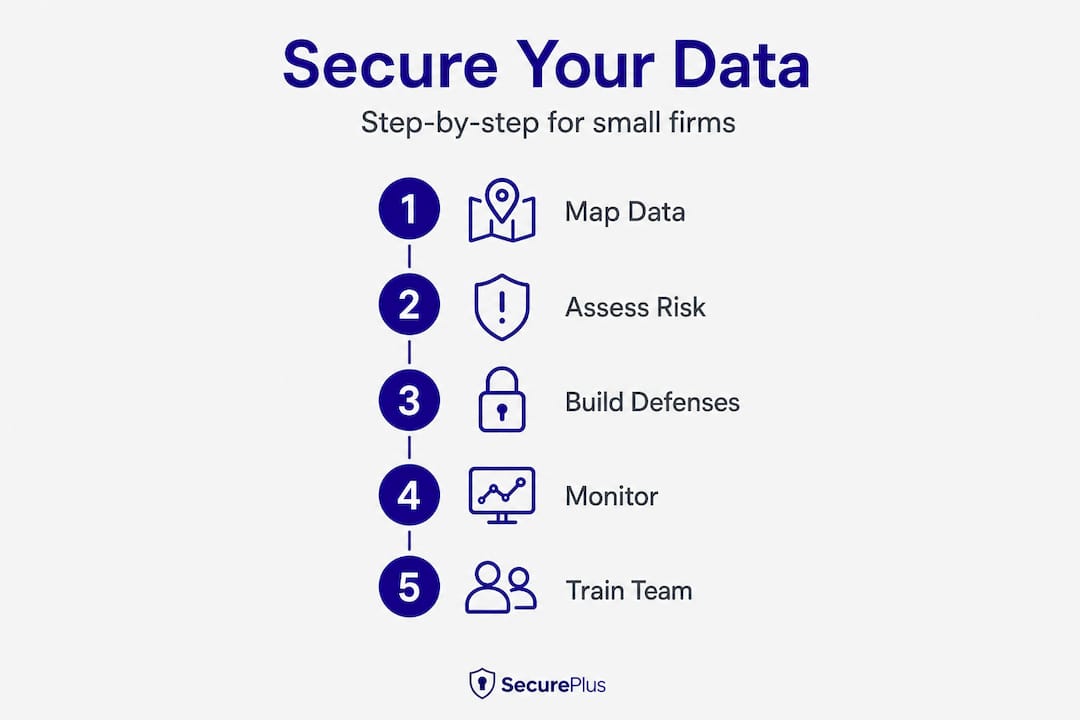
With a clear picture of your vulnerabilities, you can apply protections that are proportional to your actual risk. Generic security advice often fails small businesses because it doesn't account for limited budgets and small IT teams. The goal is targeted, layered defenses that make unauthorized access genuinely difficult without grinding operations to a halt.
Follow these steps to build your core defense structure:
- Implement role-based access control (RBAC). Assign permissions based on job function, not convenience.
- Enable multi-factor authentication (MFA). Require a second verification step for all accounts, especially email and financial systems.
- Encrypt sensitive data. Apply encryption to data both at rest (stored) and in transit (moving across networks).
- Segment your network. Keep operational technology (like manufacturing floor equipment) isolated from your general IT network to limit the spread of any breach.
- Establish a patch management schedule. Unpatched software is one of the most common entry points for attackers.
- Run regular security awareness training. Your employees are both your greatest vulnerability and your strongest potential defense.
The concept of RBAC deserves specific attention. According to data security guidance for growing businesses, implementing RBAC and least privilege principles limits data access strictly to what each role requires. The table below illustrates how this looks in practice:
| Role | Access to financial records | Access to client data | Access to production specs | Admin rights |
|---|---|---|---|---|
| Production technician | No | No | Yes (read only) | No |
| Account manager | View only | Yes | No | No |
| IT administrator | No | No | No | Yes |
| Executive | Yes | Yes | Yes | No |
This structure prevents a scenario where a compromised technician account can access your billing system, or a disgruntled account manager can alter production records. The principle is simple: each person sees only what they need to do their job.
Pro Tip: Set a quarterly calendar reminder to audit user permissions. Employee roles change through promotions, departures, and new hires. "Privilege creep," where individuals accumulate permissions over time beyond what their current role requires, is one of the most common and preventable security weaknesses in small firms.
For a step-by-step approach to locking down your infrastructure, the guide on securing networks step-by-step is a practical next resource, and proven cybersecurity steps for small U.S. businesses provides broader implementation context.
With defenses established, it's critical to ensure they're working and that you're not missing hidden gaps.
Monitoring, testing, and evolving: Keeping your defenses effective
Building security controls is not a one-time project. Threats evolve, your business changes, and new vulnerabilities emerge regularly. The firms that maintain strong data security treat it as an ongoing operational discipline, not an annual checkbox exercise.
Effective ongoing monitoring includes several key practices:
- Log review: Regularly examine system and access logs to identify unusual activity, such as logins at odd hours or mass file downloads.
- Anomaly detection: Deploy security tools that flag behavior outside normal patterns, a user suddenly accessing hundreds of files or sending large email attachments externally.
- Tabletop exercises: Run scenario-based drills where your team talks through their response to a simulated ransomware attack or data breach. These exercises reveal gaps in your incident response plan before a real event exposes them.
- Penetration testing: Periodically hire a security professional to attempt to breach your systems and report what they find.
- Vulnerability scanning: Run automated scans of your network and endpoints to identify known weaknesses before attackers exploit them.
The NIST CSF 2.0 Detect and Respond functions provide a structured approach to building these capabilities into your regular operations, even with limited internal IT resources.
Critical note: Studies consistently show that most breaches are first detected by external parties, customers, vendors, or law enforcement, rather than by the affected organization's own team. Internal monitoring closes that gap. The sooner you detect an incident, the lower the cost and damage.
When a potential incident does arise, having a written response plan matters enormously. Your plan should define who is responsible for declaring an incident, who investigates, who communicates with clients and regulators, and under what conditions you bring in outside help. Without this clarity, teams freeze or duplicate efforts when every minute counts.
For detailed guidance on building that response capability, the cyber threat response guide walks through practical steps for small businesses. It's also worth understanding why cyber insurance matters, since even excellent defenses don't eliminate all risk, and insurance provides a financial safety net when an incident does occur.
Training is the final and most continuous piece. Phishing simulations, updated security policies, and clear reporting procedures for suspicious activity should be revisited at least twice a year. The threat landscape changes; your team's awareness needs to keep pace.
Applying these strategies means your business is secure, not just in theory, but in actual daily practice. But what's the real-world experience of getting this right?
Our perspective: What most firms get wrong about securing business data
After working with small manufacturers, aerospace suppliers, and professional services firms across the U.S., one pattern stands out clearly. Most business owners over-invest in technology and significantly under-invest in people and process. A company will spend thousands on a next-generation firewall and then leave shared passwords on sticky notes next to workstations. The firewall does nothing for that vulnerability.
Technology is necessary, but it's rarely where the decisive security failures happen. The most damaging breaches we see stem from unclear accountability, no one owns the security program with real authority and real consequences attached to their performance. When security is treated as an IT department concern rather than a business priority, the people who can actually enforce culture change (managers, executives, team leads) are never genuinely engaged.
This is a meaningful distinction. Culture and clear accountability often provide stronger protection than technical controls alone. When team leads understand that their department's security posture is a performance metric, behavior changes. Employees stop sharing passwords. They report suspicious emails instead of ignoring them. They push back on shortcuts that create exposure.
Make security a KPI (key performance indicator) for team leads, not just a ticket the IT department manages. Tie it to quarterly reviews. When security has the same organizational weight as sales numbers or production output, it gets treated accordingly.
Pro Tip: If your leadership team does not actively discuss cybersecurity at the executive or board level, your defenses are structurally incomplete. Firms that survive significant incidents almost always have executive-level ownership of the security program before the incident happens. Firms that fold often discover afterward that no one at the top was truly accountable.
The overlooked lessons from cyber incidents reinforce this point repeatedly. The technical post-mortems are usually straightforward. The organizational failures are where the real story lives.
Get expert help protecting your data
Implementing and maintaining a robust data security program takes sustained effort, specialized knowledge, and time that most small business owners simply don't have to spare.
Symmetry Network Management works directly with small manufacturers, aerospace firms, and professional services businesses across the U.S. to build, manage, and continuously improve their security posture. From initial risk assessments through 24/7 monitoring and incident response, the team provides managed IT services tailored to the specific operational and regulatory demands of your industry. If you want a clear starting point, Symmetry's security controls assessment identifies your most critical gaps and prioritizes the actions that will reduce your risk fastest. Taking that first step costs you nothing and gives you a concrete roadmap to work from.
Frequently asked questions
What is the first step to secure business data?
The first step is to identify and inventory all sensitive business data and assess where it is most vulnerable. The NIST CSF 2.0 Identify function provides a structured method for this process.
How does role-based access control (RBAC) help my business?
RBAC ensures employees only access the data essential for their roles, reducing the risk of internal leaks or unauthorized changes. Applying the principle of least privilege is one of the most effective ways to limit your exposure from both insider threats and compromised accounts.
Why focus on employee training in cybersecurity?
Employee training prevents common human errors that lead to data breaches and is the top cybersecurity priority for most small firms. The Hiscox Cyber Readiness Report identifies training as the leading area where SMBs are directing increased investment.
What frameworks are most recommended for small businesses?
The NIST Cybersecurity Framework 2.0 is widely recommended for its flexibility and scalability, fitting businesses of all sizes with a structured but adaptable approach to risk management.
How often should we review our data security controls?
Data security controls should be reviewed at least annually and after any significant business changes or incidents, such as staff departures, new software deployments, or a suspected breach.