

NIST 800-171 compliance means implementing the security requirements in NIST SP 800-171 Rev. 3 for every nonfederal system that processes, stores, or transmits Controlled Unclassified Information (CUI). If your organization holds a federal contract or subcontract that involves CUI, this standard almost certainly applies to you — and your contracting officer, not NIST, is the one who enforces it.
Compliance comes down to four concrete elements:
- Implemented controls: All applicable requirements across SP 800-171's 17 control families, documented and operating in your environment.
- System Security Plan (SSP): A written description of your system boundary, the controls you have in place, and how each one is satisfied.
- Plan of Action and Milestones (POA&M): A tracked list of any gaps, with remediation timelines and responsible owners.
- Assessment evidence: Logs, configuration baselines, training records, and test results that demonstrate controls are working as described.
Your immediate next step: pull your current federal contracts, search for DFARS clause 252.204-7012 or 252.204-7020, and check whether your contracting agency has marked any data you receive as CUI. That single check tells you whether SP 800-171 applies before you spend a dollar on remediation.
Key Takeaways
NIST 800-171 compliance requires implementing SP 800-171 security requirements, documenting them in an SSP and POA&M, and maintaining assessment evidence for every nonfederal system that processes, stores, or transmits CUI.
| Point | Details |
|---|---|
| Applicability trigger | Check contracts for DFARS 252.204-7012 or 252.204-7020 and confirm whether your agency has marked data as CUI. |
| Required artifacts | Every compliant program needs an SSP, a POA&M, and an evidence repository covering all 17 control families. |
| Scope reduction first | Isolating CUI into a dedicated enclave before implementing controls can cut remediation effort by 40–60 percent. |
| Rev. 3 is current | SP 800-171 Rev. 3 (May 2024) added three new families and organization-defined parameters that must be documented in your SSP. |
| Symmnet support | Symmnet provides gap assessments, SSP development, monitoring, and segmentation services for small contractors handling CUI. |
Table of Contents
- What is NIST SP 800-171 and why does it exist?
- Who needs to comply, and how do you know if that's you?
- How do you scope your environment correctly?
- What are the 17 SP 800-171 Rev.3 control families?
- How do you build a practical compliance roadmap?
- What do assessors look for in your SSP and POA&M?
- What changed in Revision 3, and how does it map to prior versions?
- How does SP 800-171 relate to CMMC and DoD assessments?
- What does compliance realistically cost?
- What mistakes cause assessment failures?
- How does a managed IT provider support SP 800-171 implementation?
- Why small businesses often get this wrong
- Symmnet helps you build a defensible compliance program
- Sources
What is NIST SP 800-171 and why does it exist?
SP 800-171 Rev. 3 is NIST's recommended set of security requirements for protecting the confidentiality of CUI in nonfederal systems and organizations. The standard was created because federal agencies routinely share sensitive but unclassified information with contractors, universities, and research partners — and those organizations operate outside the federal security perimeter. SP 800-171 bridges that gap by specifying a baseline that nonfederal entities must meet when handling CUI.
The publication sits within a broader family of NIST documents that implementers will reference throughout their program:
- SP 800-171A: The companion assessment procedures document, which defines how assessors evaluate whether each requirement is met. Think of it as the auditor's checklist that mirrors the controls in SP 800-171.
- SP 800-172: Enhanced requirements for organizations handling CUI in high-value or high-risk programs. Most contractors will not need this unless the contract specifically requires it.
- SP 800-53 / SP 800-53B: The source catalog from which SP 800-171 requirements are derived. Rev. 3 of SP 800-171 maps explicitly to the SP 800-53r5 moderate baseline, which matters when assessors ask for control mappings.
One point the NIST SMB primer makes clearly: NIST does not issue compliance certifications and does not determine whether your organization is compliant. That determination belongs to the federal agency or prime contractor whose contract language mandates the requirements. NIST provides the technical baseline; your contracting officer holds the enforcement authority.
Who needs to comply, and how do you know if that's you?
The primary applicability trigger is straightforward: any nonfederal organization that processes, stores, or transmits CUI under a federal contract or grant is expected to meet SP 800-171. That covers defense contractors, research institutions, manufacturers in the defense supply chain, aerospace firms, and professional services companies that support federal programs.
To confirm applicability, work through this checklist:
- Check your contract for DFARS 252.204-7012. This clause, "Safeguarding Covered Defense Information and Cyber Incident Reporting," is the primary DoD trigger. Its presence means SP 800-171 applies.
- Look for DFARS 252.204-7020. This clause requires a current NIST SP 800-171 DoD Assessment on record in the Supplier Performance Risk System (SPRS).
- Confirm whether the agency has marked data as CUI. The contracting agency is responsible for identifying and marking CUI. If you receive marked data, you are in scope. Use the NARA CUI Registry to verify whether a specific category of information qualifies as CUI.
- Assess your subcontractor chain. Flow-down obligations are real. If you are a prime contractor, you are responsible for ensuring that subcontractors who handle CUI also meet SP 800-171 requirements. Your subcontract language must include the same clauses your prime contract carries.
A practical note: some organizations receive CUI without realizing it because the contracting agency failed to mark it properly. If you are unsure, ask your contracting officer directly. Proceeding without clarity is a compliance risk, not a safe harbor.
How do you scope your environment correctly?
Scoping is where most organizations either waste money or create audit risk. The rule is precise: any system component that processes, stores, or transmits CUI is in scope. Components that only provide supporting services to those systems — think shared network infrastructure or IT management tools — may also be drawn into scope depending on how they interact with CUI data flows.
A practical scoping sequence:
- Map CUI data flows. Identify every location where CUI enters, moves through, or exits your environment: email servers, shared drives, engineering workstations, cloud storage, portable media.
- Inventory system components. Document every device, application, and account that touches those flows.
- Define and document your boundary. Draw a clear line around the CUI environment. This boundary becomes the foundation of your SSP.
- Isolate CUI into a security domain. Where technically feasible, move CUI handling into a dedicated enclave or tenant, separate from general business systems.
Pro Tip: The most cost-effective scoping decision you can make is aggressive isolation before you start documenting controls. A CUI enclave built on a dedicated VLAN, a separate Microsoft 365 GCC High tenant, or a controlled gateway reduces the number of components in scope and can cut your total control implementation effort significantly. Assessors accept well-documented segmentation as a legitimate scope reduction — but the isolation must be real and verifiable, not just described in the SSP. Symmnet's network segmentation guidance covers the architecture patterns that hold up under scrutiny.
For manufacturing organizations, the scoping challenge often involves operational technology (OT) networks that share infrastructure with IT systems. Keeping OT and CUI data flows clearly separated is both a scoping necessity and a security control in its own right. The manufacturing network security guide covers the segmentation patterns that apply in those environments.

What are the 17 SP 800-171 Rev.3 control families?
SP 800-171 Rev. 3 organizes its requirements into 17 control families. Each family addresses a distinct security domain, and every family needs an owner in your organization before you can build a credible SSP.
| Family | What it covers |
|---|---|
| Access Control (AC) | Limit system access to authorized users and processes |
| Awareness and Training (AT) | Ensure personnel understand security responsibilities |
| Audit and Accountability (AU) | Create, protect, and review system logs |
| Configuration Management (CM) | Establish and maintain secure baselines for systems |
| Identification and Authentication (IA) | Verify user and device identity before granting access |
| Incident Response (IR) | Detect, report, and recover from security incidents |
| Maintenance (MA) | Control and document system maintenance activities |
| Media Protection (MP) | Protect and sanitize CUI on physical and digital media |
| Personnel Security (PS) | Screen personnel and manage termination procedures |
| Physical Protection (PE) | Control physical access to systems and CUI |
| Risk Assessment (RA) | Identify and evaluate risks to CUI on an ongoing basis |
| Security Assessment (CA) | Periodically assess controls and develop POA&Ms |
| System and Communications Protection (SC) | Protect data in transit and enforce boundary controls |
| System and Information Integrity (SI) | Detect and remediate malware, flaws, and anomalies |
| Planning (PL) | Document the security plan and rules of behavior |
| Program Management (PM) | Manage the security program at the organizational level |
| Supply Chain Risk Management (SR) | Assess and manage risks from suppliers and components |
Planning guidance and readiness overviews commonly reference 110 security requirements as the core technical baseline derived from the SP 800-53 moderate catalog. Rev. 3 introduced some restructuring, but that figure remains a useful planning anchor for scoping effort.
Four families consistently drive the most assessment gaps for small and mid-size organizations:
- Identification and Authentication (IA): Multi-factor authentication for privileged accounts and remote access is a hard requirement that many smaller firms have not fully deployed.
- Audit and Accountability (AU): Log retention periods, log integrity protections, and the ability to correlate events across systems trip up organizations that rely on default OS logging.
- Configuration Management (CM): Documented baselines, change control records, and software inventory are frequently missing or out of date.
- System and Communications Protection (SC): Network segmentation, encrypted communications, and boundary protections are often partially implemented but not fully documented.
How do you build a practical compliance roadmap?
Implementation is not a single project — it is a phased program. Organizations that treat it as a one-time checklist exercise tend to fail their first assessment. Here is a realistic sequence:
- Conduct a gap assessment. Compare your current controls against every SP 800-171 requirement. Document what is in place, what is partially implemented, and what is missing entirely. This output drives everything that follows.
- Define and document your scope. Apply the scoping sequence described above. Narrow the boundary before you start writing the SSP.
- Draft your System Security Plan. The SSP is the central compliance artifact. It must describe your system boundary, the controls you have implemented, and the organization-defined parameter (ODP) values you have selected for each applicable requirement.
- Implement missing controls. Prioritize by risk and by assessment weight. MFA, logging, and segmentation typically deliver the highest risk reduction per dollar spent.
- Build your POA&M. Any requirement not yet fully implemented goes into the POA&M with a remediation date, a responsible owner, and an interim mitigation if one exists.
- Collect and organize evidence. Assessors will ask for configuration baselines, log samples, training completion records, MFA enrollment proof, incident response test results, and media sanitization logs. Build an evidence repository before the assessment, not during it.
- Run an internal or third-party readiness review. Walk through SP 800-171A assessment procedures against your own environment. Identify gaps before an assessor does.
- Submit your SPRS score (DoD contracts). If DFARS 252.204-7020 applies, calculate your score using the DoD assessment methodology and enter it in SPRS before the contract deadline.
- Maintain and monitor. Compliance is not a point-in-time state. Controls drift, systems change, and new CUI flows appear. Continuous monitoring keeps your SSP current and your POA&M accurate.
Realistic timelines vary considerably. Practical implementation guides show a range of 4–18 months from gap assessment to a defensible compliance posture, depending on starting maturity and scope size. Small organizations with a narrow CUI enclave can reach a solid baseline in four to six months. Larger firms with legacy infrastructure and broad CUI exposure routinely need twelve months or more.
What do assessors look for in your SSP and POA&M?
The SP 800-171 Rev. 3 PDF provides the updated control language, tailoring rules, and ODP guidance that your SSP must reflect. Assessors using SP 800-171A will evaluate each requirement against three assessment methods: examine (review documents and records), interview (talk to personnel), and test (exercise mechanisms and processes).
System Security Plan structure
A credible SSP includes:
- System identification: Name, boundary description, system type, and operational environment.
- Control descriptions: For each requirement, a statement of how the control is implemented, which components satisfy it, and what the ODP values are.
- ODP documentation: Rev. 3 introduced organization-defined parameters throughout. Every ODP must have an explicit value in the SSP — "to be determined" is not acceptable.
- Evidence pointers: References to the specific configurations, logs, or records that demonstrate each control is operating.
POA&M best practices
A POA&M is not an admission of failure — it is a required artifact that shows your organization has identified gaps and is managing them. Assessors expect to see one. What they do not accept is a POA&M that lists critical controls as open with no remediation timeline or interim mitigation.
Keep each POA&M entry specific: the requirement identifier, the gap description, the responsible owner, the planned completion date, and any compensating control in place while remediation is pending. Update it at least quarterly. A stale POA&M with dates that have passed and no status updates signals to an assessor that your program is not actively managed.
Evidence checklist
Before any assessment, confirm you can produce:
- Configuration baselines for all in-scope systems
- Log samples covering the required retention period
- MFA enrollment records for privileged and remote-access accounts
- Security awareness training completion records
- Incident response plan and evidence of at least one tabletop or test exercise
- Media sanitization and disposal records
- Vulnerability scan results and patch records
What changed in Revision 3, and how does it map to prior versions?
Rev. 3, published in final form in May 2024, is a material update — not a cosmetic refresh. Organizations still operating under Rev. 2 contract language need to understand both versions until their contracts are updated.
Key changes in Rev. 3:
- Restructured to 17 families. Rev. 2 had 14 families. Rev. 3 added Planning (PL), Program Management (PM), and Supply Chain Risk Management (SR) as distinct families.
- Organization-defined parameters (ODPs). Rev. 3 introduced ODPs throughout the control set, giving organizations required flexibility on specific values (log retention periods, session timeout durations, etc.). Each ODP must be explicitly documented in the SSP.
- Supply chain risk management. The SR family is new and reflects growing federal concern about third-party and component-level risks. Small contractors will need to document supplier vetting processes.
- Incident reporting updates. Requirements around reporting timelines and reporting recipients were tightened to align with current federal incident reporting expectations.
- Explicit SP 800-53r5 mappings. Rev. 3 maps each requirement to its SP 800-53r5 source control, which simplifies evidence alignment when assessors ask for control lineage.
NIST planned crosswalks from Rev. 2 to Rev. 3 and a quick-start guide for small and medium enterprises to ease the transition. If your contract still cites Rev. 2, confirm with your contracting officer which revision governs your assessment before investing in Rev. 3-specific documentation.
How does SP 800-171 relate to CMMC and DoD assessments?
SP 800-171 and CMMC are not the same thing, though they are tightly linked. SP 800-171 is the technical standard — the list of security requirements your systems must meet. CMMC (Cybersecurity Maturity Model Certification) is the DoD's verification model that determines how compliance with those requirements is confirmed and reported.
The relationship works like this:
- CMMC Level 1 covers basic cyber hygiene (17 practices) and requires annual self-attestation.
- CMMC Level 2 maps directly to the SP 800-171 requirements and is where most defense contractors land. Level 2 may require either self-attestation or a third-party assessment by a Certified Third-Party Assessment Organization (C3PAO), depending on the program's sensitivity designation.
- CMMC Level 3 adds requirements from SP 800-172 and requires a government-led assessment.
The DoD CIO CMMC page explains the verification differences and which contract types will require C3PAO assessments. For most small contractors, the practical question is whether your prime's flow-down language requires a C3PAO assessment or whether self-attestation is sufficient.
SPRS matters more than many contractors realize. The Supplier Performance Risk System is the DoD's database where contractors record their SP 800-171 self-assessment scores. A falsified or inflated SPRS score carries False Claims Act exposure — the DoD has pursued enforcement actions against contractors who knowingly submitted inaccurate scores. Enter your score accurately, document the methodology you used to calculate it, and update it when your posture changes.
Questions to ask your contracting officer or prime before your next contract renewal:
- Which revision of SP 800-171 does this contract require?
- Is a C3PAO assessment required, or is self-attestation sufficient?
- What is the deadline for a current SPRS score?
- Does the flow-down language require my subcontractors to have their own SPRS entries?
What does compliance realistically cost?
Costs vary widely, and any vendor quoting a flat number without reviewing your environment is guessing. That said, experience-based cost breakdowns for small contractors provide useful line-item ranges for planning purposes.
The main cost drivers are scoping breadth, legacy technical debt, and whether a C3PAO assessment is required. An organization that has already isolated CUI into a narrow enclave, deployed MFA, and maintained decent logging will spend far less on remediation than one starting from a flat network with no segmentation and no formal change management process.
Implementation guides show timelines of 4–18 months and first-year costs that can range from roughly $30,000 for a well-prepared small firm to several hundred thousand dollars for a larger organization with significant technical debt. Ongoing annual costs after the first year are typically lower, concentrated in monitoring, evidence maintenance, and periodic reassessment.
The single highest-leverage investment for most small contractors is narrowing scope before spending on controls. Every system component you keep out of the CUI boundary is a component you do not need to document, monitor, or remediate.
What mistakes cause assessment failures?
Most assessment failures trace back to a small set of recurring problems. Knowing them in advance is the cheapest form of remediation.
- Over-scoping the environment. Including systems that do not touch CUI inflates the control burden without improving security. Segment aggressively and document the isolation.
- Undocumented controls. A control that is operating but not described in the SSP does not exist from an assessor's perspective. If you do it, document it.
- Missing or stale evidence. Assessors need to see that controls are working, not just described. Maintain a live evidence repository and update it continuously, not just before an assessment.
- Weak or undocumented segmentation. A VLAN with no access control list, or a cloud tenant with shared credentials, does not constitute a CUI enclave. Segmentation must be technically enforced and documented.
- Improper subcontractor flow-downs. Primes that fail to include SP 800-171 requirements in subcontract language are out of compliance even if their own systems are clean. Review every subcontract that involves CUI.
- Inadequate log retention. Default retention settings on most systems fall short of what assessors expect. Set explicit retention periods, document them as ODPs in the SSP, and verify that logs are protected from tampering.
- POA&M entries with no progress. An open POA&M item with a past-due date and no update signals an unmanaged program. Close items on schedule or update the timeline with a documented reason.
One legal point worth stating plainly: knowingly misrepresenting your compliance posture in a federal contract context — including submitting a falsified SPRS score — can constitute a False Claims Act violation. The civil penalties are substantial, and the DoD has demonstrated willingness to pursue enforcement.
How does a managed IT provider support SP 800-171 implementation?
A managed IT and cybersecurity provider does not replace your compliance obligations — you remain responsible for your SSP, your POA&M, and your SPRS score. What a provider does is handle the operational execution of controls that would otherwise require dedicated internal staff.
Here is how managed services map to specific SP 800-171 families:
- Managed detection and response (MDR) and 24/7 monitoring directly support Audit and Accountability (AU) and System and Information Integrity (SI). Continuous log collection, alerting, and incident triage generate the evidence assessors need and reduce the internal burden of log review.
- Endpoint hardening and patch management address Configuration Management (CM) and System and Information Integrity (SI). A managed provider maintains documented baselines, tracks deviations, and applies patches on a defined schedule.
- Network segmentation services support System and Communications Protection (SC). Designing, implementing, and documenting a CUI enclave is a technical task that benefits from a provider with architecture experience in regulated environments.
- MFA deployment and identity management address Identification and Authentication (IA). A provider can deploy and manage MFA across all in-scope accounts and produce enrollment records for assessment evidence.
- Backup and disaster recovery support Incident Response (IR) and system recovery requirements. Tested, documented recovery procedures are an assessor expectation, not just a best practice. Symmnet's guidance on backup testing covers what "tested" actually means in an assessment context.
When evaluating a managed provider for SP 800-171 support, ask for a shared-responsibility matrix that maps each control family to what the provider handles versus what your organization retains. Ask for sample evidence packages from prior assessments. A provider that cannot produce either is not ready to support a compliance program.
The practical payoff of managed monitoring is significant for evidence collection. Instead of manually pulling log samples before an assessment, your provider can generate a pre-formatted evidence package covering the required retention period. That alone can reduce assessment preparation time from weeks to days.
Why small businesses often get this wrong
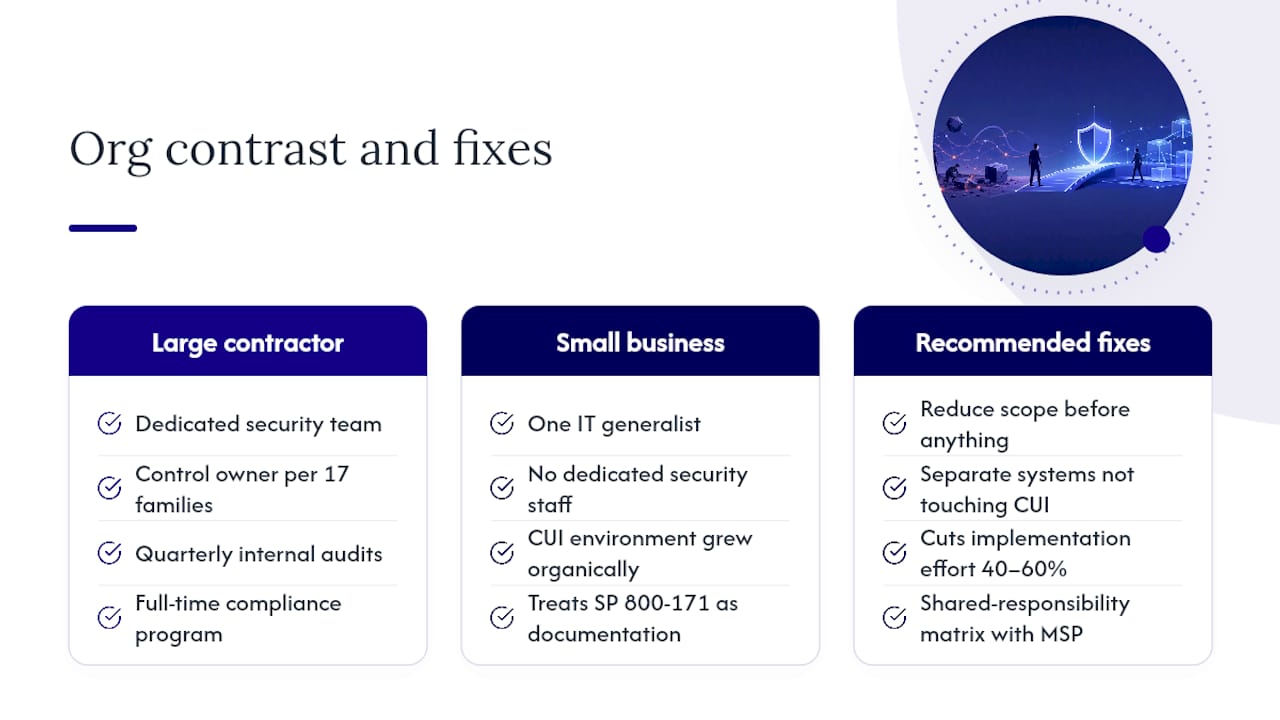
Small businesses handling CUI face a compliance challenge that is structurally different from what large contractors experience. A prime contractor with a dedicated security team can assign a control owner to each of the 17 families, run quarterly internal audits, and maintain a full-time compliance program. A 20-person manufacturer in the defense supply chain typically has one IT generalist, no dedicated security staff, and a CUI environment that grew organically alongside the business.
The mistake most small firms make is treating SP 800-171 as a documentation exercise rather than an operational program. They write an SSP, file it away, and assume the work is done. Assessors see through this immediately. Controls that are documented but not operating, log retention settings that were configured once and never verified, and MFA policies with undocumented exceptions all signal a program that exists on paper but not in practice.
The practical tip that makes the biggest difference for small organizations: reduce scope before you do anything else. Every system that does not need to touch CUI should be separated from those that do. That single decision can cut your control implementation effort by 40–60 percent and make your SSP genuinely manageable for a small team. Pair that with a shared-responsibility matrix with your managed IT provider, so both parties know exactly which controls each side owns, and you have the foundation of a defensible program.
Symmnet helps you build a defensible compliance program
For small contractors in manufacturing, aerospace, and professional services, the gap between "we handle CUI" and "we have a defensible SP 800-171 program" is almost always an operational one. The controls are not mysterious. The documentation is not impossible. What is hard is doing it consistently with a small team while running a business.
Symmnet's managed IT and cybersecurity services are built around exactly this problem. The team handles gap assessments, SSP development, network segmentation, 24/7 monitoring, MFA deployment, endpoint hardening, and the evidence collection that assessors actually require. Fixed monthly pricing means you know what compliance support costs before you commit, with no surprise project fees when an assessor asks for additional evidence.
The starting point is a free readiness assessment. Symmnet reviews your current environment against SP 800-171 requirements, identifies your highest-priority gaps, and delivers a remediation roadmap with rough cost estimates. You leave the call knowing exactly where you stand and what it will take to get to a defensible posture. Schedule your assessment at Symmnet.
Sources
Use these primary sources when you need authoritative language, official assessment procedures, or CUI category definitions:
- SP 800-171 Rev. 3, Protecting Controlled Unclassified Information in Nonfederal Systems and Organizations | CSRC
- NIST SP 800-171 Rev.3 SMB primer (NIST.SP.1318.pdf)
- Controlled Unclassified Information (CUI) Registry — NARA
- NIST 800-171: Requirements, Cost & Process (2026) | AuditXYZ
- NIST 800-171 Compliance Cost Breakdown: What Small Contractors Really Spend - Cleared Systems
This article is general information, not a substitute for advice from a qualified lawyer. Consult a qualified legal professional about your own circumstances before acting on anything here.