

Your small business compliance framework starts here
Small business compliance means meeting the legal, regulatory, and cybersecurity obligations that protect your data, your customers, and your operations. For U.S.-based small businesses, the most practical starting point is the NIST Cybersecurity Framework 2.0, a voluntary, flexible standard designed to fit organizations of any size, sector, or technical maturity.

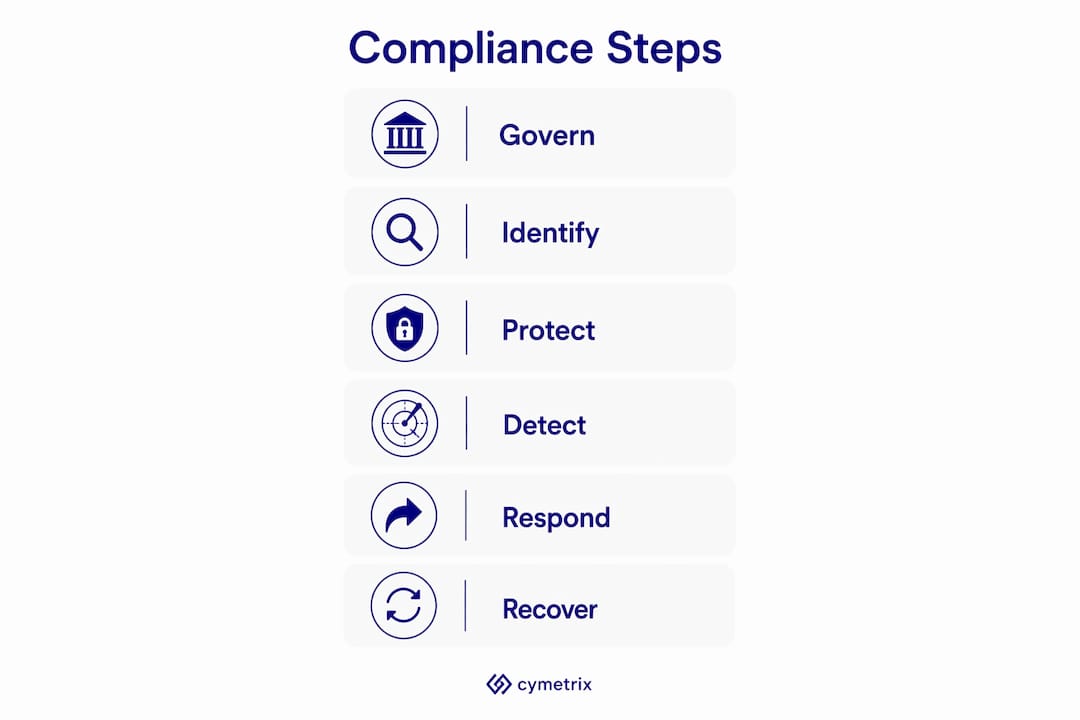
The framework organizes compliance into six functions: Govern, Identify, Protect, Detect, Respond, and Recover. Beyond NIST, small businesses must also navigate regulations tied to the data they handle, including HIPAA, GDPR, CCPA, and PCI DSS. A risk-based approach, one scaled to your actual size and data sensitivity, is what regulators and security experts consistently recommend over rigid, one-size-fits-all checklists.
Core compliance pillars every small business should address:
- Governance: Define who owns security decisions and how policies get approved
- Risk management: Identify your highest-priority threats before spending on controls
- Technical controls: MFA, patch management, encryption, and access restrictions
- Incident response: A written, tested plan for before, during, and after a breach
- Employee training: Formal, recurring security awareness for all staff
- Regulatory mapping: Document which frameworks apply to your specific data types
Symmnet helps small businesses build and maintain compliance programs across all of these areas, with managed IT and cybersecurity services tailored to industries like manufacturing, aerospace, and professional services.
Table of Contents
- How NIST CSF 2.0 gives small businesses a practical compliance backbone
- Why a risk-based approach beats a compliance checklist
- Practical steps to build your IT compliance program
- How to keep your compliance program current over time
- Industry-specific compliance requirements your business may face
- Common compliance pitfalls that catch small businesses off guard
- Tools and resources that simplify compliance management
- Employee training is where most compliance programs succeed or fail
- Incident response planning is a compliance requirement, not just a best practice
- Symmnet handles compliance so your team can focus on the business
- Key Takeaways
How NIST CSF 2.0 gives small businesses a practical compliance backbone
The NIST CSF 2.0 is not a regulation. It carries no penalties for non-adoption. What it offers instead is a structured, technology-neutral language for managing cybersecurity risk, one that works whether you have two employees or two hundred.
The six functions cover the full lifecycle of a security program:
- Govern: Establish your risk strategy, policies, and accountability structure
- Identify: Inventory your assets, data, and current risk exposure
- Protect: Deploy safeguards to prevent or reduce cybersecurity incidents
- Detect: Build capabilities to identify anomalies and security events quickly
- Respond: Define how your team acts when an incident occurs
- Recover: Restore operations and learn from the event
The CSF 2.0 Small Business Quick Start Guide translates these functions into checklists, priority questions, and starter tables that require no cybersecurity background to use. It is specifically designed for firms that lack a dedicated IT department. One underappreciated feature: the Govern function explicitly prompts you to document legal, regulatory, and contractual requirements, which means working through the guide naturally surfaces your HIPAA, PCI DSS, or GDPR obligations.
Pro Tip: Start with the Govern and Identify functions before touching any technical controls. Businesses that skip straight to tools often spend money protecting the wrong assets. The Quick Start Guide's tables take less than a day to complete and give you a defensible baseline.
Why a risk-based approach beats a compliance checklist
The FTC advises that cybersecurity compliance programs should be tailored to the organization's size, complexity, and the sensitivity of the data it handles. That guidance exists because a dental practice handling patient records faces fundamentally different risks than a two-person consulting firm.
Small businesses face real, targeted threats. According to SMBRegs, small businesses absorb 43% of cyberattacks targeting enterprises, with average data breach costs exceeding $3 million. The most common attack vectors are phishing, ransomware, vendor compromise, and credential theft.
Key factors to assess when building your risk profile:
- What types of data do you store? (health records, payment data, personal information)
- Which regulations apply based on that data and your customer geography?
- Where are your most likely entry points? (email, remote access, third-party vendors)
- What would a breach cost you in downtime, fines, and lost customer trust?
Overbuilding your compliance program is a real risk too. A small manufacturer that invests in enterprise-grade security tooling it cannot operate or monitor has not improved its posture. Prioritize controls with the highest impact relative to your actual threat profile.
Practical steps to build your IT compliance program
Building a compliant IT program does not require a large team. It requires clear ownership, documented policies, and consistent execution of a focused set of controls.
Start with these steps:
- Appoint a Security Program Manager. CISA recommends a dedicated owner who reports regularly to leadership, not just a technical fix-it role
- Conduct a formal risk assessment. Map your assets, data types, and vulnerabilities before selecting controls. Symmnet's cybersecurity risk assessment approach gives small businesses a structured starting point
- Enforce MFA across all accounts. CISA notes that many organizations instruct users to enroll but never verify compliance. Verify MFA status regularly, especially for system administrators and newly onboarded staff
- Implement patch management. Monitor CISA's Known Exploited Vulnerabilities catalog and enable auto-updates wherever possible. Patching is among the most cost-effective controls available
- Remove admin privileges from standard user accounts. This single step blocks a wide category of malware installation attacks
- Enable disk encryption on all laptops. Windows and Mac devices require explicit configuration; this is not automatic
- Document your regulatory obligations. Use a spreadsheet to track which frameworks apply, what they require, and your current status
- Write and approve an incident response plan. Leadership must formally sign off. Review it quarterly and after every security event
Pro Tip: Test your incident response plan by invoking it during a suspected false alarm. Near-miss events drive the same continuous improvement in security programs that they do in aviation. Never let one pass without a debrief.
For a deeper look at the controls that matter most, Symmnet's guide to proven cybersecurity steps for small U.S. businesses covers implementation in practical detail.
How to keep your compliance program current over time
Compliance is not a project with a finish line. Threats evolve, regulations update, and your business changes. The programs that hold up are the ones built around continuous monitoring, not annual checkboxes.
Monthly and quarterly maintenance tasks that prevent compliance drift:
- Audit MFA enrollment rates and remediate gaps for new or migrated accounts
- Review patch status against CISA's Known Exploited Vulnerabilities catalog
- Test backup restorability with both partial and full restores. Many ransomware victims discovered their backups were incomplete only after an attack
- Refresh employee security training at least annually, with targeted reminders after phishing attempts
- Update the incident response plan after every security event or significant business change
- Report compliance metrics to leadership monthly so executives stay engaged
CISA guidance is direct on this point: businesses that treat security as a one-time technical project rather than a continuous governance function are the ones that fail compliance when it matters most. Migrating on-premises mail and file storage to cloud platforms like Google Workspace or Microsoft 365 also reduces the attack surface that your team needs to monitor and maintain.
Industry-specific compliance requirements your business may face
The regulations that apply to your business depend almost entirely on what data you handle and who your customers are.
HIPAA covers any business that stores or processes protected health information, including IT providers and billing companies that work with healthcare organizations. Key requirements include access controls, audit logging, encrypted transmission, and signed Business Associate Agreements with every vendor touching patient data.
PCI DSS applies to every business that accepts credit cards, regardless of size. For most small businesses, using a compliant processor like Stripe or Square handles the bulk of the technical burden. You still need to complete an annual Self-Assessment Questionnaire and keep payment networks segmented from general business systems.
GDPR applies if you have any customers or website visitors in the European Union, regardless of where your business is located. Requirements include a documented lawful basis for data collection, a plain-language privacy policy, and breach notification to supervisory authorities within 72 hours.
CCPA/CPRA applies to for-profit businesses meeting specific California thresholds, including annual gross revenue over $25 million or handling personal data of 100,000 or more California consumers per year. Most small businesses fall below these thresholds, but growth-stage companies should track them.
For manufacturers and defense contractors, CMMC (Cybersecurity Maturity Model Certification) governs access to DoD contracts and requires meeting specific NIST 800-171 controls. Small manufacturers can find practical guidance on aligning compliance programs to their risk profile in resources like industrial compliance frameworks tailored to their sector.
Common compliance pitfalls that catch small businesses off guard
The most expensive compliance failures are rarely technical. They are organizational.
Treating compliance as a one-time event is the most common mistake. A risk assessment completed two years ago does not reflect your current vendor relationships, employee count, or software stack. Compliance requires the same ongoing attention as your financials.
Skipping documentation creates serious exposure. Regulators responding to a breach look for evidence of a functioning security program. Without written policies, risk assessments, and incident logs, even a technically sound environment looks like willful negligence.
Assuming your IT provider handles compliance is a gap that surfaces at the worst time. Managed service providers handle uptime and patching. Compliance requires documented governance, regulatory mapping, and leadership accountability that goes beyond infrastructure management.
Ignoring vendor risk is increasingly costly. Third-party vendors with access to your systems or data extend your compliance perimeter. Every vendor handling regulated data needs a reviewed contract and periodic oversight.
Tools and resources that simplify compliance management
Several free, authoritative resources reduce the effort of building a compliance program from scratch.
The NIST CSF 2.0 Small Business Quick Start Guide provides checklists, starter tables, and priority questions organized by the six CSF functions. It is the most practical free resource available for small businesses beginning a cybersecurity risk management strategy.
CISA's Known Exploited Vulnerabilities catalog gives IT teams a prioritized list of vulnerabilities actively used in real attacks, updated continuously. Monitoring it costs nothing and directly improves patch prioritization.
The FCC's Small Biz Cyber Planner 2.0 generates a customized cybersecurity plan based on your business type and size. It takes under 30 minutes and produces a written output you can share with leadership.
CISA's free vulnerability scanning is available to small businesses and assesses exposure to known threats without requiring internal security expertise.
For businesses that need a structured view of their cybersecurity controls, understanding which control types apply to your environment is a useful precursor to any compliance program.
Employee training is where most compliance programs succeed or fail
The leading cause of small business data breaches is employee behavior, specifically responses to phishing, weak password practices, and accidental data exposure. Technical controls reduce risk, but they do not eliminate the human factor.
Effective training programs share a few consistent characteristics. They are formal and documented, not informal reminders. They cover specific tasks employees must perform, including enabling MFA, recognizing phishing attempts, and knowing how to escalate suspicious activity. And they repeat. Annual training is a floor, not a ceiling.
CISA's guidance requires that all staff understand the organization's commitment to security and their individual responsibilities within it. That means training is not just an IT function. It belongs in onboarding, in quarterly reminders, and in the debrief after every near-miss event. Leadership participation signals that security is a business priority, not a compliance checkbox.
Incident response planning is a compliance requirement, not just a best practice
An incident response plan (IRP) is a written document that defines what your organization does before, during, and after a security incident. CISA is explicit: the IRP must be approved by leadership, include roles and responsibilities for all major activities, and contain an out-of-band contact list for use if your network is down during an incident.
Review the IRP quarterly and after every security event or near miss. The plan should be tested through tabletop exercises and, critically, invoked even when an incident turns out to be a false alarm. Near-miss events reveal gaps in communication, decision authority, and technical response that a document review alone will not surface.
For small businesses subject to GDPR, HIPAA, or state breach notification laws, the IRP is also the mechanism that determines whether you meet mandatory reporting deadlines. GDPR requires supervisory authority notification within 72 hours of a confirmed breach. A plan that has never been practiced is unlikely to execute that timeline under pressure.
Symmnet handles compliance so your team can focus on the business
Small businesses that manage compliance internally often find the work crowding out everything else. The documentation, monitoring, vendor reviews, and regulatory tracking add up fast, especially without a dedicated security team.
Symmnet delivers managed IT and cybersecurity services built specifically for small U.S.-based businesses in manufacturing, aerospace, professional services, and related industries. The practical difference: fixed pricing, 24/7 monitoring, and a team that already knows the compliance requirements for your sector. No learning curve, no per-incident billing surprises. Symmnet's compliance support covers risk assessments, incident response planning, MFA enforcement, patch management, and the documentation that regulators and auditors expect to see. If you want to know where your current program stands, Symmnet offers a free assessment to identify security gaps before they become incidents. Reach out at symmnet.com to get started.
Key Takeaways
A risk-based compliance program built on NIST CSF 2.0, with documented policies, enforced MFA, tested backups, and trained employees, is the most defensible foundation a small U.S. business can build.
| Point | Details |
|---|---|
| NIST CSF 2.0 is the right starting point | Its six functions cover governance through recovery and scale to any small business size or sector. |
| Risk-based programs outperform checklists | Tailor controls to your actual data types, regulatory exposure, and threat profile before spending on tools. |
| 43% of cyberattacks target small businesses | Average breach costs exceed $3 million, making a proactive compliance program a financial necessity. |
| Compliance requires continuous governance | Treating security as a one-time project is the most common reason small businesses fail audits and breach reviews. |
| Symmnet provides managed compliance support | Fixed-price managed IT and cybersecurity services cover risk assessments, monitoring, and regulatory documentation for SMBs. |