

A cybersecurity workflow for contractors is a structured, repeatable set of steps that protects sensitive client data, secures digital systems, and keeps your business compliant with federal regulations. The industry term for this practice is "security process management," but most contractors know it simply as building a security workflow. With 81.9% of U.S. small businesses classified as non-employer firms, including independent contractors and freelancers, the cybersecurity risk exposure across this segment is enormous. Frameworks like NIST CSWP 50 and the Cybersecurity Maturity Model Certification (CMMC) now set the compliance bar, and meeting that bar requires more than good intentions. It requires a documented, repeatable process.
What does a cybersecurity workflow for contractors actually require?
A contractor cybersecurity workflow combines three layers: foundational security controls, compliance alignment, and continuous review. Without all three, the workflow has gaps that attackers exploit. The good news is that you do not need an internal IT team to build one. You need a clear plan and the right controls in place.
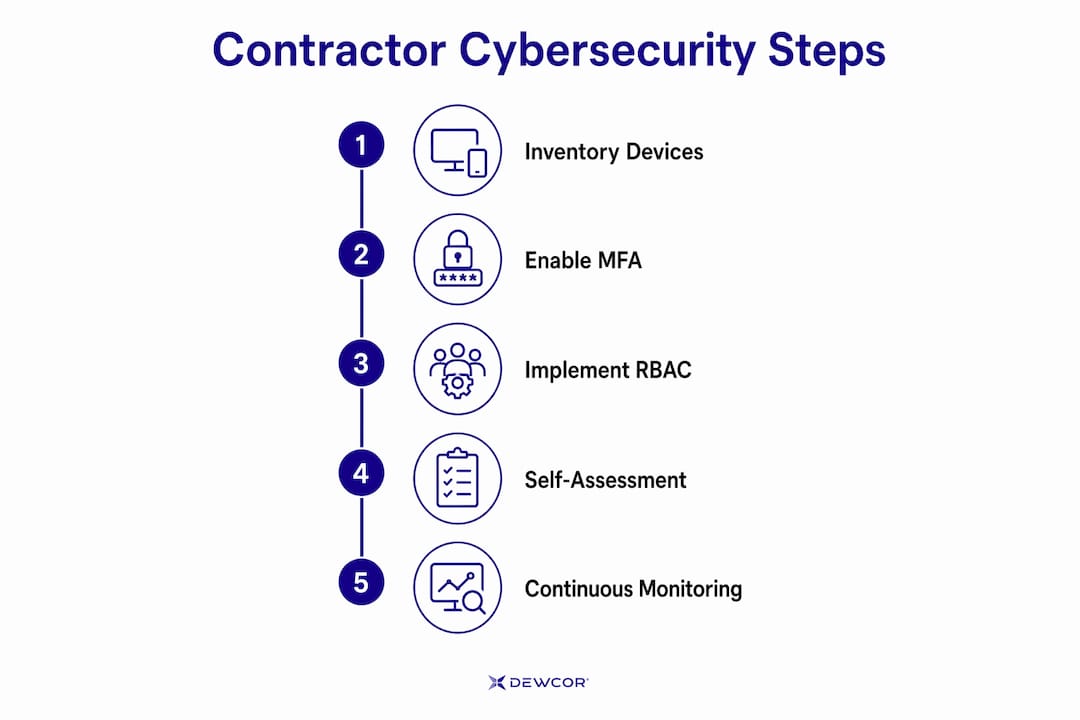
The most critical starting point is Multi-Factor Authentication. App-based MFA is the most effective control against credential-based attacks. Authenticator apps like Google Authenticator or Microsoft Authenticator are significantly more secure than SMS codes, which are vulnerable to SIM-swapping attacks. Every contractor should enable MFA on email, project management platforms, and financial applications before addressing anything else.

Access control is the second pillar. Role-based access control (RBAC) limits who can view or modify sensitive files based on job function. A subcontractor on a construction project, for example, should never have access to the general contractor's full financial records. Quarterly permission audits catch dormant accounts and over-privileged users before they become a liability.
Essential security controls every contractor needs
The following controls form the baseline of any contractor data protection strategy:
- Multi-Factor Authentication (MFA): Use an authenticator app, not SMS, on all professional platforms.
- Role-Based Access Control: Assign permissions by job function and review them quarterly.
- Data encryption: Encrypt files at rest and in transit using AES-256 or TLS 1.2 and above.
- Endpoint protection: Install endpoint detection and response (EDR) software on every device, including laptops and mobile phones.
- Email security filtering: Deploy DMARC, DKIM, and SPF to block spoofed emails and phishing attempts.
- Mobile device management (MDM): Enforce screen locks, remote wipe capability, and app restrictions on all mobile devices used for work.
- Automated backups: Schedule daily backups to a secure, offsite or cloud location.
Pro Tip: Use a dedicated password manager such as Bitwarden or 1Password to generate and store unique credentials for every platform. Reused passwords are one of the most common entry points for attackers targeting contractors.
How do CMMC and NIST frameworks apply to contractors?
Compliance is not optional for contractors working with federal agencies or defense supply chains. CMMC Level 1 and Level 2 became mandatory in november 2025 for defense contractors handling Federal Contract Information (FCI) and Controlled Unclassified Information (CUI). That mandate affects thousands of small contractors who may not realize they are in scope.
CMMC Level 1 covers 17 basic practices drawn from FAR 52.204-21. Level 2 expands to 110 practices aligned with NIST SP 800-171. If your contract involves CUI, Level 2 applies to you. NIST CSWP 50 addresses non-employer firms specifically, offering a scaled-down framework that solo contractors and micro-businesses can realistically implement without a dedicated security team.
Self-assessment using NIST and CMMC frameworks lets you identify gaps before a formal audit does. The process starts with mapping your information systems, then scoring each practice against the framework requirements. Any gap becomes a corrective action item with a deadline.
| Compliance area | CMMC Level 1 | CMMC Level 2 |
|---|---|---|
| Applicable data type | Federal Contract Information (FCI) | Controlled Unclassified Information (CUI) |
| Number of practices | 17 | 110 |
| Assessment type | Annual self-assessment | Third-party assessment required |
| Effective date | November 2025 | November 2025 |
| Framework alignment | FAR 52.204-21 | NIST SP 800-171 |
Pro Tip: CISA offers the Cyber Security Evaluation Tool (CSET) at no cost. Download it, run a self-assessment against your current environment, and use the output to build your corrective action plan before any formal audit.
How to build a contractor cybersecurity workflow step by step
Building a security process from scratch feels large, but it breaks down into manageable steps. The goal is a documented workflow you can repeat, audit, and improve over time. Contractors in construction, manufacturing, and professional services all follow the same core sequence, even if the specific tools differ.
-
Inventory your digital assets. List every device, application, and cloud service your business uses. Include personal devices if they access work data. You cannot protect what you have not identified.
-
Map where sensitive data lives. Identify which systems store client contracts, financial records, project files, or any FCI or CUI. This map drives every access control decision that follows.
-
Audit user accounts and permissions. Review every account with access to your systems. Remove dormant accounts immediately. Apply role-based access controls so each user sees only what their role requires.
-
Enable MFA on all critical platforms. Start with email, then move to project management tools, accounting software, and any cloud storage. Use an authenticator app for every account that supports it.
-
Deploy endpoint and email security. Install EDR software on all devices. Configure DMARC, DKIM, and SPF on your email domain. These two steps block the majority of common attack vectors.
-
Set a recurring review schedule. Conduct access reviews quarterly. Run software patch checks monthly. Schedule annual security training for yourself and any staff or subcontractors.
-
Write an incident response plan. Define what counts as a security incident, who gets notified, and in what order. A manufacturing contractor, for example, should know whether a ransomware attack triggers a client notification obligation under their contract or applicable state law.
-
Test your backups. Automated backup and restoration testing is the step most contractors skip. A backup that has never been tested is not a backup. Run a restoration drill at least twice a year.
Pro Tip: Document every step of your workflow in a simple one-page security policy. Clients and federal contracting officers increasingly ask for written evidence of your security practices. A documented policy signals professionalism and reduces audit friction.
What mistakes do contractors most often make in their security workflows?
The most common failure in IT security for contractors is treating cybersecurity as a one-time setup rather than an ongoing process. A contractor who installs antivirus software in January and never revisits it has a false sense of security by March. Threats evolve, software vulnerabilities emerge, and access permissions drift as projects and personnel change.
SMS-based MFA is a specific risk that many contractors underestimate. Text message codes are better than no MFA, but SIM-swapping attacks can intercept them. Switching to an authenticator app takes less than ten minutes per platform and eliminates that vulnerability entirely.
Ignoring periodic access reviews creates another common gap. A subcontractor who finished a project six months ago may still have login credentials to your shared drive. That dormant account is an open door. Quarterly reviews close it.
The following troubleshooting steps address the most frequent workflow failures:
- Weak or reused passwords: Enforce a password manager and require unique credentials for every account.
- Unpatched software: Set all operating systems and applications to auto-update, or schedule a monthly patch review.
- Untested backups: Run a restoration drill twice a year to confirm your backup actually works.
- No phishing awareness: Run phishing simulations quarterly and follow each one with a short refresher training session.
- Missing incident response plan: Write a one-page plan that names who to call, what to document, and when to notify clients or regulators.
- No mobile device policy: Apply MDM controls to every phone or tablet that touches work data, including your own.
Why I think most contractors are one audit away from a serious problem
The contractors I see struggle most are not the ones who ignore cybersecurity entirely. They are the ones who did something three years ago and assumed it was enough. They installed a firewall, set up a shared drive, and moved on. The threat environment has changed dramatically since then, and their workflow has not kept pace.
CISA is explicit that cybersecurity must be an iterative workflow, not a one-time configuration. That framing matters. It shifts the mindset from "Am I secure?" to "Is my security current?" Those are very different questions, and only the second one leads to a defensible answer during an audit or after an incident.
The CSET tool from CISA is genuinely underused. I have seen solo contractors complete a CSET assessment in an afternoon and walk away with a prioritized list of corrective actions they could address within 30 days. That is a better return on time than almost any other security activity a small contractor can do independently.
The contractors who handle this well share one habit: they schedule security reviews the same way they schedule quarterly taxes. It goes on the calendar, it happens, and the records prove it happened. That discipline is what separates a contractor who passes a CMMC self-assessment from one who fails it. You do not need a large budget. You need a repeatable process and the discipline to follow it.
— Michael
How Symmnet helps contractors build a secure, compliant workflow
Contractors who want expert support without hiring a full IT team have a practical option in Symmnet's managed IT and cybersecurity services. Symmnet provides 24/7 system monitoring, MFA deployment, endpoint security, and compliance consulting tailored for small businesses in manufacturing, aerospace, and professional services.
For contractors navigating CMMC requirements or building their first formal security process, Symmnet offers a free assessment to identify gaps and prioritize corrective actions. The fixed pricing model means no surprise invoices, and U.S.-based support means you reach a real person when something goes wrong. If you are ready to move from ad hoc security to a documented, auditable workflow, Symmnet is built for exactly that.
Key takeaways
A documented, repeatable cybersecurity workflow is the single most effective way for contractors to protect client data and pass compliance audits in 2026.
| Point | Details |
|---|---|
| MFA is the first control to deploy | Use an authenticator app, not SMS, on every professional platform before anything else. |
| CMMC compliance is now mandatory | Defense contractors handling FCI or CUI must meet CMMC Level 1 or Level 2 requirements as of november 2025. |
| Self-assessment prevents audit surprises | Use CISA's free CSET tool to score your current posture and build a corrective action plan. |
| Access reviews must be scheduled | Quarterly permission audits remove dormant accounts and prevent unauthorized data access. |
| Backup testing is non-negotiable | Run a restoration drill at least twice a year to confirm your backup actually recovers your data. |
FAQ
What is a cybersecurity workflow for contractors?
A cybersecurity workflow for contractors is a structured, repeatable set of security practices covering access control, data protection, compliance, and incident response. It replaces ad hoc security decisions with a documented process that can be audited and improved over time.
Which CMMC level applies to most small contractors?
Contractors handling Federal Contract Information must meet CMMC Level 1, which covers 17 basic practices. Those handling Controlled Unclassified Information must meet Level 2, which requires 110 practices aligned with NIST SP 800-171.
How do I start a contractor cybersecurity checklist?
Start by inventorying every device and application your business uses, then map where sensitive data lives. From there, audit user accounts, enable MFA, and deploy endpoint protection before moving to compliance alignment.
Is SMS-based MFA good enough for contractors?
SMS-based MFA is better than no MFA, but authenticator apps are significantly more secure. SIM-swapping attacks can intercept text message codes, making app-based authentication the recommended standard for contractor cybersecurity best practices.
What free tools can contractors use to assess their security posture?
CISA provides the Cyber Security Evaluation Tool (CSET) at no cost. It is a standalone application that guides contractors through a systematic self-assessment and produces a prioritized list of security gaps to address.