

Vulnerability management is defined as the continuous process of discovering, evaluating, prioritizing, and remediating security weaknesses across your IT environment before attackers can exploit them. Unlike a one-time audit, it is an ongoing operational capability that keeps your defenses current as threats evolve. The importance of vulnerability management cannot be overstated for small businesses: a single unpatched flaw can expose customer data, disrupt operations, and trigger regulatory penalties. Federal standards are tightening fast. CISA's Binding Operational Directive 26-04 now sets the most aggressive remediation timelines in U.S. history, signaling that proactive vulnerability programs are no longer optional for any organization.
What is vulnerability management, and how does it differ from patching?
Vulnerability management and patch management are related but not the same thing. Patch management is a tactical subset of vulnerability management. It focuses specifically on installing vendor-released patches to fix known software flaws. Vulnerability management is the broader strategic practice that covers identification, assessment, prioritization, remediation, and verification across your entire IT environment.

Risk management is a third concept that often gets confused with the other two. Risk management operates at the enterprise level, weighing threats against business objectives and acceptable loss thresholds. Vulnerability management feeds data into risk management decisions but focuses specifically on technical weaknesses in systems and software.
The three concepts work together, but each has a distinct scope:
- Patch management addresses known software flaws by applying vendor updates. It is reactive and tool-driven.
- Vulnerability management covers the full lifecycle from discovery to verified remediation. It includes scanning, triage, prioritization, and tracking.
- Risk management frames technical vulnerabilities within broader business risk. It decides which risks to accept, transfer, or mitigate.
Treating patch management as a substitute for vulnerability management is one of the most common mistakes small IT teams make. Patches fix software. Vulnerability management fixes your security posture.
What are the key stages in the vulnerability management lifecycle?
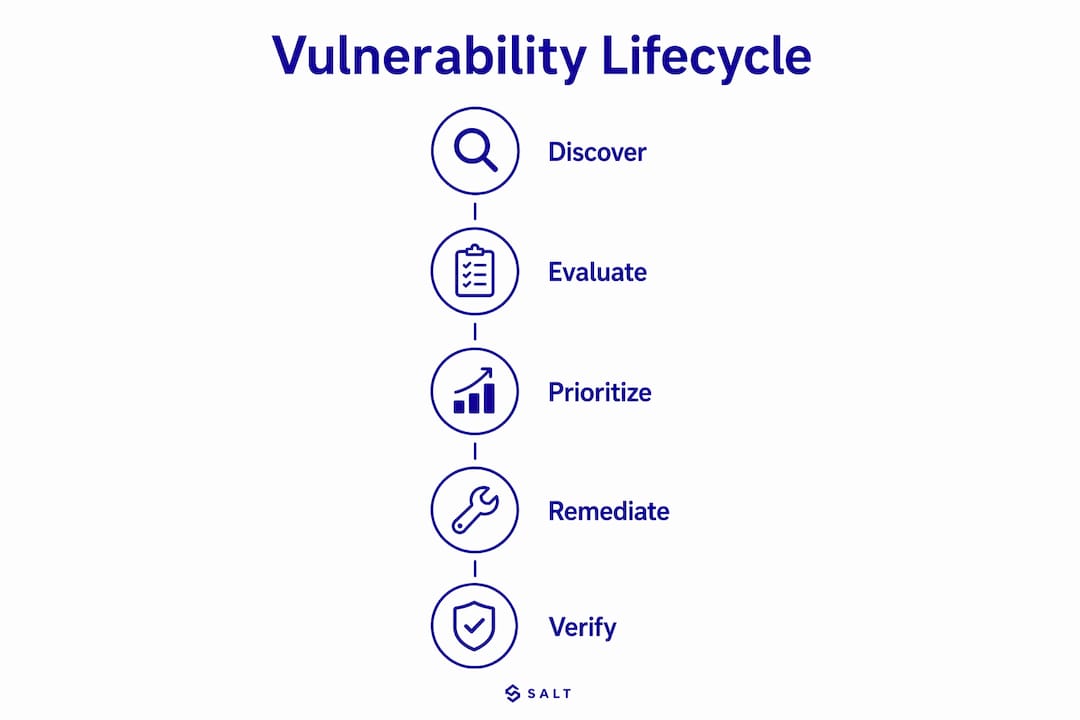
Effective vulnerability management follows a repeatable lifecycle. Each stage builds on the last, creating a continuous loop rather than a one-time project.
- Asset discovery and inventory. You cannot protect what you do not know exists. Start by cataloging every device, application, and service connected to your network. Shadow IT, forgotten servers, and unmanaged endpoints are common blind spots.
- Vulnerability scanning. Automated scanners probe your assets for known weaknesses using signature databases like the National Vulnerability Database (NVD). Scans should run on a regular schedule, not just after incidents.
- Validation and triage. Not every scanner finding is a real threat. Validation separates genuine vulnerabilities from false positives. Triage assigns severity and context before any remediation work begins.
- Risk prioritization. Rank vulnerabilities by exploitability and business impact. A critical flaw on an internet-facing server ranks higher than the same flaw on an isolated internal workstation.
- Remediation and mitigation. Apply patches, reconfigure settings, or isolate affected systems. When a patch is not available, compensating controls like firewall rules or access restrictions reduce exposure.
- Verification and rescanning. Confirm that fixes worked. Rescan affected assets to close the loop and document evidence of remediation.
The table below maps each stage to its primary output and responsible party.
| Lifecycle Stage | Primary Output | Typical Owner |
|---|---|---|
| Asset discovery | Complete asset inventory | IT operations |
| Vulnerability scanning | Findings report | Security or IT team |
| Validation and triage | Confirmed, prioritized list | Security lead |
| Remediation | Patched or mitigated assets | IT or DevOps |
| Verification | Remediation evidence | Security or IT team |
Pro Tip: Schedule your vulnerability scans immediately after any new software deployment or network change. New assets and configurations are the most common entry points attackers target first.
The lifecycle is not linear in practice. New assets appear, new vulnerabilities are disclosed, and business priorities shift. Mature programs maintain continuous lifecycle governance rather than treating each scan as a standalone event. That continuous mindset is what separates a real security program from a compliance checkbox.
Why does ownership matter so much for small business vulnerability programs?
Ownership ambiguity is the most common reason vulnerability programs stall. When no one is clearly responsible for fixing a flaw, it sits open indefinitely. Establishing default ownership by asset type solves this problem immediately upon discovery, without requiring a meeting or escalation.
A practical ownership model for small teams looks like this:
- Operating system patches go to IT operations by default.
- Container images and infrastructure configurations go to DevOps or the team managing those systems.
- Application libraries and third-party dependencies go to the engineering or development team.
- Network devices such as firewalls and switches go to the network administrator.
The second failure point is trying to fix everything at once. Small teams have limited hours, and a scanner can return hundreds of findings in a single run. Attempting to remediate every finding simultaneously leads to burnout and zero completed fixes.
Prioritize by exploitability and business impact instead. Start with vulnerabilities that have active exploits in the wild and affect systems that handle sensitive data or support critical operations. Then pursue quick wins: simple configuration fixes, outdated driver updates, and default credential changes. Quick wins build momentum and demonstrate measurable progress to leadership.
Pro Tip: Create a short "fix-it sprint" each month targeting the top five vulnerabilities by risk score. A focused sprint produces more results than an open-ended remediation backlog that never shrinks.
Small businesses do not need enterprise-grade tools or dedicated security teams to run an effective program. A practical approach built on continuous discovery, clear ownership, and realistic prioritization delivers real risk reduction with the resources you already have. The vulnerability assessment process for a 50-person company looks different from a Fortune 500 program, and that is perfectly appropriate.
How has CISA BOD 26-04 changed vulnerability management expectations?
Federal directives now set the bar for what "good" looks like in vulnerability remediation. CISA BOD 26-04 requires remediation within 3 days for vulnerabilities in the Known Exploited Vulnerabilities (KEV) catalog that grant total system control. Lower-risk, non-exposed vulnerabilities carry a 60-day remediation window. These timelines represent the most aggressive federal remediation standard issued to date.
"CISA BOD 26-04 requires forensic triage and evidence of remediation for the highest-risk vulnerabilities within 72 hours of discovery. That is not a patch cycle. That is an incident response timeline applied to vulnerability management."
That shift matters even if your organization is not a federal agency. Regulators, cyber insurers, and enterprise customers increasingly use federal standards as benchmarks when evaluating vendor and partner security posture. A small manufacturer supplying aerospace or defense contracts faces the same scrutiny as a larger prime contractor.
BOD 26-04 also emphasizes continuous asset discovery and ongoing risk assessment, not periodic scanning. The directive expects organizations to know what assets they have, what vulnerabilities exist on those assets, and what remediation evidence they can produce on demand. For small businesses, this means moving from quarterly scans to continuous monitoring. It also means documenting your remediation steps, not just applying patches and moving on.
The enterprise vulnerability management process now includes forensic triage as a standard stage, a requirement that filters down to any organization in a regulated supply chain. Small businesses in manufacturing, professional services, and aerospace should treat BOD 26-04 as a preview of where private-sector compliance requirements are heading. Building the capability now costs far less than retrofitting it after a breach or audit finding.
Key Takeaways
Vulnerability management is a continuous operational program, not a periodic scan, and small businesses that treat it as one gain a measurable security advantage over those that do not.
| Point | Details |
|---|---|
| Continuous process, not a project | Vulnerability management requires ongoing discovery, scanning, and remediation, not annual audits. |
| Ownership drives results | Assign default remediation ownership by asset type to eliminate accountability gaps immediately. |
| Prioritize by real risk | Focus on exploitable, business-critical vulnerabilities first; quick wins build sustainable momentum. |
| Federal timelines are tightening | CISA BOD 26-04 requires remediation of the highest-risk flaws within 3 days, setting a new industry benchmark. |
| Small teams can run effective programs | Practical prioritization and clear workflows deliver real risk reduction without enterprise-level resources. |
What I have learned from watching small businesses build these programs
The hardest part of vulnerability management for small businesses is not the technology. It is the organizational habit. I have seen teams invest in solid scanning tools and then let the findings sit in a spreadsheet for months because no one owned the follow-through. The scanner is not the program. The program is the process around the scanner.
The second thing I have learned is that leadership engagement makes or breaks these efforts. When an IT manager has to fight for two hours of developer time to patch a critical library, the program stalls. When a business owner understands that an unpatched system is a liability, the conversation changes. Framing vulnerabilities in terms of business risk, not technical severity, is the skill that separates effective security teams from frustrated ones.
Regulatory trends like CISA BOD 26-04 are actually useful for small businesses, even if they feel like pressure. They give IT professionals a concrete, defensible standard to point to when requesting resources or justifying process changes. "Federal agencies are required to fix this class of vulnerability in 3 days" is a more persuasive argument than "our scanner flagged this as high severity." Use the regulatory environment to your advantage.
The security controls for small businesses that matter most are the ones you actually execute consistently. A modest program with clear ownership and monthly remediation sprints outperforms a sophisticated program that no one maintains.
— Michael
Symmnet supports your vulnerability management program
Running a vulnerability management program alongside daily IT operations is a real challenge for small teams. Symmnet provides managed IT and cybersecurity services built specifically for small U.S.-based businesses in manufacturing, aerospace, and professional services.
Symmnet's services include continuous system monitoring, endpoint security, firewall management, and remediation support. The team handles vulnerability scanning, triage, and patch coordination so your internal staff can focus on operations. Fixed pricing and U.S.-based support mean you get predictable costs and fast response without building an in-house security team. Contact Symmnet to schedule a free assessment and identify the gaps in your current security posture before an attacker does.
FAQ
What is vulnerability management in simple terms?
Vulnerability management is the ongoing process of finding, evaluating, and fixing security weaknesses in your IT systems. It is a continuous program, not a one-time scan.
How does vulnerability management differ from patch management?
Patch management installs vendor updates to fix known software flaws. Vulnerability management is the broader process that includes discovery, prioritization, remediation, and verification across all asset types.
How often should small businesses run vulnerability scans?
Continuous or weekly scanning is the current best practice, especially for internet-facing systems. CISA BOD 26-04 expects organizations to maintain ongoing visibility into their asset and vulnerability status.
What is the most common reason vulnerability programs fail?
Ownership ambiguity is the leading cause of program failure. When no one is assigned responsibility for fixing a specific vulnerability, it remains open indefinitely regardless of its severity.
Do small businesses need to comply with CISA BOD 26-04?
CISA BOD 26-04 applies directly to federal agencies, but its remediation standards are increasingly used as benchmarks by cyber insurers, enterprise customers, and regulators evaluating small business security posture.