

Cyber attacks on small businesses have jumped sharply over the past three years, and manufacturers and professional services firms sit squarely in the crosshairs. Attackers know your operations depend on uptime, your client data is valuable, and your security resources are limited. A structured cybersecurity risk assessment guide gives you a clear picture of where you are exposed before an incident forces the question. This guide walks you through every stage of the process, from gathering the right inputs to building a treatment plan that fits a real-world budget and schedule.
Table of Contents
- Key takeaways
- Getting ready for your cybersecurity risk assessment
- Step-by-step guide to identifying and prioritizing cyber risks
- Building your risk treatment plan
- Keeping your assessment current over time
- What I've learned doing risk assessments for small businesses
- How Symmnet supports your cybersecurity risk assessment
- FAQ
Key takeaways
| Point | Details |
|---|---|
| Prepare before you assess | Collect asset inventories, data logs, and architecture diagrams before starting to avoid gaps mid-assessment. |
| Score risks by business impact | Align likelihood and impact scoring to operational criticality, not just technical severity, for better prioritization. |
| Produce three core outputs | A ranked risk register, a heat map, and a time-bound treatment plan make findings usable and shareable. |
| Assign ownership to every risk | Each risk treatment action needs a named owner and a deadline, or it will not get done. |
| Review on a schedule | Reassess after major changes, new threats, or at least annually to keep findings current and defensible. |
Getting ready for your cybersecurity risk assessment
Skipping preparation is the fastest way to produce a risk assessment that sits in a drawer unused. Before you run a single scan or hold a single meeting, you need three categories of input in hand.
What to gather first:
- A current inventory of all hardware, software, and data assets, including operational technology (OT) equipment on the shop floor if you run a manufacturing operation
- Network architecture diagrams showing how systems connect, where data flows, and where external access points exist
- Existing security policies, recent audit reports, and any past incident logs
- A list of third-party vendors with access to your systems or data, since vendor risk posture directly affects your overall exposure
Identifying the right stakeholders matters just as much as the documentation. Your IT lead, operations manager, and at least one senior executive should be involved from day one. In professional services firms, the partner or compliance officer who owns client data obligations belongs in that conversation too.
The most underused preparation step is a Business Impact Analysis. Many small organizations start with vulnerability scans but miss prioritizing by business context. Integrating BIA closes that gap by mapping your critical assets to the functions your business absolutely cannot lose. A CNC machine control system that runs a production line is not the same risk as the office printer, even if both show vulnerabilities.
Pro Tip: Create a single shared folder, physical or digital, that holds all your documentation before the assessment starts. Label each document by system or data type. Assessors and stakeholders waste hours hunting for files that should be a two-minute retrieval.
Step-by-step guide to identifying and prioritizing cyber risks
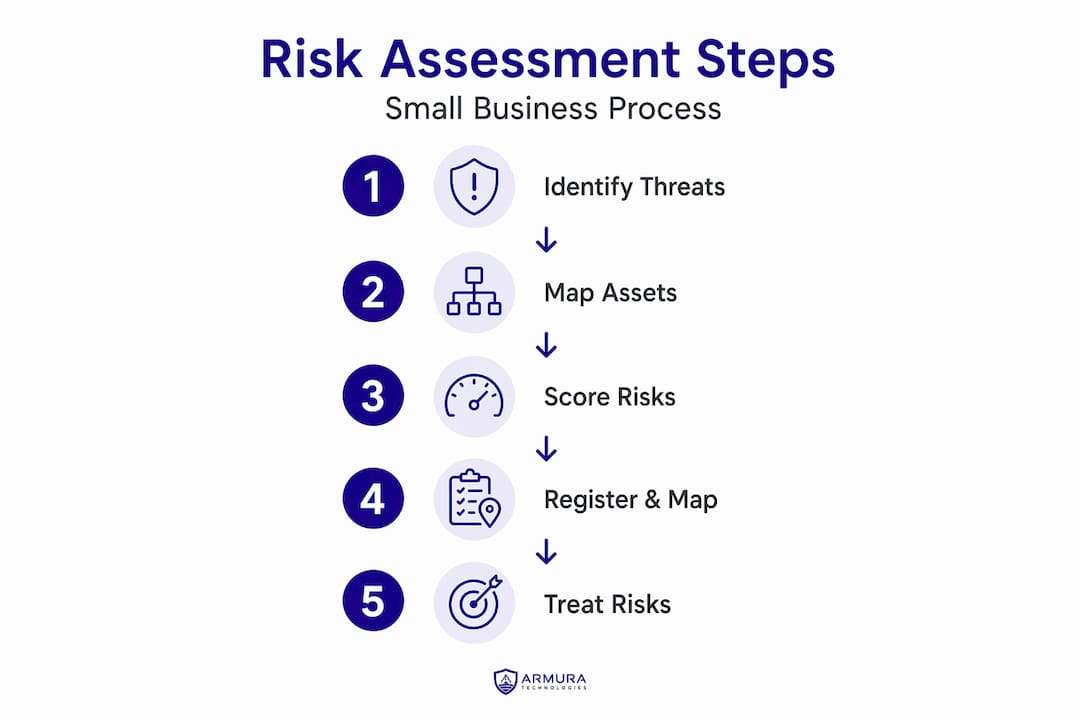
This is where a cybersecurity risk assessment guide either earns its keep or falls flat. The goal is a ranked list of risks you can act on, not a theoretical catalog of everything that could go wrong.
Step 1: Define your threat scenarios
Start with the threats most relevant to your sector. For small manufacturers, these typically include ransomware targeting production systems, common cybersecurity threats like phishing against office staff, and supply chain compromises. Professional services firms add data exfiltration and unauthorized access to client records to that list.
Step 2: Map threats to assets and vulnerabilities
For each threat scenario, identify which assets it targets and what vulnerability it would exploit. A ransomware attack targets file servers and backup systems. The vulnerabilities might be unpatched software, weak remote desktop credentials, or the absence of offline backups. This three-way mapping of threat, asset, and vulnerability is the analytical core of the assessment.
Step 3: Score likelihood and impact
Risk scoring under NIST SP 800-30 uses qualitative or semi-quantitative scales to produce a single risk level from two inputs: how likely is the threat to exploit the vulnerability, and how severe would the business impact be. A simple three-by-three matrix works well for most small businesses. Score each dimension as Low, Medium, or High.
Aligning risk scoring to operational criticality, not just technical severity, consistently produces better decisions. A Medium-likelihood threat against your order management system may outrank a High-likelihood threat against a low-value workstation simply because the operational consequence is far greater.
| Scoring approach | Best for | Example |
|---|---|---|
| Qualitative (Low/Med/High) | Smaller teams with limited data | Ransomware on file server: High likelihood, High impact = Critical |
| Semi-quantitative (1-5 scale) | Teams wanting more precision without full quantitative models | Phishing via email: Likelihood 4, Impact 3 = Risk score 12 |
| Quantitative (dollar values) | Organizations with actuarial data or compliance requirements | Annual expected loss calculation for a data breach |
Step 4: Build your risk register and heat map
Document every assessed risk in a register that captures the threat, affected asset, vulnerability, likelihood score, impact score, combined risk level, and current controls. Then plot risks on a heat map with likelihood on one axis and impact on the other. Producing these outputs makes prioritization transparent and gives you something concrete to present to leadership or a board.

Pro Tip: Color-code your heat map using red for critical, orange for high, yellow for medium, and green for low. Executives grasp this format instantly, and it cuts the time you spend explaining technical findings in half.
Building your risk treatment plan
A risk register without a treatment plan is just a list of problems. This stage is where findings convert into scheduled, owned actions.
The four treatment options:
- Mitigate: Implement controls that reduce the likelihood or impact of the risk. This is the most common choice for critical and high risks.
- Transfer: Shift some of the financial exposure through cyber insurance. This does not eliminate the risk but limits its financial consequence.
- Accept: Formally acknowledge the risk and choose not to act, typically for low-severity items where the cost of mitigation exceeds the potential loss.
- Avoid: Change a business process or discontinue a system to eliminate the risk entirely.
NIST 800-30 recommends presenting three mitigation options per risk: minimal controls, a balanced approach, and a comprehensive solution. This gives decision-makers a real choice instead of a take-it-or-leave-it recommendation.
| Treatment type | When to use | Example |
|---|---|---|
| Mitigate | Risk is above your tolerance threshold and controls exist | Deploy MFA on all remote access points |
| Transfer | Risk has high financial impact but low frequency | Purchase cyber liability insurance |
| Accept | Risk is low severity and mitigation cost is disproportionate | Accept risk of email spoofing on internal-only domain |
| Avoid | The source of risk can be removed without operational impact | Decommission unused legacy server with known vulnerabilities |
Once you have chosen a treatment for each risk, assign a named owner and a target completion date. Break the work into three phases: short-term actions within 30 days for critical risks, medium-term actions within 90 days for high risks, and longer-term projects for medium and low risks. This phased structure is practical for small teams managing day-to-day operations at the same time.
Pro Tip: Present your treatment plan to leadership as a business document, not a technical one. Frame each action by the operational or financial loss it prevents, not by the security control it deploys. That framing gets budget approved faster.
Keeping your assessment current over time
A one-time assessment has a short shelf life. Threats evolve, your infrastructure changes, and new vendors come on board. ISO/IEC 27005 frames risk management as a seven-stage cycle, with ongoing review built into the process by design, not treated as an afterthought.
Triggers that should prompt a reassessment:
- A significant change to your IT environment, such as a new cloud platform, production system, or remote access solution
- A security incident, even a near-miss
- A new regulatory requirement or contract that imposes cybersecurity obligations
- Discovery of a major new vulnerability in software you rely on
- Annual calendar review, at minimum, even if nothing else has changed
There are two risk levels worth tracking separately in your register. Inherent risk is the raw exposure before any controls are applied. Residual risk is what remains after your controls are in place. Differentiating inherent from residual risk sharpens your treatment and acceptance decisions significantly. If your residual risk on a critical system is still High after controls, you have not done enough, and the record will show it.
For ongoing monitoring between formal reassessments, consider 24/7 system monitoring, log review, and endpoint detection tools. These capabilities catch changes in your risk environment in real time rather than waiting for the next scheduled review. Manufacturers securing connected equipment should also read the practical guidance in this SMB network security guide to extend coverage to OT systems.
What I've learned doing risk assessments for small businesses
Working with small manufacturers and professional services firms over many years has taught me that the most common failure point is not technical. It is the gap between completing an assessment and acting on it.
I have seen businesses produce detailed, accurate risk registers and then never assign ownership to the items on the list. Six months later, the same vulnerabilities are open. The assessment became a compliance checkbox, not a security tool. The fix is simple but uncomfortable: every risk needs a name next to it, not a department or a vendor.
Another pattern I see consistently is over-engineering the scoring model. A small business with a 10-person IT function does not need the same quantitative model a bank uses. A clear three-level qualitative scale, applied honestly, produces better decisions than a complex formula applied inconsistently. Clarity beats precision when resources are tight.
The businesses that get the most out of a cybersecurity risk assessment are the ones that treat it as a conversation between operations and IT, not a technical deliverable handed upward. When a production manager understands why patching the SCADA system matters, it gets done. When it stays in the IT queue with no operational context, it waits. Get the right people in the room and keep the language grounded in business outcomes, not security jargon.
— Michael
How Symmnet supports your cybersecurity risk assessment
Symmnet helps small manufacturers and professional services firms work through exactly this process without the overhead of building an internal security team. From asset discovery and threat mapping to building a prioritized treatment plan, Symmnet brings the structure and experience to make the assessment usable, not just complete. Their managed IT and cybersecurity services include 24/7 monitoring, endpoint security, firewall management, and compliance support for industry-specific requirements. If you want a head start before a formal assessment, the manufacturing cybersecurity checklist from Symmnet is a practical starting point for identifying your most visible gaps right now.
FAQ
What is a cybersecurity risk assessment?
A cybersecurity risk assessment is a structured process for identifying threats, mapping them to assets and vulnerabilities, scoring their likelihood and impact, and producing a prioritized list of risks to address. The output typically includes a risk register, heat map, and treatment plan.
How often should small businesses reassess cybersecurity risks?
At a minimum, small businesses should conduct a formal reassessment annually. Any significant change to the IT environment, a security incident, or a new regulatory obligation should also trigger an unscheduled review.
What is the difference between inherent and residual risk?
Inherent risk is the exposure level before any security controls are applied. Residual risk is what remains after controls are in place. Tracking both helps you determine whether your current controls are sufficient or whether additional treatment is needed.
How do you prioritize which risks to fix first?
Score each risk by combining its likelihood of occurring with the business impact if it does. Risks that score High on both dimensions and affect operationally critical systems should be addressed first, regardless of technical complexity.
Do small businesses need a formal risk management framework?
A formal framework like NIST SP 800-30 or ISO/IEC 27005 provides a defensible, repeatable structure, but small businesses do not need to implement every element. Adopt the core steps, scoring approach, and review cycle that fit your team's capacity and adjust as your program matures.