

Network segmentation is defined as the practice of dividing a computer network into smaller, isolated zones that control traffic flow and restrict unauthorized access between them. Each zone operates independently, so a breach in one area cannot automatically spread to others. Technologies like VLANs, firewalls, and access control lists enforce these boundaries at the network level. Compliance frameworks including PCI DSS and proposed HIPAA updates now require segmentation as a technical safeguard for sensitive data environments. For small businesses in manufacturing, aerospace, and professional services, segmentation is no longer optional. It is the foundation of a defensible network.
What are the different types of network segmentation?
Network segmentation falls into two broad categories: physical and logical. Physical segmentation uses separate hardware, such as dedicated switches or routers, to isolate network zones. Logical segmentation achieves the same result through software configuration, making it far more practical for most small businesses.
Macrosegmentation vs. microsegmentation
Macrosegmentation divides a network by broad business function, such as separating finance, operations, and guest Wi-Fi into distinct zones. Microsegmentation goes deeper, applying policy enforcement at the workload or application level. Microsegmentation provides more fine-grained security controls than traditional VLAN or subnet segmentation. For most small businesses, macrosegmentation is the right starting point before adding granular controls.

Key segmentation technologies
| Technology | Layer | Primary Use |
|---|---|---|
| VLAN | Layer 2 | Isolates broadcast domains on the same physical switch |
| IP Subnet | Layer 3 | Controls routing between network zones |
| Firewall zones | Layer 3/4 | Enforces traffic rules between segments |
| Access control lists | Layer 3/4 | Filters packets based on IP, port, or protocol |
| Microsegmentation | Application | Applies per-workload or per-application policies |
What is VLAN segmentation, specifically? A VLAN, or virtual local area network, groups devices logically regardless of their physical location on the network. IP subnetting and routing policies are fundamental Layer 3 strategies that enforce segmentation boundaries, supplemented by VLANs for isolating broadcast domains at Layer 2. VLANs and subnets work together rather than as alternatives.
A common point of confusion is the difference between segmentation and a VPN. A VPN encrypts traffic between two endpoints across an untrusted network. Segmentation controls which parts of your internal network can communicate with each other. They solve different problems and are often deployed together.
Pro Tip: Start your segmentation design by drawing a simple map of your business functions first. Finance, production, IT management, and guest access each belong in their own zone before you configure a single VLAN.
How does network segmentation improve security?
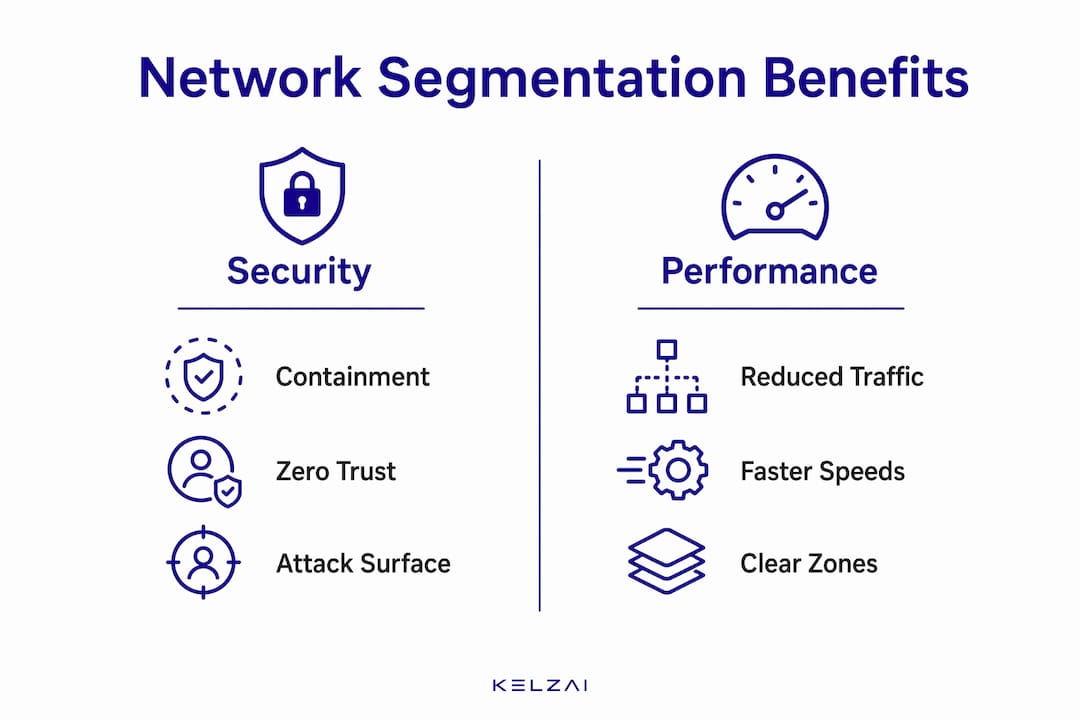
The core security value of network segmentation is containment. Think of it like a series of locked compartments inside a ship. If water floods one compartment, the others stay dry. Segmentation acts as locked compartments inside your network, ensuring that a breach in one zone does not automatically compromise the rest.
The speed of modern attacks makes this containment critical. Lateral movement can start in under 30 seconds after an initial breach. That means an attacker who compromises a single workstation can begin probing your entire network almost instantly. Without segmentation, nothing stops that movement.
Segmentation limits this threat in four concrete ways:
- Restricts lateral movement. An attacker who breaches a guest Wi-Fi segment cannot reach your accounting servers if those zones have no permitted communication path.
- Reduces blast radius. Avoiding flat network structures reduces the potential damage of a breach, even without advanced microsegmentation. Grouping assets into zones of trust limits what an attacker can access.
- Supports Zero Trust architecture. Segmentation enforces Zero Trust principles by requiring authentication and authorization at each boundary, eliminating implicit trust inside the network perimeter.
- Accelerates incident response. When a threat is detected, a segmented network lets your team isolate the affected zone without taking down the entire operation.
"NIST guidance describes network segmentation as 'damage limitation in space,' creating internal trust boundaries that prevent attackers from freely moving within the network once breached." — SentinelOne Cybersecurity 101
Pro Tip: Map your most sensitive data assets first, then build your segmentation policy outward from those assets. Protecting your crown jewels is more important than segmenting everything at once.
What are the network segmentation benefits beyond security?
Security is the headline benefit, but segmentation delivers measurable operational value as well. The role of network segmentation extends into performance, compliance, and day-to-day network management.
- Reduced broadcast traffic. Each VLAN or subnet contains broadcast traffic within its own zone. Smaller broadcast domains mean less unnecessary traffic competing for bandwidth across the entire network.
- Simplified compliance auditing. Segmenting networks that handle sensitive data significantly reduces audit scope, decreasing compliance costs and time. If your cardholder data environment is isolated, your PCI DSS audit covers only that segment rather than your entire infrastructure.
- Clearer traffic monitoring. Segmented networks produce cleaner traffic logs. Anomalies are easier to spot when you know exactly which devices belong in each zone and what traffic patterns are normal for them.
- Regulatory alignment. As of 2026, PCI DSS requires segmentation to isolate cardholder data environments. HIPAA updates proposed in late 2024 will mandate segmentation for electronic protected health information. Meeting these requirements becomes far simpler when your architecture already enforces clear boundaries.
| Benefit | Business Impact |
|---|---|
| Reduced broadcast traffic | Faster network performance for all users |
| Smaller compliance audit scope | Lower cost and time for annual audits |
| Cleaner traffic logs | Faster detection of anomalies and threats |
| Regulatory alignment | Reduced risk of fines and penalties |
Segmentation reduces the attack surface by isolating business units or functions, creating clear zones of trust that align with organizational roles and compliance boundaries. That alignment is what makes segmentation valuable beyond the security team.
How to design and implement effective network segmentation strategies
Effective segmentation starts with a clear understanding of your business, not your technology. Before configuring a single firewall rule, map out which business functions exist, what data each function handles, and which systems need to communicate with each other.
Follow these steps to build a practical segmentation plan:
- Identify your zones. Common zones include end-user devices, servers, industrial or operational technology (OT), management interfaces, and guest access. Each zone should reflect a distinct business function or trust level.
- Start with macrosegmentation. Over-segmenting prematurely creates complex management overhead and troubleshooting difficulties. Start with broad segments by business function, then add granularity as your team gains confidence.
- Define permitted traffic flows. For each zone pair, document which traffic is allowed and which is denied. Firewall rules and access control lists enforce these decisions. Default-deny policies between zones are the most secure starting point.
- Deploy VLANs and subnets. Assign each zone its own VLAN and IP subnet. Configure your managed switches and routers to enforce these boundaries at both Layer 2 and Layer 3.
- Test before going live. Verify that permitted traffic flows correctly and that blocked traffic is actually denied. Use network scanning tools to confirm no unintended paths exist between zones.
- Document everything. Record your zone definitions, VLAN assignments, subnet ranges, and firewall rules in a central document. This documentation is critical for audits and for troubleshooting future issues.
For manufacturing environments specifically, operational technology networks require their own isolated segment. Mixing IT and OT traffic on the same network is a common and serious mistake. Symmnet's guide on securing manufacturing networks covers this separation in practical detail.
Pro Tip: Review your segmentation design every time you add a new system, application, or business function. Networks change constantly, and a design that was accurate last year may already have gaps today.
What are common network segmentation challenges and how to overcome them?
Segmentation is not a one-time project. The ongoing maintenance of segmentation policies is the hardest challenge organizations face. Failures in keeping policies accurate lead to misconfigurations and security gaps that attackers can exploit.
The most common challenges include:
- Policy drift. As networks grow and change, firewall rules and VLAN assignments fall out of sync with actual business needs. Rules accumulate without review, and old exceptions become permanent holes.
- Misconfiguration. A single misconfigured access control list can open an unintended path between a sensitive segment and an untrusted one. Regular audits of firewall rules and routing policies are the only reliable defense.
- Cloud and hybrid environments. Traditional VLAN-based segmentation does not translate directly to cloud infrastructure. AWS security groups, Azure network security groups, and similar tools serve the same function but require different configuration approaches.
- Balancing security and performance. Excessive segmentation adds latency and complexity. Every inter-segment communication requires a routing decision and a firewall inspection. The balance between segmentation granularity and operational complexity is a real engineering constraint, not just a theoretical concern.
Pro Tip: Schedule a quarterly review of your firewall rules and VLAN assignments. Remove any rule you cannot justify with a current business reason. Fewer rules mean fewer gaps.
Operational discipline matters more than the technology you choose. A well-maintained simple segmentation design outperforms a complex one that nobody keeps current. Operational discipline in maintaining segmentation policies is critical, as static configurations quickly become obsolete in dynamic environments.
Key Takeaways
Network segmentation is the single most effective architectural control for limiting breach damage and meeting compliance requirements in small business environments.
| Point | Details |
|---|---|
| Start with macrosegmentation | Divide by business function first before adding granular microsegmentation controls. |
| Containment is the core value | Segmentation stops lateral movement, limiting what an attacker can reach after a breach. |
| Compliance scope shrinks | Isolating sensitive data environments reduces PCI DSS and HIPAA audit scope and cost. |
| Maintenance is the hardest part | Policy drift and misconfiguration are the leading causes of segmentation failure over time. |
| Operational discipline wins | Regular reviews of firewall rules and VLAN assignments matter more than the tools you use. |
Why segmentation is the control I recommend first
Working with small businesses across manufacturing, aerospace, and professional services, I see the same pattern repeatedly. Organizations invest in endpoint protection and email filtering, then leave their internal network completely flat. Every device can reach every other device. A single compromised laptop becomes a direct path to the accounting server, the production floor controller, and the backup system simultaneously.
Segmentation changes that equation fundamentally. It does not require a massive budget or a team of network engineers. A managed switch, a properly configured firewall, and a clear zone map are enough to get started. What I have found is that the businesses that struggle are not the ones with limited resources. They are the ones that treat segmentation as a completed project rather than an ongoing practice.
The future direction of segmentation points toward tighter integration with Zero Trust frameworks and AI-driven policy management. But the fundamentals have not changed. Divide your network by trust level, enforce boundaries at every crossing point, and review your policies regularly. That discipline protects you today and positions you well for whatever comes next.
— Michael
How Symmnet helps you build and maintain network segmentation
Designing a segmented network is straightforward in theory. Keeping it accurate as your business grows is where most small organizations struggle.
Symmnet's managed IT services include network segmentation design, VLAN configuration, firewall management, and ongoing policy reviews tailored for small businesses in manufacturing, aerospace, and professional services. The team handles the technical complexity so your staff can focus on operations. Symmnet also provides compliance assistance for PCI DSS and HIPAA requirements, reducing the audit burden that comes with managing sensitive data. If you want to know where your current network stands, Symmnet offers a free assessment to identify security gaps and segmentation opportunities. You can also review network segmentation best practices to see what a well-structured implementation looks like before your first conversation.
FAQ
What is network segmentation in simple terms?
Network segmentation is the practice of dividing a computer network into smaller, isolated zones so that traffic and access between them are controlled. Each zone operates independently, limiting how far an attacker can move after a breach.
What is VLAN segmentation and how does it work?
VLAN segmentation uses virtual local area networks to group devices logically on the same physical switch infrastructure while keeping their traffic separate. VLANs operate at Layer 2 and are typically paired with IP subnets and firewall rules to enforce full segmentation.
How does network segmentation support Zero Trust security?
Segmentation enforces Zero Trust by requiring authentication and authorization at every network boundary, eliminating the assumption that traffic inside the perimeter is automatically trusted. Every segment crossing is a verification point.
What is the difference between macrosegmentation and microsegmentation?
Macrosegmentation divides a network by broad business function, such as separating finance from operations. Microsegmentation applies policy enforcement at the workload or application level, providing finer control but requiring more management effort.
How often should segmentation policies be reviewed?
Segmentation policies should be reviewed at least quarterly and any time a new system, application, or business function is added to the network. Policy drift from infrequent reviews is a leading cause of security gaps in segmented environments.