

Ransomware is no longer a problem reserved for Fortune 500 companies. According to the 2025 DBIR manufacturing snapshot, ransomware was present in 44% of reviewed breaches, and small and medium-sized businesses experienced ransomware-related breaches at 88% overall. For manufacturers, aerospace suppliers, and professional services firms handling sensitive data, that number is a wake-up call. Network security is the foundation that separates businesses that recover quickly from those that face lasting damage to operations, reputation, and compliance standing. This article walks you from the basics all the way to practical application.
Table of Contents
- What is network security?
- Types of network security controls and their role
- Incident readiness and response: More than tools
- Network security for small business: Practical baselines and compliance
- Perspective: Network security wisdom most business guides miss
- How Symmetry Network Management can help safeguard your business
- Frequently asked questions
Key Takeaways
| Point | Details |
|---|---|
| Network security basics | Protecting networks means managing traffic, enforcing policies, and defending critical data. |
| Advanced controls | Microsegmentation and contextual access decisions are key to limiting attacker movement. |
| Incident readiness | Having a clear plan enables fast response to network events and true security incidents. |
| Practical compliance | Start with prioritized cybersecurity baselines and continuously improve for lasting compliance. |
| Next steps | Implement expert-recommended controls and frameworks, seeking trusted help when needed. |
What is network security?
With the importance clear, let's clarify what network security really means and why it matters for your business. Many owners think of network security as just a firewall or antivirus software sitting in the background. The reality is broader and more strategic than that.
Network security is protecting the integrity and usability of networks and the data they carry by controlling network traffic and enforcing security policies across the network, including edge and perimeter zones. That definition from NIST's National Initiative for Cybersecurity Education captures three essential ideas: integrity, usability, and data protection. Each one matters equally.
Integrity means that data moving across your network has not been altered by unauthorized parties. Usability means your systems stay available for the people who need them. Data protection means sensitive information, whether it's design files, client contracts, or financial records, is accessible only to those with proper authorization.
Common components that work together to achieve these goals include:
- Firewalls: Filter incoming and outgoing traffic based on defined rules, blocking unauthorized access at the perimeter.
- Intrusion detection systems (IDS): Monitor network activity for signs of suspicious behavior and generate alerts when something looks wrong.
- Secure communication protocols: Tools like TLS (Transport Layer Security) encrypt data in transit, preventing eavesdropping or tampering.
- Access control policies: Define who can access what resources, under what conditions, and from which devices.
- Network segmentation: Divides the network into isolated zones so that a breach in one area cannot freely spread to others.
For small manufacturers or aerospace contractors, network security is not just an IT concern. It directly protects intellectual property, production data, and your ability to meet compliance requirements from agencies like the Department of Defense or healthcare clients who demand data handling standards. Reviewing cybersecurity steps for small business gives you a clear roadmap for where to start, and the cybersecurity guide for manufacturers adds industry-specific depth.
Pro Tip: Think of your network as the plumbing of your business. A firewall is the main shutoff valve, but without additional controls throughout the system, one crack in a pipe can still flood the whole building.
Types of network security controls and their role
Now that you understand what network security is, let's explore the specific controls you can use and why choosing the right ones matters. Not all controls carry the same weight, and understanding the distinctions helps you allocate limited budgets wisely.
Traditional controls
Traditional network security controls have been the standard for decades. They are well understood, widely available, and relatively easy to implement:
- Perimeter firewalls: These sit at the boundary between your internal network and the internet. They allow or deny traffic based on pre-configured rules tied to IP addresses, ports, and protocols.
- VLANs (Virtual Local Area Networks): VLANs logically divide a physical network into separate segments. For example, your production floor equipment can sit on a different VLAN than your accounting workstations, limiting how those groups communicate.
- Intrusion detection and prevention systems (IDS/IPS): IDS alerts you to suspicious activity, while IPS actively blocks it. Together, they provide a second layer of inspection beyond the firewall.
- VPNs (Virtual Private Networks): Encrypt traffic for remote employees or third-party vendors connecting to your network, protecting data in transit.
These tools are valuable. But they share one critical weakness: they tend to operate on implicit trust. Once a user or device is inside the network boundary, traditional controls often assume that traffic is legitimate.
Microsegmentation and Zero Trust
This is where modern approaches add significant protection. Microsegmentation is a network control that limits connections to smaller zones or segments, typically using more granular access rules than traditional trust zones or VLANs, and it directly supports Zero Trust network architectures.

Zero Trust is a security model built on one simple principle: never trust, always verify. It assumes that threats can exist both inside and outside the network, so every connection request is evaluated based on context, not location.
Here's how traditional controls compare to microsegmentation approaches:
| Feature | Traditional controls | Microsegmentation |
|---|---|---|
| Trust model | Implicit (inside = trusted) | Contextual (verify every request) |
| Granularity | Broad zones (VLANs, IP ranges) | Fine-grained per workload or device |
| Lateral movement risk | Higher | Significantly lower |
| Visibility | Limited internal traffic view | Detailed traffic mapping |
| Scalability | Moderate | High, especially in cloud environments |
| Compliance support | Basic | Strong alignment with NIST, CISA frameworks |
For a small manufacturer with separate IT and operational technology (OT) environments, microsegmentation means that even if an attacker compromises a desktop workstation, they cannot move freely toward your production control systems. That kind of barrier dramatically limits damage from a single breach.
Reviewing network segmentation best practices gives practical implementation guidance, while the guide on how to secure manufacturing networks applies these concepts to shop-floor environments specifically.
Pro Tip: You do not need to implement full Zero Trust overnight. Start by identifying your most sensitive data and production systems, then apply microsegmentation to those specific zones first. Layered improvement beats waiting for a perfect solution.
Incident readiness and response: More than tools
Security controls are only part of the equation. Being ready to respond to incidents is equally important. Many small businesses make the mistake of assuming that installing the right tools is enough. It is not. Knowing how to act when something goes wrong is what separates a manageable disruption from a catastrophic breach.
For incident readiness, NIST frames security activity in terms of events and cybersecurity incidents, and both categories require different responses. Understanding the distinction matters:
| Characteristic | Network event | Cybersecurity incident |
|---|---|---|
| Definition | Observable change in network state | Occurrence that jeopardizes CIA (confidentiality, integrity, availability) |
| Example | Failed login attempt | Successful unauthorized data access |
| Response urgency | Monitor and log | Immediate containment required |
| Notification required | Internal logging | Often regulatory/legal notification |
| Impact level | Generally low | Moderate to severe |
"A cybersecurity incident is an occurrence that actually or imminently jeopardizes, without lawful authority, the confidentiality, integrity, or availability of information or an information system." — NIST SP 800-61r3
Many events occur on your network every day without ever escalating to incidents. The challenge is building a system that catches the events that do escalate before they cause serious damage.
Practical incident readiness for small businesses involves three stages:
- Recognize: Establish logging and monitoring so that unusual activity generates alerts. Know what normal looks like so you can spot abnormal quickly.
- Respond: Have a documented incident response plan. This includes who gets notified first, which systems get isolated, and which vendors or specialists you contact for help.
- Recover: Define your recovery objectives. How quickly must systems be restored? What data must be recovered first? Test your backup and recovery procedures before you need them.
One aspect small businesses consistently overlook is the recovery piece. Installing good tools but neglecting tested backup and recovery procedures is like having a great fire suppression system with no plan for what employees do after the alarm sounds. Your cyber threat response guide provides a practical walkthrough, and these data breach lessons from real incidents reveal what companies wish they had done differently.
Pro Tip: Run a tabletop exercise once per year. Gather key staff, simulate a ransomware attack scenario, and walk through your response plan step by step. Gaps become obvious quickly, and fixing them on paper costs far less than fixing them under pressure.
Network security for small business: Practical baselines and compliance
Even with incident readiness, small businesses need baseline protections that are manageable and compliant with relevant industry regulations. The good news is that authoritative frameworks give you clear starting points, not just aspirational goals.
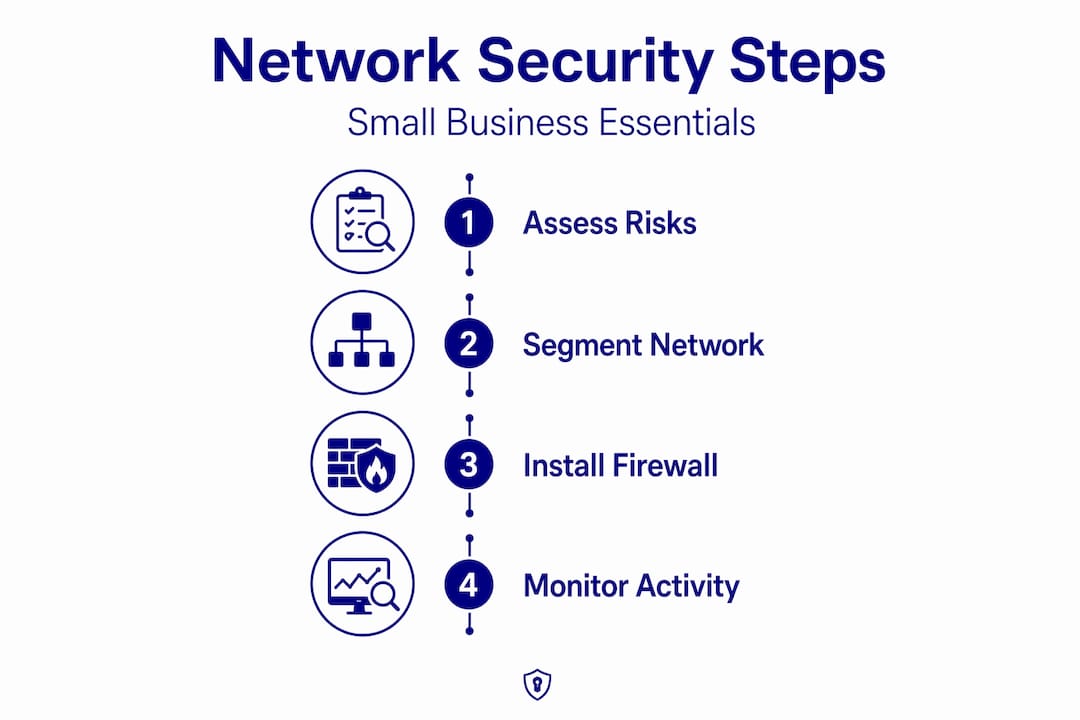
Network security for small businesses seeking practical risk reduction is often approached through prioritized cybersecurity baselines. CISA's Cybersecurity Performance Goals (CPGs) version 2.0 explicitly states that these practices are intended as a floor, not a ceiling. They represent a prioritized subset of IT and OT (operational technology) cybersecurity practices aimed at meaningfully reducing risk, even for organizations with limited resources.
Core baseline practices that every small manufacturer, aerospace firm, or professional services company should implement include:
- Multi-factor authentication (MFA): Require it for all remote access and privileged accounts. MFA alone blocks the vast majority of credential-based attacks.
- Asset inventory: Know every device on your network. You cannot protect what you cannot see.
- Patch management: Apply software and firmware updates on a regular schedule. Unpatched vulnerabilities remain one of the top entry points for attackers.
- Encrypted backups: Maintain tested, encrypted backups stored separately from your primary network. Air-gapped or cloud backups reduce ransomware leverage significantly.
- Employee security training: Human error contributes to a majority of successful breaches. Regular, focused training reduces phishing susceptibility.
- Incident response plan: Document it, assign responsibilities, and review it at least annually.
The NIST Cybersecurity Framework (CSF) 2.0 adds a governance layer, organizing security activity into six functions: Govern, Identify, Protect, Detect, Respond, and Recover. For small businesses, this framework provides a structured way to assess current maturity and prioritize improvement areas without requiring a large internal IT team.
Compliance often begins with these baselines, not with perfection. A manufacturer pursuing CMMC (Cybersecurity Maturity Model Certification) for Department of Defense contracts or a professional services firm managing HIPAA-covered data will find that most baseline controls directly map to their regulatory requirements. Starting with minimum cybersecurity standards creates a foundation that compliance builds on naturally. Exploring data protection for SMBs and IT security for manufacturers shows how those baselines apply to specific business contexts.
Key stat: CISA's CPGs cover both IT and OT environments, making them directly applicable to manufacturers and aerospace suppliers who operate both office networks and production floor systems under the same security umbrella.
Perspective: Network security wisdom most business guides miss
With the practical framework explored above, here's a deeper take you won't find in most business guides.
Most articles on network security end with a checklist. Install a firewall. Enable MFA. Do patch management. Check the boxes and move on. That approach works until it doesn't, and it usually stops working at the worst possible moment.
The real insight worth internalizing is this: security controls should be designed around risk-reduction outcomes, not compliance checkboxes. NIST's incident response guidance reinforces this directly, framing security activity as a continuous cycle of improvement rather than a finished state. Controls that were sufficient two years ago may not address the threat landscape you face today.
For small businesses, the practical implication is straightforward. The businesses that weather incidents best are not necessarily the ones with the most sophisticated tools. They are the ones that have practiced their response plans, know their most critical assets, and have committed to reviewing and updating their controls as risks evolve. A mid-sized aerospace parts supplier that runs annual tabletop exercises and keeps its segmentation maps updated is better protected than a company with a larger budget but static controls nobody has tested.
There is also a dangerous misconception that compliance equals security. Achieving CMMC Level 1 or passing a basic audit does not mean you are protected from current threats. It means you have met a documented minimum. The ceiling is much higher, and attackers are always looking for the gap between where your compliance ends and where your actual protection falls short.
Small business owners in manufacturing and professional services often operate with lean IT resources. The honest advice is to focus your limited resources on the controls that reduce risk for your specific environment, not on what a generic template recommends. Understanding data protection insights for your industry helps you make those targeted decisions with confidence.
Security is not a product you buy once. It is a practice you build and maintain, and the businesses that treat it that way are the ones that survive the inevitable incident.
How Symmetry Network Management can help safeguard your business
Armed with clear guidance, here's how Symmetry Network Management can help you move from theory to action. Understanding network security is the first step. Implementing it effectively, within budget, and in alignment with compliance requirements, is where many small businesses get stuck.
Symmetry Network Management works exclusively with small U.S.-based businesses in manufacturing, aerospace, and professional services, industries where the stakes around data protection and regulatory compliance are genuinely high. Our managed IT services include 24/7 monitoring, firewall management, endpoint security, and backup and recovery, all delivered at fixed pricing so there are no surprises. We can help you implement network segmentation best practices specific to your environment and prioritize the critical security controls that reduce your real risk exposure. If you are ready to find out where your gaps are, a free assessment is the right next step.
Frequently asked questions
What are the most important network security controls for small businesses?
The most important controls include firewalls, secure communication protocols, and segmented access controls like microsegmentation, as these address both perimeter defense and internal threat containment.
How does microsegmentation differ from traditional network segmentation?
Microsegmentation uses granular access rules, supports Zero Trust architecture, and significantly limits how far an attacker can move inside your network compared to traditional VLANs or IP-range-based segmentation.
What should a small business do if a network event becomes a security incident?
Activate your documented incident response plan immediately, focusing on detecting the scope, containing affected systems, and restoring operations from clean backups. NIST defines a cybersecurity incident as an occurrence that jeopardizes confidentiality, integrity, or availability, and the response must be swift and structured.
Are cybersecurity frameworks like NIST CSF too complex for small manufacturers?
No. CISA states CPGs are a prioritized subset of IT and OT cybersecurity practices designed as a floor, not a ceiling, giving small manufacturers a manageable starting point that scales with their capabilities over time.