

Round-the-clock IT support is no longer a luxury reserved for large enterprises. For small businesses operating in an always-on environment, it is one of the most direct ways to protect revenue, reputation, and operational continuity. Whether your team spans multiple time zones, runs overnight production shifts, or simply relies on cloud systems that never sleep, gaps in IT coverage translate directly into lost time and lost money.
Here is why 24/7 IT support matters for small businesses:
- Systems fail outside business hours far more often than most owners expect
- Cybercriminals deliberately target businesses on nights and weekends, when defenses are thinnest
- A few hours of downtime can cost lost sales, delayed projects, and lasting damage to client trust
- Remote and traveling employees need the same level of support as on-site staff
- Proactive monitoring catches problems before employees ever notice them
- Managed service pricing can replace unpredictable emergency repair costs with more predictable expenses
The financial case is straightforward. The cost of a single unresolved overnight outage often exceeds what a full month of managed IT support would cost. For small businesses where cash flow is tight and client relationships are everything, that math matters.
Table of Contents
- What does 24/7 IT support actually include?
- Key benefits of 24/7 IT support for small businesses
- Common misconceptions about round-the-clock IT coverage
- How to decide if 24/7 IT support fits your business
- What IT support is actually responsible for
- Which industries benefit most from continuous IT coverage
- What happens when businesses go without 24/7 IT coverage
- In-house 24/7 IT teams vs. outsourced managed services
- Real-world impact: what 24/7 IT support looks like in practice
- Symmnet provides 24/7 managed IT for small U.S. businesses
- Key Takeaways
What does 24/7 IT support actually include?
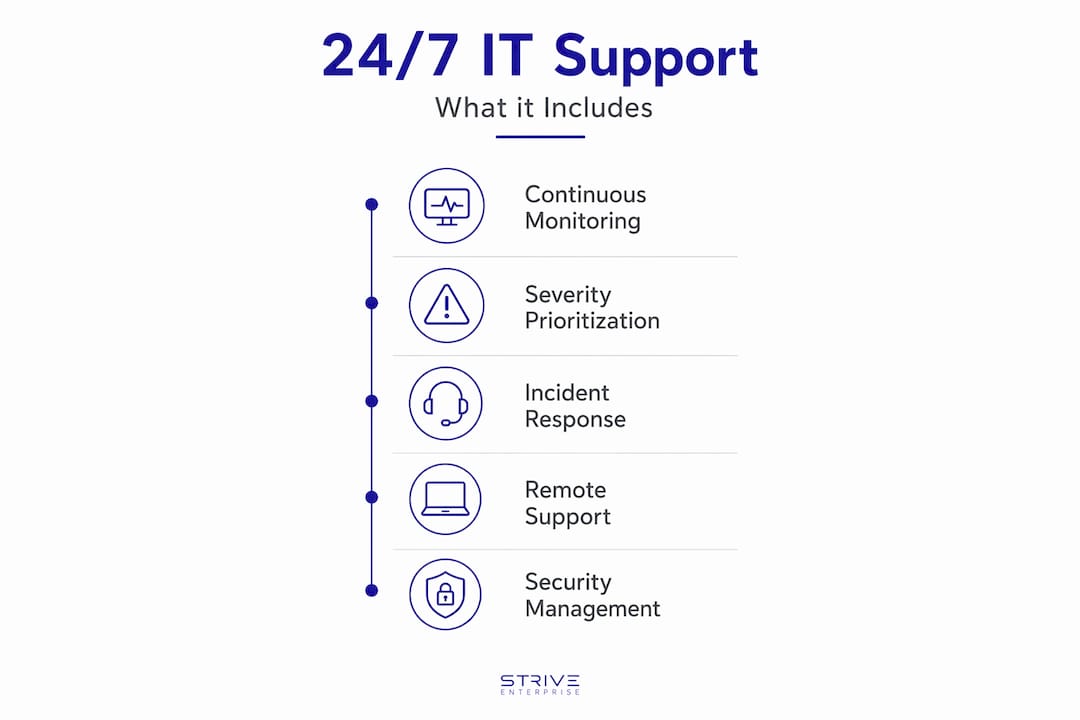
The term gets used loosely, so it is worth being specific. 24/7 IT support means continuous remote monitoring, helpdesk availability, and incident response at any hour, including nights, weekends, and holidays. It is not a single person on call with a cell phone. A real 24/7 operation typically runs three interconnected functions:
- Helpdesk: Technicians who assist users with login issues, connectivity problems, software errors, and other day-to-day requests at any hour
- Network Operations Center (NOC): A team using Remote Monitoring and Management (RMM) tools to watch server performance, network health, and system availability in real time
- Security Operations Center (SOC): Specialists using Security Information and Event Management (SIEM) tools to detect intrusion attempts, unusual login patterns, and active threats
Beyond those three pillars, a well-structured 24/7 service also covers:
- Off-hours patch deployment and system updates (applied overnight so workdays stay uninterrupted)
- Backup verification and failure alerts
- Incident escalation by severity, routing critical issues to senior engineers immediately
- Disaster recovery coordination and business continuity support
One important clarification: not every ticket gets the same response speed. Severity-based prioritization means a P1 outage affecting your entire operation gets immediate attention, while a low-impact request from a single user may be queued for the next business day. That is not a gap in service. It is how a well-run operation allocates resources efficiently.
Key benefits of 24/7 IT support for small businesses
The advantages go well beyond "someone answers the phone at midnight." The real value is structural.
Reduced downtime through proactive detection. Continuous monitoring catches issues before employees notice them. A server running hot, a backup that silently failed, a network switch showing early signs of failure — these get flagged and resolved before they become outages. That shift from reactive to proactive is what separates managed IT from break-fix support.

Stronger security posture around the clock. Cybercriminals time their attacks deliberately. A Friday night breach that goes undetected has the entire weekend to spread across your network before anyone notices Monday morning. With continuous security monitoring, an intrusion attempt at 2:00 AM triggers an alert and a human response within minutes, not 60 hours later.
Support for remote and traveling employees. A salesperson in a different time zone who cannot connect to the VPN at 6:00 AM does not have to wait until the home office opens. They get help when they need it, which means the pitch happens on time.
Predictable costs. 46% of companies cite cost predictability as a key benefit of managed IT services. A fixed monthly fee replaces the unpredictable cycle of emergency repair bills, consultant call-out fees, and unplanned hardware replacement costs.
Additional benefits include:
- Confident technology growth, because IT gaps do not appear when you add staff or open a new location
- Compliance support through continuous monitoring and documented incident response
- Better customer experience, since your client-facing systems stay online when customers need them
Common misconceptions about round-the-clock IT coverage
A few persistent myths lead small business owners to either overpay for coverage they do not need or underestimate what real 24/7 support involves.
Myth: Every request gets an immediate human response. Reality: Responses are prioritized by severity. Critical incidents get immediate attention. A password reset request submitted at 3:00 AM will likely be handled when the helpdesk opens. That is by design, not neglect.
Myth: 24/7 IT support is only for large enterprises. Small businesses with remote teams, production schedules, or e-commerce operations often have more exposure to after-hours risk than mid-sized companies with dedicated internal IT staff. The need scales with operational complexity, not headcount.
Myth: An on-call person counts as 24/7 support. A single engineer sleeping with a phone is not a Network Operations Center. True 24/7 support means staffed teams watching your systems continuously, not a callback promise.
Myth: You have to pay for full 24/7 coverage on every system. Hybrid SLA models give critical systems round-the-clock coverage while less essential assets stay on business-hours support. That approach controls cost without leaving your most important infrastructure exposed.
Common misconceptions at a glance:
- "24/7 means instant resolution for everything" — No. Severity determines response speed.
- "It's only for big companies" — No. Small businesses with non-standard hours need it most.
- "On-call equals 24/7" — No. Real coverage requires a staffed NOC, not a voicemail.
- "It has to cover everything" — No. Hybrid models protect critical systems at lower cost.
How to decide if 24/7 IT support fits your business
The decision comes down to operational exposure, not company size. A business that runs entirely on-site, on a single 9-to-5 schedule, with no customer-facing digital systems, probably does not need full round-the-clock coverage. Most small businesses today do not fit that description.
Ask yourself these questions:
- Do any employees work nights, early mornings, or weekends?
- Does your business operate across more than one time zone?
- Would two hours of system downtime cost you a real customer or a real contract?
- Do you have production systems, e-commerce platforms, or cloud services running after hours?
- Are you subject to compliance requirements with strict incident reporting windows?
If you answered yes to two or more, the case for 24/7 coverage is strong. The financial test is simple: calculate your cost of downtime per hour (idle staff, lost sales, recovery time), then compare it to the monthly cost of managed IT support. For most small businesses, a single serious overnight incident costs more than several months of managed service fees.
Pro Tip: Map your critical systems before signing any support agreement. Identify which assets, if they failed at midnight, would stop your business from operating. Build your SLA around those systems first. That approach gives you genuine protection without paying for 24/7 coverage on assets that can wait until morning.
Verify who actually handles after-hours incidents before committing. True 24/7 support means a staffed NOC watching your systems continuously, not a voicemail box and a callback promise.
What IT support is actually responsible for
IT support exists to keep your technology infrastructure stable, secure, and aligned with how your business operates. The core responsibilities include troubleshooting hardware and software issues, managing network performance, enforcing security policies, deploying patches, maintaining backups, and coordinating disaster recovery. Those functions do not change with 24/7 coverage. What changes is when they happen and how fast problems get resolved.
The fundamental purpose of IT support extends from basic troubleshooting all the way to security enforcement and disaster recovery planning. When that coverage runs continuously, it also enables compliance. Regulatory frameworks in healthcare, finance, and manufacturing often require documented monitoring and incident response within tight timeframes. A team that only works business hours cannot meet a 72-hour breach notification requirement if the breach is discovered on a Friday evening.
24/7 support elevates standard IT functions by:
- Moving disruptive maintenance tasks (updates, patches, restarts) to overnight windows
- Catching backup failures before the next business day reveals missing data
- Maintaining audit trails and incident logs that satisfy compliance requirements
- Providing continuous availability for cloud services that run around the clock
Which industries benefit most from continuous IT coverage
Some businesses have more exposure to after-hours IT risk than others. The following sectors consistently see the highest return from round-the-clock support:
Manufacturing and aerospace. Production lines do not pause for IT problems. A printer failure at 5:00 AM that halts shipping labels costs three hours of output before the helpdesk opens. Manufacturing environments also face specific cybersecurity risks tied to operational technology systems that run continuously.
Healthcare. Patient data systems, scheduling platforms, and communication tools operate at all hours. Compliance requirements under HIPAA include strict breach notification timelines that make after-hours monitoring a regulatory necessity, not just a convenience.
E-commerce and retail. A website outage during a weekend sale or a payment processing failure at 10:00 PM sends customers directly to a competitor. Uptime is revenue.
Professional services (legal, finance, accounting). Client portals, document management systems, and billing platforms hold sensitive data subject to strict regulations. A breach that sits undetected over a weekend creates both legal exposure and client trust damage.
Logistics and distribution. Order management, carrier integrations, and warehouse systems run across multiple shifts. Any gap in IT coverage can delay shipments and break SLAs with customers.
Remote-first businesses. When your team works across time zones, your IT support window needs to match their work window, not a single office's schedule.
What happens when businesses go without 24/7 IT coverage
The risks of operating without continuous IT support are concrete and cumulative. A single overnight outage is an inconvenience. A pattern of them is a business problem.
Without round-the-clock monitoring, a ransomware attack initiated on a Friday evening can spend the entire weekend spreading through your network. By Monday morning, customer databases are encrypted, backups are compromised, and recovery takes days or weeks. The financial and reputational damage from that scenario typically far exceeds what years of managed IT support would have cost.
Beyond security, the operational costs add up quietly. Employees who cannot access systems outside business hours lose productivity. Clients who experience repeated outages during off-hours lose confidence. Compliance deadlines get missed because no one was watching when the incident occurred.
The risks of going without 24/7 coverage include:
- Extended breach dwell time, giving attackers hours or days to move laterally
- Missed compliance reporting windows triggered by after-hours incidents
- Undetected backup failures that only surface during a recovery attempt
- Productivity loss for remote and shift workers who cannot get help when they need it
- Reputational damage from client-facing outages that go unresolved overnight
In-house 24/7 IT teams vs. outsourced managed services
Building an internal team capable of genuine 24/7 coverage is expensive. You need enough staff to cover three shifts, seven days a week, including holidays, which typically means four or more full-time engineers before accounting for vacation and sick leave. Add salaries, benefits, training, and enterprise-grade monitoring software, and the cost quickly exceeds what most small businesses can sustain.
Outsourcing to a managed services provider (MSP) changes that math entirely. The MSP spreads infrastructure and staffing costs across its entire client base, which means small businesses get access to a fully staffed NOC, advanced security tooling, and tiered engineering expertise at a fraction of what an internal team would cost. The monthly fee is fixed and predictable, which makes budgeting straightforward.
The trade-off worth considering: an internal team knows your environment intimately and can respond on-site immediately. An MSP brings broader expertise and 24/7 staffing depth that most small businesses cannot replicate internally. For businesses that need both, a hybrid model works well. On-site engineers handle business-hours management and hands-on work, while the MSP provides remote 24/7 monitoring and after-hours incident response for critical systems.
Real-world impact: what 24/7 IT support looks like in practice
The value of continuous IT coverage becomes clearest in specific scenarios rather than abstract descriptions.
A retail business running a weekend flash sale experiences a payment processing error at 11:00 PM Saturday. With 24/7 support, the NOC detects the anomaly within minutes, a technician isolates the issue, and the platform is restored before the sale window closes. Without it, the error sits until Monday morning, and the revenue from that window is gone.
A manufacturing company's shipping system goes offline at 4:30 AM, 30 minutes before the first production shift. A monitored alert triggers an automatic escalation. The technician resolves a failed network switch remotely before the shift starts. The team arrives to a working system and ships on schedule.
An accounting firm's file server shows signs of unusual access at 2:00 AM on a Tuesday. The SOC flags the activity, contains the affected account, and initiates an investigation before any client data is exfiltrated. The firm's compliance team is notified with a full incident log, meeting their regulatory reporting requirement with time to spare.
These are not edge cases. They are the kinds of incidents that 24/7 NOC monitoring is specifically designed to catch and resolve before they become crises.
Symmnet provides 24/7 managed IT for small U.S. businesses
Small businesses in manufacturing, aerospace, and professional services face IT and security demands that standard business-hours support simply cannot meet. Symmnet is built specifically for that gap. Unlike a generalist IT provider, Symmnet focuses on small U.S.-based businesses with real compliance requirements and operational systems that run beyond the 9-to-5 window.
Symmnet's managed IT services include 24/7 system monitoring, endpoint security, firewall management, helpdesk support, and backup and recovery, all under a fixed monthly price. No surprise invoices when something breaks at midnight. No scrambling to find coverage when your team is traveling. Just a U.S.-based support team that knows your environment and responds when it matters.
If you are evaluating whether your current IT setup would survive a critical incident over a weekend, a free security assessment from Symmnet is a practical starting point. It identifies gaps in your coverage and gives you a clear picture of where your exposure is highest, before an incident makes that decision for you.
Key Takeaways
24/7 IT support protects small business revenue and reputation by combining continuous monitoring, severity-based incident response, and proactive maintenance that prevents outages before they occur.
| Point | Details |
|---|---|
| Downtime costs are real | A few hours of unresolved downtime can cost lost sales, delayed projects, and lasting client trust damage. |
| Security threats target off-hours | Cybercriminals attack on nights, weekends, and holidays when monitoring is lowest and response is slowest. |
| Cost predictability matters | 46% of companies cite predictable costs as a key benefit of managed IT services, replacing emergency repair bills with a fixed monthly fee. |
| Hybrid SLAs balance cost and coverage | Applying 24/7 coverage only to critical systems while using business-hours support for lower-priority assets controls cost without leaving vital infrastructure exposed. |
| Symmnet fits small U.S. businesses | Symmnet delivers fixed-price 24/7 monitoring, security, and helpdesk support tailored to small businesses in manufacturing, aerospace, and professional services. |