

Most small business owners assume their IT setup is fine until something breaks. That assumption is exactly what cybercriminals and system failures count on. Understanding why 24/7 system monitoring is a non-negotiable layer of protection means recognizing that threats do not wait for business hours. A server crash at 2 a.m. or a data breach that starts on a Sunday is just as damaging as one that happens mid-afternoon. The difference between a minor incident and a catastrophic one often comes down to how fast it gets detected.
Table of Contents
- Key Takeaways
- Why 24/7 system monitoring is not optional
- Benefits of 24/7 system monitoring for IT security
- What happens when monitoring fails
- How AI is changing continuous monitoring
- Getting started with 24/7 monitoring
- My take on why businesses keep delaying this
- How Symmnet helps you monitor smarter
- FAQ
Key Takeaways
| Point | Details |
|---|---|
| Continuous monitoring beats periodic checks | Threats occur at all hours, so monitoring only during business hours creates dangerous blind spots. |
| Fast detection dramatically cuts breach costs | Organizations that detect breaches internally save nearly $1M compared to those that rely on external discovery. |
| AI-enhanced monitoring reduces alert fatigue | Intelligent correlation filters noise so your team focuses on real threats instead of chasing false alarms. |
| Human oversight is non-negotiable | Automated tools alone leave gaps; human review and escalation are what turn alerts into real incident response. |
| Managed services make this affordable | Small businesses can access enterprise-grade 24/7 coverage through fixed-price managed IT services without hiring a full team. |
Why 24/7 system monitoring is not optional
So what is 24/7 monitoring, exactly? At its core, it is the continuous observation of your IT environment around the clock, every day of the year. Unlike periodic checks that take snapshots at scheduled intervals, continuous monitoring watches your systems in real time and alerts the right people the moment something unusual happens.
For a small business, the systems being monitored typically include:
- Networks: Routers, switches, firewalls, and traffic patterns that reveal unusual data flows or unauthorized access attempts.
- Servers: CPU load, memory usage, disk health, and uptime metrics that signal hardware strain or software instability.
- Endpoints: Laptops, desktops, and mobile devices used by your team, each a potential entry point for malware or credential theft.
- Applications: Business-critical software like accounting platforms, ERP systems, or customer databases that must stay responsive and secure.
The mechanics involve a combination of automated telemetry collection, threshold-based alerting, and human oversight. Monitoring agents or sensors feed data into a centralized platform. That platform applies rules and, increasingly, machine learning to flag anomalies. Then trained analysts review and triage those alerts. No single piece of this process works without the others.
For small businesses especially, the budget concern is real. But the cost of a monitoring solution is a fraction of the cost of a breach or a prolonged outage. The importance of system monitoring becomes clearest when you look at what happens without it.
Benefits of 24/7 system monitoring for IT security
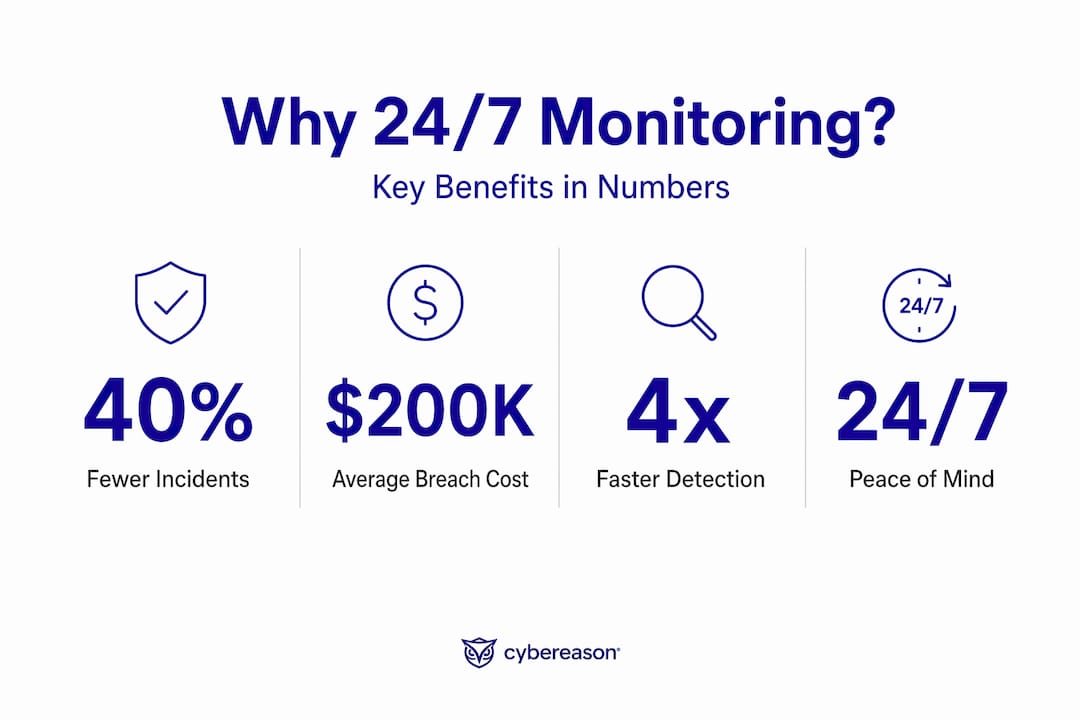
The financial case for continuous monitoring is stark. According to IBM's 2024 Cost of a Data Breach Report, the global average breach cost reached $4.88 million, with 70% of organizations reporting significant operational disruption. More importantly, companies that detected breaches internally saved nearly $1 million compared to those whose breaches were discovered by external parties.
That gap exists because speed is everything in incident response. Two metrics define that speed:
- Mean Time to Detect (MTTD): How long it takes to identify that an incident is occurring. Continuous monitoring dramatically compresses this window.
- Mean Time to Repair (MTTR): How long it takes to contain and remediate the incident after detection. Faster detection means remediation starts sooner.
NIST recommends tracking both MTTD and MTTR as core incident response KPIs. Organizations with 24/7 monitoring coverage reduce both metrics significantly because telemetry is always flowing and triage never waits until Monday morning.
Beyond the financial impact, continuous monitoring aligns with the NIST Risk Management Framework's Monitor step, which treats security as an ongoing authorization process rather than a one-time certification. Your controls do not stay effective automatically. They degrade as your environment changes, and only continuous monitoring catches that drift in real time.
Pro Tip: Set up baseline performance profiles for your most critical systems so that your monitoring platform learns what "normal" looks like. Deviations from that baseline surface much faster than threshold-only alerts.
The operational benefits extend well beyond security. Detecting a failing hard drive before it causes data loss, catching a memory leak before it crashes your server, or identifying a network bottleneck before it disrupts your team are all advantages of 24/7 monitoring that compound over time. You are not just preventing disasters. You are keeping your operation running at the level your customers expect.

What happens when monitoring fails
There is a lesson buried in one of the most well-documented IT outages in recent years. Datadog, a leading monitoring and observability platform, went dark for over 24 hours due to a legacy automated update that caused a cascading network failure. The irony is sharp. A company whose entire business is helping others monitor their systems lost visibility into its own infrastructure.
The outage resulted in an estimated $5 million in revenue loss and forced a fundamental rethinking of how monitoring systems themselves are protected.
The key lessons from that incident apply directly to small businesses:
- Automated tools are not self-sufficient. When the automation fails, and it will, you need human oversight and manual fallback procedures ready to activate.
- Redundancy is a requirement, not a luxury. If your monitoring platform goes down alongside your infrastructure, you have a complete blind spot. Backup alerting mechanisms and secondary systems matter.
- Graceful degradation must be planned. Systems should be designed to fail safely, shedding load or limiting impact rather than crashing completely and silently.
- Recovery planning is part of monitoring. Knowing an incident occurred is only the first step. Having a rehearsed response playbook reduces the chaos that follows.
"Monitoring platforms can fail. The businesses that weather outages best are the ones with human processes, backup systems, and response playbooks that do not depend entirely on their primary monitoring tool." — Symmnet
For small businesses, this means is 24/7 monitoring necessary as a question has a clear answer. Yes. But good monitoring combines automation with human accountability, not automation alone.
How AI is changing continuous monitoring
Artificial intelligence has shifted continuous monitoring from reactive alerting to genuine prediction. The advantages of continuous monitoring today look different from what they did five years ago, largely because of how AI processes telemetry at scale.
Here is what AI-enhanced monitoring actually delivers:
- Anomaly detection without manual thresholds: Instead of setting static rules like "alert if CPU exceeds 90%," AI models learn normal behavior patterns and flag deviations that static rules would miss entirely.
- Predictive fault identification: AI-powered monitoring systems can detect early warning signals of hardware failure or software instability before they cause outages, giving teams time to act.
- Alert correlation and noise reduction: Without intelligent filtering, a single incident can trigger dozens of alerts simultaneously. Intelligent alert correlation groups related signals into a single actionable event, preventing the alert storms that cause analysts to miss the real problem.
- Self-healing and automated remediation: In more advanced setups, AI does not just detect a problem. It initiates a fix, restarting a service, reallocating resources, or isolating a compromised endpoint without waiting for human input.
The shift from static rule-based systems to change-aware detection also matters for small businesses deploying software updates frequently. Traditional monitors would generate noise every time a deployment changed system behavior. Dynamic monitoring adapts, recognizing that a spike after a new release is expected, and focuses attention on the signals that actually indicate problems.
Pro Tip: When evaluating monitoring tools, ask vendors specifically how they handle alert noise. A platform that generates 200 alerts a day with no correlation is not better than one that surfaces 10 high-confidence, actionable alerts.
The proactive reliability that AI enables is the real competitive advantage for small businesses. You gain the kind of anticipatory awareness that used to require a dedicated 10-person operations team.
Getting started with 24/7 monitoring
Understanding the benefits of 24/7 IT monitoring is one thing. Implementing it is another. Here is how small business owners can move from awareness to action without overcomplicating the process.
| Starting Point | Key Action |
|---|---|
| Assess current coverage | Identify which systems have no monitoring today and what data you are currently collecting. |
| Prioritize critical systems | Focus initial coverage on the assets where failure or breach would hurt most: financial systems, customer data, core infrastructure. |
| Choose the right tools | Balance automation with human review. Look for platforms with intelligent alerting, not just raw data collection. |
| Build an incident response plan | Define who gets notified, in what order, when an alert fires at 3 a.m. |
| Consider managed services | A managed IT services provider with 24/7 coverage fills gaps without requiring you to hire around-the-clock staff. |
A few additional considerations worth keeping in mind:
- Review your monitoring coverage quarterly as your technology environment changes.
- Map your cybersecurity threat exposure before choosing which systems to prioritize.
- Continuous monitoring programs succeed only when automated alerts connect to human processes for review and escalation. Build that workflow before you go live.
Pro Tip: Start with a free IT assessment if you are unsure where your gaps are. Identifying what you do not know is more valuable than optimizing what you already monitor.
My take on why businesses keep delaying this
I have worked with enough small business owners to know that the delay on 24/7 monitoring almost never comes down to not understanding that it is important. The hesitation is almost always about perceived cost and the assumption that "we haven't been hit yet, so we must be fine."
That logic only holds until it does not. I have seen businesses lose weeks of operational momentum recovering from incidents that a monitoring alert caught in testing, but slipped through in production because no one was watching overnight. The breach or the outage itself is survivable. The loss of customer trust and the internal scramble that follows are harder to recover from.
What I have found is that businesses that start small with monitoring, covering just their most critical systems first, build confidence quickly. They see value in the first week when an alert catches something they would have missed. That early win makes the next phase of investment an easy conversation.
Monitoring did not make these businesses complicated. It made them confident. They stopped reacting to fires and started managing their technology like the operational asset it is. That shift in posture is what actually enables growth, because you cannot scale a business on a foundation you are afraid to trust.
— Michael
How Symmnet helps you monitor smarter
Symmnet builds 24/7 monitoring programs specifically for small businesses that cannot afford a full internal IT team but absolutely cannot afford to go dark. Their managed IT services combine AI-powered monitoring tools with U.S.-based human analysts who review alerts, triage incidents, and respond around the clock. Fixed-price plans mean you know exactly what you are spending each month, with no surprise invoices after an incident. Whether you run a manufacturing operation, a professional services firm, or an aerospace supplier, Symmnet tailors coverage to the systems and compliance requirements that matter most to your industry. If you are not sure where your monitoring gaps are, their free IT assessment is the right place to start.
FAQ
What is 24/7 system monitoring?
24/7 system monitoring is the continuous, around-the-clock observation of your IT infrastructure, including networks, servers, applications, and endpoints. It uses automated tools and human oversight to detect issues in real time before they escalate into costly outages or breaches.
Is 24/7 monitoring necessary for small businesses?
Yes. Cyber threats and system failures do not follow business hours. According to IBM's 2024 data, organizations that detect breaches internally save nearly $1 million compared to those that discover incidents through external parties, making continuous monitoring a clear financial priority.
What are the main benefits of 24/7 IT monitoring?
The core benefits include faster threat detection, reduced breach costs, lower downtime, improved Mean Time to Detect and Mean Time to Repair metrics, and proactive identification of system issues before they affect operations or customers.
How does AI improve 24/7 monitoring?
AI enables anomaly detection based on learned behavior patterns, predictive fault identification before failures occur, and intelligent alert correlation that reduces noise. This means fewer false alarms and faster response to real incidents, even for small teams.
How can a small business afford 24/7 monitoring?
Managed IT service providers like Symmnet offer fixed-price 24/7 monitoring plans that give small businesses enterprise-grade coverage without the cost of hiring round-the-clock staff. Starting with a free assessment helps identify the highest-priority gaps so coverage can be scoped efficiently.