

Running a small business means every dollar and every hour counts. Yet many owners discover too late that trying to handle IT and cybersecurity in-house quietly drains both. The question of why choose managed services isn't just about convenience. It's about whether your current approach is actually protecting your business or just creating the illusion of coverage. With 25-30% of the IT services market already relying on managed services, small businesses that haven't made the shift are increasingly exposed, operationally and financially.
Table of Contents
- Key Takeaways
- Why choose managed services: what they are and how they work
- The real benefits of managed services for small businesses
- Challenges to consider before committing
- How to evaluate and select the right MSP
- My perspective: what most small businesses miss about managed services
- How Symmnet helps small businesses take the next step
- FAQ
Key Takeaways
| Point | Details |
|---|---|
| Cost savings are significant | Managed security delivers 40-60% lower total cost of ownership compared to building in-house security operations. |
| Faster threat response | Organizations using MDR services report 73% faster breach containment than those relying on internal teams alone. |
| Internal oversight still matters | Managed services require ongoing internal governance. Treating them as "set it and forget it" leads to gaps and misaligned expectations. |
| Provider selection is critical | Tailored SLAs and clear performance metrics separate effective MSP partnerships from costly ones. |
| SMBs gain enterprise-level capability | SMBs access enterprise expertise and improved uptime without the overhead of a full internal IT team. |
Why choose managed services: what they are and how they work
Managed IT services involve outsourcing specific technology functions to a third-party provider, known as a managed service provider or MSP. That provider takes ongoing responsibility for monitoring, managing, and securing your IT infrastructure. It's not a one-time fix or a break-fix relationship. It's a structured, proactive partnership.
Where traditional IT support reacts to problems after they occur, managed services operate in prevention mode. Your systems are monitored around the clock. Patches are applied before vulnerabilities are exploited. Security alerts are triaged before they escalate into incidents. For a small business without a dedicated IT team, this proactive posture is difficult to replicate internally at any reasonable cost.
The scope of managed services for businesses typically includes several core functions:
- 24/7 system monitoring and alerting to detect performance issues or threats in real time
- Endpoint security and firewall management to protect devices and network perimeters
- Helpdesk support for day-to-day employee IT needs
- Backup and disaster recovery to protect critical business data
- Compliance assistance for industry-specific regulatory requirements
Managed security services extend this further into threat detection, incident response, and vulnerability management. For small businesses in industries like manufacturing, aerospace, or professional services, where compliance requirements are strict and downtime is costly, this level of coverage is not optional. It's operational infrastructure.
The real benefits of managed services for small businesses
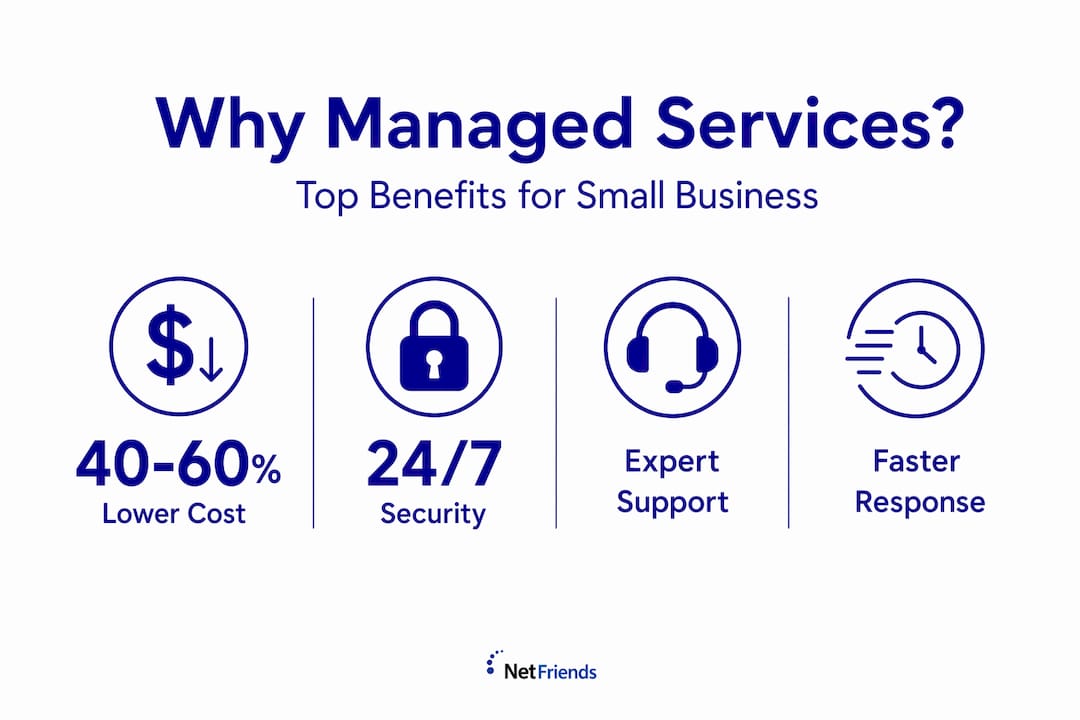
The most cited advantage of managed services is cost control, and the data supports it. Equivalent protection costs 40-60% less when delivered through a managed security provider compared to building an internal security operations center. That gap comes from several compounding factors.
The hidden costs of in-house IT
Building a functional in-house security team requires more than salaries. You need continuous training as threats evolve, recruitment coverage when analysts leave, and enough staff to maintain 24/7 operations. True in-house security costs include analyst turnover, ongoing training, and the minimum of 8 to 12 analysts needed for round-the-clock coverage. For most small businesses, that math doesn't work.
Small and mid-market organizations simply cannot match managed security providers on personnel and technology costs. The tools alone, including SIEM platforms, endpoint detection systems, and threat intelligence feeds, carry price tags that only make economic sense when shared across many clients.

Speed and security outcomes
Speed matters enormously in cybersecurity. The faster a breach is contained, the lower the damage. Organizations using managed detection and response services report 73% faster breach containment compared to those handling incidents internally. That's not a marginal improvement. That's the difference between a contained incident and a business-altering event.
On the operational side, unified management consoles reduce administrative time by up to 70% through AI-driven automation. When your IT team isn't buried in manual monitoring tasks, they can focus on work that actually moves the business forward.
The full picture of managed IT services advantages includes:
- Predictable monthly costs instead of unpredictable capital expenses
- Access to certified specialists across networking, security, and compliance without hiring them full time
- Scalability to add users, sites, or services as your business grows
- Reduced downtime through proactive maintenance and faster incident resolution
- Improved compliance posture with built-in controls and documentation support
Challenges to consider before committing
Choosing managed services isn't a decision to make casually. There are real pitfalls, and small businesses that skip due diligence often end up with contracts that don't match their actual needs.
Here are the most common challenges to work through before signing with any MSP:
- Vague SLAs. Generic service level agreements that lack specific performance benchmarks give providers cover when things go wrong. Tailored SLAs with clear penalties for non-compliance are the standard you should hold any provider to.
- Lack of transparency. Some MSPs report minimally, making it hard to know whether you're getting what you paid for. Require regular, readable performance reports before committing.
- Technology stack mismatches. Not every MSP's toolset will integrate cleanly with your existing systems. Evaluate compatibility early, especially if you run industry-specific software.
- Underskilled providers. Small MSPs without specialized experience in your industry may not understand your compliance obligations or operational risk profile. Verify credentials, certifications, and relevant client references.
- Internal resistance. Cultural fit matters in MSP engagements. If your team views outsourcing as an admission of weakness, adoption suffers. Address this directly before onboarding.
Pro Tip: Ask every MSP candidate how they handled a client incident in the past 12 months. A confident, detailed answer tells you more about their actual capabilities than any sales brochure.
One point worth emphasizing: managed services are not "set-it-and-forget-it". You still need internal oversight. Someone on your team should own the MSP relationship, review reports, and hold the provider accountable to agreed outcomes. The MSP handles execution. Strategic accountability stays with you.
How to evaluate and select the right MSP
Knowing the advantages of managed services is one thing. Choosing the right provider is where most small businesses either win or lose on this decision.
Start with a structured evaluation before you ever take a demo. Know your own IT environment, your compliance requirements, your biggest operational risks, and what you're currently spending. That baseline gives you something to measure providers against.
Questions to ask every MSP candidate
- What does your 24/7 monitoring actually cover, and how are alerts escalated?
- What are your guaranteed response times for critical incidents?
- How do you handle compliance requirements specific to my industry?
- What reporting will I receive, and how often?
- Can I see a sample SLA and a sample monthly report?
- What happens if you fail to meet an SLA commitment?
A useful comparison framework before signing anything:
| Evaluation Criteria | What to Look For |
|---|---|
| SLA specificity | Named metrics, penalties, and escalation paths |
| Security certifications | SOC 2, CISSP-certified staff, industry-specific credentials |
| Reporting cadence | Monthly reports at minimum with clear KPIs |
| Technology integration | Compatibility with your current software and infrastructure |
| Industry experience | Proven track record in your sector, with client references |
| Pricing model | Fixed monthly pricing with clearly defined scope |
Pro Tip: Pilot the relationship before signing a multi-year agreement. A 90-day trial with defined success metrics protects you and reveals how the provider performs under real conditions.
Once you select an MSP, maintain internal governance. Designate an internal point of contact who reviews deliverables and communicates business changes that affect IT scope. For manufacturers, a good starting point is reviewing what a manufacturing cybersecurity checklist covers so you arrive at those conversations prepared.
My perspective: what most small businesses miss about managed services
I've spent years working with small business owners who believe their IT situation is "good enough." What I've consistently found is that "good enough" usually means reactive, understaffed, and one incident away from a costly disruption.
The part that surprises most people isn't the sticker price of building internal IT. It's the hidden math. When you account for analyst turnover, the time managers spend babysitting underfunded IT setups, and the very real cost of a breach or extended downtime, in-house often costs far more than the monthly invoice from a capable MSP.
What I've also learned is that cultural acceptance inside the organization makes or breaks MSP engagements. I've seen technically excellent providers fail because internal staff felt threatened or bypassed. Framing managed services as adding capacity and expertise, not replacing people, changes the entire dynamic.
My honest take on why choose managed security in particular: small businesses are disproportionately targeted by attackers because they're perceived as low-defense. An MSP that specializes in your industry doesn't just solve today's problem. It builds the kind of ongoing resilience that lets you actually focus on running your business. That's the return that rarely shows up in a spreadsheet, but it's the one that matters most.
— Michael
How Symmnet helps small businesses take the next step
If the challenges described in this article sound familiar, Symmnet is built to address them directly.
Symmnet provides managed IT and security services designed specifically for small U.S.-based businesses in industries like manufacturing, aerospace, and professional services. Services include 24/7 monitoring, endpoint security, firewall management, helpdesk support, backup and recovery, and compliance assistance. Every engagement is built around a fixed pricing model and tailored SLAs, so you know exactly what you're getting. Symmnet also offers a free assessment to identify security gaps before they become incidents. If your current IT setup leaves you uncertain about coverage, it's worth finding out where you actually stand with a team that understands small manufacturer security at an operational level.
FAQ
What are managed IT services?
Managed IT services involve outsourcing ongoing IT management, monitoring, and security to a specialized third-party provider. The provider handles proactive maintenance, support, and threat response under a defined service agreement.
What are the top reasons for managed services for small businesses?
The primary reasons include significantly lower security costs, access to specialized expertise, predictable monthly pricing, faster incident response, and the ability to scale IT capability without hiring full-time staff.
How do managed services compare to in-house IT?
Managed services typically deliver equivalent or better protection at 40-60% lower cost than in-house security operations, particularly for small businesses that cannot sustain 24/7 staffing and continuous training internally.
Why choose managed security over a general IT provider?
Managed security providers specialize in threat detection, incident response, and compliance, delivering capabilities that general IT support typically cannot match. Organizations using managed detection and response report 73% faster breach containment than those relying on internal-only teams.
How do I know if my business is ready for managed services?
If your current IT setup is reactive, if you lack 24/7 monitoring, or if you're uncertain about your compliance posture, your business is ready. A free assessment from a qualified MSP is the fastest way to identify where your gaps are before they become problems.