

Regular security assessments are periodic, structured evaluations of a business's cybersecurity posture designed to identify vulnerabilities, measure risk, and guide remediation before attackers exploit gaps. For small businesses, these evaluations are not optional extras. They are the foundation of any working security program. Cyber threats evolve constantly, and a network that passed a review 18 months ago may harbor a dozen new weaknesses today. Understanding why regular security assessments belong on your operational calendar is the first step toward protecting your data, your customers, and your reputation.
Why regular security assessments are non-negotiable for small businesses
Security assessments must be conducted regularly because business environments and attack methods change over time. A one-time review captures a snapshot of your security posture at a single moment. The moment you add a new cloud application, onboard a vendor, or update your network infrastructure, that snapshot becomes outdated. Small businesses are particularly exposed because they often lack dedicated security staff to monitor these changes in real time.
The industry term for this recurring practice is a security assessment program, which encompasses vulnerability assessments, penetration tests, configuration reviews, and compliance audits conducted on a scheduled basis. The phrase "regular security assessments" describes the same discipline from a practical, operational perspective. Both terms belong in your vocabulary, and both point to the same core requirement: you cannot protect what you do not continuously examine.
Check Point's network security research confirms that recurring assessments protect against evolving threat landscapes by uncovering vulnerabilities, mapping assets including shadow IT, and supporting remediation prioritization. Shadow IT alone, which refers to software and devices employees use without IT approval, creates attack vectors that never appear on a static inventory. Regular evaluations surface these blind spots before a threat actor does.

What benefits do regular security assessments provide small businesses?
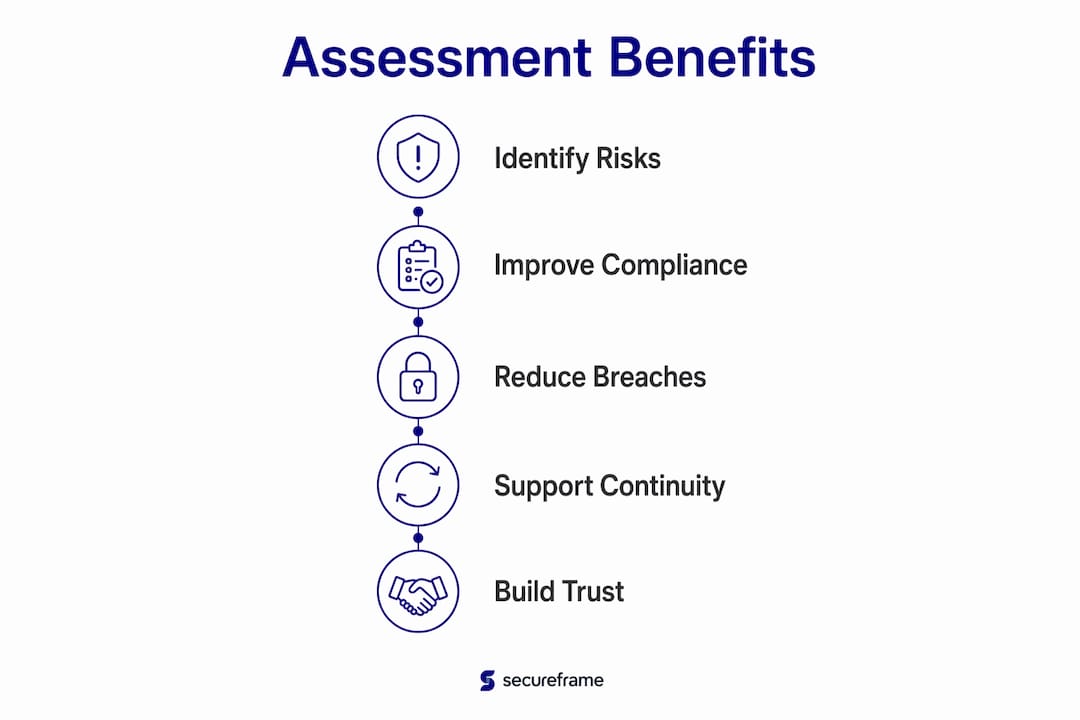
The advantages of a consistent assessment program extend well beyond finding open ports or outdated software. Here is what small businesses gain from making security evaluations a recurring practice.
- Vulnerability detection before exploitation. Assessments identify weaknesses in your systems, applications, and configurations while they are still theoretical risks rather than active incidents. Finding a misconfigured firewall rule during a review costs far less than discovering it during a breach.
- Risk-based prioritization. Assessment results objectively evaluate risk magnitude by combining likelihood and impact, helping you direct limited budgets toward the highest-priority fixes first. This removes guesswork from security spending decisions.
- Regulatory compliance support. Industries such as manufacturing, aerospace, and professional services face frameworks including CMMC, HIPAA, and SOC 2. Regular audits demonstrate due diligence to customers, partners, and regulators, identifying gaps before breaches or compliance violations occur.
- Improved security awareness. The process of conducting an assessment forces your team to examine access controls, password policies, and data handling practices. That examination alone raises awareness and operational discipline across the organization.
- Stakeholder trust and credibility. Customers and partners increasingly ask for evidence of security practices before signing contracts. A documented assessment history provides that evidence without requiring you to build a security operations center from scratch.
"Regular assessments inform actions for many months, not just reactive remediation. Microsoft's CISO guidance frames risk reviews as proactive tools that convert reactive data into forward-looking security decisions."
The compliance angle deserves particular attention for small manufacturers and professional services firms. Demonstrating that your organization conducts structured, recurring security evaluations is often the difference between winning a contract and losing it to a competitor who can show documented security practices.
How often should small businesses conduct security assessments?
Security assessment frequency is one of the most common questions small business owners ask, and the honest answer is: more often than most currently do. A practical framework combines scheduled cadences with event-triggered reviews.
- Annual assessments as a baseline. Annual penetration testing is a business discipline that compounds over time, strengthening your risk posture beyond mere compliance. Treat the annual assessment as your comprehensive review: full vulnerability scan, penetration test, and policy audit.
- Quarterly vulnerability scans. Automated vulnerability scans run quarterly catch newly disclosed vulnerabilities and configuration changes that accumulate between annual reviews. These are lower cost and faster than full assessments but provide continuous visibility.
- After major system changes. Assessment scope should focus on changes since the last test, including new integrations and cloud migrations that invalidate prior security assumptions. Any time you move workloads to the cloud, add a new line-of-business application, or integrate a vendor system, schedule a targeted review.
- Following a security incident. A breach or near-miss is a signal that your current controls have gaps. A post-incident assessment identifies what failed and what else may be exposed.
- When regulatory requirements change. New compliance obligations often require a fresh look at controls that were previously adequate. Waiting until an audit to discover gaps is the most expensive way to find them.
Pro Tip: Set your annual penetration test on a fixed calendar date, the same way you schedule your financial audit. Consistency builds institutional knowledge and makes year-over-year trend analysis possible.
SaaS companies deploy code more than 200 times per year, creating continuous risk that requires regular testing to catch security regressions. Even if your business is not a software company, your vendors and cloud platforms update constantly. That update cadence affects your risk exposure whether you track it or not.
What types of security assessments should small businesses consider?
Not all assessments serve the same purpose. Using only one type creates blind spots. The table below compares the four most common assessment types and their primary use cases.
| Assessment type | What it does | Best used for |
|---|---|---|
| Vulnerability assessment | Automated scanning to identify known weaknesses in systems and software | Quarterly visibility into patch gaps and misconfigurations |
| Penetration test | Simulated attack by a human tester to exploit vulnerabilities and measure real-world impact | Annual deep-dive and post-major-change validation |
| Configuration and compliance audit | Review of system settings against benchmarks such as NIST configuration checklists | Ongoing compliance and detecting configuration drift |
| Risk assessment | Structured evaluation of threats, assets, and business impact | Strategic planning and budget justification |
Each type answers a different question. Vulnerability assessments answer "what weaknesses exist?" Penetration tests answer "can those weaknesses actually be exploited?" Configuration audits answer "are our controls set up correctly?" Risk assessments answer "what should we fix first given our business context?"
Small businesses benefit most from combining these methods rather than relying on a single approach. A vulnerability scan without a penetration test tells you what doors are unlocked but not whether an attacker can actually walk through them. A penetration test without a configuration audit may miss systemic issues that no single exploit would reveal. Rotating methodologies across your assessment calendar closes the gaps each individual method leaves open. For manufacturers specifically, pairing these reviews with network asset mapping adds another layer of visibility into operational technology environments where undocumented devices are common.
How do regular assessments support risk management and business continuity?
Security assessments do not exist in isolation. They feed a continuous improvement cycle that keeps your defenses aligned with your actual risk environment. The Plan-Do-Check-Act model, widely used in quality management, applies directly here. You plan your security controls, implement them, check their effectiveness through assessments, and act on the findings to improve. Without the "check" step, the cycle breaks.
- Objective, risk-ranked reports justify budget decisions. When you bring assessment findings to leadership or a board, you are presenting evidence rather than opinion. A ranked list of vulnerabilities with associated business impact makes it straightforward to allocate resources to the highest risks first.
- Trend analysis reveals posture changes over time. A single assessment tells you where you stand today. A series of assessments tells you whether you are improving, stagnating, or declining. That trend data is more valuable than any single snapshot.
- Continuous evidence collection prevents audit scrambles. Effective recurring assessment programs treat control evidence as living data constantly collected and validated, avoiding last-minute scrambling during regulatory audits. Organizations that wait until an audit is scheduled to gather evidence routinely discover gaps too late to remediate before the review.
- Reducing breach impact through early detection. Assessments that catch vulnerabilities early reduce the probability of a breach reaching the point of data exfiltration or operational disruption. The cost of a proactive assessment is a fraction of the cost of incident response, legal notification, and reputational recovery.
Pro Tip: After each assessment, create a simple remediation tracker with three columns: finding, owner, and target resolution date. Review it monthly. Assessments that produce reports that sit unread deliver zero security value.
Periodic audits risk missing control drift, which occurs when configurations and access controls gradually deviate from their intended state between formal reviews. Continuous validation models address this by providing recurring evidence that controls behave as intended under realistic conditions. For small businesses without a full security team, this is where managed services and automated monitoring tools fill the gap that point-in-time audits leave open. Pairing your assessment program with data breach lessons from real incidents gives you a practical lens for prioritizing which findings to address first.
Key takeaways
Regular security assessments are the mechanism that keeps your defenses aligned with an evolving threat environment, and skipping them is not a cost saving but a deferred liability.
| Point | Details |
|---|---|
| Assessments must be recurring | A one-time review becomes outdated the moment your environment changes. |
| Risk-based prioritization saves budget | Objective risk ranking directs limited resources to the highest-impact fixes first. |
| Combine multiple assessment types | Vulnerability scans, penetration tests, and configuration audits each reveal different gaps. |
| Frequency depends on change and risk | Annual assessments plus quarterly scans plus event-triggered reviews form a practical baseline. |
| Continuous evidence prevents audit failures | Treat control validation as ongoing, not a pre-audit scramble. |
The discipline most small businesses skip, and why that needs to change
I have worked with dozens of small business owners who treat security assessments the way most people treat dental checkups: they know they should do them, they intend to schedule one, and then six months pass. The difference is that a cavity does not typically cost you a federal contract or expose your customers' financial data.
The most common mistake I see is treating the first assessment as the finish line. A business invests in a penetration test, gets a clean-ish report, and considers the job done. Twelve months later, they have added three new cloud integrations, two remote employees, and a new point-of-sale system. None of those changes were assessed. The original report is now a historical document, not a security guarantee.
The second mistake is ignoring the remediation report. An assessment that produces a findings document that no one acts on is an expense, not an investment. The value is entirely in the follow-through. I recommend assigning a named owner to every finding before the assessment debrief meeting ends. If no one owns it, no one fixes it.
Budget is a real constraint for small businesses, and I respect that. The practical answer is to prioritize by risk tier rather than trying to fix everything at once. Address critical and high findings within 30 days. Schedule medium findings for the next quarter. Document your rationale for deferring low findings. That documented decision-making process itself demonstrates due diligence to auditors and partners.
Third-party assessors bring objectivity that internal reviews cannot replicate. Your team knows your systems, which means they also carry assumptions about how those systems work. An outside assessor brings no assumptions and no institutional blind spots. For small businesses without dedicated security staff, that external perspective is not a luxury. It is the only way to get an honest picture of your actual risk posture.
— Michael
How Symmnet helps small businesses build a consistent assessment program
Symmnet's managed IT services give small businesses access to structured security assessment support without the overhead of building an internal security team. Symmnet provides 24/7 monitoring, endpoint security, firewall management, and compliance assistance tailored to industries including manufacturing, aerospace, and professional services. Rather than scheduling a single annual review and hoping for the best, Symmnet clients benefit from continuous visibility and expert-guided remediation that turns assessment findings into resolved risks. If you want to know where your security gaps are before an attacker finds them, Symmnet offers a free assessment to get you started.
FAQ
What is a security assessment in simple terms?
A security assessment is a structured review of your business's IT systems, policies, and controls to identify vulnerabilities and measure risk. The goal is to find weaknesses before attackers do and prioritize fixes based on business impact.
How often should a small business conduct a security assessment?
Small businesses should conduct a full assessment at least annually, with quarterly vulnerability scans and additional reviews after major system changes such as cloud migrations or new vendor integrations.
What is the difference between a vulnerability assessment and a penetration test?
A vulnerability assessment uses automated tools to identify known weaknesses across your systems. A penetration test goes further by having a human tester actively attempt to exploit those weaknesses to measure real-world impact and validate whether defenses hold under attack.
Do security assessments help with regulatory compliance?
Yes. Regular security audits demonstrate due diligence to regulators, customers, and partners by providing documented evidence that your organization identifies and addresses security gaps on an ongoing basis.
What happens if a small business skips regular security assessments?
Without recurring evaluations, vulnerabilities accumulate undetected, configuration drift goes uncorrected, and compliance gaps widen. The result is a higher probability of a breach and a weaker position when customers or regulators ask for evidence of your security practices.