

Cyber crime insurance covers direct financial losses from fraud, social engineering, and unauthorized funds transfers. That is a narrower, more specific protection than most cyber liability or business owner's policies provide. Before you buy anything, do three things: check whether your existing policies contain explicit social engineering and funds-transfer language; document your current security controls (MFA, backups, endpoint detection); and request a written quote that lists social engineering and BEC sublimits in plain numbers. Insurance finances recovery after an incident, but it does not prevent one. Strong security controls do both.
Table of Contents
- What does "cyber crime insurance" actually cover?
- What cyber crime insurance commonly covers for small businesses
- Common exclusions and policy traps you need to watch for
- How claims, limits, deductibles, and timelines typically work
- What insurers commonly require before issuing coverage
- How to choose the right cyber crime coverage
- How managed IT services help you qualify for better coverage
- Key Takeaways
- Why insurance and strong security are better together
- Symmnet helps small businesses meet insurer requirements and reduce risk
- Authoritative sources and further reading
What does "cyber crime insurance" actually cover?
The industry term you will see on policy forms is computer crime or cyber crime coverage, sometimes written as a standalone policy and sometimes as an endorsement attached to a broader cyber liability or commercial crime form. The core purpose is narrow: it pays for direct financial losses your business suffers when a criminal deceives someone into moving money or surrendering credentials.
Cyber liability insurance is a related but different product. It bundles first-party response costs (forensic investigation, breach notification, credit monitoring, business interruption) with third-party liability coverage for legal defense and settlements when a breach exposes customer data. According to the FTC, comprehensive cyber policies typically include both first-party response costs and third-party liability components. Cyber crime coverage, by contrast, focuses almost entirely on first-party financial theft.
Here is where the distinction matters in practice:
- Business email compromise (BEC) wire fraud: A vendor's email is spoofed; your accounts-payable team wires $47,000 to a fraudulent account. Cyber crime coverage responds. A standard cyber liability policy may not, unless it includes a social engineering endorsement.
- Data breach with customer notification: An attacker exfiltrates customer records. Cyber liability responds to forensic costs, legal fees, and notification expenses. Cyber crime coverage typically does not.
- Ransomware extortion: Some cyber policies include extortion/ransom as a specific endorsement; some cyber crime forms do too. Neither automatically covers it. You must read the policy.
One of the most common and costly mistakes small businesses make is assuming a Business Owner's Policy (BOP) or general liability policy covers cyber incidents. Standard general liability policies are built around bodily injury and property damage and typically exclude data breach and cyber incident costs entirely. Verify your current coverage before assuming you are protected.
All 50 states require data breach notification, but no state statute requires businesses to carry cyber insurance to fund that response. The legal obligation to notify affected individuals exists regardless of whether you are insured.
What cyber crime insurance commonly covers for small businesses
Most cyber crime forms cover a defined set of loss types. Understanding them helps you match your actual risk profile to the right policy language.
| Covered Loss Type | What It Means in Practice |
|---|---|
| Fraudulent funds transfer | Attacker impersonates a vendor or executive; employee authorizes a wire to a fraudulent account |
| Social engineering / BEC | Employee is deceived via phishing or spoofed email into transferring funds or disclosing credentials |
| Payment diversion scam | Attacker intercepts or redirects a legitimate payment to a controlled account |
| Authorized-signatory impersonation | Criminal impersonates an officer or owner to instruct a bank or employee to release funds |
| Computer fraud | Unauthorized access to systems directly causes a financial transfer |
Beyond the direct loss, some cyber crime forms include associated first-party response costs: forensic accounting to trace diverted funds, bank negotiation fees, legal fees for urgent payment recovery, and coordination with law enforcement. These ancillary costs add up quickly and are worth confirming during the quoting process.
Ransom and extortion coverage varies significantly. Some cyber crime policies include it; many do not unless you add a specific extortion endorsement. Some cyber liability policies include it as a separate sublimit. The safest approach is to treat extortion as a gap until you see explicit policy language confirming it is covered.
Cyber and crime policies are genuinely complementary. A single attack often involves credential theft (a cyber exposure) that leads to a fraudulent wire (a crime exposure). Businesses with meaningful money movement and sensitive data frequently need both types of coverage, or a cyber policy with explicit crime endorsements, to avoid a gap between the two.
Common exclusions and policy traps you need to watch for
Knowing what a policy covers is only half the job. These exclusions and sublimit traps catch small businesses off guard at claim time.
- Employee dishonesty: Most cyber crime forms exclude losses caused by a dishonest employee unless you add a specific employee dishonesty endorsement. If an insider initiates a fraudulent transfer, a bare cyber crime policy may deny the claim.
- Acts of war and terrorism: Nation-state attacks are increasingly common, and many policies exclude losses attributed to acts of war. Some carriers have added "cyber war" exclusions following high-profile state-sponsored incidents.
- Pre-existing incidents: Coverage applies to incidents that begin after the retroactive date. If an attacker had access to your systems before the policy's retroactive date, the claim may be denied even if the loss occurs during the policy period.
- Cryptocurrency exclusions or sublimits: Many policies exclude crypto-related losses entirely or cap them at a low sublimit. If your business accepts or holds cryptocurrency, confirm coverage explicitly.
- Failure to maintain security controls: Policies increasingly include a warranty clause stating that the controls you described at application time are in place throughout the policy period. If MFA lapses or backups are not maintained, a carrier may reduce or deny a claim.
- Voluntary disclosure limits: Some policies limit coverage when an employee voluntarily provided credentials or authorized a transfer, even under deception. Read the social engineering trigger language carefully.
- Sublimits for social engineering and BEC: This is the most common gap. A policy may carry a $1 million headline limit with a $25,000–$50,000 social engineering sublimit buried in the endorsement schedule. That sublimit is the real number that matters for most small-business wire fraud claims.
Practical rule: Never rely on a verbal assurance from an agent that social engineering, funds-transfer fraud, or employee dishonesty is covered. Ask for the endorsement form and read the trigger language yourself, or have a broker or counsel review it.
How claims, limits, deductibles, and timelines typically work
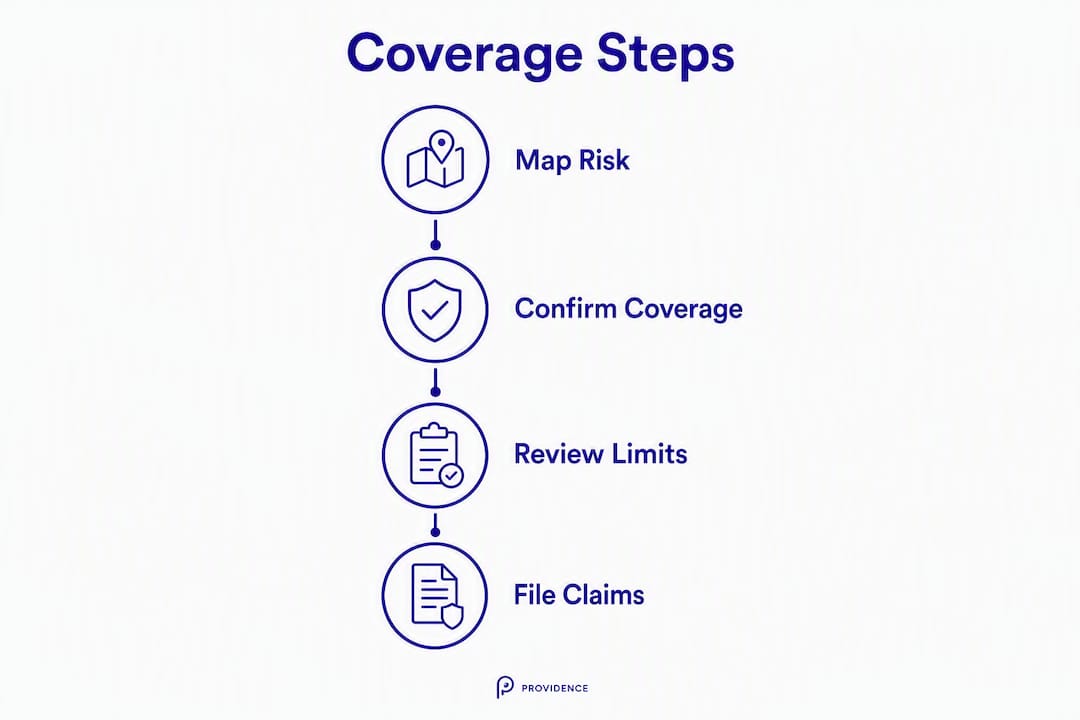
Filing a cyber crime claim quickly is not optional. Funds moved via wire fraud are often recoverable only if acted on very quickly through the FBI's Financial Fraud Kill Chain program, but that window closes fast.

| Step | Action | Timing |
|---|---|---|
| 1. Preserve evidence | Screenshot emails, save wire instructions, do not delete anything | Immediately |
| 2. Contact your bank | Request a recall or reversal of the wire | Within 1 hour |
| 3. Notify your insurer | Call the claims line; do not wait to file online | Within 2–4 hours |
| 4. Engage forensics/legal | Insurer typically deploys a forensic team or panel counsel | Within 24 hours |
| 5. File a report | FBI IC3 complaint and local law enforcement | Same day |
Small-business cyber policies are typically offered in tiered coverage amounts ($250,000–$5 million), but social engineering and BEC sublimits are commonly capped at $25,000–$50,000 unless you specifically request higher limits. That gap between headline limit and sublimit is where most small-business claims run into trouble.
Deductibles for cyber crime coverage usually run as flat dollar amounts rather than percentages. Higher headline limits generally mean higher premiums, but the per-dollar rate often decreases as limits increase. A $500,000 policy does not cost twice as much as a $250,000 policy.
Most carriers acknowledge a claim within 24–72 hours and mobilize a forensic team within hours for active incidents. Expect a full coverage determination to take several weeks, particularly when the loss involves multiple parties or a disputed social engineering trigger.
What insurers commonly require before issuing coverage
Insurers have tightened underwriting requirements significantly.
, not a nice-to-have. Weak controls lead to higher premiums, lower sublimits, or outright declination.The controls underwriters ask about most often:
- Multifactor authentication (MFA): Required for email, remote access, and privileged accounts. Absence of MFA is the single most common reason for declination or premium surcharge.
- Endpoint detection and response (EDR): Basic antivirus is no longer sufficient. Underwriters want to see behavioral detection tools deployed across all endpoints.
- Documented backups with tested restores: Backups that have never been tested are treated skeptically. Insurers want evidence of restore tests, not just backup logs.
- Network segmentation: Flat networks where a single compromised endpoint can reach all systems are a red flag. Network segmentation limits lateral movement and reduces potential loss scope.
- Patch management: A documented, regular patching schedule for operating systems and critical applications.
- Secure remote access: VPN or zero-trust access controls for remote employees, with MFA enforced.
Beyond technical controls, underwriters also ask for written security policies, an incident response plan, user access reviews, and vendor risk assessments. New York's DFS cybersecurity regulation (23 NYCRR Part 500) requires similar programs for covered financial entities, and insurers have adopted nearly identical checklists for their own underwriting, regardless of whether a business is DFS-regulated.
Underwriters commonly ask how many employees have wire authorization, whether your bank requires dual approval for large transfers, and whether you have had prior phishing incidents. Implementing two-person verification for large transfers materially reduces underwriting friction and can lower your premium.
Pro Tip: Complete a security gap assessment before you request quotes. Closing obvious gaps (enabling MFA, scheduling a backup restore test) before the underwriting application can meaningfully improve your terms.
How to choose the right cyber crime coverage
A structured buying process prevents the most common coverage gaps.
Step 1: Map your risk profile. Identify how your business moves money (ACH, wire, card), how many employees have payment authority, and what sensitive data you hold. A 15-employee professional services firm that wires vendor payments weekly has a very different risk profile than a retail shop that processes card transactions.

Step 2: Confirm which coverages you actually need. For a business with frequent vendor wires, social engineering and funds-transfer fraud coverage are the priority. For a business holding customer health or financial data, cyber liability with breach response is equally critical. Many small businesses need both.
Step 3: Check sublimits, not just headline limits. Ask every agent for the social engineering sublimit and the BEC sublimit in writing. If those numbers are $25,000 on a $1 million policy, negotiate higher sublimits or find a carrier that offers them.
Step 4: Ask these questions before binding:
- What is the exact trigger for social engineering coverage? Does it require a direct communication from the attacker, or does it cover indirect deception?
- Is ransomware/extortion included, or does it require a separate endorsement?
- What is the retroactive date, and does it match my prior policy's expiration?
- How does this policy coordinate with my commercial crime policy if I have one?
- What security controls are warranted at bind, and what happens if one lapses?
Step 5: Decide between standalone and endorsement. A standalone cyber crime policy gives you dedicated limits and clearer trigger language. An endorsement on a cyber liability policy is often less expensive but may carry lower sublimits. Businesses with significant money movement and sensitive data are generally better served by carrying both a cyber liability policy and a cyber crime policy, or a cyber policy with explicit, high-limit crime endorsements.
Contractual requirements from enterprise clients, payment processors, and government contracts increasingly require minimum cyber liability limits as a condition of doing business. Even if no law mandates coverage, your contracts may.
How managed IT services help you qualify for better coverage
The controls insurers require are not abstract. They are specific technical and operational practices that a managed IT provider can implement, document, and maintain on your behalf.
Here is how common underwriting requirements map to managed service deliverables:
- MFA rollout and enforcement: A managed IT partner deploys and enforces MFA across email, remote access, and privileged accounts, then produces the configuration evidence underwriters request.
- EDR deployment: Managed endpoint security means behavioral detection tools are installed, monitored, and updated across all devices, with logs available for underwriting review.
- Backup and restore testing: Managed backup services include scheduled restore tests and documented results, which is exactly the evidence insurers want to see.
- Patch management: A managed patching program produces audit logs showing patch cadence and coverage, satisfying underwriter documentation requirements.
- Network segmentation: Properly segmented networks limit breach scope and are a direct underwriting positive, as shown in this Financial Services WiFi and Security Upgrade project example. Symmnet's network segmentation work addresses this requirement directly.
- Written security policies and incident response plans: Managed IT providers can help draft and maintain the documentation insurers ask for during the application process.
Insurers increasingly require proof of controls at bind time, and weak controls can lead to higher premiums or declination. Managed services close that gap by making controls continuous rather than point-in-time. For small manufacturers and professional services firms, the cybersecurity controls that satisfy insurers are the same ones that protect operations day to day.
Managed IT services complement insurance. They do not replace it. The goal is to arrive at the underwriting application with documented, verified controls that earn better terms and reduce the likelihood of a claim in the first place.
Key Takeaways
Cyber crime insurance pays for direct financial theft from fraud and social engineering, but sublimits, exclusions, and security control requirements determine whether a claim actually gets paid.
| Point | Details |
|---|---|
| Check for specific coverage language | Verify your policy includes explicit social engineering and funds-transfer fraud language, not just a broad cyber liability form. |
| Sublimits matter more than headline limits | Social engineering sublimits of $25,000–$50,000 are common for small-business cyber policies; negotiate higher limits if your business moves significant funds. |
| Security controls affect insurability | MFA, EDR, tested backups, and documented policies are prerequisites for coverage, not optional extras. |
| Contracts often drive the requirement | Enterprise clients and payment processors increasingly require minimum cyber coverage limits as a condition of doing business. |
| Symmnet bridges the security gap | Symmnet's managed IT services implement and document the controls insurers require, reducing underwriting friction and supporting better policy terms. |
Why insurance and strong security are better together
The conventional wisdom treats insurance and security as alternatives: either you invest in prevention or you buy coverage for when prevention fails. That framing is wrong, and it costs small businesses money.
Insurers have made the relationship explicit. Businesses with documented MFA, EDR, and tested backups get better terms. Businesses without them pay more or get declined. Security investment now has a direct, measurable return in the form of lower premiums and fewer coverage conditions. That changes the calculus for a small business owner who was previously skeptical about the ROI of managed security.
There is also a claims dimension. When a loss does occur, businesses with strong security controls tend to have cleaner forensic trails, faster incident containment, and less insurer friction at claim time. A business that can hand its carrier a documented incident response timeline and a clean backup restore is in a fundamentally different position than one scrambling to explain what happened.
The realistic picture for most small businesses is this: the controls insurers require are achievable with clear planning and the right support. MFA, regular patching, tested backups, and a basic incident response plan are not enterprise-scale projects. They are the baseline, and with managed support, they are maintainable without a full internal IT team.
Symmnet helps small businesses meet insurer requirements and reduce risk
Most small businesses that struggle to qualify for favorable cyber coverage have the same problem: the controls are not in place, or they are in place but not documented. Insurers cannot give credit for controls they cannot verify.
Symmnet's managed IT and cybersecurity services are built around exactly the controls underwriters ask for. MFA enforcement, EDR deployment, managed backup with tested restores, patch management, network segmentation, and written security documentation are all part of the managed service model. When you go to quote or renew a cyber policy, Symmnet can produce the evidence your insurer needs.
The free security assessment Symmnet offers is a practical starting point. It identifies the gaps that hurt your insurability, maps your current controls against common underwriting checklists, and gives you a clear remediation path before you approach a carrier. Managed services are a companion to purchasing insurance, not a substitute for it. The goal is to arrive at the underwriting table with controls that earn better terms and keep your business protected between claims.
Request your free security assessment at symmnet.com/services and find out exactly where your coverage gaps start.
Authoritative sources and further reading
The following resources provide primary guidance on cyber insurance requirements, breach notification obligations, and security control standards:
- FTC: Cyber Insurance for Small Businesses — plain-language guidance on policy types, coverage questions, and breach response planning from the Federal Trade Commission.
- U.S. Chamber of Commerce: Small-Business Cyber Insurance — practical framing of why contracts and client requirements drive cyber insurance adoption.
Before assuming any policy covers a specific loss, review the endorsement forms and policy wording with a licensed broker or coverage counsel. Policy language varies significantly between carriers, and verbal assurances do not create coverage. A free security assessment from Symmnet can help you prepare the documentation insurers require before you begin the quoting process.