

IT compliance in manufacturing means your IT systems, data handling practices, and network infrastructure meet the regulatory and cybersecurity standards that govern your industry. This is not a back-office concern. When your production floor connects to enterprise software, when your engineers exchange technical drawings with a defense contractor, or when your ERP system stores customer payment data, every one of those touchpoints carries a compliance obligation. The NIST Cybersecurity Framework (CSF) and the broader suite of National Institute of Standards and Technology (NIST) publications form the backbone of IT compliance for most US manufacturers today.
Non-compliance carries real consequences that go beyond fines:
- Lost contracts: Defense suppliers that miss CMMC certification deadlines lose eligibility to bid on Department of Defense work.
- Regulatory penalties: The Federal Trade Commission Act gives the FTC broad authority to act against organizations that fail basic cybersecurity and privacy practices.
- Operational disruptions: A ransomware attack on an unprotected industrial control system can halt a production line for days or weeks.
- Reputational damage: A single data breach involving customer or partner data can end long-standing business relationships.
- Legal exposure: State privacy laws and federal regulations impose specific data handling requirements, and violations can trigger civil liability.
Getting compliance right protects your operations, your contracts, and your reputation simultaneously.
What does IT compliance actually cover in manufacturing?
Manufacturing compliance spans a wider territory than most business owners expect. The scope includes not just your office IT network but also the operational technology (OT) on the shop floor, the industrial control systems (ICS) running your equipment, and every vendor or partner with network access to your environment. Treating these as separate worlds is one of the most common and costly mistakes manufacturers make.
The key compliance areas break down as follows:
- Quality management systems (QMS): IT systems that support ISO 9001 or AS9100 quality processes must maintain data integrity and audit trails.
- Workplace safety: Systems connected to safety-critical equipment fall under OSHA requirements and must be protected from unauthorized access or tampering.
- Environmental regulations: Data collected for EPA reporting must be accurate, protected, and retained according to federal and state schedules.
- Supply chain controls: Third-party vendors and suppliers with access to your systems or data must meet contractual cybersecurity requirements.
- Software and hardware governance: Unauthorized software on production systems and unpatched firmware on programmable logic controllers (PLCs) are audit red flags.
- ICS and OT security: Supervisory control and data acquisition (SCADA) systems and distributed control systems (DCS) require dedicated security controls separate from standard IT policies.
The critical insight here is that IT, operations, legal, and engineering teams must coordinate. Compliance gaps almost always appear at the seams between departments, not within them.
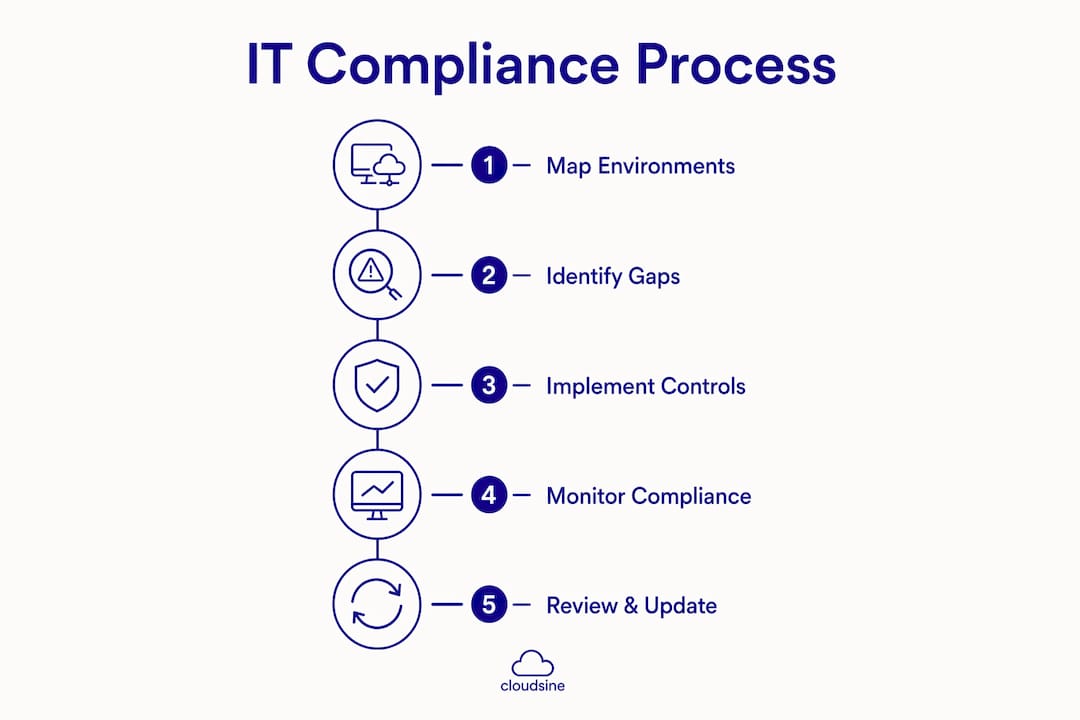
Pro Tip: Map your IT and OT environments on a single diagram before your next compliance review. Gaps between the two are where auditors find problems first, and where attackers look second.

Which US regulatory frameworks apply to your manufacturing IT systems?
The US regulatory environment for manufacturing IT is layered, mixing mandatory federal requirements with voluntary frameworks that carry real weight in contract negotiations and risk management. Knowing which ones apply to your specific situation determines where you spend your compliance budget.
Key frameworks and regulations include:
- NIST CSF 2.0 Manufacturing Profile (NIST IR 8183r2): A voluntary, risk-based roadmap for reducing cybersecurity risk in manufacturing environments, structured around six functions: Govern, Identify, Protect, Detect, Respond, and Recover.
- CMMC (Cybersecurity Maturity Model Certification): All defense supply chain entities must achieve at least Level 1 certification by 2026; Level 3 is required for any entity handling Controlled Unclassified Information (CUI).
- DFARS: Defense Federal Acquisition Regulation Supplement requirements appear directly in defense contracts and mandate specific cybersecurity controls for covered contractors.
- NIST SP 800-171: Provides the security requirements for protecting CUI in nonfederal systems and underpins the CMMC framework.
- ISO/IEC 27001: An internationally recognized information security management standard that many commercial customers now require in supplier contracts.
- PCI DSS: Applies to any manufacturer that processes, stores, or transmits credit card data, requiring controls over cardholder data environments.
- Sarbanes-Oxley (SOX): Publicly traded manufacturers must maintain formal data security policies and enforce them consistently.
- FTC Act and state privacy laws: Govern how manufacturers collect, use, and protect consumer and operational data, with enforcement authority at both federal and state levels.
| Framework | Mandatory or Voluntary | Primary Scope | Who It Applies To |
|---|---|---|---|
| NIST CSF 2.0 Manufacturing Profile | Voluntary | Cybersecurity risk management | All manufacturers |
| CMMC Level 1 | Mandatory | Basic cyber hygiene | All DoD supply chain entities |
| CMMC Level 3 / NIST SP 800-171 | Mandatory | CUI protection | DoD contractors handling CUI |
| DFARS | Mandatory | Contract cybersecurity requirements | Defense contractors |
| ISO/IEC 27001 | Voluntary (often contractually required) | Information security management | Commercial supply chain participants |
| PCI DSS | Mandatory | Payment card data security | Manufacturers processing card payments |
| Sarbanes-Oxley | Mandatory | Data security policies | Publicly traded manufacturers |
| FTC Act / State Privacy Laws | Mandatory | Consumer and operational data | All manufacturers collecting consumer data |
One point worth emphasizing: voluntary does not mean optional in practice. A manufacturer pursuing government contracts or large commercial customers will find that frameworks like NIST CSF and ISO/IEC 27001 function as de facto requirements even without a legal mandate.

Why IT compliance pays off for manufacturers
Compliance is often framed as a cost center. The more accurate view is that it functions as a risk transfer mechanism and a business development tool simultaneously.
Operational benefits include:
- Reduced downtime: Documented incident response plans and tested backups mean faster recovery when systems fail or are attacked.
- Data protection: Proper access controls and encryption protect proprietary designs, customer data, and financial records from theft or exposure.
- Audit readiness: Continuous compliance programs eliminate the scramble and cost of reactive audit preparation.
- Vendor and partner trust: Suppliers and customers increasingly vet the cybersecurity posture of their partners before signing contracts.
Business advantages go further:
- Government contract eligibility: CMMC certification is a hard gate for DoD work. Manufacturers that achieve it early gain a competitive edge over those still working toward it.
- Insurance leverage: Documented compliance programs often translate to better terms on cyber liability insurance policies.
- Regulatory confidence: A manufacturer with a functioning compliance program faces lower risk of FTC enforcement actions or state privacy law penalties.
- Long-term growth: Customers in aerospace, defense, and healthcare supply chains require suppliers to meet specific IT security standards. Compliance opens those doors.
The manufacturing cybersecurity checklist approach works well here: treating compliance as a living checklist rather than a one-time project keeps these benefits compounding over time.
How to assess IT compliance risk in your manufacturing environment
A risk-based approach to compliance assessment starts with knowing exactly what you have. You cannot protect or audit systems you have not inventoried. For manufacturers, that inventory must include both IT assets (servers, workstations, cloud services) and OT assets (PLCs, SCADA systems, DCS controllers, and the networks connecting them).
Common audit failure points that cost manufacturers contracts and cause operational downtime include:
- Unscoped OT systems: Operational technology that was never formally included in the compliance boundary but connects to in-scope networks creates uncontrolled risk.
- Overly broad CMMC boundaries: Pulling too many systems into the CUI scope inflates assessment costs and complexity without improving security.
- Unmanaged vendor access: Third-party technicians with persistent remote access to production systems are a frequent audit finding and a real attack vector.
- Uncontrolled export-controlled data: Technical data subject to ITAR or EAR controls that flows through unprotected systems creates both compliance and legal exposure.
- Untested backups: Backup systems that have never been tested against a real recovery scenario regularly fail when they are actually needed.
Mapping data flows before setting security boundaries reduces both the cost and complexity of compliance assessments. Continuous monitoring and thorough documentation are what turn a point-in-time assessment into a sustainable compliance posture. For a deeper look at how these operational risk levels translate into practical decisions, the root cause analysis framework offers a useful parallel methodology.
Best practices for building a compliance program that actually holds up
Most manufacturers treat compliance as an audit-triggered project rather than embedding it into daily operations. That reactive posture is expensive. When compliance lives inside your Quality Management System rather than in a separate binder that comes out before an assessment, it becomes self-sustaining.
Practical steps for building a durable compliance program:
- Establish formal IT governance: Assign clear ownership for compliance tasks across IT, operations, and legal. Ambiguous ownership is where compliance gaps hide.
- Integrate compliance into your QMS: Embed IT security controls into existing quality procedures so they get reviewed on the same cadence as production quality checks.
- Map and minimize your CUI footprint: Isolate Controlled Unclassified Information to the smallest legitimate digital and physical boundary. Smaller scope means lower assessment cost and tighter control.
- Train employees regularly: Staff who cannot recognize a phishing email or do not know how to report a suspected incident are a compliance liability regardless of how good your technical controls are.
- Test backups against real scenarios: Run recovery drills that simulate an actual line-stop event, not just a file restore. Recovery time objectives mean nothing if they have never been validated under realistic conditions.
- Document everything continuously: Auditors look for evidence of ongoing compliance, not just a policy document dated the week before the assessment.
- Control vendor access tightly: Use time-limited credentials, log all remote sessions, and review vendor access rights on a defined schedule.
Pro Tip: Build your compliance documentation directly into your change management process. Every system change that touches an in-scope asset should automatically generate a compliance record. That habit eliminates most of the documentation scramble before an audit.
The role of compliance in manufacturing operations goes beyond checking boxes. When compliance is woven into how your team works every day, it stops being a burden and starts functioning as an operational quality control.
How the NIST Manufacturing Profile and managed IT services work together
The NIST IR 8183r2 Manufacturing Profile is the most practical starting point for any US manufacturer building or improving a cybersecurity compliance program. It is voluntary, risk-based, and designed specifically for manufacturing environments, covering both IT and OT systems. The profile does not replace existing standards. It supplements them by providing a common language and scalable controls that manufacturers can apply at Low, Moderate, or High impact levels depending on their operational criticality.
The six functional areas of the CSF 2.0 Manufacturing Profile give manufacturers a structured way to assess and improve their posture:
- Govern: Establish cybersecurity risk management strategy, policies, and supply chain risk management programs. CSF 2.0 added this function specifically to address the coordination gap between IT, operations, legal, HR, and engineering.
- Identify: Maintain asset inventories for both IT and OT systems, assess risks, and understand the business context of each system.
- Protect: Implement access controls, data security measures, and protective technology for manufacturing systems.
- Detect: Deploy continuous monitoring to identify cybersecurity events in real time across both IT and OT environments.
- Respond: Execute documented incident response plans when events occur, including communication protocols and containment procedures.
- Recover: Restore manufacturing operations after an incident, with recovery plans tested against realistic line-stop scenarios.
Manufacturers that prioritize cybersecurity investments based on critical service delivery rather than applying uniform controls across all systems get better outcomes per dollar spent. A Low baseline is the starting point; Moderate and High levels build on it as operational criticality increases.
Managed IT services fill a specific gap here. Small and mid-size manufacturers rarely have the internal staff to maintain continuous monitoring, manage asset inventories, and stay current on evolving compliance requirements simultaneously. A managed IT provider with manufacturing experience delivers 24/7 monitoring, endpoint security, firewall management, and compliance consulting without the overhead of a full internal IT team. Symmnet's managed IT services are built specifically for this context, providing the continuous oversight that keeps compliance programs from drifting between formal assessments.
Statistic callout: The NIST CSF 2.0 Manufacturing Profile structures security protections across scalable impact levels, allowing manufacturers to build compliance incrementally rather than attempting a single large-scale overhaul.
Incident response and breach notification in manufacturing IT environments
When a cybersecurity incident hits a manufacturing environment, the clock starts immediately. Production lines, customer commitments, and regulatory obligations all run on tight timelines, and an unplanned response is almost always slower and more expensive than a practiced one.
What an effective incident response plan covers
A manufacturing-specific incident response plan must address both IT and OT systems. A ransomware attack that encrypts office servers is serious. The same attack reaching a SCADA system controlling a production line is a safety and operational emergency. Your plan needs to distinguish between these scenarios and define different response tracks for each.
Core components of a manufacturing incident response plan:
- Detection and classification: Define what constitutes a security event versus a full incident, and assign responsibility for making that call.
- Containment: Isolate affected systems without triggering unplanned production shutdowns where possible. Network segmentation is the technical control that makes this feasible.
- Notification protocols: Federal contractors must follow DFARS 252.204-7012 reporting requirements, which include notifying the DoD within 72 hours of discovering a cyber incident affecting covered defense information. State breach notification laws impose separate timelines for consumer data.
- Evidence preservation: Forensic evidence must be preserved before remediation begins, particularly for incidents involving CUI or export-controlled data.
- Recovery and restoration: Restore systems in a defined priority order, with production-critical OT systems typically taking precedence after safety is confirmed.
- Post-incident review: Document what happened, how it was detected, what worked, and what failed. Feed those findings back into your compliance program.
Breach notification requirements manufacturers must know
Defense contractors face the most specific notification obligations. DFARS 252.204-7012 requires reporting cyber incidents to the DoD Cyber Crime Center (DC3) within 72 hours and preserving images of compromised systems for 90 days. Separately, if the incident involves consumer data, applicable state breach notification laws may require notifying affected individuals within timeframes that vary by state, typically ranging from 30 to 90 days.
Network segmentation between IT and OT environments is the single most effective technical control for limiting the blast radius of an incident. When a threat actor moves from a compromised workstation toward production systems, segmentation is what stops them. Manufacturers that have not yet implemented formal segmentation between office IT and shop floor OT are carrying a risk that no policy document can offset.
The cybersecurity guide for small manufacturers covers the foundational controls that make incident response plans executable rather than theoretical.
Key Takeaways
Effective IT compliance in manufacturing requires integrating cybersecurity controls across both IT and OT environments, aligning with frameworks like NIST CSF 2.0, and embedding compliance into daily operations rather than treating it as a periodic audit exercise.
| Point | Details |
|---|---|
| CMMC certification deadline | All defense supply chain entities must achieve at least Level 1 CMMC certification by 2026 to maintain DoD contracts. |
| NIST CSF 2.0 impact levels | The Manufacturing Profile scales across Low, Moderate, and High levels, letting manufacturers build compliance incrementally. |
| CUI scope management | Isolating Controlled Unclassified Information to the smallest legitimate boundary reduces assessment cost and complexity. |
| Incident notification timeline | DFARS requires defense contractors to report cyber incidents to DC3 within 72 hours of discovery. |
| Compliance integration | Embedding compliance into Quality Management Systems creates a living program and eliminates costly reactive audit preparation. |