

Compliance regulations are legally binding requirements that businesses must follow to operate lawfully, protect stakeholders, and avoid financial penalties. Across industries like healthcare, finance, manufacturing, and professional services, regulatory bodies including OSHA, the SEC, and the EPA enforce specific rules that carry real legal consequences. Understanding examples of compliance regulations relevant to your sector is not optional. It is the foundation of sound business operations and long-term market credibility.
1. Examples of compliance regulations in healthcare and data privacy
Healthcare and data privacy regulations set the strictest standards for how businesses collect, store, and share sensitive information. The three most consequential frameworks in this space are HIPAA, HITECH, and GDPR.
HIPAA (Health Insurance Portability and Accountability Act) governs how U.S. healthcare providers and their business partners handle protected health information. It requires physical, administrative, and technical safeguards for patient data. HIPAA violations can result in fines up to $1.5 million per incident category annually. Fines accumulate rapidly when violations involve willful neglect, meaning ignorance of the rule is not a defense.

HITECH (Health Information Technology for Economic and Clinical Health Act) strengthened HIPAA by expanding breach notification requirements. If a covered entity experiences a data breach affecting 500 or more individuals, it must notify the Department of Health and Human Services and affected patients without unreasonable delay.
GDPR (General Data Protection Regulation) applies to any U.S. business that processes personal data of EU residents. It requires explicit data subject consent, the right to erasure, and documented data processing agreements. Businesses must also execute Business Associate Agreements with any third-party vendor that touches protected data.
- Maintain a current inventory of all systems that store or transmit patient or personal data.
- Review Business Associate Agreements annually and update them when vendor relationships change.
- Train staff on breach notification timelines. Delayed reporting compounds penalties.
- Document every data access event with timestamps and user IDs.
Pro Tip: Under HIPAA, a Business Associate Agreement is not a formality. It is a legal requirement. Missing one agreement with a single cloud storage vendor can trigger a violation.
2. Financial and banking industry compliance regulations
Financial institutions face some of the most detailed regulatory frameworks of any sector. These rules address financial reporting accuracy, digital system resilience, and fraud prevention.
Sarbanes-Oxley Act (SOX)
SOX applies to all publicly traded U.S. companies and their auditors. SOX Section 404 requires documented internal controls and tested change management processes for financial reporting. Annual external audits verify that these controls are functioning. Any undocumented system change that affects financial data is a red flag during an audit.
Digital Operational Resilience Act (DORA)
Since january 2025, EU financial institutions must comply with DORA for digital operational resilience. DORA requires incident classification, ICT change management controls, and third-party risk assessments. U.S. firms with EU operations or EU clients fall within its scope.
SEC disclosure rules
The SEC requires public companies to disclose material cybersecurity incidents within four business days of determining that an incident is material. This rule, effective since 2023, forces compliance officers to have incident response plans ready before a breach occurs, not after.
| Regulation | Governing body | Core requirement | Penalty for non-compliance |
|---|---|---|---|
| SOX Section 404 | SEC / PCAOB | Documented internal controls and annual audits | Criminal charges, fines, delisting |
| DORA | EU financial regulators | ICT resilience and incident classification | Regulatory sanctions, operational restrictions |
| SEC cybersecurity rule | SEC | Material incident disclosure within 4 business days | SEC enforcement action, investor liability |
| Bank Secrecy Act | FinCEN | Anti-money laundering reporting and recordkeeping | Civil and criminal penalties |
- Map every IT system that touches financial data before your next audit cycle.
- Document all system changes with dates, approvers, and business justifications.
- Classify cybersecurity incidents by severity as part of your incident response plan.
- Assign a named owner to each compliance control, not a department.
3. Compliance regulations in manufacturing and environmental sectors
Manufacturing businesses operate under two distinct categories of rules: mandatory government regulations and voluntary industry standards. Confusing the two is a costly mistake.
OSHA workplace safety requirements are legally binding. OSHA sets enforceable standards for machine guarding, hazardous materials handling, and worker exposure limits. Violations carry per-incident fines and, in cases of willful violations, criminal liability. The EPA enforces environmental regulations covering air emissions, wastewater discharge, and hazardous waste disposal. Manufacturing facilities that operate spray booths or generate chemical waste must hold current EPA permits and maintain emission logs.
Voluntary industry standards like ANSI and ASTM are consensus-driven and carry no legal penalties for non-adoption. Failing to meet them may cost you contracts and market access, but it will not result in a government fine. The practical distinction matters: OSHA and EPA rules require documented compliance evidence. ANSI and ASTM standards require only that you choose to follow them.
Environmental compliance in manufacturing extends to dust control and air quality. Facilities that generate airborne particulates must meet EPA National Emission Standards for Hazardous Air Pollutants (NESHAP). Proper dust control practices reduce both regulatory exposure and worker health risk simultaneously.
Pro Tip: Adopting voluntary consensus standards like ANSI benchmarks before a regulation is finalized gives your operation a head start. When the mandatory rule arrives, your processes are already aligned.
For a detailed look at how compliance fits into daily manufacturing operations, the role of compliance in manufacturing covers practical integration strategies.
4. Common operational compliance requirements across industries
Certain compliance obligations apply regardless of industry. These cross-sector requirements form the operational backbone of any compliance program.
U.S. labor regulations mandate I-9 documentation for every employee to verify employment authorization. Non-compliance results in government fines assessed per violation. A business with 50 employees and incomplete I-9 files faces 50 separate fine opportunities during a single audit.
Lack of formal documentation and audit trails leads to failed compliance audits more often than lack of policies. Auditors require dated access logs, incident reports, and change records as evidence. A policy document without supporting evidence of execution is worth nothing during an audit.
- Maintain I-9 forms for all current employees and for three years after termination or one year after separation, whichever is later.
- Log every IT system change with a date, a responsible party, and a business reason.
- Store incident reports in a centralized, access-controlled location.
- Conduct internal audits quarterly, not only when an external audit is scheduled.
- Assign a compliance calendar with named owners for each recurring requirement.
Operational compliance demands continuous configuration management and recurring evidence collection. Setting up a policy once and assuming it holds is the most common compliance failure pattern in small businesses.
5. How to prioritize and implement compliance regulations effectively
Compliance is a continuous, organization-wide process requiring board-level accountability. Treating it as a one-time project creates gaps that regulators and auditors find quickly. The businesses that handle compliance well integrate it into hiring, financial reporting, and IT operations as a standing function, not a seasonal task.
Regulations address market failures like information asymmetry and environmental harm. Viewing compliance as a trust-building mechanism rather than a cost center changes how leadership allocates resources. Customers, partners, and investors all use compliance status as a proxy for operational maturity.
- Identify which regulations apply to your industry, your data types, and your geographic markets before building a compliance calendar.
- Assign board-level ownership of compliance outcomes. Delegating entirely to a single manager creates accountability gaps.
- Integrate compliance checkpoints into your hiring process, IT change management workflow, and financial close cycle.
- Use industry associations and peer networks to stay current on regulatory changes before they take effect.
- For small businesses, prioritize the regulations with the highest financial penalties first. HIPAA and SOX fines dwarf most operational costs.
Pro Tip: Effective compliance management must be integrated across business functions. Treating compliance as a project risks neglect and penalties. Build it into your standard operating procedures instead.
Small manufacturers and professional services firms can find practical starting points in a manufacturing cybersecurity checklist that covers IT-related compliance controls relevant to regulated industries.
Key takeaways
Compliance regulations are legally binding, industry-specific requirements that demand continuous documentation, board-level accountability, and integration across all business functions to avoid penalties.
| Point | Details |
|---|---|
| Healthcare regulations carry steep fines | HIPAA violations can reach $1.5 million per incident category annually for willful neglect. |
| Financial rules require documented controls | SOX and DORA both mandate tested change management and audit trails, not just written policies. |
| Standards and regulations are not the same | ANSI and ASTM are voluntary; OSHA and EPA rules are legally enforceable with real penalties. |
| Documentation failures cause most audit failures | Auditors need dated logs and incident reports as evidence, not just policy documents. |
| Compliance is an ongoing process | Board-level ownership and integration into daily operations prevent the gaps that trigger violations. |
Why compliance is harder than it looks from the outside
Most business owners I work with understand that compliance matters. Where they struggle is in recognizing that compliance is not a status you achieve. It is a condition you maintain. The moment you stop actively managing it, you start drifting out of it.
The operational overhead is the real cost, not the initial setup. Writing a HIPAA policy takes a week. Keeping your access logs current, your Business Associate Agreements updated, and your staff trained takes every quarter of every year. That ongoing burden is what catches small businesses off guard.
What I find most underappreciated is the interplay between voluntary standards and mandatory regulations. Businesses that adopt ANSI or ASTM benchmarks early are not just being thorough. They are building the operational habits that make mandatory compliance far less disruptive when the regulation arrives. The companies that wait for the law to force their hand always pay more to catch up.
My strongest advice for compliance officers at small businesses: stop treating your compliance calendar as a list of deadlines. Treat it as a live operational system. Connect it to your IT change log, your HR onboarding workflow, and your financial reporting cycle. When compliance is embedded in those processes, it stops being a separate burden and starts being a byproduct of running the business well.
— Michael
How Symmnet supports compliance-ready IT operations
Compliance requirements like HIPAA, SOX, and DORA all share a common dependency: a secure, well-documented IT infrastructure. Without it, even the best compliance policies fail at the audit stage.
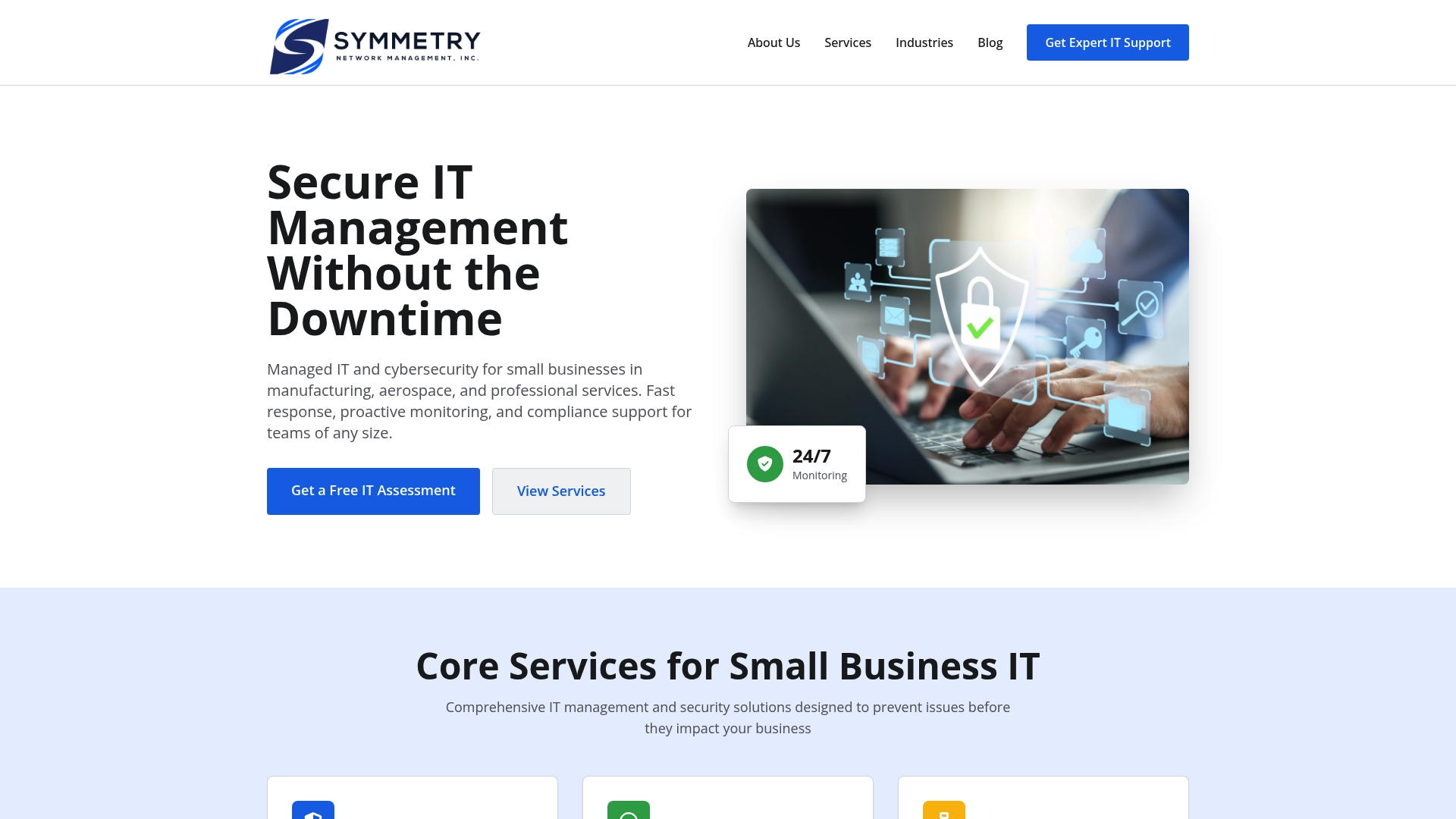
Symmnet provides managed IT services built for small businesses in regulated industries including manufacturing, aerospace, and professional services. Services include 24/7 system monitoring, endpoint security, firewall management, and audit-ready documentation support. Symmnet's fixed-price model gives compliance officers predictable costs without the overhead of a full internal IT team. If your business operates in a regulated industry and needs IT infrastructure that holds up under audit, a free assessment from Symmnet identifies exactly where your gaps are.
FAQ
What are the most common examples of compliance regulations?
The most cited compliance regulations across U.S. industries include HIPAA for healthcare data, SOX for public company financial reporting, OSHA for workplace safety, and EPA rules for environmental standards. Each carries distinct enforcement mechanisms and financial penalties for non-compliance.
What is the difference between a regulation and an industry standard?
A regulation is a legally binding government requirement enforced by agencies like OSHA or the SEC, with fines or criminal liability for violations. An industry standard like ANSI or ASTM is voluntary and consensus-driven, carrying no legal penalty but potentially affecting market access.
How often do compliance regulations change?
Compliance regulations change frequently, driven by new legislation, agency rulemaking, and court decisions. The SEC's cybersecurity disclosure rule took effect in 2023, and DORA became mandatory for EU financial institutions in january 2025, showing that the pace of regulatory change is accelerating.
What happens if a small business fails a compliance audit?
Failed audits result in fines, corrective action plans, and in serious cases, criminal referrals or loss of operating licenses. The most common audit failure cause is insufficient documentation, not the absence of policies.
How should a small business start building a compliance program?
Identify which regulations apply to your industry and data types first, then assign named owners to each requirement. Integrate compliance checkpoints into hiring, IT, and financial reporting workflows rather than managing compliance as a separate project.