

Most manufacturers treat compliance the same way they treat fire extinguishers: necessary to have, painful to think about, and only truly appreciated after something goes wrong. That framing costs real money. The role of compliance in manufacturing goes far beyond meeting regulatory requirements. When structured correctly, compliance functions as the backbone of operational consistency, product quality, and risk control. This guide breaks down what compliance actually looks like on the production floor in 2026, where manufacturers most commonly get it wrong, and how a mature compliance program translates directly into competitive and financial advantage.
Table of Contents
- Key takeaways
- The role of compliance in manufacturing explained
- How compliance improves efficiency and quality
- Risk management and regulatory protection
- Common pitfalls in compliance programs
- Building an effective compliance framework
- My take: compliance as a competitive differentiator
- How Symmnet supports manufacturing compliance
- FAQ
Key takeaways
| Point | Details |
|---|---|
| Compliance drives efficiency | Standardized compliance controls reduce process variability, rework, and unplanned downtime. |
| Documentation quality matters | Records must meet ALCOA+ principles or regulators treat them as nonexistent regardless of actual quality. |
| Proactive programs protect revenue | Routine risk-based auditing limits audit scope and reduces financial exposure during inspections. |
| Automation without process reform fails | Digitizing flawed workflows produces non-compliant records faster, not better compliance outcomes. |
| IT and compliance must integrate | Aligning IT security with compliance functions creates audit-ready, secure data environments. |
The role of compliance in manufacturing explained
Compliance in manufacturing is not a single rulebook. It is a layered set of regulatory requirements, industry standards, and internal controls that govern how products are designed, produced, documented, and delivered. Understanding that scope is the first step toward using compliance strategically rather than reactively.
At the regulatory level, manufacturers must navigate frameworks that vary significantly by sector:
- Pharmaceuticals and biotech: FDA Current Good Manufacturing Practices (cGMP) and 21 CFR Parts 210/211 govern production controls, quality systems, and data integrity.
- Food manufacturing: FSMA regulations require hazard analysis, preventive controls, and supplier verification programs.
- Automotive: IATF 16949 certification aligns quality management with global automotive supply chain requirements.
- Environmental compliance: ISO 14001:2026, which replaced the 2015 version as of April 15, 2026, is now a critical supply chain standard for any manufacturer with environmental impact. Over 670,000 organizations worldwide hold ISO environmental certifications, reflecting how widely these standards are expected by partners and customers alike.
Beyond external regulations, internal compliance controls span the entire production cycle. That means raw material qualification, equipment calibration, in-process monitoring, finished product testing, and workplace safety programs all carry compliance obligations. Tailored compliance routines by sector maintain consistent core controls while adapting to unique risk profiles, such as allergen management in food or process validation in pharmaceutical manufacturing.
Pro Tip: Map your compliance obligations by production stage, not just by regulatory category. This gives your team a clear picture of where gaps are most likely to surface during an audit.
How compliance improves efficiency and quality
This is where most manufacturers leave real operational value on the table. Compliance procedures, when built into daily workflows rather than bolted on as an afterthought, directly improve process consistency and reduce costly quality failures.
Here is how that works in practice:
- Process standardization reduces variability. Standard operating procedures required by compliance frameworks force your team to perform tasks the same way every time. That consistency is what eliminates the batch-to-batch variation that drives rework costs up and throughput down.
- Real-time documentation catches deviations early. Compliance in manufacturing requires adherence to ALCOA+ data integrity principles, meaning records must be attributable, legible, contemporaneous, original, and accurate. Without meeting those standards, records are treated as nonexistent by regulators regardless of actual product quality. More practically, real-time records give your quality team the signal to intervene before a minor deviation becomes a full batch failure.
- Audit readiness prevents production disruption. Manufacturers who maintain immutable, real-time audit trails from raw material receipt through machine calibration and batch release avoid the scramble of reconstructing historical records during inspections. That scramble pulls supervisors and engineers off the production floor for days or weeks.
- Compliance integration reduces waste. When quality checkpoints are embedded in production workflows rather than added at the end, defect rates drop and scrap volumes shrink. That reduction flows directly to margin.
The connection between compliance and operational efficiency is not theoretical. Companies that build compliance into production design see measurably fewer nonconformances and faster cycle times than those treating compliance as an end-of-process check.
Risk management and regulatory protection
Reactive compliance is expensive. A manufacturer who only addresses compliance gaps when regulators come knocking faces a very different financial exposure than one running a proactive program. Proactive compliance programs reduce audit duration and limit financial exposure by restricting the scope of repayment calculations and enforcement actions.

The difference between proactive and reactive compliance approaches is significant:
| Compliance Approach | Audit Outcome | Financial Risk |
|---|---|---|
| Reactive (fix when flagged) | Broad scope, extended review | High exposure, potential shutdown |
| Proactive (routine risk-based audits) | Narrow scope, faster resolution | Limited exposure, minimal disruption |
Regulators are not simply looking for documented policies. Active oversight and accountability are what weigh most heavily in enforcement decisions. A manufacturer who can demonstrate responsiveness to deviations and show systemic corrective actions fares far better than one who hands over a binder of procedures that staff cannot articulate.
The 2026 regulatory environment adds urgency. Pharmaceutical manufacturers, for example, must submit onshoring agreements within 30 days of May 14, 2026, to avoid 100% tariffs effective September 29, 2026. Missing that deadline is not a paperwork inconvenience. It is an existential financial risk for affected producers. Staying ahead of regulatory timelines is not bureaucratic diligence. It is revenue protection.
Environmental compliance carries similar stakes. Spray finishing and coating operations, for instance, now face updated environmental controls tied to air quality standards. Understanding how spray booth air quality requirements connect to your ISO 14001 obligations helps manufacturers avoid violations that trigger both fines and reputational damage.
Common pitfalls in compliance programs
Even manufacturers with genuine commitment to compliance make mistakes that undermine their programs. Knowing what those mistakes look like is half the battle.
The most expensive error is digitizing a broken process. Automating chaotic or inefficient workflows without redesigning them first produces non-compliant records faster, not compliant ones. If your paper-based deviation process was inconsistent before you moved it to a digital platform, the digital version will be inconsistent at scale. The technology amplifies the problem rather than solving it.
AI-generated documentation carries a specific and growing risk. A 2026 FDA warning letter highlighted the dangers of AI-generated manufacturing documents used without human review or quality unit oversight. Polished formatting does not substitute for operationalized quality controls. Regulators can identify AI-generated content that lacks the specificity and traceability of genuine process records, and that identification triggers deeper scrutiny.
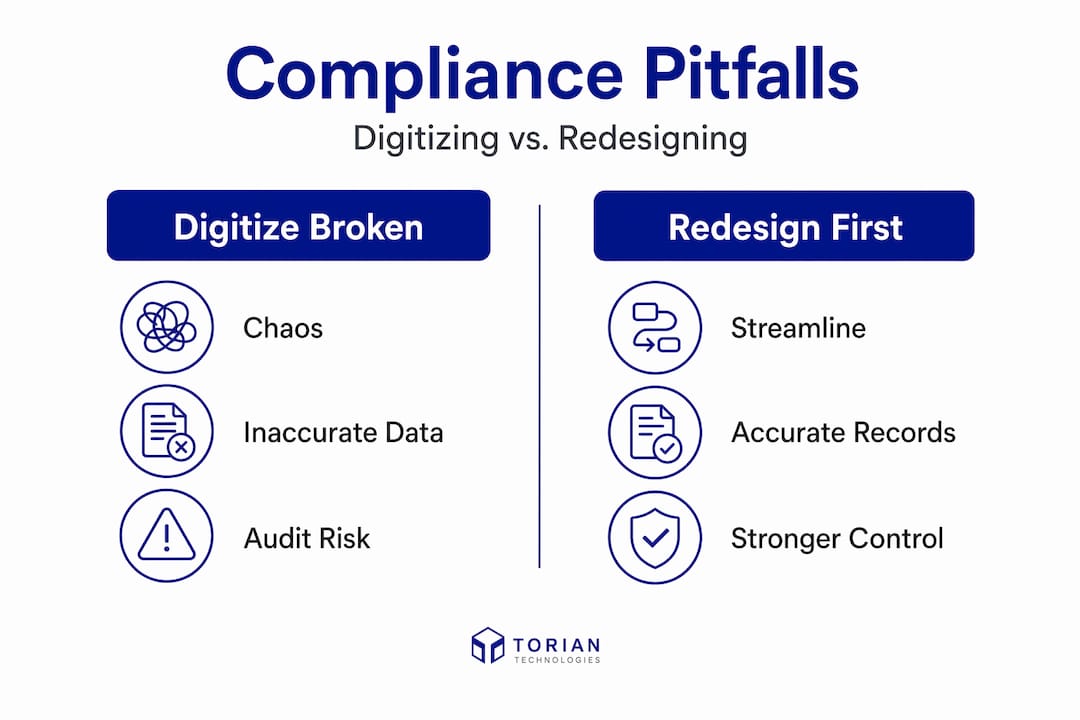
Pro Tip: Before adopting any digital compliance tool, audit the underlying process it will support. Clean up the workflow on paper first, then apply technology to a process that already works.
Other common pitfalls include:
- Point-in-time compliance. Passing an audit and then letting controls drift is not compliance. It is a postponed crisis. Regulators increasingly expect evidence of continuous control, not period-end clean-ups.
- Compliance without traceability. Demonstrable control and traceability enable manufacturers to respond to production issues and regulator inquiries effectively. If you cannot trace a non-conforming batch back through every stage of production within hours, your compliance program has a structural gap.
- Overlooking IT security as a compliance risk. Data integrity failures frequently originate from IT vulnerabilities rather than procedural gaps. Your manufacturing cybersecurity posture directly affects the security and authenticity of your compliance records.
Building an effective compliance framework
Compliance programs that actually work share a common structure. They are governed, owned, measured, and integrated with the broader operating environment.
Here is a practical framework for manufacturing leaders:
- Establish governance and change control. Define who approves changes to processes, equipment, and documentation. Without structured change control, compliance gaps appear every time a well-meaning team member improvises a workaround.
- Assign clear ownership. Clear ownership of compliance tasks improves accountability and speeds corrective action closure. Every procedure and every control point should have a named owner, not just a department.
- Adopt digital tools that support traceability. Look for platforms that create time-stamped, user-attributed records automatically. The goal is audit readiness as a byproduct of normal operations, not as a separate activity.
- Set measurable compliance KPIs. Track metrics like deviation closure time, audit finding recurrence rate, and training completion rates. What gets measured gets managed. Compliance metrics belong in the same operational reviews as throughput and OEE.
- Integrate IT security and compliance functions. Aligning IT security with compliance creates secure data flows and audit-ready environments. This is especially relevant for manufacturers subject to IT compliance obligations tied to customer contracts or industry certifications.
| Compliance KPI | What It Measures | Target |
|---|---|---|
| Deviation closure rate | Speed of corrective action resolution | 90%+ closed within 30 days |
| Audit finding recurrence | Effectiveness of root cause analysis | Less than 10% repeat findings |
| Training completion rate | Staff readiness and competency | 100% prior to task assignment |
| Change control cycle time | Governance efficiency | Under 14 days for standard changes |
My take: compliance as a competitive differentiator
I've watched manufacturing leaders spend considerable energy resisting compliance investments, framing them as cost centers that slow production. What I've consistently seen play out differently in practice is this: the operations with mature compliance programs move faster, not slower, when problems arise.
When a quality event hits, the team with real-time traceability and clear ownership has a root cause identified and a corrective action in progress within 24 hours. The team relying on reconstructed paper records is still looking for the batch record three days later while the production line sits.
What I've also learned is that compliance is not a static program you build once and maintain. It is a dynamic risk management framework requiring active leadership and governance. The manufacturers who treat it that way consistently outperform their peers on audit outcomes, customer retention, and operational resilience. That is not a coincidence. Compliance done right creates the verifiable, repeatable processes that customers and regulators trust, and that trust is genuinely hard to replicate.
— Michael
How Symmnet supports manufacturing compliance
For manufacturing businesses managing complex compliance obligations, the technology infrastructure underneath those programs is as critical as the programs themselves. Symmnet provides managed IT and compliance-focused services purpose-built for small manufacturers, including 24/7 system monitoring, endpoint security, backup and recovery, and audit-ready data environments.
Symmnet helps manufacturers align IT security with compliance requirements, so your records stay protected, traceable, and accessible when regulators come calling. Whether you are working toward ISO certification, FDA audit readiness, or simply need secure infrastructure that supports your quality management system, Symmnet offers a free assessment to identify gaps and map out a clear path forward. Contact Symmnet today to see how the right IT foundation makes compliance a strength rather than a liability.
FAQ
What is the role of compliance in manufacturing?
Compliance in manufacturing governs how products are produced, documented, and delivered to meet regulatory, safety, and quality standards. When structured effectively, it drives process consistency, reduces defects, and protects manufacturers from costly enforcement actions.
How does compliance affect manufacturing efficiency?
Compliance procedures standardize production workflows, catch deviations in real time, and reduce the rework and waste that come from process variability. Manufacturers with audit-ready documentation also avoid the operational disruption that comes from scrambling during inspections.
What are the most important compliance standards for manufacturers in 2026?
Key standards include ISO 14001:2026 for environmental management, FDA cGMP for pharmaceutical production, IATF 16949 for automotive quality, and FSMA for food manufacturing. The specific standards that apply depend on your sector, product type, and customer requirements.
What is the biggest compliance mistake manufacturers make?
The most damaging mistake is digitizing broken workflows without fixing the underlying processes first. Automating a flawed compliance process produces non-compliant records more efficiently, not better compliance outcomes.
Why does IT security matter for manufacturing compliance?
IT security directly protects the integrity and authenticity of compliance records. Data breaches or system vulnerabilities can compromise audit trails and documentation, turning a cybersecurity incident into a regulatory compliance failure simultaneously.