

IT compliance services are the structured set of activities, controls, and documentation that keep your business aligned with regulatory requirements and ready for an audit at any given moment. For most small and mid-sized businesses, the relevant frameworks include HIPAA (healthcare data), PCI DSS (payment card data), SOC 2 (service organization trust), NIST CSF (general cybersecurity posture), GLBA (financial data), and ISO 27001 (information security management). The core goals are consistent: collect defensible evidence, close control gaps before auditors find them, and maintain that posture continuously rather than scrambling every twelve months. The single best next step for an SMB is to request a scoped readiness assessment from a managed compliance provider and ask specifically for a control-by-control scope matrix that names who owns each control and what the evidence delivery SLA is.
Table of Contents
- What do IT compliance services actually include?
- Which regulations and frameworks do IT compliance services cover?
- How does a compliance engagement actually work?
- Why do SMBs outsource IT compliance instead of handling it in-house?
- What should you budget for timeline and cost?
- How do you choose the right IT compliance provider?
- How Symmnet delivers compliance services for U.S. SMBs
- Key Takeaways
- The case for keeping compliance practical
- Symmnet's managed compliance service: what you get and how to start
- Useful sources and further reading
What do IT compliance services actually include?
A compliance engagement covers far more than a checklist review. Here is what a complete service package should deliver:
- Scoping and discovery. Identifies which systems, data flows, and personnel fall within the regulatory boundary. Scope creep in either direction wastes money or creates audit exposure.
- Gap analysis. Maps your current controls against the target framework's requirements and produces a prioritized list of deficiencies.
- Policy and controls design. Drafts or updates your Written Information Security Program (WISP), acceptable-use policies, access-control procedures, and incident-response plans.
- Evidence collection and evidence registry. Gathers the screenshots, logs, configuration exports, and signed attestations that auditors actually request. A well-run engagement maintains a live evidence registry tied to each control.
- Remediation and hardening. Closes the gaps identified in the analysis: patching, MFA rollout, network segmentation, encrypted backups, role-based access controls.
- Continuous monitoring and control validation. Integrates compliance telemetry with your SIEM, endpoint detection, and identity tools so that audit evidence generates automatically from daily security operations rather than from a separate documentation effort.
- Penetration testing and vulnerability scanning. Provides the external validation that most frameworks require at least annually.
- Audit coordination and report facilitation. Manages the auditor relationship, responds to evidence requests, and prepares the final report package.
- Training and tabletop exercises. Builds staff awareness and tests your incident-response plan under realistic conditions.
Delivery models vary. An advisory engagement means the provider guides your team but your staff owns execution. A co-managed model splits ownership by control domain. A fully managed model means the provider runs evidence collection, monitoring, and auditor coordination end to end. The distinction matters because "fully managed" without a written scope matrix often means your team still owns the hard parts.
Pro Tip: Before signing any contract, request a control-by-control scope matrix. It should name the responsible party for each control, the evidence type required, and the SLA for delivery. If a provider cannot produce this document during the sales process, that tells you something important about how they operate.
Which regulations and frameworks do IT compliance services cover?
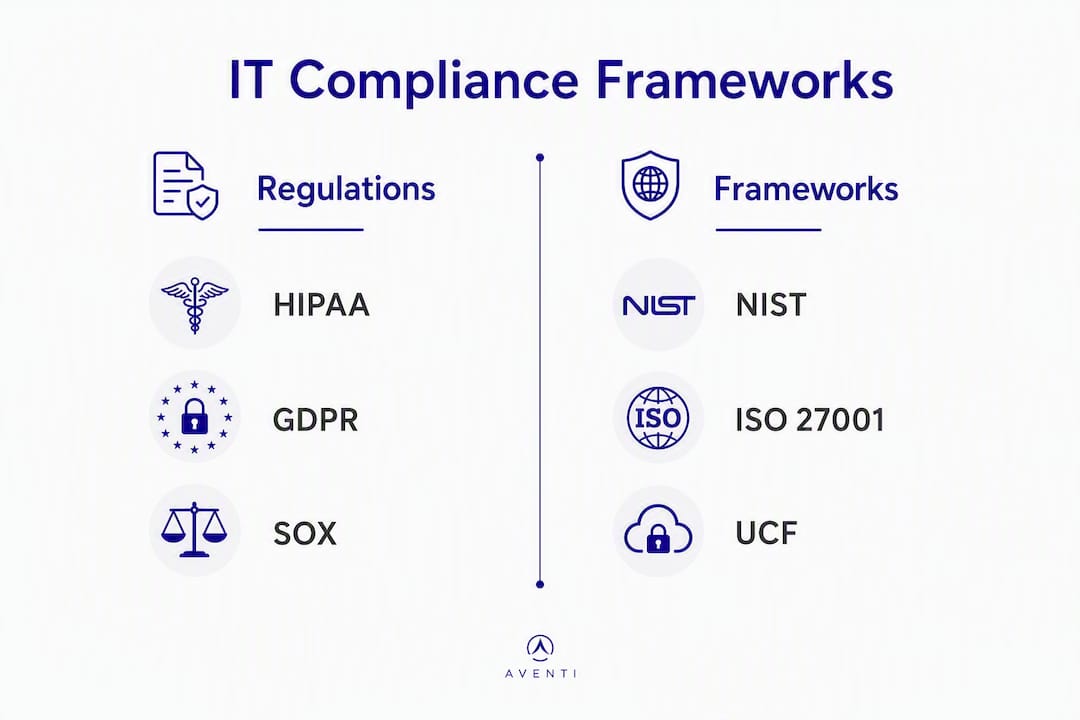
The frameworks your business needs depend on the data you handle and the customers you serve. Here is a quick-reference overview:
| Framework | Who typically needs it | Core focus |
|---|---|---|
| HIPAA | Healthcare providers, insurers, business associates | Protected health information (PHI) privacy and security |
| PCI DSS | Any business that processes, stores, or transmits card data | Cardholder data environment security |
| SOC 2 | SaaS companies, MSPs, service orgs with enterprise customers | Trust service criteria: security, availability, confidentiality |
| NIST CSF | Any U.S. business seeking a risk-based security baseline | Identify, protect, detect, respond, recover |
| GLBA | Banks, credit unions, financial advisors, insurance firms | Consumer financial data safeguards |
| ISO 27001 | Organizations with international customers or supply-chain requirements | Information security management system (ISMS) |
A few practical notes for SMBs:
- Manufacturing businesses supplying aerospace or defense primes often face NIST CSF and CMMC requirements simultaneously.
- Professional services firms handling client financial data may need both SOC 2 and GLBA coverage.
- The FTC Safeguards Rule and HIPAA both require a documented security program, a named responsible person, risk analyses, MFA, encryption, and regular testing — a baseline that overlaps heavily with NIST CSF controls.
The overlap between major frameworks is significant and variable. A Unified Controls Framework (UCF) approach lets you build a control once and map it to multiple frameworks, cutting duplicated effort and audit fatigue. For manufacturing businesses specifically, the IT compliance requirements for your industry often layer operational technology controls on top of these standard frameworks.
How does a compliance engagement actually work?
Most engagements follow a five-phase model. The timeline varies by complexity, but the sequence is consistent.
- Scoping and discovery (weeks 1–3). The provider inventories in-scope systems, data flows, third-party vendors, and personnel. Output: a written scope statement and a preliminary control list.
- Risk assessment and gap analysis (weeks 3–6). Each control is tested against current state. Output: a gap report with risk ratings and a prioritized remediation roadmap.
- Remediation and implementation (months 2–6+). Your team and the provider close gaps in priority order: MFA, encrypted backups, access reviews, policy documentation, network segmentation. Output: updated configurations, signed policies, and a growing evidence repository.
- Continuous monitoring and control validation (ongoing). Compliance tooling integrates with your security stack so that telemetry from IAM, SIEM, and endpoint tools feeds the evidence registry automatically. Integrated compliance turns the annual audit scramble into a continuous operating state, catching control drift between audits rather than during them. Organizations using an integrated ISMS reduced average time to comply with ISO 27001 from 15.5 months to 8.8 months and reported better visibility and fewer incidents.
- Pre-audit readiness and audit coordination. The provider assembles the evidence package, responds to auditor requests, and manages the audit timeline. Output: audit report, letter of attestation, or certification.
A control-by-control RACI (Responsible, Accountable, Consulted, Informed) is the document that makes this sequence work. Without it, remediation stalls because no one knows who owns the fix. Ask for it in writing before the engagement starts.
Timeline frames: a rapid readiness sprint for a single framework with a small scope runs 3–6 months. A typical SMB engagement covering one or two frameworks runs 6–12 months. Multi-framework or higher-complexity environments (manufacturing OT, cloud-heavy architectures) often require 12 months or more.

Why do SMBs outsource IT compliance instead of handling it in-house?
Building an internal compliance function from scratch requires a security analyst, a compliance manager, a GRC platform license, and the institutional knowledge to run audits. For most SMBs, that overhead is neither practical nor affordable. Outsourcing to a managed compliance provider delivers several concrete advantages:
- Faster readiness. A provider with a pre-built control library and auditor relationships compresses the timeline significantly. Organizations using an integrated ISMS reduced average time to comply with ISO 27001 from 15.5 months to 8.8 months.
- Predictable monthly cost. Fixed-fee managed models replace unpredictable project billing and eliminate the cost of a full-time compliance hire.
- Access to specialist expertise. A virtual CISO (vCISO) and dedicated compliance engineers bring framework-specific experience that a generalist IT team rarely has.
- Evidence collection automation. When compliance workflows live in one system, executive reporting and evidence assembly shift from hours of manual work to minutes.
- Auditor coordination. Providers who run audits regularly know what auditors want and how to present evidence cleanly, reducing back-and-forth and audit duration.
- Multi-framework efficiency. A provider running a unified control set maps shared controls once and reuses evidence across frameworks, cutting duplicated effort when you add a second or third certification.
The operational case is straightforward: compliance integrated into daily security operations becomes measurable and continuous. Your team detects and fixes control drift between audits rather than discovering gaps when the auditor arrives.
What should you budget for timeline and cost?

Cost and timeline both depend on scope. The table below gives realistic ranges for common SMB scenarios.
| Scenario | Typical timeline | Primary cost drivers |
|---|---|---|
| Single framework, small scope (e.g., SOC 2 Type I) | 3–6 months | Gap analysis, policy work, evidence setup |
| Single framework, typical SMB | 6–12 months | Remediation effort, monitoring setup, audit fees |
| Two frameworks, moderate complexity | 6–12 months | Control harmonization, additional audit coordination |
| Multi-framework or OT/cloud-heavy environment | 12+ months | Platform integration, segmentation, extended monitoring |
The variables that move cost most are:
- Scope breadth. More in-scope systems mean more evidence items and more remediation work.
- Cloud complexity. Multi-cloud or hybrid environments require CSPM tooling and additional configuration reviews.
- Remediation depth. A business with no existing security controls will spend more on implementation than one that already has MFA and encrypted backups in place.
- Provider model. A fully managed provider who runs your platform tenant and delivers audit coordination end to end costs more per month than an advisory engagement, but typically costs less in total when you factor in staff time and audit prep hours.
Deliverables to expect at each tier: an assessment-only engagement produces a gap report and remediation roadmap. A managed engagement adds policy documentation, an evidence repository, continuous monitoring, and audit coordination. A full-service package includes penetration testing, DR validation, and a named vCISO.
For manufacturing businesses, automating compliance workflows and evidence collection can meaningfully reduce the manual labor cost at every tier.
How do you choose the right IT compliance provider?
The sales process for compliance services is where scope surprises are planted. Here is a structured evaluation approach.
Questions to ask during the sales process:
- Can you provide a control-by-control scope matrix before we sign?
- Who specifically owns evidence collection for each control domain?
- Is there a named engineer or vCISO assigned to our account?
- What is the written SLA for evidence delivery and customer security questionnaire turnaround?
- Do you coordinate directly with our auditor, or do we manage that relationship?
- Are audit fees included in the monthly retainer, or billed separately?
- Who holds the platform tenant, and what are the exit terms if we change providers?
Red flags to watch for:
- The provider defines "managed" verbally but cannot produce a written scope matrix. Many buyers discover the missing work around month four when auditors request evidence that was never collected.
- No written SLA on evidence collection or questionnaire response time.
- The provider insists on owning your evidence registry without clear exportability guarantees. Best practice is for the customer to hold the platform tenant or have contract terms that guarantee exportability of evidence and control mappings.
- Pricing described as "all-in" but with audit fees, penetration testing, and remediation billed separately.
Trust signals that indicate a reliable provider:
- Named engineer and vCISO assigned at contract signing, not after onboarding.
- Independent audit coordination with documented auditor relationships.
- Exportable evidence and platform-agnostic delivery.
- Published case studies with specific framework outcomes.
- Fixed monthly pricing with clear renewal terms and no lock-in on your evidence data.
How Symmnet delivers compliance services for U.S. SMBs
Symmnet (Symmetry Network Management) structures every compliance engagement around a scoped readiness assessment before any contract is signed. The assessment produces a control-by-control gap report mapped to the frameworks relevant to your business, whether that is HIPAA for a healthcare-adjacent operation, NIST CSF for a manufacturer supplying regulated customers, or SOC 2 for a professional services firm with enterprise clients.
The managed service model is fixed monthly pricing with no hidden audit fees. A named engineer is assigned at onboarding, and a vCISO is available for executive reporting and auditor coordination. Key service features include:
- 24/7 system monitoring with evidence-ready telemetry feeding the compliance registry automatically.
- Endpoint security, firewall management, and network segmentation configured to meet framework-specific requirements.
- Backup and disaster recovery with documented DR validation, producing the continuity evidence auditors require.
- Penetration testing and vulnerability scanning on a scheduled cadence.
- Microsoft 365 management with audit logging and access controls aligned to your compliance scope.
- Audit coordination: Symmnet manages the auditor relationship and assembles the evidence package.
Symmnet's focus is specifically on small U.S. businesses in manufacturing, aerospace, professional services, and FDA-regulated sectors — industries where the cost of a compliance failure is operational, not just financial.
Book a readiness assessment to get your control-by-control gap report and a plain-language remediation roadmap.
Key Takeaways
Outsourcing IT compliance services to a managed provider with a written scope matrix and fixed pricing is the most reliable path for SMBs to reach and maintain audit readiness across HIPAA, PCI DSS, SOC 2, NIST CSF, GLBA, and ISO 27001.
| Point | Details |
|---|---|
| Start with a scope matrix | Require a control-by-control document naming owners and evidence SLAs before signing any contract. |
| Framework overlap is real | Control overlap between major frameworks runs 40–70%; a unified control set cuts duplicated effort across certifications. |
| Integrated compliance saves time | Organizations using an integrated ISMS reduced average time to comply with ISO 27001 from 15.5 months to 8.8 months and reported better visibility and fewer incidents. |
| Watch for scope surprises | Many buyers discover missing evidence collection around month four; get SLAs in writing upfront. |
| Symmnet for U.S. SMBs | Symmnet delivers fixed-price managed compliance with a named engineer, 24/7 monitoring, and audit coordination for small businesses. |
The case for keeping compliance practical
Most compliance conversations start with the frameworks and end with the fear. What gets lost is the practical reality that a small business does not need a perfect security program to pass an audit. It needs a documented, consistent, and defensible one.
The SMBs that struggle most with compliance are not the ones with the weakest controls. They are the ones that outsourced to a provider who never defined scope clearly, or tried to build an internal program without the staff to maintain it. The frameworks themselves — HIPAA, NIST CSF, SOC 2 — are written to be scalable. A 20-person manufacturer and a 2,000-person enterprise can both achieve SOC 2 certification; the scope just looks different.
The practical implication: prioritize a provider who will show you the scope matrix before you sign, assign a named engineer on day one, and hold your evidence in a tenant you control. Those three conditions predict engagement success better than any certification the provider holds. Fixed pricing matters too, but only after scope is defined. A fixed price on an undefined scope is just a different kind of risk.
Symmnet's managed compliance service: what you get and how to start
Small businesses in manufacturing, aerospace, and professional services face compliance requirements that a generic IT provider is not equipped to handle. Symmnet's managed compliance service is built specifically for that gap: fixed monthly pricing, a named engineer from day one, and a readiness assessment that produces a real gap report before you commit to a full engagement.
The service covers the full compliance lifecycle: scoped assessment, gap analysis, policy documentation, evidence collection, continuous monitoring, penetration testing, and audit coordination. No hidden fees for audit prep. No ambiguity about who owns the evidence. Your data stays in a tenant you control.
To get started, request a readiness assessment from Symmnet. The assessment maps your current controls against the frameworks relevant to your business and delivers a prioritized remediation roadmap you can act on immediately, whether you engage Symmnet for the full managed service or handle remediation internally.
Useful sources and further reading
The sources below are the primary references for the frameworks and regulatory requirements discussed in this article. Consult them when verifying specific control requirements or preparing for a regulatory review.
- Cybersecurity for Small Business — Federal Trade Commission: The FTC's practical guidance for SMBs, covering the NIST CSF baseline, network security, and common attack vectors. Start here for a plain-language overview of your baseline obligations.
- GLBA Safeguards Rule — FTC: The authoritative source for financial data protection requirements under the Gramm-Leach-Bliley Act, including the updated Safeguards Rule requirements for financial institutions.
- NIST Cybersecurity Framework — NIST.gov: The primary reference for the NIST CSF, including the CSF 2.0 update. Use this when scoping a risk-based security program or mapping controls to the Identify/Protect/Detect/Respond/Recover functions.
- Small Business Cybersecurity: Non-Employer Firms — NIST CSRC: NIST's guidance specifically for small firms with minimal IT complexity; useful for establishing a minimum viable control baseline.
- Stay Legally Compliant — U.S. Small Business Administration: The SBA's overview of federal and state compliance obligations for small businesses, including record-keeping and reporting requirements.
This article provides general information about IT compliance frameworks and services. It is not legal or regulatory advice. Confirm current requirements with the relevant regulatory body or a qualified compliance professional before making compliance decisions for your business.