

IT service management (ITSM) is defined as the structured discipline of designing, delivering, managing, and continuously improving IT services to align with business goals. Unlike ad hoc IT support, ITSM treats every IT function as a managed service with defined processes, clear ownership, and measurable outcomes. Frameworks like ITIL (Information Technology Infrastructure Library) provide the best-practice guidelines, while platforms like ServiceNow and Atlassian translate those guidelines into daily operations. For small and mid-sized businesses, understanding the IT service management definition is the first step toward turning IT from a source of frustration into a reliable business asset.
What is IT service management and what does it include?

ITSM is the operational implementation of best-practice frameworks like ITIL, turning strategic concepts into daily IT management realities. It covers every process involved in delivering IT services to employees and customers, not just fixing broken computers. The scope includes people, documented processes, and the tools that support them.
Three elements make up every ITSM program:
- People: Service owners, IT managers, and support staff who are accountable for specific services
- Processes: Documented, repeatable workflows that govern how IT services are requested, delivered, and resolved
- Tools: Software platforms that automate and track those workflows, such as ServiceNow, Jira Service Management by Atlassian, or Freshservice
ITSM is often misunderstood as merely a help desk. The reality is that it encompasses change management, incident management, problem management, and asset management, all working together to align IT with business objectives.
What are the core ITSM processes and best practices?
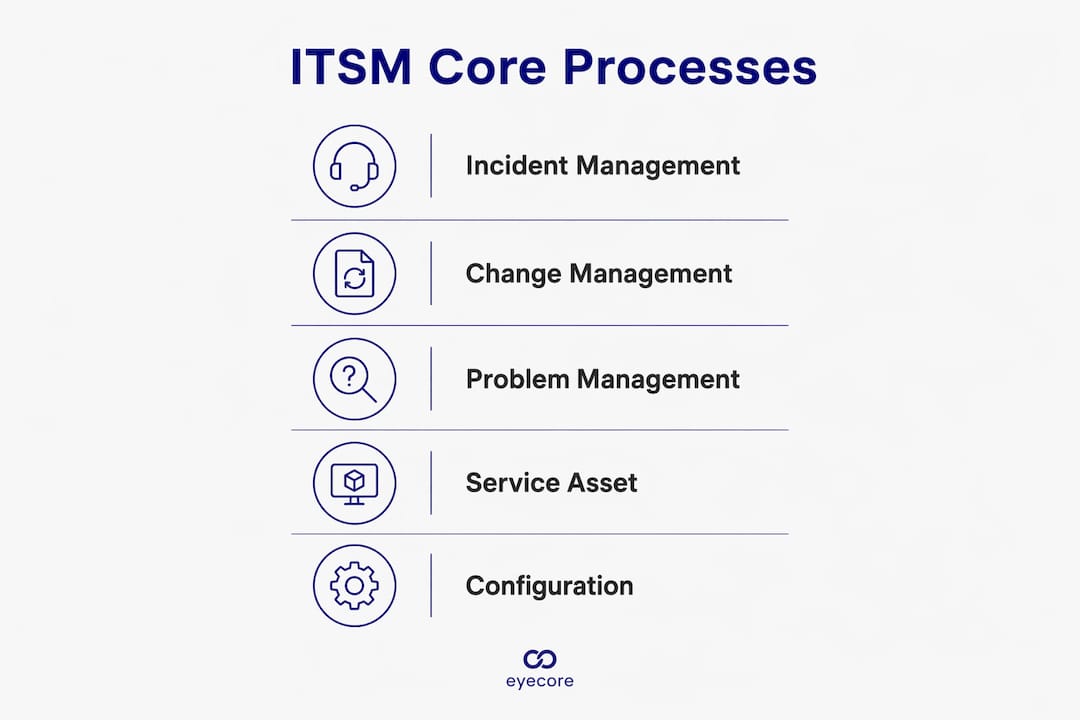
Five processes form the operational backbone of any ITSM program. Each one addresses a specific category of IT activity and contributes to overall service stability.
- Incident management: Restoring normal service as quickly as possible after an unplanned disruption. A server outage or a failed login are both incidents.
- Problem management: Identifying and eliminating the root cause of recurring incidents. Where incident management fixes the symptom, problem management removes the disease.
- Change management: Controlling how changes to IT systems are planned, approved, and implemented to reduce the risk of disruption.
- Service request fulfillment: Handling routine user requests like password resets, software installs, or new hardware provisioning through a defined, repeatable process.
- Asset management: Tracking hardware, software licenses, and configuration items throughout their lifecycle to control costs and reduce risk.
These processes contribute to stability because they replace improvised responses with repeatable workflows. When every technician follows the same incident process, resolution times drop and errors decrease.
Clear SLAs and KPIs are essential to codify service expectations and the consequences of failure. An SLA (Service Level Agreement) defines what the business can expect, such as a four-hour resolution time for critical incidents. A KPI (Key Performance Indicator) measures whether the team is meeting that expectation. Without both, accountability disappears.
Pro Tip: Standardize your processes before you automate them. Automating a broken or undocumented process only makes the problem faster. Map your workflows on paper first, then introduce tools.
Service ownership is the accountability piece that most small businesses skip. Every service needs a named owner who is responsible for its performance, documentation, and improvement. Without ownership, processes drift and SLAs become meaningless.
How do ITSM frameworks and tools compare?
ITIL is a best-practice framework, but ITSM is the actual daily operational execution of those principles inside your organization. ITIL tells you what good looks like. ITSM is how you get there.
One distinction that trips up many business leaders is the difference between ITSM and IT Operations Management (ITOM). ITSM focuses on end-user IT services such as support tickets and software requests, while ITOM manages backend infrastructure like servers and network equipment. Both are necessary. ITSM without ITOM is like a customer service team with no warehouse behind it.
The table below compares the leading ITSM frameworks and tools by focus area and best fit:
| Framework or Tool | Type | Primary Focus | Best Fit |
|---|---|---|---|
| ITIL 4 | Framework | Best-practice guidelines for service lifecycle | Organizations building or maturing ITSM programs |
| ServiceNow | Platform | Enterprise workflow automation and ITSM | Mid-to-large organizations with complex IT needs |
| Jira Service Management | Platform | Agile ITSM and developer-friendly workflows | Tech teams and growing SMBs |
| Freshservice | Platform | Simple ITSM with built-in asset management | Small businesses starting their ITSM journey |
| COBIT | Framework | IT governance and risk management | Regulated industries needing compliance alignment |
Pro Tip: Choose your ITSM tool based on where your organization is today, not where you want to be in five years. A small team of 20 people does not need ServiceNow. Freshservice or Jira Service Management will deliver 90% of the value at a fraction of the cost and complexity.
The right framework and tool combination depends on your team size, industry, and regulatory requirements. A manufacturing firm with AS9100 compliance obligations has different needs than a professional services firm with 15 employees.
What benefits does IT service management bring to small businesses?
ITSM transforms IT from a reactive cost center into a value-added strategic partner, improving efficiency and reducing costs. For small and mid-sized businesses, this shift is particularly significant because IT failures hit harder when there is no redundancy or backup team.
The measurable benefits include:
- Faster incident resolution: Defined escalation paths and documented runbooks mean technicians spend less time figuring out what to do and more time fixing the problem.
- Cost reduction: Organizations adopting ITIL frameworks eliminate redundant software licenses and reduce wasted IT spend through better asset visibility.
- Reduced downtime: Standardized processes eliminate risk by reducing reliance on individual experts who hold critical knowledge in their heads.
- Improved user satisfaction: Employees get consistent, predictable IT support instead of unpredictable outcomes that depend on who picks up the phone.
- Compliance support: Documented processes and audit trails make regulatory compliance far easier to demonstrate.
35% of organizations apply ITSM to improve customer experience, while 48% use it to enhance service quality. Those numbers reflect a clear shift: ITSM is no longer just an IT concern. It is a business performance tool.
"The biggest value of ITSM in smaller organizations is enforcing consistency through process standardization, which reduces reliance on individual experts." — Salesforce
For small manufacturers and aerospace suppliers, this consistency is not optional. A single unplanned outage on a production floor can cascade into missed delivery deadlines and compliance violations.
How does ITSM work in practice day to day?
ITSM operates across the full lifecycle of an IT service, from initial design through active delivery to continual improvement. Understanding this lifecycle helps business leaders see where their current IT operations fit and where the gaps are.
A practical ITSM workflow follows these stages:
- Service design: Define what the service does, who it serves, and what success looks like. Services should be defined from the user perspective as repeatable capabilities that deliver value, not just as technical components. "Email access for all staff" is a service. "Exchange Server 2019" is a component.
- Service catalog creation: Build a menu of available IT services that employees can request. A clear catalog reduces informal requests and sets consistent expectations.
- Request and incident intake: Users submit requests or report incidents through a defined channel, such as a ticketing system. Every submission gets logged, categorized, and assigned.
- Resolution and fulfillment: Technicians follow documented processes to resolve incidents or fulfill requests within the agreed SLA timeframe.
- Review and improvement: Teams analyze ticket data, SLA performance, and recurring problems to identify where processes need refinement.
Roles in an ITSM team typically include a service desk analyst who handles first-line support, a problem manager who investigates root causes, a change manager who governs system modifications, and a service owner who holds accountability for each service's performance.
Automation plays a growing role in steps three and four. Routine tasks like password resets, software provisioning, and system health alerts can be automated through platforms like Freshservice or Jira Service Management. Automation only works well, however, when the underlying process is already documented and stable. For small businesses, proactive management and automation for reliability represent the direction ITSM standards are moving in 2026.
A practical example: when a new employee joins a manufacturing company, an ITSM-driven onboarding workflow automatically triggers account creation, hardware provisioning, software licensing, and security access, all within a defined timeframe and without manual follow-up from a manager. That is ITSM working as designed.
Key Takeaways
Effective IT service management requires documented processes, clear service ownership, and the right tools chosen for your organization's current size and maturity.
| Point | Details |
|---|---|
| ITSM is more than a help desk | It covers incident, change, problem, and asset management aligned to business goals. |
| Process before automation | Standardize workflows on paper before introducing any ITSM software platform. |
| SLAs and KPIs are non-negotiable | Define measurable service expectations and track them consistently to maintain accountability. |
| Tool choice must match maturity | Small businesses benefit more from Freshservice or Jira than from enterprise platforms like ServiceNow. |
| ITSM reduces tribal knowledge risk | Documented processes protect small businesses when key staff are unavailable or leave. |
Why most small businesses get ITSM backwards
The most common mistake I see small and mid-sized businesses make is buying a tool and calling it ITSM. They purchase a ticketing system, point staff at it, and expect results. Six months later, the tool is underused, tickets pile up unresolved, and leadership concludes that ITSM "didn't work." The tool was never the problem.
ITSM depends on people and documented processes rather than solely on tools. Without process discipline, even the most advanced platforms cannot improve efficiency or reliability. The discipline has to come first.
The second misconception I encounter regularly is that ITSM is only for large enterprises. That thinking leaves small businesses exposed. A 30-person manufacturer without documented incident processes is one server failure away from a production shutdown. ITSM at that scale does not require a full-time IT department. It requires clear ownership, a simple service catalog, and a ticketing system that everyone actually uses.
The third thing I would tell any business leader: start with incident management and change management. Those two processes deliver the fastest visible return. Once your team sees the difference between a chaotic outage response and a structured one, buy-in for the rest of the program follows naturally.
ITSM is not a project with an end date. It is an operating model. The organizations that treat it that way, reviewing their processes quarterly and adjusting based on real data, are the ones that see IT become a genuine competitive advantage rather than a recurring headache.
— Michael
How Symmnet helps small businesses apply ITSM principles
Symmnet builds managed IT services around the same principles that make ITSM effective: documented processes, defined service ownership, clear SLAs, and proactive monitoring. Small businesses in manufacturing, aerospace, and professional services get the structure of a mature IT program without the overhead of building one from scratch. Symmnet's team handles incident response, asset management, change control, and IT monitoring so your staff can focus on operations rather than IT firefighting. Explore Symmnet's managed IT services to see how a structured approach to IT service delivery can reduce downtime and protect your business.
FAQ
What is the IT service management definition?
IT service management (ITSM) is the discipline of designing, delivering, managing, and improving IT services to align with business needs. It encompasses processes, people, and tools rather than just technical support functions.
How does ITSM differ from ITIL?
ITIL is a best-practice framework that describes what good IT service management looks like. ITSM is the actual daily execution of those principles inside your organization through defined processes and tools.
What are the main benefits of IT service management for small businesses?
ITSM reduces downtime, speeds up incident resolution, cuts wasted IT spend, and replaces reliance on individual experts with documented, repeatable processes that any trained team member can follow.
What ITSM tools work best for small and mid-sized businesses?
Freshservice and Jira Service Management are well suited to smaller organizations. Both offer core ITSM capabilities including ticketing, asset management, and SLA tracking without the complexity of enterprise platforms like ServiceNow.
How does ITSM relate to IT Operations Management?
ITSM focuses on end-user services such as support requests and software provisioning. IT Operations Management (ITOM) handles backend infrastructure like servers and networks. Most organizations need both to run IT effectively.