

A manufacturing data protection workflow is a structured, repeatable process for safeguarding sensitive manufacturing data and meeting industry cybersecurity standards by integrating asset management, tailored controls, and supply chain governance. The term "data protection workflow" is the practical, operational expression of what the industry formally calls an information security program adapted for manufacturing environments. For IT managers and manufacturing professionals, building this workflow correctly means addressing both IT networks and operational technology (OT) systems, such as programmable logic controllers and industrial control systems. Frameworks like NIST CSF 2.0, NIST SP 800-82, ITAR, NIS 2, and TISAX define the compliance boundaries you must work within. Getting this right in 2026 is not optional. Cyberattacks on manufacturers continue to rise, and regulators are tightening reporting requirements across every major jurisdiction.
What are the essential components of a manufacturing data protection workflow?
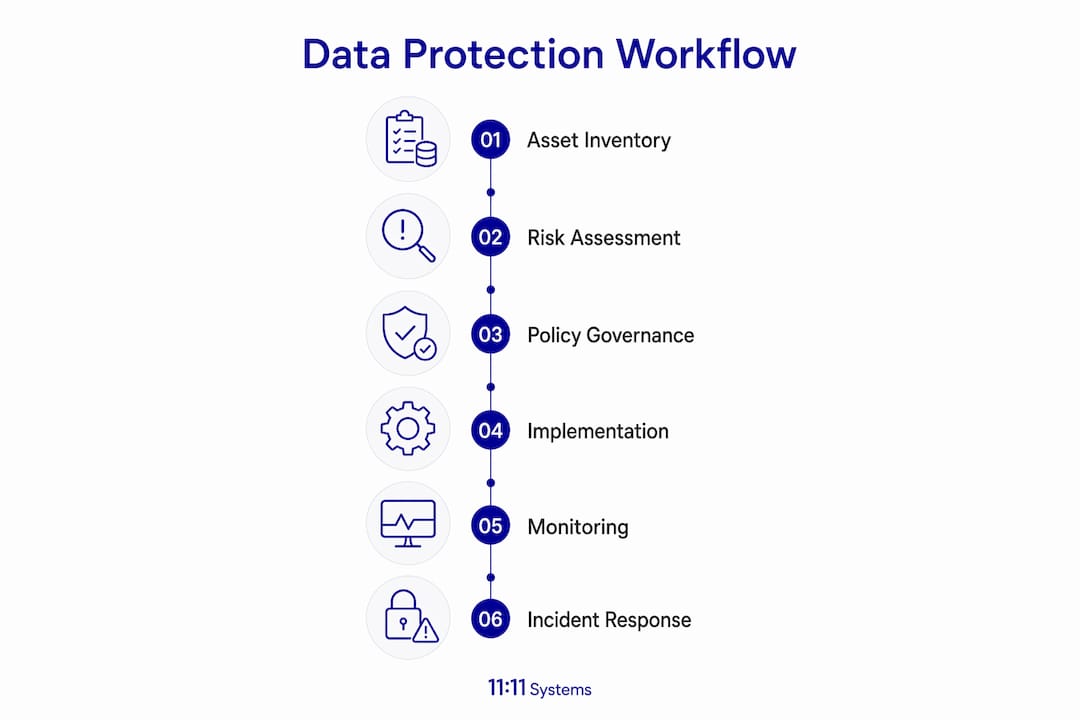
A manufacturing data protection workflow starts with knowing exactly what you have. Asset inventory is the foundational step; without a complete list of factory floor devices and their communication paths, security efforts have blind spots that attackers will find before you do. This means cataloging every OT device, IT endpoint, sensor, historian server, and network connection across your facility.
The core prerequisites for an effective workflow include:
- Comprehensive asset inventory: Document every OT device, IT system, and network segment. Include firmware versions, communication protocols, and vendor support status.
- OT/IT boundary mapping: Define where your corporate IT network ends and your operational technology network begins. This boundary is where most manufacturing breaches originate.
- Governance roles and policy oversight: Assign clear ownership for data protection decisions. The NIST CSF 2.0 Govern function covers 30% of manufacturing-specific subcategories, with supply chain risk management alone accounting for over 9% of those subcategories.
- Discovery and monitoring tools: Use passive network monitoring tools designed for OT environments. Active scanning can disrupt legacy industrial systems, so passive discovery is the safer starting point.
- Supply chain risk integration: Map your suppliers and identify which ones have access to your systems or sensitive data. This feeds directly into your governance structure.
Pro Tip: When selecting security tools for your OT environment, prioritize usability above feature count. Controls that operators find too slow or complex get bypassed, which creates more risk than having no control at all.
Governance is not a one-time document exercise. Policy oversight requires regular review cycles, named owners for each policy, and a clear escalation path when incidents occur. Small manufacturers often skip this step and pay for it during audits.

How to implement a step-by-step data protection workflow for OT and IT
Implementing OT data protection workflows follows four distinct phases. Each phase builds on the last, and skipping ahead creates gaps that are difficult to close later.
-
Phase 1: Asset inventory and security baseline. Complete your asset inventory and establish a security baseline for each system. Classify OT systems separately from IT systems. OT classification must account for availability impact, meaning a control that causes a 30-second delay in an IT system may halt an entire production line in an OT environment.
-
Phase 2: Apply NIST SP 800-82 control overlays. NIST SP 800-82 provides OT-specific guidance that adjusts standard IT security controls for industrial environments. Apply these overlays to your baseline. For example, patch management in OT follows maintenance windows tied to production schedules, not monthly IT patch cycles.
-
Phase 3: Risk-based remediation prioritization. Not every vulnerability gets fixed immediately. Prioritize remediation based on consequence: production loss, safety risk, and regulatory exposure rank highest. A vulnerability in an isolated historian server ranks lower than one in a system connected to your corporate network.
-
Phase 4: Continuous monitoring and incident response. Deploy monitoring tools that generate alerts without disrupting production. Your incident response plan must prioritize safety and production stability, not just data containment. Coordinate response procedures with operations staff and process engineers, not just the IT team.
| Phase | Key Activity | Primary Standard |
|---|---|---|
| 1. Asset inventory | Catalog all OT and IT assets with communication maps | NIST CSF 2.0 Identify |
| 2. Control overlays | Apply OT-specific security controls | NIST SP 800-82 |
| 3. Remediation | Prioritize by production and safety consequence | NIST CSF 2.0 Respond |
| 4. Monitoring | Continuous detection and incident coordination | NIST CSF 2.0 Detect |
Legacy OT systems present a specific challenge. Many older industrial control systems lack native logging or audit capabilities. The solution is compensating controls: network segmentation isolates the system, and centralized monitoring captures traffic at the network level rather than the device level. This approach satisfies auditors without requiring a full system replacement.
Pro Tip: Integrate OT backups into your change management process. OT backups must sync with production configurations. Restoring an OT backup that predates a firmware update can create an incompatible environment and extend downtime significantly.
What are the best methods to protect supply chain data and intellectual property?
Manufacturing data falls into three distinct categories, and each carries different compliance obligations. Personal data (employee and customer records) falls under GDPR. Operational data (production metrics, process parameters) falls under NIS 2. Controlled technical data, such as defense-related designs, falls under ITAR. Treating all three the same way is a compliance failure waiting to happen.
Protecting intellectual property shared with suppliers requires a specific approach. Applying standard IT file-sharing workflows to manufacturing IP creates shadow IT risk. Suppliers can end up with copies of CAD files or process specifications stored on uncontrolled systems in foreign jurisdictions. Possessionless collaboration tools solve this by using document-level digital rights management (DRM) to let suppliers view and annotate files without ever downloading them. The source file stays within your security perimeter.
Key technical and contractual controls for supply chain data protection include:
- Possessionless collaboration: Suppliers review and annotate CAD and technical documents without file transfer. This keeps controlled technical data within your jurisdiction.
- Immutable audit logs: Every access event records what was shared, with whom, when, and from which jurisdiction. These logs satisfy NIS 2 and ITAR reporting requirements and support the 24-hour incident reporting obligation triggered by supplier breaches.
- Jurisdiction-aware data residency: Store data in geographic regions that align with your regulatory obligations. Defense contractors must keep ITAR-controlled data within U.S. borders.
- Zero trust access controls: Grant suppliers the minimum access needed for each specific project. Revoke access automatically when the project closes.
- Contractual cybersecurity requirements: Require suppliers to meet defined security standards as a condition of the contract. Under NIS 2, supplier security assessments are mandatory, not optional.
Pro Tip: Run a supplier security assessment before granting any access to controlled technical data. A short questionnaire covering patch management, access controls, and incident response capability takes less than an hour and gives you documented due diligence.
Manufacturers handling defense-related technical data increasingly adopt possessionless data exchange platforms. These platforms meet nearly 90% of CMMC Level 2 controls out of the box, which significantly reduces the compliance burden for small manufacturers pursuing defense contracts.
How to maintain and troubleshoot data protection workflows for ongoing compliance
Sustained compliance comes from embedding evidence collection into daily operations, not from scrambling before an audit. Automated log collection aligned with NIST CSF 2.0 generates the evidence trail auditors need without requiring manual effort from your team. Set this up once, verify it monthly, and your audit readiness becomes a byproduct of normal operations.
Common mistakes that break manufacturing data protection workflows include:
- Applying IT security controls directly to OT systems without adjustment, which causes latency and operational friction
- Treating OT backups as separate from IT backups, leading to restore failures during incidents
- Failing to update the asset inventory after equipment changes or additions
- Skipping incident response drills with operations staff, leaving process engineers unprepared during actual events
- Relying on annual audits as the primary compliance check instead of continuous monitoring
Sustained compliance in manufacturing does not come from annual audits. It comes from building evidence generation into the daily rhythm of operations so that regulatory readiness is always current, not reactive. When your log management, access reviews, and change records are automated and aligned with NIST CSF 2.0, an audit becomes a reporting exercise rather than a crisis.
Troubleshooting legacy system compatibility is the most common maintenance challenge. When a new monitoring tool causes latency on a legacy programmable logic controller, the answer is not to remove the tool. The answer is to move monitoring to the network layer, where it captures the same data without touching the device. CISA advises balancing security with operational usability because controls that operators reject create more risk than the vulnerabilities they were meant to address.
Pro Tip: Automate evidence collection from day one. Configure your SIEM or log management platform to generate compliance-ready reports on a scheduled basis. This cuts audit preparation time and gives you a real-time view of your security posture.
Incident response in manufacturing requires coordination that goes beyond the IT team. ICS incident response must prioritize safety and production stability. Your incident plan should name specific operations staff and process engineers as response participants, not just cybersecurity personnel. Test the plan with tabletop exercises that include production scenarios, not just data breach scenarios.
Key Takeaways
A manufacturing data protection workflow succeeds when asset inventory, OT-specific controls, supply chain governance, and continuous monitoring work together as a single integrated program.
| Point | Details |
|---|---|
| Start with asset inventory | Catalog every OT device and IT system before applying any security control. |
| Use OT-specific controls | Apply NIST SP 800-82 overlays to avoid disrupting production with IT-only approaches. |
| Protect supply chain IP | Use possessionless collaboration tools to keep controlled technical data within your jurisdiction. |
| Automate evidence collection | Align log management with NIST CSF 2.0 to maintain continuous audit readiness. |
| Coordinate incident response | Include operations staff and process engineers in every incident response drill. |
What I've learned building manufacturing data protection workflows
The single biggest mistake I see manufacturing teams make is skipping the asset inventory because it feels tedious. Every time, that shortcut comes back as a blind spot during an incident or audit. You cannot protect what you cannot see. The asset inventory is not a prerequisite you complete once. It is a living document that needs to update every time a device is added, replaced, or reconfigured on the factory floor.
The second lesson is harder to accept: security controls that operators bypass are worse than no controls at all. I have seen facilities install technically sound access controls that the production team disabled within a week because the login delay was slowing output. CISA's guidance on operational usability exists for exactly this reason. If your security program creates friction that operators cannot tolerate, the program will fail regardless of how well it was designed.
The third insight is about compliance culture. Teams that treat compliance as a quarterly or annual event always struggle. Teams that build evidence generation into daily operations, through automated logging, scheduled access reviews, and routine change documentation, find that audits become straightforward. The NIST CSF 2.0 Govern function is built around this principle. Governance is not a document. It is a daily practice.
Finally, the IT and operations teams must work together. Cybersecurity decisions made without input from process engineers create controls that look good on paper and fail on the floor. The most effective workflows I have seen were built by teams that sat in the same room, understood each other's constraints, and designed solutions that both sides could live with.
— Michael
How Symmnet supports your manufacturing data protection program
Manufacturing cybersecurity is not a one-size-fits-all problem, and small manufacturers rarely have the internal resources to build and maintain a full data protection program on their own.
Symmnet provides managed IT services built specifically for manufacturing environments, covering 24/7 monitoring, endpoint security, firewall management, backup and recovery, and compliance support aligned with NIST CSF 2.0 and industry-specific regulations. The team understands the difference between IT and OT environments and designs controls that protect your data without disrupting production. If you want to know where your current program stands, Symmnet offers a free assessment to identify security gaps and prioritize your next steps. You can also review the manufacturing cybersecurity checklist to benchmark your current posture before the assessment.
FAQ
What is a manufacturing data protection workflow?
A manufacturing data protection workflow is a structured program that identifies, protects, monitors, and responds to threats against manufacturing data across both IT and OT environments. It integrates asset management, access controls, supply chain governance, and continuous monitoring into a single repeatable process.
Which frameworks apply to data security in manufacturing?
NIST CSF 2.0, NIST SP 800-82, ITAR, NIS 2, and TISAX are the primary frameworks governing data security in manufacturing. The applicable frameworks depend on your industry segment, geographic markets, and whether you handle defense-related technical data.
How do you protect manufacturing intellectual property shared with suppliers?
Possessionless collaboration tools use document-level DRM to let suppliers view and annotate technical files without downloading them, keeping controlled data within your security perimeter. Immutable audit logs record every access event to satisfy ITAR and NIS 2 reporting requirements.
What makes OT incident response different from IT incident response?
OT incident response must prioritize safety and production stability before data containment, which is the reverse of standard IT response priorities. Response plans require coordination with operations staff and process engineers, not just the cybersecurity team.
How often should a manufacturing data protection workflow be reviewed?
The asset inventory and control effectiveness should be reviewed continuously through automated monitoring, with a formal program review at least annually or after any significant change to production systems or regulatory requirements.