

IT risk assessment identifies, estimates, and prioritizes threats and vulnerabilities across your information systems, then maps each risk to its likelihood and potential impact so decision-makers can act with confidence. NIST SP 800-30 defines risk as a function of two variables: the likelihood that a threat source will exploit a vulnerability, and the magnitude of harm that exploitation would cause. That framing turns a vague sense of "something could go wrong" into a defensible, prioritized list your organization can actually use.
The core functions of IT risk assessment include:
- Identifying threats and vulnerabilities across systems, processes, and data assets
- Estimating likelihood based on threat-source capability, motivation, and existing control effectiveness
- Evaluating impact in terms of mission consequences, operational disruption, and data loss
- Prioritizing risks against your organization's defined risk tolerance and business objectives
- Supporting governance by feeding findings into frameworks like the NIST Risk Management Framework, which integrates assessment outputs with control selection, authorization, and continuous monitoring
- Enabling compliance by documenting risk posture for audits, regulatory reviews, and executive authorization decisions
Risk assessment is not a one-time audit. Organizations conduct it continuously across the system development life cycle at multiple levels, including organizational, mission/business process, and information system tiers.
Why organizations conduct IT risk assessments
The most direct reason to conduct an IT risk assessment is to find vulnerabilities before an attacker does. Waiting for an incident to reveal gaps is expensive and often irreversible. A structured assessment gives your security team a documented picture of where exposure exists and how severe each gap is, before it becomes a breach headline.
Beyond threat detection, risk assessments serve several strategic purposes:
- Governance and audit readiness: Documented risk findings demonstrate due diligence to auditors, regulators, and executive leadership. Federal agencies operating under FISMA and private organizations pursuing frameworks like ISO 27001 both rely on formal risk assessment records.
- Regulatory compliance: Industries including healthcare, defense contracting, and financial services face specific compliance requirements. A cybersecurity risk assessment maps your controls against those requirements and surfaces gaps before a regulator does.
- Cost justification for security spending: Security budgets compete with every other line item. Risk assessment quantifies exposure in terms executives understand, making it far easier to justify firewall upgrades, endpoint protection, or staff training.
- Alignment with business objectives: NIST guidance emphasizes connecting cybersecurity risk information to the broader enterprise risk management conversation, so executives can weigh IT risk alongside financial, operational, and reputational risk using a common language.
- Minimizing disruption: Identifying high-likelihood, high-impact risks early lets teams implement controls before an incident forces unplanned downtime, data recovery, or regulatory notification.
ISACA warns that assessments decoupled from specific decisions waste resources and produce findings that never translate into action. The assessment scope should always trace back to a concrete choice an executive or system owner needs to make.
Who is responsible for IT risk assessment?
Clear role assignment is what separates a risk assessment that drives decisions from one that sits in a shared drive. The NIST RMF Roles and Responsibilities Crosswalk defines accountability at every stage of the process.
Key roles and their responsibilities include:
- Authorizing Official (AO): Holds sole authority to accept risk and authorize a system for operation. The AO reviews assessment findings, determines whether residual risk is acceptable, and signs the authorization decision. No other role can substitute for this accountability.
- Risk Executive (Function): Provides organization-wide risk oversight, ensures risk decisions at the system level align with enterprise risk strategy, and communicates risk posture upward to senior leadership.
- Senior Information Security Officer (SISO): Develops and maintains the continuous monitoring strategy, assesses ongoing organization-wide security risk, and aligns information security management with budgetary and operational planning.
- System Owner: Conducts and continuously updates the system-level risk assessment, defines protection needs, and coordinates with the AO on categorization and control selection decisions.
- Security and Privacy Architects: Conduct system-level security and privacy risk assessments, coordinate authorization boundary definitions, and advise on control tailoring to match the system's specific risk profile.
- Control Assessors: Independently evaluate whether implemented controls are operating as intended and producing the desired security outcomes. Their objectivity is what makes assessment findings credible to the AO.
- Information System Security Officer (ISSO): Supports the system owner in selecting controls, participates in common control identification, and coordinates day-to-day assessment activities.
Separation of duties across these roles is not bureaucratic overhead. It creates the checks that make risk findings defensible in an audit or authorization review.
What are the foundational principles behind IT risk assessment?
Understanding the mechanics of risk assessment prevents the most common failure: producing likelihood and impact scores that are subjective, inconsistent, and impossible to defend. The principles below come directly from NIST SP 800-30 and the broader RMF ecosystem.

Risk is a function of likelihood and impact. Likelihood reflects the probability that a threat source will successfully exploit a vulnerability, considering the source's capability, intent, and targeting behavior alongside the effectiveness of existing controls. Impact reflects the magnitude of harm to the organization's mission, assets, and data if that exploitation occurs.
Threat source analysis drives likelihood. A threat source with high capability, clear motivation, and a history of targeting your sector produces a higher likelihood score than a theoretical threat with no demonstrated intent. Anchoring likelihood to these observable factors keeps scores objective and auditable.
Impact ties to mission criticality. The NIST impact level definition grounds impact ratings in the actual consequences of losing confidentiality, integrity, or availability for a given system or data type. A payroll system and a public-facing marketing site carry very different impact profiles even if they face similar threats.
Risk assessment is continuous, not periodic. Systems change. Threat actors evolve. A risk assessment completed at system authorization becomes stale the moment the environment shifts. The NIST RMF builds continuous monitoring directly into its lifecycle, requiring organizations to reassess risk whenever significant changes occur and to maintain ongoing situational awareness between formal assessments.
Artifacts carry forward across RMF stages. Risk assessment outputs feed directly into control selection, authorization packages, and monitoring plans. Reusing these artifacts across RMF stages reduces duplicated effort and keeps the risk picture consistent from categorization through ongoing monitoring.
Adherence to standards strengthens credibility. ISO 27001 and NIST SP 800-30 both provide structured methodologies that regulators, auditors, and executives recognize. Following an established standard means your findings carry weight beyond your own organization.
How to perform an IT risk assessment: a step-by-step guide
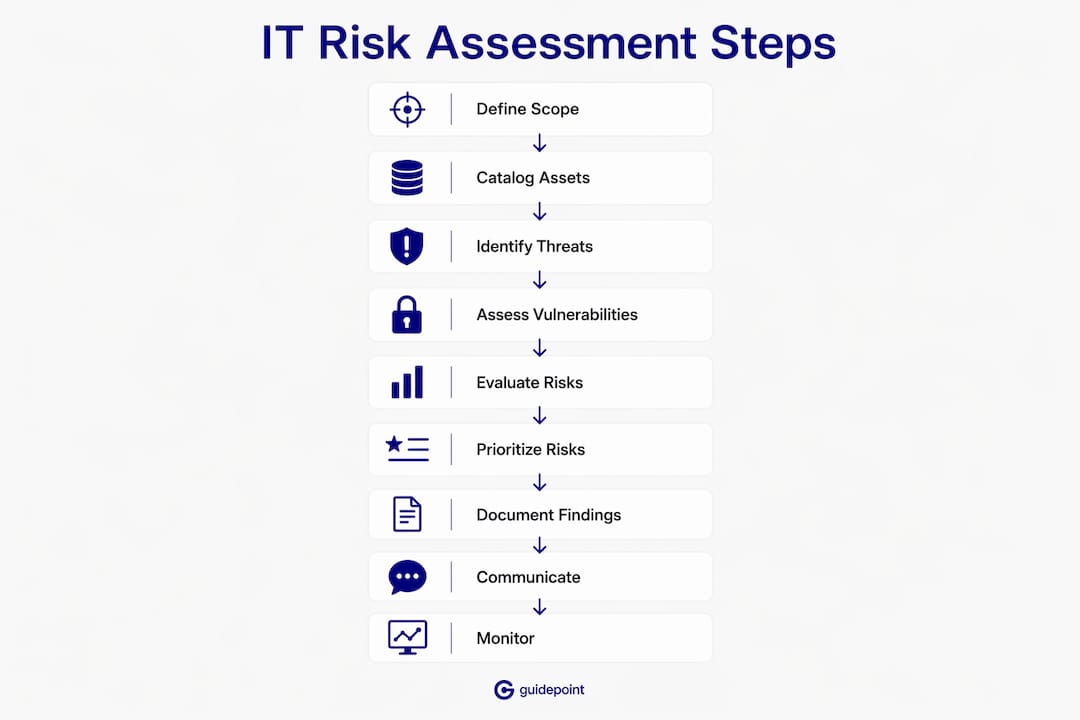
A well-executed risk assessment follows a structured sequence. Skipping steps or treating them as checkboxes produces the subjective, inconsistent scores that undermine authorization confidence. Here is the full process.
1. Define the assessment scope
Identify the systems, data types, and organizational boundaries the assessment will cover. A scope that is too broad produces unmanageable findings; too narrow and you miss critical interdependencies. Document the authorization boundary, the information types processed, and the operational environment before anything else.
2. Catalog and value organizational assets
List every asset within scope, including hardware, software, data stores, and supporting infrastructure. Assign a criticality value to each based on its role in mission delivery. Manufacturing environments, for example, often include operational technology assets that carry far higher impact ratings than their IT classification suggests. Symmnet's guidance on manufacturing IT security covers asset identification in environments where IT and operational technology converge.
3. Identify potential threats
Build a threat catalog covering adversarial threats (external attackers, malicious insiders), environmental threats (power failures, natural disasters), and structural threats (hardware failures, software defects). Use current threat intelligence relevant to your sector and geography. A defense contractor faces a different threat profile than a regional accounting firm.
4. Determine vulnerabilities and assess existing controls
For each asset, identify technical and procedural vulnerabilities. Then evaluate how effectively your current controls reduce the likelihood of exploitation. A vulnerability with no compensating control in place carries a much higher likelihood score than one protected by layered defenses. This step is where most of the real work happens. Obtaining accurate, defensible data on control effectiveness is consistently the most time-consuming part of any assessment.
5. Analyze risk by evaluating likelihood and impact
Combine your threat and vulnerability findings with your control effectiveness data to produce likelihood ratings. Apply your impact values from step 2 to determine the potential harm for each threat-vulnerability pair. The result is a risk rating for each identified risk, expressed as a function of both variables. Linking likelihood objectively to threat capability, motivation, and control presence is what makes these ratings defensible in an audit.
6. Prioritize risks against organizational tolerance
Rank risks from highest to lowest based on their combined likelihood and impact scores. Compare each rating against your organization's defined risk tolerance. Risks that exceed tolerance require immediate treatment decisions: accept, avoid, mitigate, share, or transfer. Risks below tolerance may be accepted with documentation.

Pro Tip: Align your prioritization directly to the decisions your Authorizing Official needs to make. A risk register that maps each finding to a specific authorization or investment decision gets acted on. One that simply lists threats by severity often does not.
7. Document findings and recommended treatments
Produce a Risk Assessment Report (RAR) that records the planning, execution, and evaluation of every identified risk. Include recommended controls, rationale for prioritization decisions, and any assumptions or constraints that shaped the analysis. This document becomes the foundation for your Plan of Action and Milestones (POA&M) and feeds directly into the authorization package.
8. Communicate findings to stakeholders
Risk findings need to reach the right people in the right language. Technical details matter to system owners and security architects. Executives and authorizing officials need risk information framed in terms of mission impact, cost, and business consequence. NIST's guidance on integrating cybersecurity and enterprise risk recommends translating cybersecurity risk into the language of enterprise risk management so executives can weigh it alongside financial and operational risks. Tailoring the communication to the audience is not optional; it is what converts findings into decisions.
9. Establish continuous monitoring and update cadence
A completed assessment is a starting point, not a finish line. Define a monitoring strategy that tracks control effectiveness, flags environmental changes, and triggers reassessment when significant events occur. Integrate your monitoring outputs with the organization's broader IT governance processes so risk posture stays current between formal assessment cycles. For organizations managing backup and recovery as part of their risk controls, testing those backups regularly is a concrete monitoring activity that validates a critical control's effectiveness.
Integrating assessment outputs with IT governance and security strategy
Risk assessment findings should flow directly into your IT governance structure. Control selection under NIST SP 800-53, network segmentation decisions, and endpoint security investments all become more defensible when they trace back to documented risk findings. Network segmentation is one control category where risk assessment outputs frequently drive architecture decisions, particularly in environments with mixed-criticality systems on shared infrastructure.
Tools and technologies that support the process
Several categories of tools support different stages of the assessment:
- Vulnerability scanners (such as Tenable Nessus or Qualys) automate the identification of technical vulnerabilities across networked assets
- GRC platforms (such as ServiceNow GRC or Archer) centralize risk registers, control documentation, and assessment workflows
- Threat intelligence feeds provide current data on threat actor capabilities and targeting behavior relevant to your sector
- Asset management platforms maintain the asset inventory and criticality data that underpin likelihood and impact analysis
- SIEM solutions (such as Splunk or Microsoft Sentinel) support continuous monitoring by correlating security events against known risk indicators
No tool replaces the analytical judgment required to produce defensible risk ratings. Tools accelerate data collection and reporting; the quality of the assessment still depends on the rigor of the methodology behind it. Organizations that want structured support for critical security controls alongside their assessment process benefit from pairing tooling with expert guidance.
How Symmnet supports your IT risk management program
Symmnet provides managed IT and cybersecurity services built specifically for small U.S. businesses in manufacturing, aerospace, and professional services. That includes 24/7 system monitoring, endpoint security, firewall management, and compliance assistance for industry-specific regulations. For organizations that need a structured starting point, Symmnet offers a free assessment to identify security gaps and prioritize remediation based on your actual risk profile.
Key Takeaways
Effective IT risk assessment requires connecting threat and vulnerability analysis to specific organizational decisions, using documented likelihood and impact ratings that hold up under audit scrutiny.
| Point | Details |
|---|---|
| Risk is likelihood times impact | NIST SP 800-30 defines risk as a function of threat-source capability and the magnitude of harm from exploitation. |
| Role clarity drives accountability | The Authorizing Official alone accepts risk; system owners, architects, and assessors each hold distinct, non-overlapping duties. |
| Continuous assessment, not periodic | Risk assessments must be updated whenever systems or environments change, not only at initial authorization. |
| Scope findings to real decisions | ISACA warns that assessments disconnected from specific executive decisions waste resources and rarely produce action. |
| Artifacts carry across RMF stages | Risk assessment outputs feed control selection, authorization packages, and monitoring plans, reducing duplicated effort. |