

The role of IT in professional services is to transform how firms manage operations and deliver client value through automation, AI, and integrated technology. This is not a support function. IT is the engine that determines whether a consulting, legal, or audit firm can compete on quality, speed, and margin in 2026. AI is expected to impact 10–15% of workflow-heavy roles in professional services by automating document analysis and data processing. That shift is already forcing firms to rethink not just their tools, but their entire operating model.
What is the role of IT in professional services?
IT in professional services is defined as the application of technology systems, automation, and data infrastructure to improve how firms deliver expertise-based services to clients. The industry term for this is IT-enabled service delivery, and it covers everything from cloud infrastructure and cybersecurity to AI-powered workflow automation. Understanding this distinction matters because many firms still treat IT as overhead rather than a core delivery mechanism.
Professional services firms, including law firms, consulting practices, accounting firms, and engineering consultancies, sell expertise and time. IT changes what that time produces. A consultant supported by AI-assisted research tools delivers more in four hours than one working manually in eight. That productivity gap is where competitive advantage is built or lost.

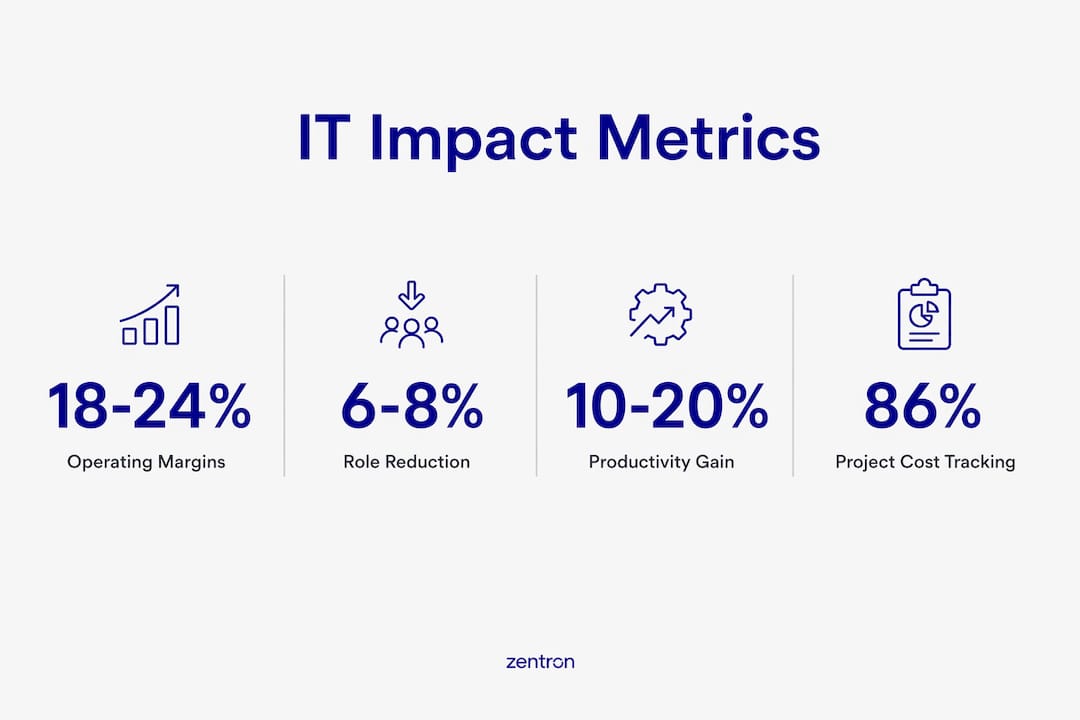
The pressure is real. Operating margins historically run 18–24% in professional services. AI is eroding labor-heavy delivery models, which means firms that do not adapt face structural margin compression. IT is not optional. It is the mechanism for survival and growth.
How does IT improve operational efficiency in professional services?
IT improves operational efficiency by automating routine tasks, reducing labor intensity, and giving leaders real-time visibility into project performance. The gains are not theoretical. Firms using AI in legal documentation and coding workflows are already seeing measurable productivity improvements.
The most direct benefits fall into three categories:
- Workflow automation: Document review, contract analysis, and data entry are now handled by AI tools, freeing professionals to focus on judgment-intensive work.
- Project management visibility: Cloud-based project platforms give leadership real-time access to utilization rates, budget burn, and delivery timelines.
- Financial clarity through cost allocation: Firms that track IT costs at the project level, rather than as blanket overhead, gain accurate profitability data per engagement.
That last point is underused. Approximately 6–8% of roles in coding and legal documentation already face productivity-led reduction as of early 2026. The firms absorbing those gains into margin rather than reinvesting in capability are falling behind.
In consulting, AI-assisted analysis tools cut research cycles from days to hours. In audit, automated data sampling replaces manual testing across thousands of transactions. In legal services, natural language processing tools review contracts at a speed no associate team can match. These are not edge cases. They are the new baseline for competitive firms.
Pro Tip: Assign a dedicated IT cost code to each client engagement. This single change gives you accurate per-project profitability data and supports the shift to outcome-based pricing.
How does IT affect client satisfaction and service quality?
IT affects client satisfaction by making service quality measurable, consistent, and responsive. The traditional professional services model relies on individual expertise and relationship management. Technology does not replace that. It makes the quality of every interaction trackable and improvable.
IT converts subjective, high-touch client interactions into measurable data using tools like speech analytics and electronic documentation. That capability lets leaders monitor quality in real time rather than waiting for client feedback surveys. The shift from reactive to proactive quality management is significant.
Four specific ways IT raises service quality:
- Standardized delivery workflows: Checklists, templates, and automated approval flows reduce variation and human error across engagements.
- Client portals and real-time reporting: Clients access project status, documents, and communications through secure portals, reducing friction and building trust.
- Speech analytics in client-facing roles: Call monitoring tools flag communication gaps, compliance risks, and sentiment shifts before they become problems.
- Electronic documentation and audit trails: Every client interaction is logged, searchable, and retrievable, which matters in regulated industries.
"Technology's strategic role in professional services is to standardize high-touch interactions and make quality measurable for real-time management." — SLM MBA
The balance between technology and human judgment is where firms get this wrong. Automating a client status update is smart. Automating a difficult conversation about project scope is not. IT solutions for professionals work best when they handle process and data, leaving relationship management to people.
How should firms align IT investments with profitability?
Firms should align IT investments with profitability by shifting from time-based billing to outcome-based pricing and tracking technology costs at the engagement level. This is the commercial logic that AI-enabled delivery requires. Most firms have not made this shift yet.
86% of firms using AI allocate technology costs at the project level rather than as blanket overhead. That approach improves engagement profitability measurement and supports pricing decisions grounded in actual delivery cost. Firms still using flat overhead allocation are flying blind on true margin.
| Billing model | How IT costs are treated | Profitability visibility |
|---|---|---|
| Time-and-materials | Overhead allocation | Low |
| Fixed-fee | Partial project allocation | Medium |
| Outcome-based | Full project-level allocation | High |
The concept of a Virtual FTE is emerging in AI-driven engagements. Instead of billing for a human analyst's hours, firms price the output of an AI-assisted workflow as a unit of delivery. This model requires knowing exactly what the AI tooling costs per engagement. Without project-level cost tracking, that pricing is guesswork.
Many firms have not updated legacy billing models to capture AI-driven productivity gains. AI delivers 10–20% productivity improvements that flow to internal margin rather than client-facing value pricing. That is revenue left unclaimed.
Pro Tip: Before repricing any engagement, map your actual AI tooling and cloud infrastructure costs per project. You cannot price for value you cannot measure.
What are the key challenges in integrating IT strategically?
The key challenge in IT integration is not technology selection. It is communication between business leaders and technologists. Success in IT modernization depends more on communication quality between these two groups than on any specific tool choice. Leaders focus on outcomes. Technologists focus on implementation. When those conversations do not connect, projects stall.
Common bottlenecks in professional services IT integration include:
- Legacy billing models: Firms cannot monetize AI gains without changing how they price services. The commercial model must evolve alongside the technology.
- Shadow IT: Professionals adopt unauthorized tools to fill gaps, creating security and compliance risks that managed IT security programs are designed to prevent.
- Cybersecurity gaps: As more client data moves to cloud platforms and AI tools, the attack surface grows. Firms without endpoint security and firewall management expose client data to significant risk.
- Talent and skills gaps: IT services firms are shifting from system maintenance to AI architecture and advisory, requiring new skills that many internal teams do not yet have.
The firms that integrate IT well share one practice: they treat IT as a business function, not a technical department. Leadership sets the outcomes. IT builds the path. That alignment, maintained through regular structured communication, is what separates firms that modernize from those that stall.
IT consulting has become a growth engine by blending advisory, managed services, and cybersecurity. Firms that cannot build this capability internally are partnering with managed service providers to close the gap without adding headcount.
Key Takeaways
IT in professional services is the primary driver of operational efficiency, client quality, and commercial model evolution, not a background support function.
| Point | Details |
|---|---|
| IT drives delivery, not just support | Technology in professional services directly determines service quality, speed, and margin. |
| AI automates routine work | Document analysis and data processing automation frees professionals for judgment-intensive tasks. |
| Project-level cost tracking is critical | Allocating IT costs per engagement enables accurate profitability analysis and outcome-based pricing. |
| Communication determines IT success | Alignment between business leaders and IT teams matters more than the technology itself. |
| Cybersecurity is non-negotiable | Expanding cloud and AI use increases exposure; endpoint security and firewall management are baseline requirements. |
Why the firms winning with IT are doing something most leaders ignore
The most underrated insight I have seen in professional services IT is this: the firms getting the most from technology are not the ones with the biggest budgets. They are the ones that treat IT decisions as business decisions from the start.
Most leaders I speak with still hand IT strategy to their technology team and ask for a recommendation. That is backwards. The business outcome has to come first. What does the client experience need to look like? What does the margin target require? What does the delivery model need to produce? Those answers define the IT requirements, not the other way around.
AI is genuinely changing what is possible. The shift from labor-heavy maintenance to AI-powered advisory is not a future trend. It is happening now, and the talent and operating models required are different from what most firms have built. The firms that recognize this early are redesigning their delivery models, not just adding tools.
The uncomfortable truth is that most professional services firms are sitting on productivity gains they are not monetizing. AI is doing the work. The billing model has not caught up. That gap is a leadership problem, not a technology problem. Fixing it requires business leaders to get specific about how value is created, measured, and priced in an AI-assisted environment.
The firms that get this right will not just be more efficient. They will be structurally more profitable and more defensible as competitors.
— Michael
How Symmnet supports professional services firms with managed IT
Professional services firms need IT that works reliably, stays secure, and supports growth without requiring a full internal team to manage it.
Symmnet provides managed IT services built for small and mid-sized firms that need dependable infrastructure, cybersecurity, and compliance support. From 24/7 system monitoring and endpoint security to backup and recovery and helpdesk support, Symmnet handles the operational layer so your team stays focused on client delivery. Fixed pricing means no surprise costs. U.S.-based support means fast response when it matters. If you want to know where your current IT setup has gaps, Symmnet offers a free assessment to identify security risks and opportunities for improvement.
FAQ
What is the role of IT in professional services?
IT in professional services is defined as the use of technology systems, automation, and data infrastructure to improve service delivery, operational efficiency, and client outcomes. It functions as a core delivery mechanism, not a support function.
How does AI affect professional services firms?
AI automates routine tasks like document analysis and data processing, with 10–15% of workflow-heavy roles expected to be impacted by early 2026. Firms that realign their billing and delivery models capture the productivity gains as margin or client value.
Why do IT projects fail in professional services?
IT projects most often fail because of poor communication between business leaders and technologists, not because of the technology itself. Aligning on business outcomes before selecting tools is the most reliable predictor of success.
What is outcome-based pricing in professional services?
Outcome-based pricing charges clients for a defined result rather than hours worked. It requires project-level IT cost tracking to price accurately and is becoming the preferred model for AI-enabled service delivery.
How can small professional services firms manage IT without a full internal team?
Small firms use managed IT service providers to cover infrastructure monitoring, cybersecurity, compliance, and helpdesk support at a fixed monthly cost. This model provides enterprise-level IT capability without the overhead of a dedicated internal department.