

Eighty-one percent of small businesses suffered a breach in the past year, and 62.5% of those reported financial impacts exceeding $250,000. For a small business, that kind of hit isn't just painful, it can be fatal. Cybersecurity compliance is the structured practice of following specific laws, standards, and frameworks to protect your customers' data and your own. This guide breaks down what compliance actually means, which regulations likely apply to your business, how to get started, what it costs, and why the investment pays off in ways most owners don't anticipate.
Table of Contents
- What is cybersecurity compliance?
- Key frameworks and regulations for small businesses
- How to become cybersecurity compliant: A step-by-step overview
- Cost of compliance: What small businesses can expect
- Why cybersecurity compliance is worth the investment
- A practical perspective: What most guides miss about compliance
- Need help with compliance? Symmetry Network Management can guide you
- Frequently asked questions
Key Takeaways
| Point | Details |
|---|---|
| Know your regulations | Different frameworks apply depending on your industry and the kind of data you handle. |
| Compliance is ongoing | Cybersecurity compliance is a continuous process that requires regular monitoring and updates. |
| Costs are manageable | Compliance investments are often less than the potential costs of a breach or regulatory penalties. |
| Prioritize risk reduction | The real value is reducing business risk, not just ‘checking boxes’ for audits. |
| Small steps matter | Even basic controls can make a significant difference in compliance readiness and security. |
What is cybersecurity compliance?
With the importance clear, let's break down what cybersecurity compliance really means for businesses like yours.
At its core, cybersecurity compliance means meeting a defined set of security requirements set by regulators, industry bodies, or contractual agreements. The goal is simple: protect sensitive data from unauthorized access, theft, or loss. But the specific requirements you must follow depend entirely on your industry and the type of information you handle.
Compliance means following rules for protecting data specific to your industry, such as HIPAA for healthcare or PCI DSS for businesses that accept card payments. The rules aren't one-size-fits-all. A medical billing firm has different obligations than a small aerospace parts manufacturer. Both, however, have obligations.
Here's what cybersecurity compliance typically covers:
- Access controls: Who can see sensitive data and systems, and how access is verified
- Encryption: Protecting data in transit and at rest so it's unreadable if intercepted
- Incident response: Having a documented plan when something goes wrong
- Employee training: Ensuring your team knows how to recognize and avoid threats
- Audit trails: Logging who accessed what and when, for accountability
- Vendor management: Making sure third-party partners don't introduce risk into your systems
Understanding cybersecurity compliance meaning is easier when you stop thinking of it as a one-time audit and start treating it as ongoing risk management. Passing an audit doesn't mean you're secure. It means you met a standard at a specific point in time. Real compliance is continuous.
"Compliance is not a destination. It's a discipline. The most vulnerable businesses are often those that passed their last audit and stopped paying attention."
Two of the biggest myths small business owners believe are "compliance is only for large enterprises" and "it costs too much to bother with." Both are wrong. Many regulations apply regardless of company size, and the cost of non-compliance, measured in breach response, legal fees, and lost business, far exceeds the cost of getting ahead of it.
Pro Tip: If you're unsure whether compliance applies to you, start with a simple question: do you collect, store, or process any customer data? If yes, some form of compliance obligation almost certainly exists.
Key frameworks and regulations for small businesses
Now that we know what compliance means, let's see which rules might affect your business specifically.
The U.S. regulatory landscape includes several major frameworks. Most small businesses fall under at least one, and many fall under two or more simultaneously.

| Framework | Who it applies to | Core focus | Required or voluntary |
|---|---|---|---|
| HIPAA | Healthcare providers, insurers, business associates | Protected health information (PHI) | Required |
| PCI DSS | Any business accepting credit/debit card payments | Cardholder data security | Required by card brands |
| SOC 2 | SaaS companies, B2B service providers | Trust, availability, confidentiality | Contractual |
| NIST CSF | All businesses (especially critical infrastructure) | Risk management baseline | Voluntary |
| CMMC | Department of Defense contractors and subcontractors | Controlled unclassified information | Required for DoD contracts |
Key frameworks for U.S. small businesses include HIPAA for PHI in healthcare, PCI DSS for card data, SOC 2 for SaaS and B2B relationships, NIST CSF as a voluntary baseline applicable to everyone, and CMMC for any company in the defense supply chain. Understanding the overlap is critical because many businesses qualify for multiple frameworks at once.
For example, a small manufacturer that also accepts credit cards and serves as a DoD subcontractor could fall under PCI DSS, CMMC, and potentially NIST CSF guidance all at the same time. Knowing how those requirements overlap, and where they don't, saves significant time and money. You can explore manufacturer cybersecurity frameworks in detail to understand what manufacturers face specifically.
A few things most of these frameworks share:
- Multi-factor authentication (MFA) for any privileged or remote access
- Encryption of data at rest and in transit
- Regular vulnerability scans and patch management
- Access controls based on least privilege (employees only see what they need)
- Documented incident response plans
- Employee security awareness training at least annually
If you're a defense contractor or subcontractor, CMMC for defense contractors has specific maturity level requirements that go well beyond a simple checklist. Missing CMMC compliance can mean losing your DoD contract eligibility entirely.
Starting with the NIST Cybersecurity Framework is a smart move for most small businesses. It's voluntary, yes, but it maps directly onto the controls required by HIPAA, PCI DSS, and CMMC, so building your security posture around NIST CSF typically gets you most of the way toward satisfying the others.
How to become cybersecurity compliant: A step-by-step overview
Understanding which frameworks matter is just the start. Here's how to actually get compliant, step by step.
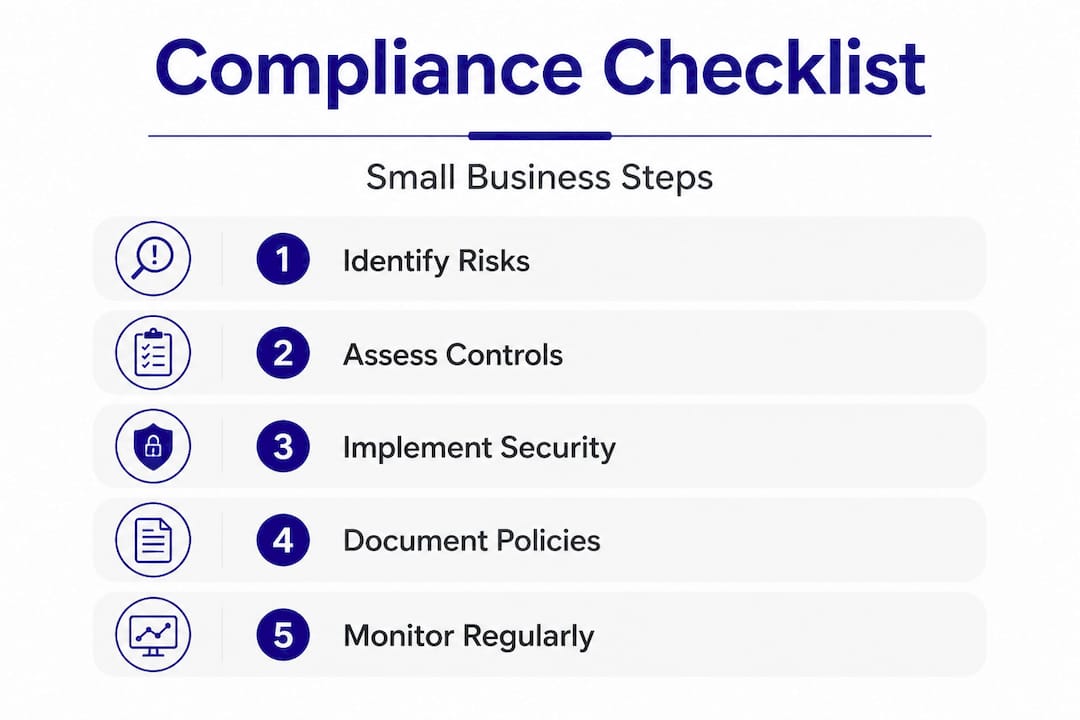
Implementation methodologies consistently follow the same pattern: identify applicable regulations, conduct a risk assessment, implement controls, document policies, complete an audit or assessment, and establish continuous monitoring. Let's walk through each step.
-
Identify your applicable regulations. Start by cataloging the data you collect: customer names, health records, payment card numbers, government contract data. Match that data type to the relevant framework.
-
Conduct a risk assessment. A risk assessment identifies where your vulnerabilities are and what the potential impact of a breach would be. This is not optional. It's the foundation of any real compliance program. You can start exploring cybersecurity steps for SMBs to understand what a proper assessment covers.
-
Implement required controls. Controls are the technical or procedural safeguards you put in place. Common examples include firewalls, endpoint detection software, MFA, encrypted backups, and staff training programs. Understanding essential cybersecurity controls helps you choose the right ones for your risk profile.
-
Document your policies and procedures. Auditors don't just want to see tools. They want to see that your business has written policies defining what is done, by whom, and when. Documentation is often the step that trips small businesses up the most.
-
Complete an audit or formal assessment. Depending on the framework, this might be a self-assessment (PCI DSS for small merchants), a third-party audit (SOC 2), or a certified assessment (CMMC). Know what your framework requires.
-
Monitor continuously. Cyber threats evolve. New vulnerabilities emerge daily. Ongoing monitoring ensures that controls remain effective and that your compliance status doesn't drift over time.
| NIST CSF function | What it means in practice |
|---|---|
| Identify | Know your assets, risks, and applicable regulations |
| Protect | Deploy controls: MFA, encryption, access policies |
| Detect | Monitor systems for anomalies and potential breaches |
| Respond | Execute your incident response plan when issues arise |
| Recover | Restore systems and data using tested backup procedures |
| Govern | Establish accountability, roles, and ongoing oversight |
Pro Tip: Don't wait until you're fully resourced to start. Begin with your highest-risk data assets and build from there. Partial compliance is far better than no compliance when a breach occurs.
Cost of compliance: What small businesses can expect
Once a roadmap is in place, budgeting becomes critical. Here's what small businesses need to know about compliance costs.
Cost varies widely depending on the framework, your starting point, and whether you use internal resources or a managed service provider. Here's a realistic snapshot:
| Compliance type | Estimated cost range | Typical timeframe |
|---|---|---|
| HIPAA | $4,000 to $50,000 | 2 to 6 months |
| PCI DSS | $1,000 to $50,000 | 1 to 6 months |
| SOC 2 | $20,000 to $100,000 | 3 to 12 months |
| CMMC | $5,000 to $100,000 | 3 to 18 months |
SOC 2 costs $20K to $100K, HIPAA $4K to $50K, PCI $1K to $50K, and CMMC $5K to $100K. Those numbers may look high. But compare them to what a breach actually costs: the average U.S. SMB breach for companies with fewer than 500 employees reaches $3.31 million, with most small firms experiencing impacts between $120,000 and $1.24 million. The math isn't close.
The indirect benefits of compliance investment also add up over time:
- Lower cyber insurance premiums: Insurers reward demonstrable security controls with lower rates. Strong compliance posture can reduce premiums by 10% to 30%.
- Faster partner and customer onboarding: Many enterprise customers and government agencies now require proof of compliance before signing contracts.
- Reduced breach response costs: Businesses with mature compliance programs contain breaches faster, limiting total damage.
- Fewer operational disruptions: Good security hygiene reduces the frequency of malware incidents, ransomware attacks, and system outages.
You can explore the full picture of data protection costs and risks to see how the financial case builds over time. For manufacturers in particular, IT security budgeting often reveals that proactive investment costs a fraction of unplanned incident response.
Pro Tip: Layer your controls strategically. A single control like MFA or encryption often satisfies requirements across HIPAA, PCI DSS, and NIST CSF simultaneously. Smart layering reduces duplication and cuts your total compliance cost significantly.
Why cybersecurity compliance is worth the investment
Understanding cost leads to a bigger question: is compliance truly worth it for a small business? The answer goes well beyond just avoiding fines.
Compliance builds trust, reduces insurance premiums, and prevents costly fines, but the real value comes from treating it as risk management rather than audit preparation. Here's what that looks like in practice.
Consider a small professional services firm that handles sensitive client contracts. By achieving SOC 2 Type II certification, they gain a third-party-verified report they can share with enterprise clients during procurement. Suddenly, they win contracts they previously couldn't even get considered for. The certification didn't just protect their data, it opened a new revenue tier.
Or consider a small healthcare clinic that invests in HIPAA-compliant infrastructure. When a ransomware incident hits their network, encrypted backups and a tested incident response plan allow them to restore operations in 48 hours instead of two weeks. They notify the appropriate parties, avoid a major HHS fine, and retain patient trust. Without the compliance investment, the same incident could have ended the practice.
The broader business case for compliance includes:
- Customer loyalty: Patients, clients, and partners increasingly ask about security before sharing data. A documented compliance posture answers that question before it becomes a concern.
- Competitive differentiation: In crowded markets, compliance certification is a signal that your business operates at a higher standard.
- Legal protection: Documented policies and controls provide evidence of due diligence if a breach ever leads to litigation.
- Workforce confidence: Employees who work in a compliant, well-organized IT environment experience fewer disruptions and operate more efficiently.
Explore proven security value-adds for real examples of how specific controls translate into business outcomes for small firms.
"Compliance isn't just about protecting what you have today. It's about building the foundation your business needs to grow into tomorrow."
A practical perspective: What most guides miss about compliance
We've covered the landscape. Now here's where most compliance advice falls short, and what actually works in the field.
Most guides treat compliance as a project with a clear start and end date. You implement controls, pass an audit, and check the box. That approach creates a false sense of security and leaves businesses exposed the moment the threat landscape shifts, which happens constantly.
The businesses that handle compliance best treat it as a living part of their operations, not a separate initiative. Security awareness training isn't a one-time annual event; it's woven into onboarding and regular team meetings. Access control reviews don't happen only before an audit; they happen whenever an employee changes roles or leaves. Incident response plans aren't filed away; they're tested through tabletop exercises at least twice a year.
One of the most underestimated compliance mistakes is documentation that reflects what the policy says rather than what actually happens. Auditors, and more importantly attackers, look for gaps between stated policy and real practice. If your policy says all remote access uses MFA but three legacy systems bypass it, that gap is a liability regardless of what the policy document states.
Choosing security controls selection with crossover value is one of the highest-leverage moves a small business can make. A well-chosen set of 10 to 15 controls can satisfy the core requirements of HIPAA, NIST CSF, and PCI DSS simultaneously. Many businesses spend twice as much time and money as necessary because they treat each framework as a completely separate exercise.
For manufacturers and industrial firms, the practical network security guide for SMBs offers concrete, operational guidance for securing environments where IT and OT (operational technology) systems intersect. That intersection is one of the most overlooked compliance risk zones in the manufacturing sector.
The most important shift any small business owner can make is moving from "what do we need to pass the audit?" to "what do we need to actually reduce our risk?" Those two questions often lead to the same controls, but the second mindset produces a program that actually holds up when pressure arrives.
Need help with compliance? Symmetry Network Management can guide you
Compliance work doesn't have to feel like navigating a maze alone. Symmetry Network Management works specifically with small U.S. businesses in regulated industries, helping them build practical, cost-effective security programs that meet real requirements without unnecessary overhead.
Whether you're starting from zero or trying to tighten up an existing program, Symmetry's team provides the structure, tools, and expertise to move forward with confidence. From 24/7 monitoring to documentation support and audit preparation, their cybersecurity compliance support is built around the realities of small business operations. For a focused starting point, their 5 critical security controls resource identifies the highest-impact steps your business can take right now. Reach out for a free assessment and get a clear picture of where you stand and what to do next.
Frequently asked questions
What is cybersecurity compliance in plain language?
Cybersecurity compliance means following specific rules for protecting data based on your industry, such as HIPAA for healthcare or PCI DSS for payment processing, to keep customer and business information safe.
Which compliance framework applies to my business?
It depends on your industry and the data you handle. Key frameworks include HIPAA for healthcare, PCI DSS for card payments, SOC 2 for B2B service providers, NIST CSF as a general risk baseline, and CMMC for Department of Defense contractors.
How long does it take to get compliant?
Most small businesses achieve basic compliance in 2 to 12 months. Timeframes vary by framework: PCI DSS can take as little as one month for small merchants, while CMMC can take up to 18 months depending on your current security maturity.
What happens if a small business fails cybersecurity compliance?
Non-compliance exposes your business to data breaches, regulatory fines, lawsuits, and reputational damage. The average SMB breach costs $3.31 million, and 62.5% of affected businesses report impacts exceeding $250,000.
Is ongoing monitoring really necessary after initial compliance?
Yes. Threats evolve constantly, and continuous monitoring is what keeps your defenses aligned with new risks. Initial compliance is the starting point, not the finish line.