

Most small business owners treat IT compliance the way they treat smoke detectors — they know they should have it, but they don't think much about it until something's on fire. The importance of IT compliance goes far beyond avoiding fines. For businesses in manufacturing, aerospace, healthcare, and professional services, non-compliance creates a direct path to data breaches, operational shutdowns, and damaged client relationships. This article breaks down what compliance actually costs when ignored, what it truly requires to do right, and how small businesses can build programs that protect operations for the long term.
Table of Contents
- Key takeaways
- What non-compliance actually costs you
- Compliance is more than your tech stack
- Major frameworks and what they require
- Building a compliance program that actually holds
- The role of IT support in compliance
- My take: compliance isn't a project, it's a posture
- How Symmnet helps small businesses stay compliant
- FAQ
Key takeaways
| Point | Details |
|---|---|
| Non-compliance is expensive | Non-compliant organizations pay 2.71 times more for data breaches than compliant ones. |
| Compliance is a discipline, not a checkbox | Governance, accountability, and documented processes matter as much as technical controls. |
| Regulations affect most small businesses | HIPAA, PCI-DSS, and emerging frameworks like DORA apply across industries, not just large enterprises. |
| IT support is a compliance enabler | Managed IT services translate policies into enforceable technical controls with continuous monitoring. |
| Continuous effort is required | Modern auditors expect ongoing evidence, not a single annual review. |
What non-compliance actually costs you
The financial risks tied to weak IT compliance are larger than most small business owners expect. Non-compliant organizations pay 2.71 times more for data breaches than their compliant counterparts, with average breach costs reaching $4.44 million. For a small business, even a fraction of that number can be catastrophic.
Beyond raw dollar figures, the damage compounds quickly. Regulatory fines hit first, then come the legal fees, forensic investigation costs, and mandatory notifications to affected customers. After that, the reputational damage sets in, and that's often the hardest to recover from.
"Non-compliance usually involves multiple gaps, including poor access controls, unlogged admin actions, and misconfigured backups."
These aren't exotic vulnerabilities. They're the kinds of accumulated gaps that build up quietly when nobody owns the compliance function. A manufacturing firm that hasn't audited its admin account access in 18 months, a professional services company running unpatched endpoints, a small healthcare practice with no backup verification process. Each gap on its own might seem minor. Together, they represent a breach waiting to happen.
The less visible costs include the following:
- Operational disruption: Systems go offline, workflows stall, and productivity losses extend for days or weeks during incident response.
- Client and partner fallout: Regulated industries often require proof of compliance from their vendors. One failed audit can terminate a contract.
- Extended remediation timelines: Fixing compliance gaps after a breach takes far longer than addressing them proactively, often stretching remediation across months.
The data breach lessons that repeat across industries share a common thread: the businesses hit hardest are the ones that assumed compliance was someone else's concern.
Compliance is more than your tech stack

Here's a misconception that derails a lot of small business compliance programs: the assumption that buying the right software solves the problem. It doesn't.
IT compliance challenges are less about technology and more about governance, operational clarity, and accountability. Technology is the vehicle, not the destination. You can deploy the best endpoint detection platform on the market and still fail an audit because nobody documented who reviewed the alerts or how access changes were approved.
"The real compliance crisis is not technology. It's the absence of clear ownership, documented workflows, and consistent accountability."
What a well-functioning compliance program actually requires:
- Policies in writing: Acceptable use policies, data handling procedures, and incident response plans need to exist as documented, approved documents, not informal understandings.
- Clear process ownership: Someone must own each compliance control. When ownership is ambiguous, controls drift and evidence gaps follow.
- Continuous monitoring with documented review: Immutable logs and policy-as-code automation prevent configurations from drifting away from required standards without detection.
- Evidence collection: Auditors don't take your word for it. They want screenshots, reports, change logs, and access reviews to verify that controls are actually operating.
Pro Tip: Before investing in new compliance tools, map your current process ownership. Identify which controls have no clear owner and address those first. Technology without accountability still fails audits.
The role of IT in compliance is to translate documented policies into enforceable system configurations. But those policies have to come from leadership, legal, and operational stakeholders working together. IT can't write compliance policy in a vacuum and expect it to stick.
Major frameworks and what they require
If your business operates in a regulated industry, you're almost certainly subject to one or more compliance frameworks, whether you've formalized your response to them or not.
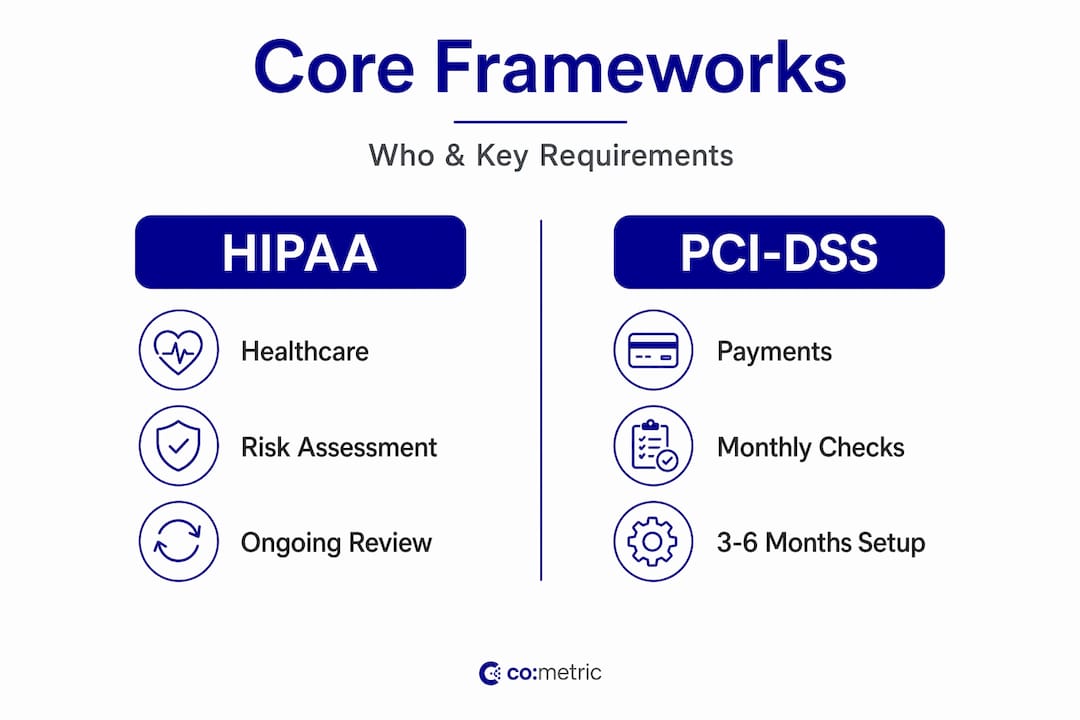
| Framework | Who it applies to | Core requirements |
|---|---|---|
| HIPAA | Healthcare providers and business associates | Risk analysis, access controls, audit logs, breach notification |
| PCI-DSS | Any business accepting card payments | Network segmentation, encryption, vulnerability scans, access controls |
| DORA | Financial sector and ICT suppliers in the EU/UK | ICT risk management, incident reporting, resilience testing |
| CMMC | Defense contractors and subcontractors | Tiered cybersecurity practices, access control, incident response |
A few things these frameworks share: they all require documented risk assessments, they all demand evidence of ongoing control operation, and none of them treat compliance as a one-time event. Treating compliance as a static checklist rather than a continuous operational program is one of the most reliable ways to fail an audit.
HIPAA is a particularly instructive example. Its Security Rule divides controls into "required" and "addressable" categories. Addressable doesn't mean optional. Addressable controls require a documented risk-based rationale explaining why a control was implemented, modified, or not implemented at all. Failing to create that documentation is one of the most common HIPAA violations, and it's entirely preventable.
PCI-DSS compliance setup typically takes three to six months to establish and requires two to four hours per month of ongoing maintenance. Audits can cost $15,000 to $50,000 depending on your merchant level. That investment is predictable and manageable. A breach is neither.
Pro Tip: Review your regulatory obligations with legal counsel at least once a year. Frameworks evolve, and your exposure may increase as your business grows or takes on new types of data.
The forward-looking picture matters too. 81% of organizations view compliance with newer digital regulations like DORA and NIS2 as a strategic opportunity to improve their IT asset management. The businesses that treat regulatory changes as a reason to strengthen operations will outcompete those that treat them as a burden.
Building a compliance program that actually holds
A compliance program is only as strong as the habits that sustain it. Here's a practical sequence for small businesses building or reinforcing their approach.
-
Inventory your assets and data flows. You cannot protect what you haven't mapped. Know where sensitive data lives, who accesses it, and how it moves through your systems. This is the foundation of every risk assessment.
-
Conduct a formal risk analysis. Identify your highest-risk assets and access points. For businesses handling protected health information, HIPAA's risk analysis must be updated regularly and drives prioritization of security controls. The same logic applies to any framework.
-
Assign ownership to every control. Each compliance requirement needs a named owner who is accountable for its operation and documentation. No owner means no accountability, and no accountability means drift.
-
Implement baseline technical controls. These include multi-factor authentication, role-based access control, system patching schedules, encrypted backups, and firewall configurations. The 5 critical security controls that form a compliance foundation are not complex, but they must be implemented correctly and verified regularly.
-
Automate monitoring where possible. Manual checks get skipped. Automated monitoring with alerting, combined with regular log reviews, keeps control operation visible and auditable.
-
Document everything. Every policy approval, access review, patch cycle, and incident response step should leave a paper trail. If it wasn't documented, auditors treat it as if it didn't happen.
-
Review and test on a schedule. Quarterly access reviews, annual policy updates, and periodic tabletop exercises for incident response keep your program current and your team prepared.
For businesses in manufacturing, the manufacturing cybersecurity checklist from Symmnet provides a framework-aligned starting point that maps practical controls to compliance requirements.
The role of IT support in compliance
Small businesses rarely have the internal bandwidth to manage compliance alongside everything else operations demands. That's where the role of IT support in compliance becomes a real competitive advantage.
Managed IT service providers do more than keep the lights on. When integrated into a compliance program, they provide:
- Continuous monitoring and alerting: Around-the-clock visibility into system events means anomalies surface before they become incidents.
- Patch management and vulnerability remediation: Consistent patching schedules close the most common attack vectors that regulators also scrutinize.
- Network segmentation support: Proper segmentation limits the blast radius of any breach and is a core requirement under frameworks like PCI-DSS. The network segmentation best practices that auditors look for require technical expertise to implement correctly.
- Documentation and audit support: A good managed IT partner maintains records of system changes, access events, and control reviews in formats that map directly to audit evidence requirements.
- Incident response readiness: Having a response plan is one thing. Having a team that has tested and executed one is another.
Executives need IT compliance metrics translated into business impact terms: legal exposure, remediation cost, and revenue at risk. A managed IT partner with compliance experience can speak that language, connecting technical controls to the business outcomes leadership actually cares about.
For small businesses in industries with strict operational and regulatory requirements, the cost of a qualified managed IT partner is a fraction of the cost of a single non-compliance incident.
My take: compliance isn't a project, it's a posture
I've worked with small businesses that went through a full compliance audit, passed, and then didn't touch their program for two years. They treated certification as a finish line. When the next audit came around, or worse, when a breach happened, they were starting over, often in a much harder position than before.
The threat environment doesn't pause between your audit cycles. Neither do regulators. What I've found is that the businesses with the strongest compliance track records don't think of compliance as a project with an end date. They treat it as an operational posture, the same way they treat financial reporting or quality control. It's a continuous function with regular review cycles, clear ownership, and genuine accountability.
The other pattern I've observed is that compliance culture starts at the top. When leadership treats IT compliance as a priority and asks for regular reporting on control status, the entire organization operates differently. When leadership treats it as an IT department problem, the gaps accumulate quietly until they become very loud.
Continuous compliance programs are now required by modern auditors. The businesses that build this into their operating model stop dreading audits and start using them as confidence-building exercises.
— Michael
How Symmnet helps small businesses stay compliant
Running a compliance program while managing day-to-day operations is a real challenge for small businesses, especially in regulated industries where the requirements keep evolving.
Symmnet's managed IT services are designed specifically for small U.S.-based businesses in manufacturing, aerospace, professional services, and other regulated industries. Symmnet delivers 24/7 system monitoring, endpoint security, patch management, backup and recovery, and compliance documentation support under fixed, predictable pricing. Their U.S.-based team translates your regulatory obligations into enforceable technical controls and maintains the evidence trail that auditors require. Whether you're working toward your first formal compliance program or shoring up gaps ahead of an audit, Symmnet offers a free assessment to identify your current exposure and map a clear path forward.
FAQ
What is IT compliance and why does it matter?
IT compliance means operating your technology systems according to defined regulatory standards, frameworks, and internal policies. It matters because non-compliant organizations face significantly higher breach costs, regulatory penalties, and operational disruptions that compliant businesses avoid.
How much does non-compliance cost a small business?
The financial impact varies, but organizations without strong compliance programs pay 2.71 times more per breach than compliant ones, with average breach costs reaching $4.44 million. Even partial breach costs can be devastating for a small business.
Is IT compliance only relevant for large enterprises?
No. Frameworks like HIPAA, PCI-DSS, and DORA apply to small businesses and their vendors whenever they handle regulated data or operate in regulated industries. Size doesn't determine exposure; the type of data and industry does.
What is the role of IT support in compliance?
IT support translates documented compliance policies into enforceable technical controls, manages continuous monitoring, maintains audit-ready documentation, and provides the expertise needed to respond to incidents. For small businesses, managed IT providers fulfill this role without the overhead of a full internal team.
How often should a small business review its IT compliance program?
At minimum, conduct a formal review annually. Most frameworks and modern auditors expect quarterly access reviews, continuous monitoring logs, and updated risk assessments whenever your systems or data handling practices change materially.