

Managed Service Providers (MSPs) are third-party firms that take full operational responsibility for a small business's IT environment under formal service-level agreements, delivering proactive monitoring, security, and support without the overhead of an in-house team. The role of MSPs for small businesses has expanded well beyond fixing broken computers. Today, MSPs offload IT to specialists who bring enterprise-grade tools, cybersecurity expertise, and strategic guidance to organizations that could never afford those capabilities on their own. By 2027, 40 to 60% of MSP revenue is forecast to come from security, compliance, automation, AI, and advisory services rather than basic infrastructure maintenance. That shift defines what you should expect from an MSP partnership today.
What do MSPs actually do for small businesses?
An MSP provides end-to-end IT responsibility under a service-level agreement (SLA) that defines monitoring scope, response times, and remediation obligations. This is fundamentally different from a break/fix contractor who only shows up when something fails. MSPs watch your systems continuously, apply patches before vulnerabilities are exploited, and resolve issues before they become outages.
The practical services covered in a typical managed services engagement include:
- 24/7 system monitoring to detect hardware failures, network anomalies, and performance degradation in real time
- Patch management and software updates applied on a scheduled, tested basis to reduce exposure windows
- Helpdesk support for end-user issues, typically with defined response tiers based on severity
- Cloud and device management covering Microsoft 365, Google Workspace, endpoint configuration, and mobile device policies
- Backup and disaster recovery with tested restoration procedures, not just passive data copies
- Firewall and network management including configuration reviews and traffic policy enforcement
Beyond daily operations, MSPs also take on a technology planning role. Quarterly business reviews give you a structured opportunity to assess where your IT investment is going, what risks remain unaddressed, and what upgrades align with your growth plans. This strategic layer is what separates a capable MSP from a vendor that simply keeps the lights on.
Pro Tip: Ask any MSP candidate to show you a sample quarterly business review report from a current client. If they cannot produce one, their "strategic advisory" claim is marketing, not practice.

The SLA and statement of work define exactly what is in scope and what is not. Ambiguity in these documents is the leading cause of disputes and unexpected invoices. Before signing, verify that every service you expect is explicitly listed, with defined performance metrics attached.
How do MSPs strengthen cybersecurity for small businesses?
Cybersecurity is now the defining function of a quality MSP. Small businesses face the same threat actors targeting enterprises, but with a fraction of the security budget. Understanding the types of cybersecurity threats your business faces is the starting point, but detection and response require tools and expertise most small teams cannot maintain internally.

Managed Detection and Response (MDR) delivers 24/7 human-led threat hunting, incident containment, and remediation. This goes beyond a standard Managed Security Service Provider (MSSP), which typically monitors and alerts. MDR analysts actively hunt for threats that evade automated detection and take direct action to contain them. For small businesses in regulated industries like manufacturing, aerospace, or professional services, the difference between an alert and an actual response can mean the difference between a minor incident and a reportable breach.
| Service type | What it does | Best for |
|---|---|---|
| Standard MSP | Monitoring, patching, helpdesk, backup | General IT management for most SMBs |
| MSSP | Security monitoring, alerting, log management | Businesses needing dedicated security oversight |
| MDR | Threat hunting, active containment, incident remediation | Regulated industries or high-risk environments |
When evaluating an MSP's security capabilities, verify how containment and remediation are handled operationally. Ask specifically: What happens in the first 30 minutes after a threat is confirmed? Who makes the call to isolate a device? How is evidence preserved for forensic review? Quality MSPs answer these questions with documented playbooks. Weaker providers answer with vague reassurances.
MSPs also support compliance reporting for frameworks like CMMC, HIPAA, and SOC 2. They maintain audit logs, generate compliance documentation, and help you understand where your controls fall short. For small businesses pursuing government contracts or handling sensitive client data, this compliance support alone can justify the MSP investment.
Pro Tip: Request a copy of the MSP's own security posture documentation before signing. An MSP that cannot demonstrate its internal security controls is a liability, not an asset.
How are MSPs evolving with AI and strategic business outcomes?
The MSP of 2026 is not the IT support desk of 2015. Around 50 to 70% of MSP-served small businesses expect their provider to manage AI tools and automation projects by 2027. This expectation reflects a real shift in how technology creates value for small businesses. MSPs are now expected to help you govern AI responsibly, not just keep your servers running.
Here is how leading MSPs are delivering on this expanded role:
-
AI readiness assessments. Before deploying tools like Microsoft Copilot or automation platforms like Zapier, a capable MSP evaluates your data governance posture, identifies sensitive data exposure risks, and establishes usage policies. Deploying AI without this step creates compliance and liability exposure.
-
Workflow automation projects. MSPs identify repetitive processes, such as ticket triage, invoice processing, or document generation, and implement automation that reduces manual labor. A manufacturing firm handling 200 work orders per week can realistically cut administrative processing time by automating routing and status updates through tools like Power Automate.
-
Quarterly business reviews focused on outcomes. Rather than reporting on uptime percentages, outcome-focused MSPs present metrics tied to operational efficiency, risk reduction, and technology ROI. This reframes the relationship from vendor to business partner.
-
Vertical specialization. MSPs serving manufacturing or aerospace clients understand ITAR compliance, operational technology (OT) network segmentation, and supply chain data requirements. Generic IT support cannot replicate this depth. Industry-specific MSPs bring pre-built frameworks that reduce your configuration and compliance burden significantly.
This evolution means you should evaluate MSP candidates not just on their technical certifications, but on their understanding of your industry's regulatory environment and their track record of delivering measurable business outcomes for similar clients.
What should you look for when selecting an MSP?
Selecting the wrong MSP costs more than the contract value. Switching providers mid-year means migrating documentation, reconfiguring tools, and rebuilding institutional knowledge. Getting the selection right the first time is worth the extra diligence.
Vague SLA language is the most common contract failure point. Buyers should require defined severity levels, documented escalation paths, and service credits for missed response targets. A contract that says "we will respond promptly" is unenforceable. A contract that says "P1 incidents receive a response within 15 minutes, with service credits of $X per hour beyond that threshold" is a real commitment.
Key factors to evaluate when shortlisting MSPs:
- Scope clarity. Every service must be explicitly listed in the statement of work. "General IT support" is not a scope definition.
- Incident response SLAs. Verify that response time commitments are tied to severity classifications and carry financial penalties for non-compliance.
- Security posture. Ask for the MSP's own vulnerability assessment results, SOC 2 report, or equivalent documentation. Their security is your security.
- Integration capabilities. Confirm the MSP can integrate with your existing tools, whether that is a manufacturing ERP, a CRM, or a cloud accounting platform.
- Transparency and communication. Monthly reporting, defined escalation contacts, and clear communication protocols separate professional MSPs from reactive ones.
For small businesses in sectors with strict operational requirements, reviewing proven cybersecurity steps before entering MSP negotiations gives you a baseline to measure proposals against. You will ask better questions and identify gaps in coverage that a generic proposal might obscure.
Pro Tip: Run a reference check with at least two current clients in your industry. Ask specifically about how the MSP handled a significant incident or outage, not just day-to-day satisfaction.
Key takeaways
MSPs deliver the most value for small businesses when they operate as security-first, outcome-focused partners governed by clear, enforceable service-level agreements.
| Point | Details |
|---|---|
| MSPs go beyond break/fix | Proactive monitoring and patching prevent outages rather than just reacting to them. |
| MDR is not the same as MSSP | MDR actively hunts and contains threats; MSSP primarily monitors and alerts. |
| SLA specificity protects you | Require defined severity levels, escalation paths, and service credits before signing. |
| AI management is now in scope | Leading MSPs govern AI tools, automate workflows, and report on measurable business outcomes. |
| Industry specialization matters | MSPs with vertical expertise reduce compliance burden and deliver faster, more relevant support. |
Why the MSP relationship is more than a vendor contract
I have worked with small businesses across manufacturing, professional services, and aerospace for years, and the pattern I see most often is this: owners sign an MSP contract expecting a technology fix and are surprised when the relationship either transforms their operations or quietly underdelivers for 18 months before anyone notices.
The businesses that get the most from managed services for SMBs treat the MSP as a seat at the operational table, not a utility bill. They show up to quarterly reviews prepared with questions. They share their growth plans so the MSP can anticipate infrastructure needs. They push back when reporting feels generic. That engagement is not extra work. It is what makes the investment pay off.
The misconception I hear most often is that MSPs are only for businesses that cannot afford IT staff. That framing misses the point entirely. Some of the best-run small businesses I know have one or two internal IT people and an MSP handling security, compliance, and strategic planning. The internal team focuses on business-specific systems. The MSP handles the specialized, high-stakes work that requires tools and expertise no single hire can replicate.
The uncomfortable truth is that most small businesses are underpaying for IT support and overpaying for the consequences of inadequate security. A ransomware incident that costs $50,000 in recovery, lost revenue, and reputational damage looks very different in hindsight against a $2,500 per month MSP contract that included MDR. The math is not complicated. The decision to act on it is.
— Michael
See how Symmnet supports small businesses with managed IT
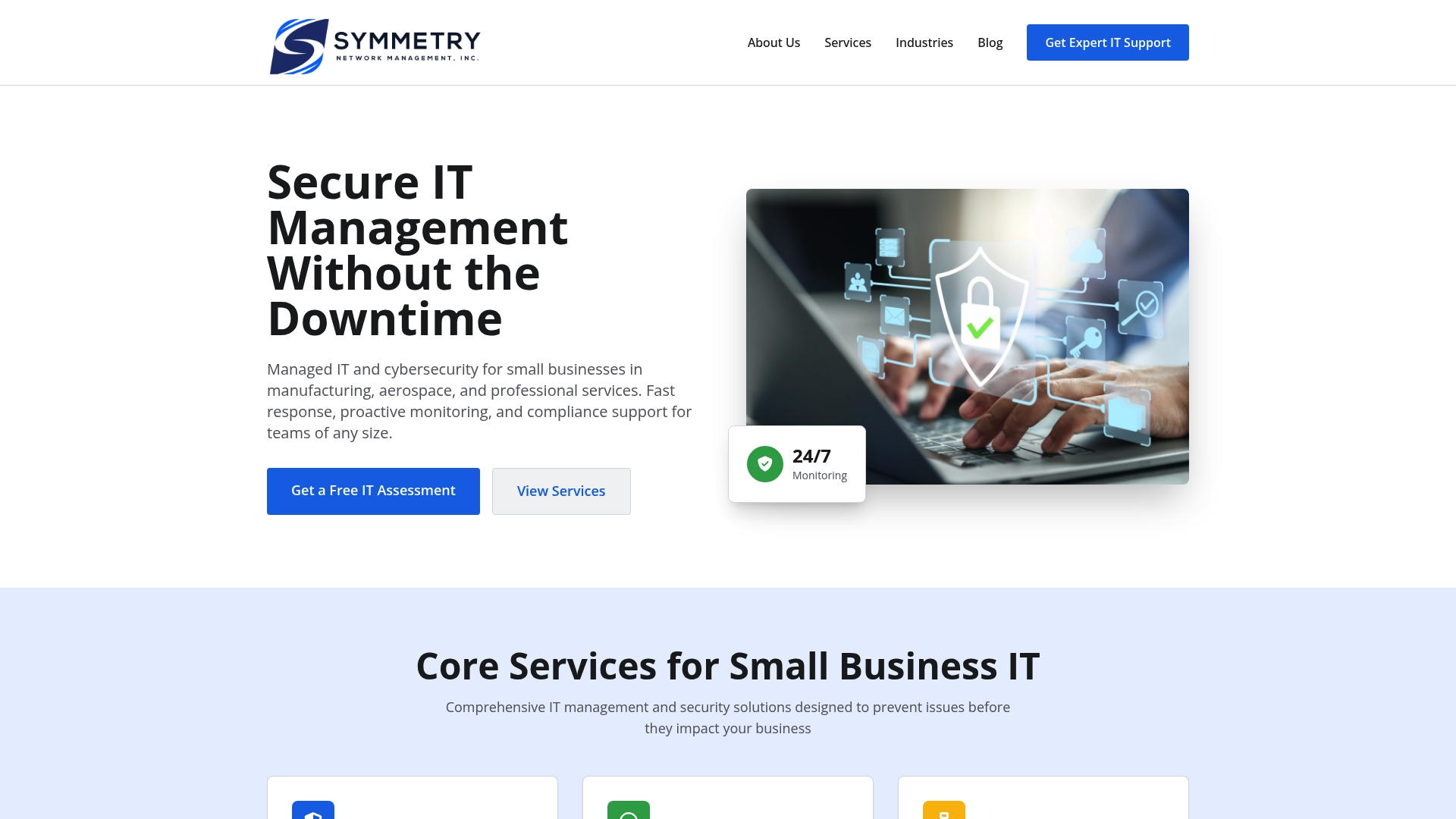
Symmnet delivers managed IT services built specifically for small U.S.-based businesses in manufacturing, aerospace, and professional services. The service model covers 24/7 monitoring, endpoint security, firewall management, helpdesk support, backup and recovery, and compliance assistance for industry-specific regulations including CMMC and HIPAA. Symmnet operates on fixed pricing with no surprise invoices, and all support is U.S.-based. For small businesses in the greater Los Angeles area, West Covina IT services from Symmnet offer the same enterprise-grade capabilities with local accountability. Contact Symmnet for a free assessment to identify your current security gaps and build a technology plan aligned with your business goals.
FAQ
What is the role of an MSP for a small business?
An MSP takes full responsibility for managing a small business's IT systems under a service-level agreement, covering monitoring, security, helpdesk support, and strategic technology planning. This gives small businesses access to expert IT capabilities without hiring a full internal team.
How is an MSP different from break/fix IT support?
Break/fix support is reactive, meaning you pay when something breaks. MSPs focus on prevention and continuous monitoring, resolving issues before they cause downtime and operating under a predictable monthly fee structure.
Do small businesses really need MDR, or is basic security monitoring enough?
For small businesses in regulated industries or those handling sensitive client data, MDR is the stronger choice because it actively hunts threats and contains incidents rather than just generating alerts. Standard monitoring without human-led response leaves a significant gap between detection and damage control.
What should a small business require in an MSP contract?
The contract must include defined severity levels, documented escalation paths, specific response time commitments, and service credits for missed targets. Vague language around "best efforts" or "prompt response" is not enforceable and should be rejected.
Are MSPs equipped to manage AI tools for small businesses?
Yes. Modern MSPs increasingly handle AI readiness assessments, usage governance policies, and workflow automation projects. By 2027, the majority of MSP-served small businesses are expected to rely on their provider for AI tool management and integration.