

Threat detection is defined as the continuous process of monitoring an organization's digital environment to identify malicious or suspicious activity before it causes serious damage. Cybersecurity threat detection spans five domains: endpoints, network traffic, cloud infrastructure, identity access, and application logs. Modern platforms built around Security Information and Event Management (SIEM), Extended Detection and Response (XDR), and formal Threat Detection and Response (TDR) frameworks correlate signals across all of these domains simultaneously. For business owners and IT managers, understanding what is threat detection means understanding the foundation of every effective cybersecurity strategy.
What is threat detection and how does it work?
Threat detection is the practice of continuously collecting telemetry from IT systems and applying detection logic to separate normal activity from malicious behavior. Industry-standard detection uses five core methods, each with distinct strengths and limitations:
- Signature-based detection matches activity against a database of known attack patterns. It is fast and accurate for recognized threats but blind to zero-day exploits and novel malware variants.
- Behavioral detection establishes a profile of normal user and system activity, then flags deviations. A user who never accesses financial records suddenly downloading thousands of files triggers a behavioral alert.
- Anomaly-based detection uses statistical models to identify outliers in network traffic, login times, or data volumes. It catches advanced threats but requires careful calibration.
- Threat-intelligence-based detection cross-references activity against external feeds of known malicious IP addresses, domains, and file hashes from sources like MITRE ATT&CK or commercial threat intel providers.
- Machine learning models analyze large datasets to detect subtle patterns that rule-based systems miss, including slow-moving attacks designed to evade traditional signatures.
No single method covers every attack scenario. Mature detection systems combine all five into correlational rules that link multiple indicators into a single, high-confidence alert. A login from an unusual country, followed by a privilege escalation attempt, followed by a large data transfer, is far more meaningful as a combined signal than any one event alone.
Pro Tip: Collect telemetry with discipline. More data is not necessarily better; organizations that ingest every available log without a clear purpose drown their analysts in noise and miss the signals that matter.

Why does real-time threat detection matter for your business?
Speed is the defining variable in cybersecurity incident outcomes. The longer an attacker operates undetected inside your network, the greater the damage to data, operations, and reputation. A formal TDR framework built around continuous monitoring can isolate a compromised device or block malicious traffic within seconds of detection. That speed is the difference between a contained incident and a full breach.
"Threat detection is reactive and automated, triggered by alerts, whereas threat hunting is proactive and human-driven, helping refine detection capabilities." — Splunk
This distinction matters practically. Automated detection handles the high volume of daily alerts your systems generate. Threat hunting, conducted by skilled analysts, searches for stealthy attackers who have already evaded those automated systems. The two functions are not interchangeable. Automated detection without threat hunting leaves gaps. Threat hunting without automated detection is unsustainable at scale.
Real-time detection triggers a sequence of responses that protect your business without waiting for human intervention:
- Alert generation. The detection engine flags an anomaly and creates a prioritized alert with context about the affected asset and the type of activity observed.
- Automated containment. The system isolates the affected endpoint, blocks the suspicious IP address, or revokes the compromised user credential automatically.
- Forensic capture. In cloud-native environments using containers or serverless functions, evidence is captured at the moment of detection. If that window is missed, the evidence disappears when the workload terminates.
- Analyst notification. A validated alert reaches your security team or managed service provider with enough context to act immediately rather than investigate from scratch.
- Incident documentation. Every action taken is logged for compliance reporting and post-incident review.
For small manufacturers, professional services firms, and aerospace suppliers, this sequence is not optional. Regulatory frameworks including CMMC, HIPAA, and NIST 800-171 require documented detection and response capabilities.
What are the biggest challenges in implementing threat detection systems?
The most common failure in threat detection is not a technology gap. It is a tuning gap. Organizations deploy capable platforms and then leave them misconfigured, generating thousands of low-quality alerts that analysts learn to ignore.
Anomaly detection is the most difficult method to implement correctly. Establishing a meaningful behavioral baseline requires weeks of stable historical data. In highly dynamic environments, such as cloud workloads that spin up and down daily, baselines degrade quickly and alert volumes spike. The result is alert fatigue, a condition where analysts become desensitized to notifications and begin missing genuine threats.
Detection rules compound this problem when they are poorly classified:
- Atomic rules fire on a single event, such as a failed login attempt. They are easy to write but easy for attackers to evade by staying just below the threshold. They also produce the highest volume of false positives.
- Collection-based rules trigger when a volume threshold is crossed, such as 50 failed logins in five minutes. They reduce noise but can miss slow, distributed attacks.
- Correlational rules model complex attack sequences by linking cause-and-effect chains across multiple events. They are harder to build but deliver the strongest detection capability with the fewest false positives.
Over-reliance on atomic rules is a documented weakness. Attackers who understand common detection thresholds deliberately operate below them. A detection strategy built primarily on atomic rules gives a false sense of coverage.
Pro Tip: Audit your detection rules quarterly. Retire atomic rules that generate high false-positive rates and replace them with correlational rules that model the actual attack patterns relevant to your industry. For manufacturing environments, review the manufacturing cybersecurity checklist to align your detection priorities with sector-specific risks.
How can IT managers build an effective threat detection program?
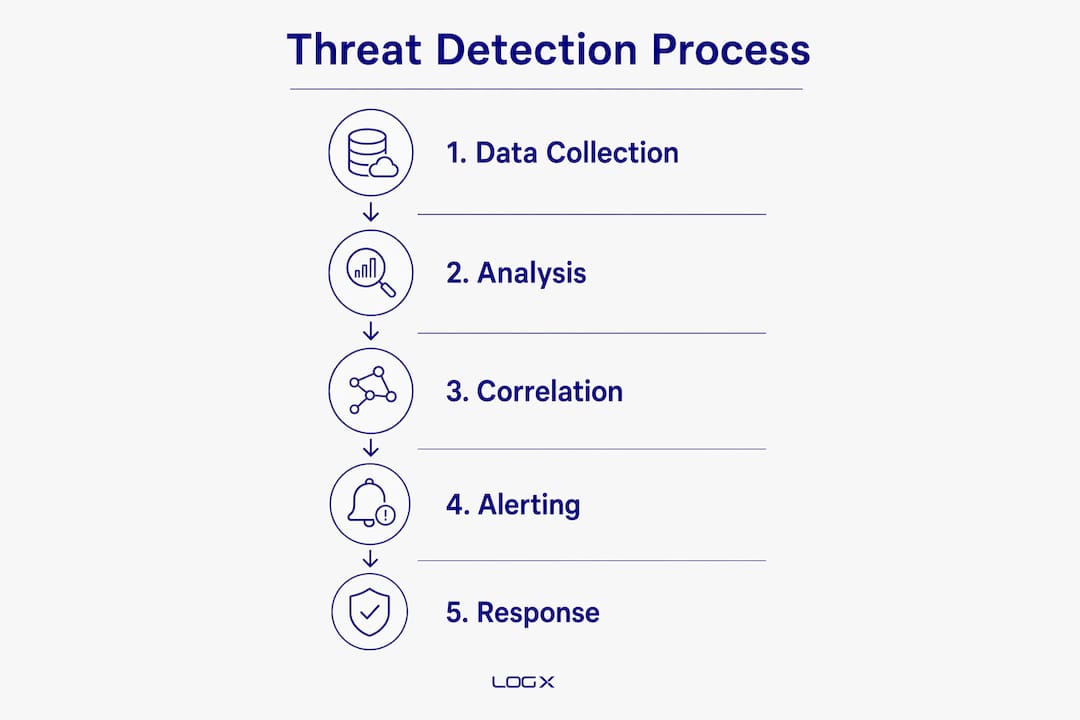
A detection program that works in practice follows a defined lifecycle, not a one-time deployment. The TDR lifecycle consists of five repeating phases:
- Continuous monitoring. Deploy agents on endpoints, configure network sensors, and connect cloud workloads to a central SIEM or XDR platform. Coverage gaps are detection gaps.
- Active detection. Apply your detection rule library, threat intelligence feeds, and machine learning models to the incoming telemetry. Prioritize correlational rules for your highest-risk assets.
- Threat assessment. Triage alerts by severity and context. Determine whether an alert represents a genuine incident, a misconfiguration, or a false positive. This step is where human judgment adds the most value.
- Response. Execute containment, eradication, and recovery actions. Automated playbooks handle routine responses. Complex incidents require analyst-led investigation.
- Continuous improvement. Feed the findings from threat hunting and incident reviews back into your detection rules. Threat hunting output should directly inform and improve automated detection capabilities.
For small businesses without a dedicated security operations center, Managed Detection and Response (MDR) services provide a practical path to this capability. MDR services combine 24/7 monitoring, enriched detection engines, and expert analyst investigation to deliver validated incident alerts with guided response. The key advantage is noise filtering. MDR analysts separate meaningful security signals from the overwhelming volume of false positives that exhaust in-house teams.
| Approach | Best For | Key Limitation |
|---|---|---|
| In-house SIEM/XDR | Organizations with dedicated security staff | Requires significant tuning and analyst capacity |
| MDR Service | Small to mid-size businesses without security operations center | Less direct control over detection rules |
| Managed IT with monitoring | Small businesses needing full IT coverage | Detection depth depends on provider expertise |
For IT managers in manufacturing or professional services, the priority areas to monitor are operational technology networks, privileged user accounts, cloud storage access, and email gateways. Each of these surfaces represents a documented entry point for ransomware, data theft, and supply chain attacks. The IT monitoring process guide from Symmnet provides a step-by-step framework for building continuous monitoring into your existing IT operations.
Key takeaways
Effective threat detection requires combining multiple detection methods, real-time monitoring, and continuous rule refinement to stay ahead of attackers who adapt their tactics constantly.
| Point | Details |
|---|---|
| Five detection methods | Signature, behavioral, anomaly, threat intelligence, and machine learning each cover different attack types. |
| Real-time response matters | Automated containment within seconds of detection limits attacker dwell time and reduces breach impact. |
| Alert fatigue is a real risk | Poorly tuned atomic rules generate noise; correlational rules reduce false positives and improve detection quality. |
| MDR fills the staffing gap | Managed Detection and Response provides 24/7 expert monitoring for businesses without a dedicated security team. |
| Detection is a cycle | Continuous improvement through threat hunting and incident reviews keeps detection rules current and effective. |
The part most businesses get wrong about threat detection
I have worked with enough small and mid-size businesses to know that most of them treat threat detection as a product purchase rather than a practice. They buy a SIEM, connect a few log sources, and assume the work is done. Six months later, the platform is generating 3,000 alerts a day and nobody is reviewing them.
The uncomfortable truth is that technology does not detect threats. Properly configured, continuously tuned, and actively managed technology detects threats. That distinction sounds minor. In practice, it is the entire difference between a detection program that works and one that creates a false sense of security.
What I have found actually works is starting small and building deliberately. Pick your five highest-risk assets. Build correlational detection rules around the specific attack patterns that target your industry. Review and refine those rules every quarter. Add coverage incrementally as your team's capacity grows. This approach produces a detection program that your analysts trust and actually use.
The other thing I would push back on is the assumption that more automation equals better detection. Automation handles volume. Human analysts handle judgment. The businesses that get this right invest in both, and they make sure their threat hunting findings feed directly back into their automated detection rules. That feedback loop is what separates a static detection program from one that actually improves over time.
— Michael
How Symmnet supports your threat detection strategy

Symmnet delivers managed IT services that include 24/7 system monitoring, endpoint security, and firewall management built specifically for small U.S.-based businesses in manufacturing, aerospace, and professional services. Rather than leaving your team to manage detection rule tuning and alert triage alone, Symmnet's experts handle continuous monitoring and rapid response on your behalf. The result is a detection program that runs at full capacity without requiring a dedicated in-house security operations team. If you want to know where your current detection gaps are, Symmnet offers a free assessment to identify vulnerabilities and build a plan that fits your environment and budget. Explore the critical security controls every small business needs as a starting point.
FAQ
What is threat detection in cybersecurity?
Threat detection is the continuous process of monitoring endpoints, networks, cloud workloads, and user activity to identify malicious or suspicious behavior before it causes a breach. It combines automated detection methods with human analysis to generate prioritized, actionable alerts.
How does threat detection differ from threat hunting?
Threat detection is reactive and automated, triggered by alerts from detection rules and machine learning models. Threat hunting is proactive and human-driven, searching for stealthy threats that have already evaded automated systems.
What are the main threat detection methods?
The five core methods are signature-based, behavioral, anomaly-based, threat-intelligence-based, and machine learning detection. Most mature platforms combine all five into correlational rules for stronger, lower-noise coverage.
What are threats in cybersecurity that detection systems target?
Detection systems target ransomware, data exfiltration, credential theft, insider threats, and supply chain attacks. You can review the full range of cybersecurity threat types relevant to small businesses to prioritize your detection focus areas.
Do small businesses need a dedicated team for threat detection?
No. Managed Detection and Response services provide 24/7 monitoring and expert analyst investigation without requiring an in-house security operations center. MDR is the practical path for small businesses that need enterprise-grade detection capabilities at a manageable cost.