

Zero trust security is a resource-centric model that grants no implicit trust to any user, device, or network location and instead requires continuous, per-session verification before access to any resource is allowed. NIST SP 800-207 defines it as a shift from static perimeter defenses to identity- and data-focused controls that treat every access request as potentially hostile, regardless of where it originates.
For small businesses, that shift matters in a concrete way: when an attacker compromises one account or endpoint, Zero Trust limits how far they can move. Instead of walking freely across your network, they hit a wall at the next resource.
Why Zero Trust matters for your small business right now:
- It eliminates the "trusted insider" assumption that makes lateral movement so damaging after a breach.
- The CISA Zero Trust Maturity Model gives you a staged roadmap, so you don't have to do everything at once.
- Protecting your highest-value apps first, what practitioners call "crown-jewel" resources delivers the most risk reduction per dollar spent.
- Symmnet helps small businesses in manufacturing, aerospace, and professional services implement Zero Trust incrementally, with managed monitoring and fixed pricing.
Table of Contents
- What are the core principles behind zero trust security?
- How Zero Trust architecture actually works
- Zero Trust vs. VPN: which one does your business actually need?
- Where Zero Trust delivers the most value for small businesses
- A phased Zero Trust roadmap built for small businesses
- Best practices and pitfalls to avoid when adopting Zero Trust
- Which technology categories support Zero Trust in an SMB environment?
- How to measure Zero Trust effectiveness and maturity
- Key Takeaways
- The case for starting smaller than you think
- Symmnet's Zero Trust assessment and implementation services
- Authoritative references and further reading
What are the core principles behind zero trust security?
Zero Trust is built on a specific set of design goals, not a single product or vendor. NIST SP 800-207 outlines seven foundational tenets that shape every architecture decision:
- All data sources and computing services are resources. Every device, SaaS app, and data store is treated as a resource that requires explicit authorization.
- All communication is secured regardless of network location. Traffic on your internal LAN gets the same scrutiny as traffic from a coffee shop.
- Access is granted per session. Each request is evaluated individually; yesterday's approval doesn't carry over.
- Access policy is dynamic and context-aware. Decisions factor in user identity, device health, time of day, and behavioral signals.
- Asset integrity and posture are continuously monitored. Devices that fall out of compliance lose access automatically.
- Authentication and authorization are strictly enforced before any session. There is no "log in once, roam freely" model.
- Telemetry is collected broadly. The system learns from access patterns to improve policy over time.
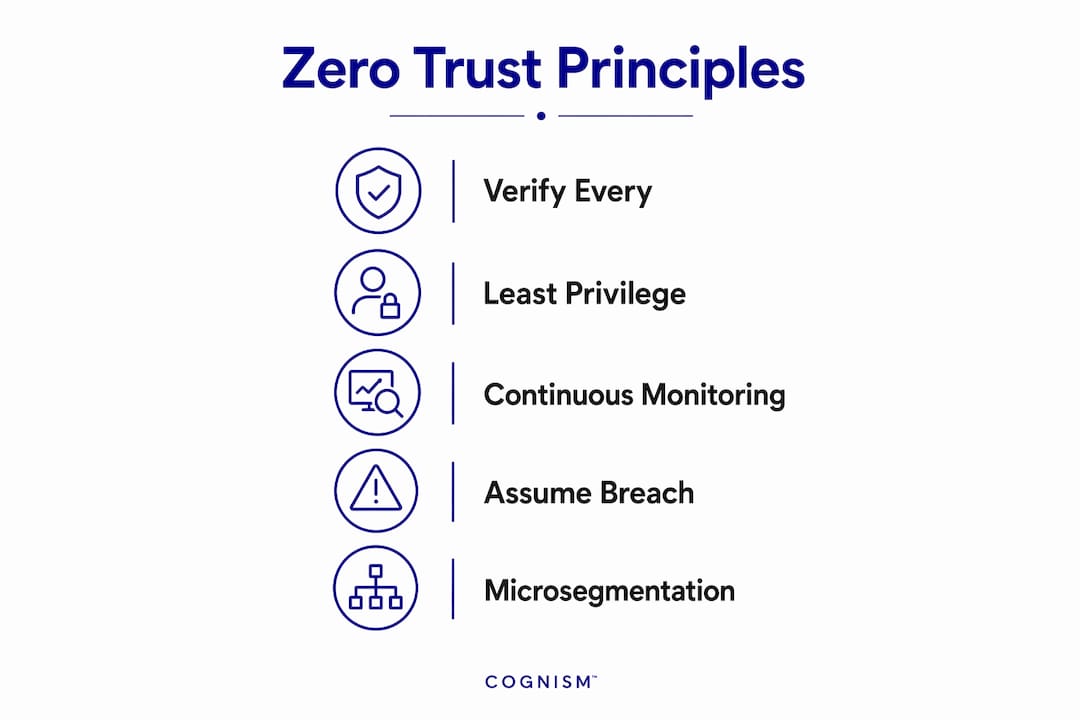
In day-to-day operations, these tenets translate to four non-negotiable controls: multi-factor authentication (MFA) on every account, device posture checks before access is granted, per-application access rules rather than broad network permissions, and microsegmentation that prevents one compromised workload from reaching another. Together, they replace the old "castle-and-moat" assumption that anything inside the perimeter is safe.
How Zero Trust architecture actually works
The architecture has five functional layers that work together to enforce those principles.
Identity provider (IdP): The authoritative source for who a user is. Every access decision starts here. Examples include cloud-based directory services and federated identity platforms.

Policy decision point (PDP): The brain of the system. It evaluates the request against policy rules, device posture data, and risk signals, then issues an allow or deny decision.
Policy enforcement point (PEP): The gatekeeper that acts on the PDP's decision. In a Zero Trust Network Access (ZTNA) deployment, this is typically a broker or gateway sitting in front of each application.
Device posture and orchestration: Endpoint agents or mobile device management (MDM) tools that report device health, patch status, and compliance state to the PDP in real time.
Telemetry and analytics: Logs, behavioral signals, and anomaly detection feeds that feed back into policy refinement. This is where SIEM or XDR platforms plug in.
ZTNA and SASE in context: ZTNA acts as the resource access broker, replacing broad VPN tunnels with narrow, per-app connections. SASE (Secure Access Service Edge) converges ZTNA, cloud access security broker (CASB), firewall-as-a-service, and SD-WAN into a single cloud-delivered service, which is particularly practical for small businesses that lack on-premises security infrastructure.
| Component | What it protects | Typical SMB deployment |
|---|---|---|
| Identity provider (IdP) | User identity and authentication | Cloud-hosted (e.g., Azure AD, Okta) |
| Policy decision point (PDP) | Access logic and risk scoring | Built into ZTNA platform or SASE |
| Policy enforcement point (PEP) | Per-app access gating | ZTNA broker/gateway per critical app |
| Device posture check | Endpoint health and compliance | MDM agent or EDR integration |
| Telemetry / SIEM or XDR | Visibility and anomaly detection | Cloud SIEM or managed SOC service |
| Data protection controls | Data at rest and in transit | Encryption + CASB for SaaS |
Zero Trust vs. VPN: which one does your business actually need?
The core difference is trust scope. A VPN authenticates once and then grants broad network access, meaning a stolen credential gives an attacker the same reach as a legitimate employee. Zero Trust grants explicit, narrow access to a specific application and continuously re-verifies identity and device posture throughout the session.
| Dimension | Traditional VPN | Zero Trust (ZTNA) |
|---|---|---|
| What it protects | Network perimeter | Individual resources and apps |
| Trust model | Implicit after login | Continuous, per-session |
| Lateral movement risk | High | Low |
| Implementation phases | Single deployment | Phased, pillar by pillar |
| Time to implement | Days to weeks | 4 weeks per pilot app; months for full rollout |
| Cost and effort | Lower upfront | Higher initial; scales with managed services |
| Required technologies | VPN gateway, firewall | IdP, ZTNA broker, MDM, telemetry |
When a hybrid model makes sense: Many small businesses have legacy on-premises applications that are expensive or slow to modernize. Protecting those systems with a hardened VPN, strong authentication, and endpoint checks while deploying ZTNA in front of your highest-risk cloud apps is a practical middle path. You get Zero Trust benefits where they matter most without a full infrastructure overhaul on day one.
For very small teams, a well-architected VPN with mandatory MFA and modern endpoint security can provide meaningful risk reduction as a first step, before a full ZTNA deployment is warranted.
Pro Tip: Pilot ZTNA on one high-value application, such as your ERP or admin console, and measure access telemetry for 30 days before expanding. You'll surface policy gaps and user friction points at low risk.
Where Zero Trust delivers the most value for small businesses
Zero Trust isn't an abstract enterprise concept. For small businesses, it addresses the specific threat scenarios that cause the most damage.
Remote work and BYOD: When employees connect from personal devices or home networks, you lose visibility into endpoint health. Zero Trust enforces device posture checks before granting access, so a personal laptop with outdated patches doesn't become your breach entry point.

Protecting cloud SaaS and admin consoles: Your accounting software, CRM, and cloud storage hold your most sensitive data. Per-app access controls and MFA enforcement mean a phished password alone isn't enough to reach them.
Third-party and contractor access: Vendors and contractors are a common breach vector. Zero Trust lets you grant time-limited, resource-specific access without putting contractors on the same network segment as your internal systems.
Compliance-sensitive data: For businesses subject to HIPAA, CMMC, or PCI DSS, per-resource access controls and continuous logging directly support audit requirements. The CISA Zero Trust Maturity Model frames Zero Trust as a data-centric approach that provides the visibility needed to enforce and evolve security policies over time.
OT and IIoT segmentation for manufacturers: Microsegmentation keeps operational technology networks isolated from IT systems. A ransomware infection on the office network stays off the shop floor. For manufacturers, this is one of the highest-value Zero Trust use cases available. Symmnet's guidance on securing manufacturing networks covers segmentation patterns specific to SMB industrial environments.
The NIST SP 800-207 principle at work: Zero Trust focuses on protecting resources rather than network segments, which means a compromised network location no longer automatically grants access to your most sensitive data.
A phased Zero Trust roadmap built for small businesses
CISA's guidance frames Zero Trust as a path with realistic, incremental stages rather than an all-or-nothing replacement. That framing is exactly right for small businesses with limited staff and budget.
Phase 1: Assess (weeks 1–4)
- Inventory all users, devices, applications, and data stores.
- Identify your crown-jewel apps, those whose compromise causes the greatest business harm.
- Map current authentication methods and flag accounts without MFA.
- Document network segments and identify flat or over-permissioned zones.
- Assign ownership: who is responsible for identity, devices, and network policy?
Phase 2: Prioritize and pilot (weeks 5–12)
- Enforce MFA on all accounts, starting with admin and privileged users.
- Deploy ZTNA or identity-aware access controls on one or two crown-jewel applications.
- Implement device posture checks for users accessing those applications.
- Establish baseline telemetry: log all access events for the pilot apps.
- Review access logs at the end of week 12 and adjust policy rules based on findings.
Phase 3: Expand across pillars (months 4–12+)
- Roll out ZTNA to additional applications, pillar by pillar: identity, then devices, then network, then applications, then data.
- Implement microsegmentation for your most sensitive network zones.
- Automate policy lifecycle tasks: provisioning, deprovisioning, and posture-based access revocation.
- Conduct quarterly access reviews and update least-privilege role assignments.
- Train staff on new authentication workflows and report suspicious access attempts.
Cost and effort factors: Licenses for cloud-based IdP and ZTNA platforms typically run per user per month. Staff hours for configuration and policy tuning are the largest variable cost. Managed services reduce that burden significantly for teams without dedicated security engineers.
Pro Tip: Start your pilot with third-party contractor access rather than internal users. Contractors are a high-risk vector, the access scope is narrow, and the change management impact on your core team is minimal.
Best practices and pitfalls to avoid when adopting Zero Trust
Getting the principles right matters less than avoiding the operational mistakes that derail most implementations.
Do these:
- Enforce MFA on every account, no exceptions, before touching network architecture.
- Apply least privilege by default: grant the minimum access needed for the job, then expand only when justified.
- Maintain a current asset inventory; you can't protect what you haven't cataloged.
- Automate policy lifecycle management: provisioning and deprovisioning should not depend on manual tickets.
- Train staff before rollout, not after. User friction is the most common reason Zero Trust projects stall.
- Use the CISA ZTMM maturity stages to set realistic goals and communicate progress to leadership.
Avoid these:
- Trying to implement all five pillars simultaneously. Scope creep kills momentum.
- Ignoring device posture. An identity-only Zero Trust model leaves a significant gap.
- Weak logging and visibility. If you can't see access events, you can't detect policy violations.
- Insufficient governance: no defined owner, no policy review cadence, no change management process.
- Policy sprawl: too many granular rules that nobody maintains, leading to brittle access controls and frequent false positives that erode user trust in the system.
Red flags in a Zero Trust implementation: If your access rules haven't been reviewed in six months, if users routinely get blocked from legitimate resources, or if your telemetry isn't feeding any detection workflow, the implementation is drifting toward security theater rather than actual risk reduction.
Which technology categories support Zero Trust in an SMB environment?
Zero Trust is not a single product. It's an architecture assembled from several technology categories. Here's how they map to the model:
- Identity providers (IdP): The foundation. Cloud-hosted directory and federation services authenticate users and feed identity signals to the policy engine.
- Multi-factor authentication (MFA): The single highest-impact control. MFA enforcement, ideally at Authentication Assurance Level 3, stops credential-based attacks cold.
- Endpoint detection and response (EDR): Monitors device behavior, reports posture to the PDP, and detects threats that bypass perimeter controls.
- ZTNA brokers: Replace VPN tunnels with per-app access gateways. Available as cloud-native services that require no on-premises hardware.
- Microsegmentation and SDN tools: Divide your network into isolated zones so a compromised workload can't reach adjacent systems. Particularly valuable for manufacturers with OT networks.
- CASB and SASE components: Provide visibility and control over SaaS usage, enforce data loss prevention policies, and converge networking and security for cloud-first environments.
- SIEM or XDR platforms: Aggregate telemetry from all the above, correlate events, and surface anomalies for investigation.
When evaluating vendors, prioritize interoperability, API access for automation, logging depth, and support for policy lifecycle management. A tool that produces rich logs but can't export them to your SIEM is a visibility gap waiting to happen. Microsoft's cloud services, for example, provide prescriptive configuration guidance mapped directly to CISA ZTMM objectives, which simplifies alignment for SMBs already in the Microsoft ecosystem.
How to measure Zero Trust effectiveness and maturity
Measuring progress objectively is what separates a real Zero Trust program from a compliance checkbox exercise. The CISA ZTMM's four stages, Traditional, Initial, Advanced, and Optimal, give you a framework for setting realistic goals and communicating progress to leadership.
| KPI | Why it matters | Suggested SMB target |
|---|---|---|
| % of crown-jewel apps behind ZTNA | Measures direct risk reduction on highest-value resources | within 12 months of pilot |
| MFA adoption rate | Single strongest predictor of credential-attack resilience | every user account |
| Mean time to detect anomalous access | Measures telemetry effectiveness and SOC responsiveness | Under 24 hours |
| Privileged accounts with just-in-time access | Limits standing privilege exposure | 80%+ of admin accounts |
| Device posture compliance rate | Ensures endpoint health is enforced, not assumed | most managed devices |
Using the CISA maturity stages in practice: Most small businesses start at Traditional (implicit trust, minimal segmentation) and should target Initial within the first six months of a Zero Trust program. Initial means MFA is enforced, some segmentation exists, and access logging is active. Advanced and Optimal stages involve automation, dynamic policy, and continuous telemetry, which are realistic multi-year goals for most SMBs.
Tracking these KPIs monthly gives you a clear signal of whether the program is moving forward or stalling. If MFA adoption is stuck below 90%, that's the bottleneck to fix before expanding ZTNA coverage.
Key Takeaways
Zero Trust security reduces breach impact by enforcing continuous, per-resource access verification rather than trusting network location, making it practical for small businesses when implemented in phases starting with identity and MFA.
| Point | Details |
|---|---|
| Start with identity and MFA | MFA on every account is the single highest-impact first step before any architectural change. |
| Protect crown-jewel apps first | Pilot ZTNA on your highest-risk applications before expanding to full network segmentation. |
| Use CISA's maturity model | The four ZTMM stages (Traditional → Initial → Advanced → Optimal) give you realistic milestones and timelines. |
| Measure progress with KPIs | Track MFA adoption, device posture compliance, and mean time to detect anomalous access monthly. |
| Symmnet accelerates adoption | Symmnet provides managed assessments, identity services, and monitored ZTNA pilots for small businesses in manufacturing, aerospace, and professional services. |
The case for starting smaller than you think
Zero Trust conversations in the industry tend to gravitate toward enterprise-scale deployments: full SASE stacks, automated policy engines, and SOC teams running 24/7 detection. For a small business with 20 to 80 employees, that picture can make the whole model feel out of reach. It isn't, but the framing matters.
The most durable Zero Trust programs at the SMB level don't start with architecture. They start with behavior. Enforcing MFA across every account, auditing who actually needs access to which systems, and checking device health before granting access to your most sensitive apps, those three steps alone move you from Traditional to Initial on the CISA maturity scale. No ZTNA broker required on day one.
Where small businesses consistently go wrong is treating Zero Trust as a product purchase rather than a policy discipline. A vendor can sell you a ZTNA gateway, but if your access policies are poorly scoped, your device inventory is incomplete, and nobody owns the policy review cadence, the gateway becomes expensive infrastructure with minimal security return. The technology is the easy part. The governance is where most implementations either succeed or quietly drift.
The other underappreciated reality: managed services change the calculus significantly. Operational automation, policy lifecycle management, and continuous telemetry are precisely where in-house teams at small businesses run out of capacity. Partnering with a managed provider for those functions lets your internal staff focus on the business-critical decisions, what to protect and why, while the provider handles the operational execution.
Symmnet's Zero Trust assessment and implementation services
Small businesses that want Zero Trust benefits without building an internal security engineering team have a direct path forward with Symmnet. Rather than selling you a product stack and stepping back, Symmnet's approach starts with a free security assessment that maps your current state against the CISA ZTMM pillars, identifies your crown-jewel applications, and surfaces the gaps with the highest risk exposure.
From there, Symmnet's managed IT and cybersecurity services cover the full implementation lifecycle: identity hardening and MFA rollout, ZTNA pilot configuration for your highest-risk apps, 24/7 monitoring and telemetry, network segmentation guidance, and ongoing policy administration. Fixed pricing means no surprise invoices as your program matures. For manufacturers, aerospace suppliers, and professional services firms operating under strict compliance requirements, Symmnet brings industry-specific experience that generic IT providers don't. Schedule your free assessment to get a clear, prioritized roadmap built for your environment.
Authoritative references and further reading
The sources below are the primary standards and guidance documents referenced throughout this article. Consulting them directly gives you the vendor-neutral detail needed for procurement decisions and maturity planning.
- NIST SP 800-207, Zero Trust Architecture: The foundational standard. Defines Zero Trust, the seven tenets, core logical components, and deployment models. Start here for architecture decisions.
- CISA Zero Trust Maturity Model v2: The five-pillar maturity framework with Traditional, Initial, Advanced, and Optimal stages. Use this when setting timelines and communicating progress to leadership.
- CISA ZTMM v2 full PDF: The complete model document with detailed capability descriptions per pillar and maturity stage. Useful for building procurement checklists.
- Microsoft Zero Trust guidance for CISA ZTMM: Prescriptive configuration guidance for Microsoft cloud services mapped to ZTMM objectives. Practical for SMBs already using Microsoft 365 or Azure.
- Symmnet manufacturing cybersecurity checklist: A practical control checklist aligned to Zero Trust tasks for small manufacturers and SMBs mapping controls to compliance requirements.
When planning your timeline, use the CISA maturity model to anchor each phase to a defined stage rather than a vague milestone. During procurement, evaluate vendors against vendor-neutral capability criteria, interoperability, logging depth, API access, and automation support, before reviewing product-specific feature lists.