

Most small businesses do not think about security policies until something goes wrong. A breach, a failed audit, a lost contract. That reactive posture is costly — and increasingly untenable. 35.5% of data breaches in 2024 originated from third parties, meaning your business can be compromised through a vendor you trusted without a written security requirement in place. For small manufacturers, aerospace subcontractors, and professional services firms operating under strict regulatory frameworks, the role of security policies has moved from "good practice" to a business-critical requirement. This guide breaks down what that means in practical terms.
Table of Contents
- Understanding the foundation: what security policies are and why they matter
- Core security policy requirements for small U.S. manufacturers and aerospace firms
- How security policies help manage third-party risks and maintain business trust
- Practical steps to develop and implement effective security policies
- Common pitfalls and expert tips for maintaining cybersecurity policies over time
- Why many small business security policies fall short — and how to fix them
- How Symmetry Network Management supports your cybersecurity policy needs
- Frequently asked questions
Key Takeaways
| Point | Details |
|---|---|
| Policies as foundation | Security policies establish clear roles and governance essential for managing cybersecurity risks in small businesses. |
| Compliance mandates | Small manufacturers and aerospace firms handling CUI must comply with all NIST SP 800-171 controls under CMMC Level 2. |
| Managing third-party risk | Security policies define vendor expectations, helping prevent data breaches from third-party partners. |
| Tailored implementation | Using free templates as a start, customize policies to sector-specific risks for practical and effective cybersecurity. |
| Ongoing maintenance | Regular reviews, leadership accountability, and physical security documentation are key to policy effectiveness and compliance. |
Understanding the foundation: what security policies are and why they matter
Security policies are not just documents that sit in a shared drive. They are the operational rules that define who is responsible for protecting your data, what acceptable use looks like, how incidents get reported, and what happens when something goes wrong. Without them, your cybersecurity program has no spine.
Security policies are the cornerstone of any cybersecurity program. They establish roles, responsibilities, risk management expectations, and accountability across the entire organization. That last word matters: accountability. When a breach occurs and there is no documented policy, it is nearly impossible to establish what went wrong, who was responsible, or how to prevent it next time.
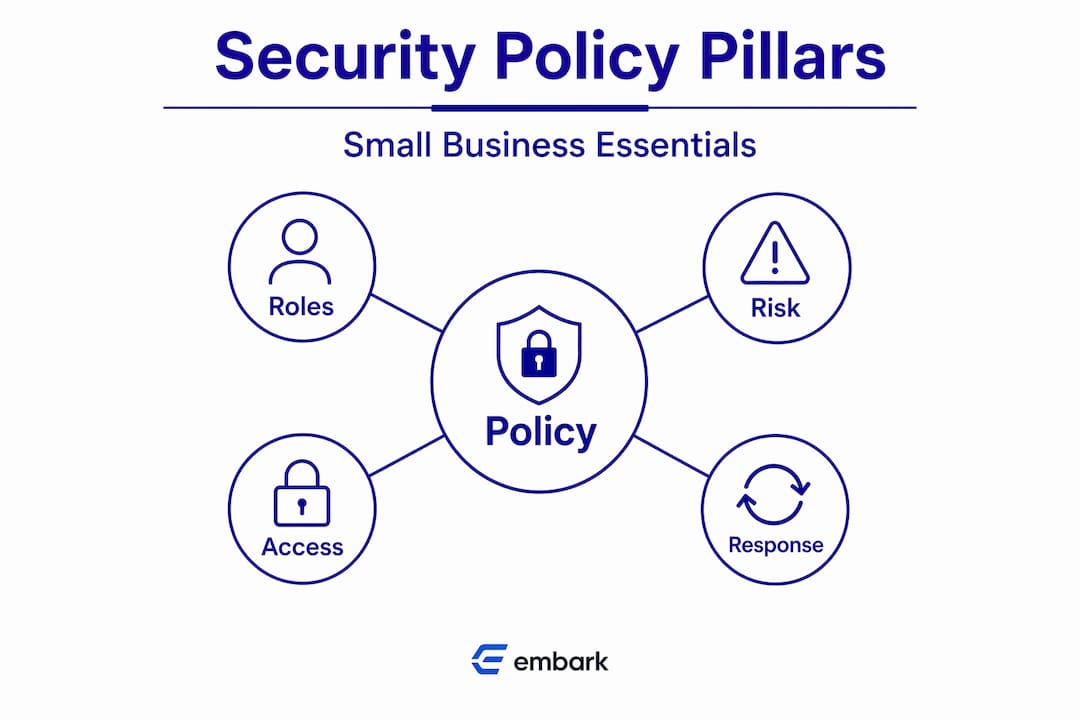
The NIST Cybersecurity Framework 2.0 places policies squarely inside the "Govern" function, meaning they are not just IT documents. They reflect leadership priorities, risk tolerance, and organizational values. The framework calls for policies to be reviewed at least annually and updated when business conditions or threats change. That cadence is not arbitrary. Cyber threats evolve fast. A policy written in 2022 likely does not address current ransomware tactics, AI-generated phishing, or new vendor access requirements.
For small businesses specifically, policies need to do several things at once:
- Define roles and responsibilities so employees know exactly what is expected of them
- Set risk tolerance thresholds so leadership can make informed decisions when incidents occur
- Establish acceptable use rules for devices, networks, and cloud applications
- Document response procedures for incidents, data loss, and system failures
- Support compliance with NIST, CMMC, HIPAA, or other applicable frameworks
Small manufacturers and aerospace firms can get a useful starting point from IT security essentials for manufacturers and cybersecurity basics for small manufacturers to understand what policies need to address in an operational technology environment.
Core security policy requirements for small U.S. manufacturers and aerospace firms
The compliance landscape for small manufacturers and aerospace subcontractors changed significantly in 2025 and 2026. If your business handles Controlled Unclassified Information (CUI) as part of a Department of Defense supply chain, you face specific, non-negotiable policy requirements.
All 110 NIST SP 800-171 controls must be documented and enforced under CMMC Level 2, with mandatory third-party assessments starting November 2026. That is not a suggestion. It is a contract requirement. Failure to comply means losing DoD work.
Here is how to approach the core compliance requirements:
- Document every security control applied in your environment, not just the ones that seem obvious
- Define your CUI scope by mapping exactly where controlled information is created, processed, stored, and transmitted
- Establish an incident response policy with clear timelines and reporting chains
- Create a supply chain risk policy that covers vendor access, assessments, and contractual security requirements
- Schedule annual policy reviews tied to internal audits or major operational changes
One of the most time-sensitive requirements involves incident reporting. DFARS 252.204-7012 requires cyber incident reporting within 72 hours of detection. That window is tight. Without a documented incident response policy and pre-assigned roles, most small businesses will miss it.
| Policy area | Requirement | Framework |
|---|---|---|
| Access control | Role-based access, least privilege | NIST SP 800-171, CMMC Level 2 |
| Incident response | 72-hour reporting, documented procedures | DFARS 252.204-7012 |
| Multi-factor authentication | Enforced on all privileged accounts | CMMC Level 2, NIST |
| Patch management | Documented schedule and exception process | NIST SP 800-171 |
| Physical security | CUI area controls and visitor management | CMMC Level 2 |
| Media protection | Handling, labeling, and disposal of CUI media | NIST SP 800-171 |
Review your CMMC Level 2 requirements carefully to understand which policy gaps could put your contracts at risk.
Pro Tip: Reducing the scope of your CUI environment is one of the most cost-effective moves a small manufacturer can make before a CMMC assessment. The fewer systems that touch CUI, the fewer controls you need to document and the lower your audit complexity.
How security policies help manage third-party risks and maintain business trust
Third-party vendors are one of the most underestimated risks in small business cybersecurity. You may have solid internal controls, but if your vendors do not, your data is still at risk. This is not a theoretical concern.

35.5% of breaches in 2024 came through third parties, a 6.5% increase from the prior year. That trend is moving in the wrong direction. Small businesses with limited IT resources are frequently targeted as entry points into larger supply chains.
Security policies give you a concrete mechanism to manage this risk. Strong security policies systematize data protection and define third-party requirements, reducing breach exposure and supporting regulatory compliance. In practical terms, this means your policies should require:
- Vendor security questionnaires before granting system or data access
- Contractual flow-down clauses that hold vendors to the same security standards you follow
- Access controls that limit what third parties can see and do in your environment
- Periodic reassessment of vendor security posture, not just at onboarding
- Incident notification requirements embedded in vendor contracts
"A security policy without vendor provisions is like locking your front door while leaving the side gate open. Your defenses are only as strong as the weakest access point you grant to others."
For professional services firms, this extends to clients. If your firm manages sensitive financial, legal, or engineering data on behalf of clients, your security policies need to address how that data is classified, stored, and accessed. Clients increasingly request proof of your cybersecurity posture before signing contracts. A documented policy framework gives you that proof.
Understanding data protection risks for SMBs can help you identify where third-party exposure is highest in your specific business model.
Practical steps to develop and implement effective security policies
Building security policies from scratch feels overwhelming to most small business owners. It does not have to be. The key is starting with a solid baseline and then customizing for your context.
NIST and CISA provide free policy templates that cover most standard cybersecurity controls. The SANS Institute also offers 36 free templates specifically designed for organizational use. These are not perfect out of the box, but they give you a defensible starting structure.
Here is a practical approach to developing effective policies:
- Start with free templates from SANS or NIST as your baseline
- Map your operational environment — identify what systems, data types, and users need to be covered
- Customize for your sector — manufacturing with OT/SCADA systems has very different risk profiles than a professional services firm
- Prioritize high-impact policies first — multi-factor authentication, patch management, and incident response address the most common attack vectors
- Get leadership sign-off on every policy before distributing it
- Communicate policies clearly to all staff, not just IT personnel
- Train employees annually and document that training for audit purposes
MFA, patch management, and incident response are priority policies that collectively address approximately 60% of supply chain attacks targeting aerospace small businesses. Start there before working through the full policy catalog.
| Approach | Best for | Risk |
|---|---|---|
| Generic template only | Quick draft | May not reflect actual operations |
| Custom policy from scratch | Large teams | Time-intensive, inconsistencies likely |
| Template + customization | Small businesses | Best balance of speed and accuracy |
| Managed policy development | Compliance-driven | Highest accuracy, requires external support |
Pro Tip: Write policies at a reading level your least technical employee can understand. If your access control policy requires a cybersecurity background to interpret, it will not be followed consistently.
For guidance on responding when policies are tested by real incidents, see these cyber threat response steps.
Common pitfalls and expert tips for maintaining cybersecurity policies over time
Writing a policy is the beginning, not the finish line. Most small businesses that fail CMMC assessments or breach investigations do not fail because they lacked policies entirely. They fail because their policies were incomplete, outdated, or never enforced.
Many small manufacturers and aerospace companies underestimate the importance of documenting physical security controls around CUI areas, leading to assessment failures. Physical security is a blind spot. Who has keycard access to your server room? Is that logged? Are visitors escorted? These are policy questions, and auditors ask them.
Common pitfalls to avoid:
- Scoping CUI too broadly — including systems that do not actually touch controlled data inflates your compliance burden unnecessarily
- Ignoring physical security — server rooms, workstations, and removable media all require documented controls
- Treating policies as one-time documents — policies that are written once and never revisited become liabilities
- Skipping employee communication — a policy no one knows about cannot be followed
- Assigning ownership to IT only — cybersecurity is a business function and needs leadership visibility
Leadership accountability and regular policy reviews are essential to keeping cybersecurity integrated with actual business priorities. When executives treat security policy reviews as a quarterly business item alongside financial reporting, the entire organization takes it more seriously.
Pro Tip: Assign a named policy owner for each document, not just a department. When one person is accountable for keeping a policy current, it gets done.
For more on why cybersecurity requires ongoing attention rather than a one-time setup, read about the importance of ongoing cybersecurity for small businesses.
Why many small business security policies fall short — and how to fix them
Here is an uncomfortable truth: most small business security policies fail before anyone tries to use them. Not because the companies lack good intentions, but because the policies were created to satisfy an auditor rather than to actually guide behavior.
Policies that mimic generic templates without reflecting organizational culture or real risk tolerance undermine practical security. A manufacturing firm with 30 employees running shift operations has fundamentally different access control needs than a professional services firm with remote staff spread across five states. A policy that does not account for those differences becomes background noise.
The fix is not to write better policies. It is to involve the right people in writing them. Small business leadership must be accountable and visibly engaged in cybersecurity decisions to connect security with actual business priorities. When a business owner personally reviews and approves security policies, those policies reflect real risk tolerance and real operational constraints. When IT writes them in isolation, they often reflect theoretical best practices that clash with daily operations.
The businesses that get the most value from their security policy framework are the ones that treat it as a living document. They review it when something breaks. They update it after an incident. They compare it against their actual operations at least once a year and ask: does this policy reflect what we really do? If not, they fix it.
There is also a cultural dimension that most guides skip. Security policies are only effective when the people subject to them believe those policies make sense. That requires explanation, not just enforcement. When employees understand why MFA is required or why CUI must stay off personal devices, they comply more consistently. Training is not just a compliance checkbox. It is the mechanism that turns a written policy into practiced behavior.
For a practical look at applying these ideas, explore effective cybersecurity strategies built specifically for small businesses navigating complex regulatory environments.
How Symmetry Network Management supports your cybersecurity policy needs
Developing, implementing, and maintaining cybersecurity policies is a significant undertaking for any small business without a dedicated IT team. Symmetry Network Management works directly with small manufacturers, aerospace subcontractors, and professional services firms to make that process manageable.
Symmetry's managed IT services are built around the compliance and operational realities of regulated industries. The team helps clients develop policies aligned with CMMC, NIST SP 800-171, and DFARS requirements, then monitors systems around the clock to enforce those policies in practice. From documenting critical security controls to implementing network segmentation practices that protect CUI environments, Symmetry provides the technical depth small businesses need without the overhead of a full in-house team. Contact Symmetry for a free assessment to identify your current policy gaps before your next audit or contract renewal.
Frequently asked questions
What is the role of security policies in small business cybersecurity?
Security policies establish roles, responsibilities, and procedures to manage cybersecurity risks, serving as the foundation for compliance and data protection. Security policies are the cornerstone of cybersecurity programs, defining accountability across the entire organization.
How often should cybersecurity policies be reviewed and updated?
Policies should be reviewed at least annually and updated whenever significant changes occur in technology, risk, or organizational priorities. The NIST Cybersecurity Framework 2.0 calls for policies to be reviewed at least annually and communicated across the organization.
Are all small manufacturers required to comply with CMMC Level 2?
If your business handles CUI under a DoD contract, CMMC Level 2 applies regardless of company size. CMMC Level 2 applies to every organization handling CUI, including small manufacturers and aerospace firms with triennial third-party assessments beginning November 2026.
How do security policies reduce risks from third-party vendors?
They define security expectations, vendor assessment requirements, and contractual obligations that prevent breaches from entering through supplier relationships. Strong policies reduce breach risk by systematizing data protection and establishing clear third-party security benchmarks.
Where can small businesses find useful cybersecurity policy templates?
The SANS Institute is one of the most reliable sources, offering free policy templates that small businesses can customize to their specific sector and risk profile. SANS Institute and Cybersecurity Risk Foundation provide 36 free cybersecurity policy templates designed to give small businesses a defensible starting point.