

Securing client data means protecting sensitive customer information through a layered set of controls including encryption, access management, backup procedures, and continuous monitoring. The industry term for this practice is information security management, and it draws from frameworks like NIST Zero Trust and the FTC Safeguards Rule to give small businesses a structured path forward. If you run a small business in manufacturing, professional services, or any field where you handle personal or financial records, knowing how to secure client data is not optional. A breach does not just cost money. It costs trust, and for small businesses, that trust is often the whole business.
How to secure client data: foundational frameworks every SMB needs
The strongest data protection strategies start with a clear framework, not a shopping list of tools. Two frameworks stand out for small businesses in 2026: NIST Zero Trust and the FTC Safeguards Rule.
Zero Trust treats every access request as untrusted until verified with strong identity controls. This matters because most small businesses now operate in hybrid environments where employees connect from home, from job sites, and from personal devices. Trusting a request just because it comes from inside your office network is no longer a safe assumption. Zero Trust closes that gap by requiring continuous verification regardless of where a user connects from.

The FTC Safeguards Rule requires covered businesses to maintain a written, risk-based information security program. That program must include access controls, encryption of customer data at rest and in transit, multifactor authentication (MFA), and activity logging. The rule also requires ongoing monitoring and regular updates to keep the program effective as threats change. This is not a one-time compliance checkbox. It is a living document tied to your actual data holdings.
NIST SP 800-63-4 adds a third layer by providing digital identity guidelines covering identity proofing, authentication strength, and federation. These guidelines help you select the right authentication methods for employees, contractors, and any third parties who access client records. Weak identity verification is one of the most common entry points for attackers.
Here is what these frameworks require in practice:
- A written security program that maps to the specific client data you hold
- Multifactor authentication for all accounts that touch sensitive information
- Encryption of client data both at rest and during transmission
- Access controls that limit who can view or modify client records
- Logging of access events to detect unusual activity
- Regular program reviews and updates as your business changes
Pro Tip: Write your security program before you buy any tools. Knowing what data you hold, where it lives, and who needs it will tell you exactly which controls to prioritize.
What technologies protect client data at rest and in transit?
Technical safeguards are the practical expression of your security framework. The two most critical categories are encryption and access control, and they must work together.
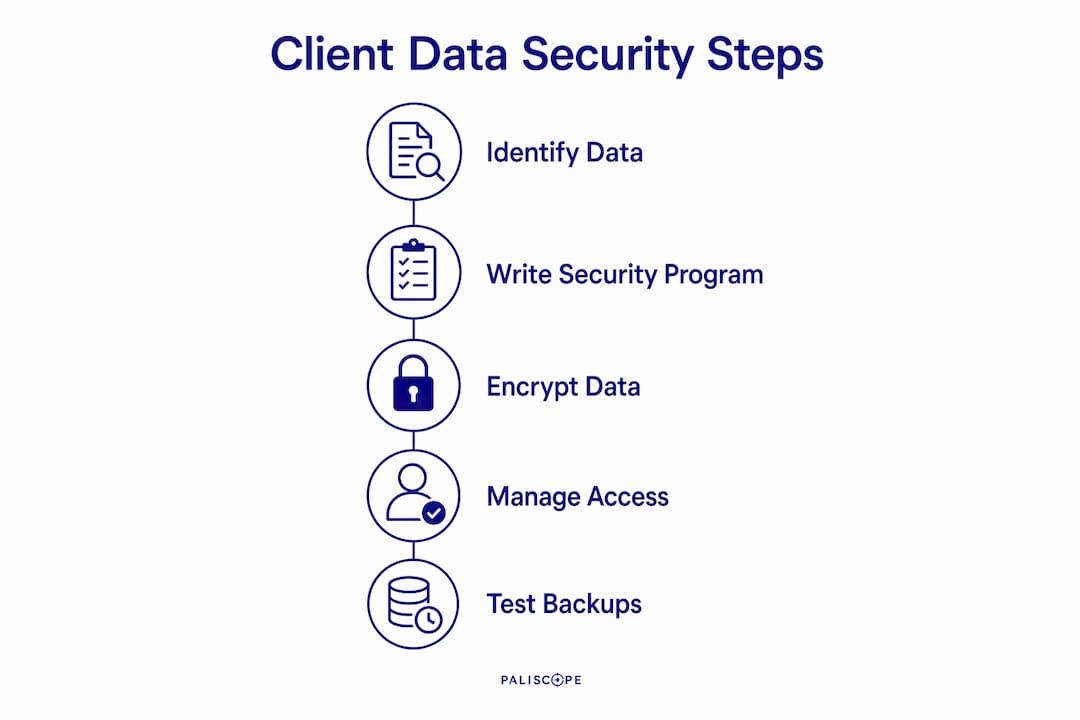
Encrypting data at both layers, in transit and at rest, is the standard for defense-in-depth. Encrypting only one layer leaves exposure. For data in transit, HTTPS and TLS protocols protect information moving between browsers, applications, and servers. For data at rest, full-disk encryption and encrypted database storage protect records even if physical hardware is stolen or a cloud storage bucket is misconfigured. Tools like HashiCorp Vault handle secrets management and encryption key rotation, which prevents a single compromised key from unlocking your entire data store.
Tokenization is a technique that reduces exposure further by replacing sensitive values, such as credit card numbers or Social Security numbers, with non-sensitive tokens. The actual value is stored securely elsewhere. Even if an attacker accesses your application database, they retrieve tokens with no usable value. This is especially useful for businesses in professional services or healthcare that process regulated personal data.
The table below compares the primary technical controls and their use cases:
| Control | What it protects | Best used for |
|---|---|---|
| TLS/HTTPS encryption | Data in transit between systems | Web apps, APIs, email |
| Full-disk encryption | Data at rest on devices and servers | Laptops, servers, cloud storage |
| Tokenization | Sensitive field values in databases | Payment data, SSNs, health records |
| MFA | Account access | All employee and admin logins |
| Role-based access control | Data visibility by job function | CRM, ERP, file storage systems |
Encryption alone is not enough. It must be paired with strong access governance and continuous identity verification. If an attacker steals valid credentials, they can decrypt data just as easily as a legitimate user. MFA and role-based access control (RBAC) limit the blast radius of a compromised account by restricting what that account can reach.
Pro Tip: Audit your access control lists every quarter. Employees change roles, leave the company, or pick up temporary project access that never gets revoked. Stale permissions are a silent risk.
For businesses that use Microsoft 365, configuring conditional access policies and enabling MFA across all accounts are two of the highest-return security actions available at no additional licensing cost.
How to establish and test backup and recovery processes
Backups are your last line of defense when every other control fails. The problem is that most small businesses back up their data but never confirm those backups actually work.
CIS Critical Security Controls recommend automated backups weekly or more often for sensitive data, quarterly recovery testing, and protecting backup copies with the same controls applied to production data. That means encrypting backups, storing them in an isolated location separate from your primary systems, and restricting access to backup management interfaces.
Follow these steps to build a backup program that holds up under pressure:
- Identify your critical data. Map every location where client data lives: file servers, cloud storage, CRM systems, email archives, and local workstations.
- Automate backups on a defined schedule. Sensitive client records should be backed up daily at minimum. Less critical data can follow a weekly schedule.
- Encrypt backup files and store them off-site or in an isolated cloud environment. A backup stored on the same network as your primary data offers no protection against ransomware.
- Test recovery quarterly. Restore a sample of files from backup and confirm they are complete and usable. Document the process and the results.
- Maintain written recovery procedures. If your IT contact is unavailable during an incident, someone else needs to be able to execute the recovery plan.
Untested backups are a common cause of failure during ransomware attacks and data incidents. Discovering that your backups are corrupted or incomplete in the middle of a crisis is a preventable disaster. Symmnet's guidance on backup recovery testing walks through exactly how to structure these tests so they reflect real recovery scenarios, not just file existence checks.
Key backup requirements to keep in mind:
- Backups must be isolated from the production environment
- Encryption keys for backups should be stored separately from the backup files themselves
- Recovery time objectives (RTOs) and recovery point objectives (RPOs) should be documented and tested against
What operational practices maintain client data security day-to-day?
Technology controls only work when the people using them understand why the rules exist. Operational practices close the gap between a written security policy and actual daily behavior.
Employee cybersecurity awareness training is the most direct way to reduce human error, which remains the leading cause of data breaches. Training should cover phishing recognition, password hygiene, proper handling of client records, and what to do when something looks suspicious. Annual training is a starting point, but quarterly refreshers tied to real incidents or new threat patterns are more effective.
The least privilege principle means every employee gets access only to the data their job requires, nothing more. A billing coordinator does not need access to engineering files. A sales rep does not need access to HR records. Implementing least privilege through RBAC in your CRM, file storage, and cloud platforms limits how much damage a compromised or malicious account can cause.
Pro Tip: Run a simulated phishing test before your next training session. The results will show you exactly where your team is vulnerable and make the training feel relevant rather than routine.
Continuous monitoring and maintaining updated data security programs help detect vulnerabilities and keep controls effective over time. Log access events for all systems that hold client data. Review those logs regularly, or use a security information and event management (SIEM) tool to flag anomalies automatically. Unusual login times, access from unexpected locations, and bulk data downloads are all signals worth investigating.
Third-party vendors are a frequently overlooked risk. Any service provider with access to your client data, whether a payroll processor, a cloud software vendor, or an IT contractor, extends your security perimeter. Require vendors to demonstrate their own security controls, and include data protection requirements in your contracts. For small businesses managing data protection risks, vendor risk management is one of the areas most commonly left unaddressed until after an incident.
How to avoid the most common client data security mistakes
The most dangerous misconception in client data security is that encryption alone constitutes a complete defense. Encryption protects data from being read if intercepted or stolen. It does not prevent an authorized user from misusing data, and it does not stop an attacker who has already obtained valid credentials.
"Defense-in-depth means layering encryption, access control, and identity verification so that no single failure exposes client data. Removing any one layer turns a resilient system into a fragile one." — HashiCorp Well-Architected Framework
Weak authentication is the second most common gap. Passwords alone are not sufficient for accounts that access client records. NIST digital identity guidelines provide clear criteria for selecting authentication methods based on the sensitivity of the data being protected. For most small businesses, MFA using an authenticator app meets the standard for general business systems. Higher-sensitivity systems may require phishing-resistant MFA methods like hardware security keys.
Stale recovery plans are the third pitfall. Security programs written two years ago may not reflect your current data environment, your current vendors, or the current threat landscape. The FTC Safeguards Rule explicitly requires programs to be updated as circumstances change. Schedule a formal review of your written security program at least annually, and update it whenever you add a new system, a new vendor, or a new category of client data.
Key takeaways
Securing client data requires layered controls across encryption, access management, backup testing, and continuous monitoring, with written policies grounded in frameworks like NIST Zero Trust and the FTC Safeguards Rule.
| Point | Details |
|---|---|
| Start with a written security program | Map your data holdings and align controls to actual risk before deploying tools. |
| Layer encryption with access control | Encrypt data at rest and in transit, then restrict who can decrypt and use it. |
| Test backups quarterly | Automated backups only protect you if recovery has been confirmed to work. |
| Apply least privilege consistently | Limit data access by job role and audit permissions every quarter. |
| Monitor and update continuously | Log access events and review your security program at least annually. |
Why Zero Trust is the mindset shift small businesses actually need
I have worked with small businesses across manufacturing, professional services, and aerospace, and the pattern I see most often is the same: owners invest in tools but skip the framework. They buy endpoint protection, set up a firewall, and assume the perimeter is secure. Then a contractor's credentials get phished, and suddenly someone outside the building has full access to client records.
Zero Trust is not a product. It is a way of thinking about access. The question is never "is this person inside our network?" The question is "has this specific request been verified, and does this person need this access right now?" That shift in thinking changes everything from how you configure your cloud storage to how you onboard a new vendor.
The written security program requirement from the FTC Safeguards Rule is the other piece most small businesses skip. Writing it down forces clarity. You have to name the data you hold, identify who accesses it, and describe the controls protecting it. That exercise alone surfaces gaps that no tool would have caught. I have seen businesses discover they had former employees with active CRM access simply by going through the documentation process.
The businesses that handle client data security well are not necessarily the ones with the biggest IT budgets. They are the ones that treat security as an operational discipline, not a one-time project. That means regular training, quarterly backup tests, annual program reviews, and a culture where employees know what to do when something looks wrong.
— Michael
How Symmnet helps small businesses protect client data
Small business owners should not have to become cybersecurity experts to protect their clients. Symmnet's managed IT services are built specifically for small U.S.-based businesses that need professional-grade data protection without the overhead of an internal IT team.
Symmnet handles 24/7 system monitoring, endpoint security, firewall management, encrypted backup and recovery, and compliance support for industry-specific regulations including the FTC Safeguards Rule. For businesses in manufacturing, aerospace, and professional services, Symmnet brings both the technical controls and the written program documentation that regulators and clients expect. The team is U.S.-based, responsive, and priced on a fixed monthly model so there are no surprise costs. If you want to know where your current security program has gaps, Symmnet offers a free assessment to identify vulnerabilities and prioritize the fixes that matter most.
FAQ
What does it mean to secure client data?
Securing client data means implementing controls including encryption, access management, backup procedures, and monitoring to protect sensitive customer information from unauthorized access, loss, or misuse. The goal is to maintain confidentiality, integrity, and availability of all client records.
What is Zero Trust and why does it matter for small businesses?
Zero Trust is a security framework that requires every access request to be verified regardless of network location, making it well-suited for hybrid work environments where employees connect from multiple devices and locations.
How often should I test my data backups?
CIS Critical Security Controls recommend testing backup recovery quarterly at minimum. Testing confirms that backups are complete, usable, and can be restored within your required timeframe during an actual incident.
Is encryption enough to protect client data?
Encryption alone is not sufficient. It must be combined with strong access controls and multifactor authentication, because an attacker with valid credentials can decrypt data just as easily as a legitimate user.
What is the FTC Safeguards Rule and does it apply to my business?
The FTC Safeguards Rule requires certain financial institutions and related businesses to maintain a written, risk-based information security program covering access controls, encryption, MFA, and ongoing monitoring. If your business handles customer financial data, review the FTC's guidance to determine whether it applies to you.