

A security audit is a systematic evaluation of an organization's cybersecurity controls, policies, and compliance posture against established standards. For small business owners and executives, understanding the importance of security audits is not optional. Regulations like HIPAA, PCI DSS, and GDPR carry real financial penalties for non-compliance, and frameworks like SOC 2 and NIST SP 800-53A define exactly how controls must be verified. A security audit tells you whether your defenses actually work, not just whether they exist on paper.
Why do security audits matter for your business?
Security audits are the primary mechanism for identifying gaps between what your security controls are supposed to do and what they actually do. Without a formal audit, most small businesses operate on assumption. That assumption is where breaches happen.
The role of security audits goes beyond checking boxes. Audits uncover misconfigurations, weak permissions, and outdated systems before those issues become public failures. Each of those findings represents a real attack surface that a threat actor could exploit. Catching them internally is far less costly than discovering them through an incident.

Audits also support compliance by providing evidence that controls meet standards like HIPAA, PCI DSS, and GDPR. This matters because regulators and customers do not accept verbal assurances. They require documented proof. An audit produces that proof in a format that holds up under scrutiny.
The security audit significance for small businesses is especially high because smaller organizations typically lack dedicated security staff. An audit brings structured, expert-level assessment to teams that would otherwise have no formal mechanism for measuring their own risk exposure.
How do security audits identify vulnerabilities and reduce risk?
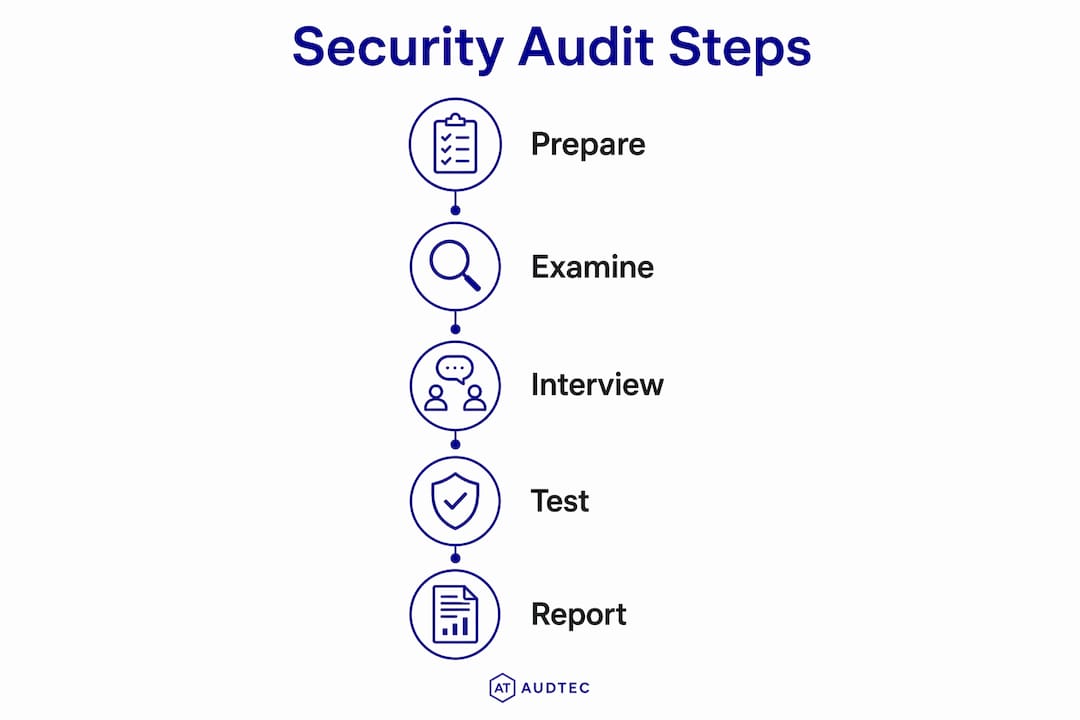
The core value of a cybersecurity audit lies in its methodology. NIST SP 800-53A defines three essential assessment methods that produce defensible audit conclusions:
- Examine: Reviewing documentation, policies, configurations, and system records to verify that controls are designed correctly.
- Interview: Speaking with staff and system owners to confirm that controls are understood and followed in practice.
- Test: Actively probing systems to verify that controls operate as intended under real conditions.
This examine, interview, and test methodology is what separates a credible audit from a self-assessment questionnaire. A questionnaire tells you what people believe is true. An audit tells you what is actually true. That distinction matters enormously when your business is defending against threats that exploit exactly the gap between belief and reality.
Common findings from audits include firewall misconfigurations, excessive user permissions, unpatched software, and missing encryption on sensitive data. Each of these is a known entry point for ransomware, data theft, and unauthorized access. Auditors verify operational reality through evidence, logs, interviews, and testing, not just documentation. You can review a practical security controls checklist to understand what auditors typically examine in small business environments.
Pro Tip: Maintain a running evidence folder throughout the year. Collect access logs, patch records, and policy acknowledgment forms on a rolling basis. Organizations that do this reduce audit disruption significantly and produce cleaner findings.
What role do security audits play in ensuring compliance?
Compliance is not a one-time event. Regulations evolve, threat environments shift, and auditors expect to see that your controls have kept pace. The role of audits in cybersecurity compliance is to produce continuous, verifiable evidence that your organization meets its obligations.
Here is how audits connect directly to the most common regulatory requirements small businesses face:
- HIPAA: Healthcare-adjacent businesses must demonstrate that protected health information is secured through access controls, encryption, and audit logging. An audit verifies each control is operating, not just documented.
- PCI DSS: Any business processing payment cards must show that cardholder data is protected. Audits confirm that network segmentation, access controls, and monitoring are functioning as required.
- GDPR: Businesses handling data from EU residents must demonstrate data protection by design. Audits identify gaps in consent management, data retention, and breach notification readiness.
- SOC 2: Service organizations seeking SOC 2 Type II certification must demonstrate consistent control operation over 3–12 months. This is not a snapshot. It is sustained proof of operational discipline.
The consequences of skipping audits are concrete. HIPAA fines reach up to $1.9 million per violation category annually. PCI DSS non-compliance can result in card processing termination. GDPR penalties reach 4% of global annual revenue. Beyond fines, a compliance failure that becomes public damages customer trust in ways that are difficult to recover from. Ongoing audits reduce the risk of costly compliance failures and keep small businesses aligned with regulatory and threat changes.
For manufacturers and professional services firms, the compliance dimension is especially relevant. You can explore how compliance fits manufacturing operations to see how audit requirements translate into day-to-day operational decisions.
How do security audits support executive decision-making?
Executives and board members are responsible for cybersecurity risk, but most receive technical reports that do not translate into business decisions. A well-scoped audit changes that. Audits provide governance-level confidence by validating risk management and operational resilience in terms that leadership can act on.
The key is audit scope. Scope must be tied to specific risks and control ownership to produce findings that executives can use. An audit that covers everything superficially tells leadership very little. An audit scoped to your highest-risk systems, your most sensitive data, and your most critical compliance obligations tells leadership exactly where to invest and where risk is acceptable.
Cybersecurity audits are most valuable when treated as governance and risk control mechanisms rather than simple checklists. The goal is not to pass. The goal is to know.
Audits also clarify ownership. When a finding identifies that no one is responsible for patching a critical system, that is a governance failure, not just a technical one. Executives need that information to assign accountability and allocate resources correctly.
Leaders should demand evidence of control effectiveness and maturity, not just a pass/fail result. Measurement of effectiveness, maturity, and efficiency is what separates a useful audit from a compliance formality. That measurement is what allows executives to make informed tradeoffs between security investment and operational cost.
Pro Tip: When reviewing an audit report, ask your auditor to show you the evidence behind each finding. If a control is marked effective, you should be able to see the logs, test results, or interview notes that support that conclusion. A finding without evidence is an opinion.
What are security audit best practices and common challenges?
Preparation is the single biggest factor in audit quality. Well-prepared organizations reduce audit duration by 30–40% and produce more actionable findings. That time savings translates directly into lower disruption for your staff and faster remediation of real issues.
Building an evidence-ready organization
Evidence readiness is the most common bottleneck in small business audits. Consistent, repeatable proof of control execution is what auditors need to reach defensible conclusions. This means maintaining patch logs, access review records, incident response test results, and configuration baselines as ongoing operational outputs, not documents assembled under audit pressure.
Automation tools like Microsoft Sentinel, Qualys, and Tenable can continuously collect and organize evidence. These platforms generate the logs and reports that auditors require, reducing the manual burden on small teams. For businesses in manufacturing or aerospace, integrating IT security practices into daily operations makes evidence collection a natural byproduct of normal work.
Internal vs. external audits: knowing the difference
| Audit Type | Who Conducts It | Frequency | Best Use |
|---|---|---|---|
| Internal Audit | Your own team or IT partner | Quarterly or ongoing | Continuous monitoring, gap identification |
| External Audit | Independent third-party firm | Annually or per regulation | Compliance certification, board reporting |
| Penetration Test | Specialized security firm | Annually or after major changes | Active exploitation testing, red team validation |
Internal audits keep your controls honest between formal reviews. External audits provide the independent verification that regulators and customers require. Both are necessary. Treating them as substitutes for each other is a common mistake that leaves organizations exposed.
The biggest audit value comes from remediation and retesting, not the static report. A finding that gets fixed and verified closed is worth far more than a finding that sits in a spreadsheet. Build remediation timelines into your audit process from the start, and schedule retesting before the next audit cycle begins.
Key takeaways
Regular security audits are the most reliable way for small businesses to verify control effectiveness, maintain compliance, and give leadership the evidence needed to make informed cybersecurity decisions.
| Point | Details |
|---|---|
| Audits verify real control performance | Use examine, interview, and test methods to confirm controls work in practice, not just on paper. |
| Compliance requires continuous evidence | Standards like SOC 2 Type II and HIPAA require ongoing proof of control operation, not one-time snapshots. |
| Preparation cuts audit time significantly | Well-prepared organizations reduce audit duration by 30–40% and produce cleaner, more actionable findings. |
| Executives need evidence, not just results | Ask auditors to show logs, test results, and interview notes behind every finding to support real decisions. |
| Remediation closes the loop | Retesting after fixes confirms that vulnerabilities are actually resolved, not just acknowledged. |
Security audits are a leadership decision, not an IT task
I have seen small business owners treat security audits as something the IT team handles and reports back on. That framing is the problem. An audit that leadership does not engage with produces a report that no one acts on.
The most effective audits I have observed are ones where the executive team defines the scope. They decide which systems hold the most critical data. They decide which regulatory obligations carry the most business risk. When leadership sets the scope, the findings land in the right hands and drive real decisions about investment, staffing, and control ownership.
The other pattern worth noting is the difference between businesses that audit reactively and those that audit on a schedule. Reactive audits happen after an incident, a customer demand, or a regulatory inquiry. Scheduled audits happen because leadership has decided that knowing their risk posture is a standing business requirement. The second group consistently has shorter incident response times, cleaner compliance records, and more confident conversations with customers and partners.
The cybersecurity environment in 2026 does not reward passivity. Threat actors target small businesses specifically because they assume smaller organizations lack the discipline to audit and remediate consistently. Proving that assumption wrong starts with treating audits as a governance function, not a compliance chore.
— Michael
How Symmnet supports your security audit readiness
Small businesses rarely have the internal resources to prepare for, conduct, and remediate a security audit on their own. That is exactly the gap Symmnet fills.
Symmnet's managed IT and cybersecurity services are built for small U.S.-based businesses in manufacturing, aerospace, and professional services. Symmnet handles audit preparation, evidence collection, remediation support, and ongoing monitoring so your team is not scrambling when an auditor arrives. With 24/7 system monitoring, endpoint security, and compliance assistance built into a fixed-price model, Symmnet gives small business leaders the audit readiness and governance confidence they need without the overhead of a full internal IT department. Start with a free assessment to identify your current security gaps.
FAQ
What is a security audit?
A security audit is a systematic evaluation of an organization's cybersecurity controls, policies, and configurations against established standards like NIST, HIPAA, or PCI DSS. It verifies whether controls are designed correctly and operating effectively in practice.
How often should small businesses conduct security audits?
Small businesses should conduct internal audits quarterly and external audits at least annually. Businesses subject to regulations like HIPAA or SOC 2 may require more frequent formal reviews depending on their compliance obligations.
What is the difference between a security audit and a penetration test?
A security audit evaluates whether controls exist and operate as designed across policies, configurations, and processes. A penetration test actively attempts to exploit vulnerabilities to determine how far an attacker could get if controls fail.
Why conduct security audits if you have not had a breach?
Audits identify vulnerabilities before incidents occur, not after. Most breaches exploit known gaps like misconfigurations or unpatched systems that a formal audit would have flagged and remediated.
What should executives look for in an audit report?
Executives should look for evidence behind each finding, clear ownership assignments for remediation, and measurable indicators of control effectiveness. A report that only lists pass/fail results without supporting evidence does not give leadership enough to act on.