

Securing aerospace data means implementing a layered defense built on cryptographic attestation, hardware-rooted validation, and compliance with frameworks like NAS 9933, NIST 800-171, and the Cybersecurity Maturity Model Certification (CMMC). For IT managers at small to mid-sized aerospace companies, the stakes are high. A single breach can disrupt flight operations, void government contracts, and expose controlled unclassified information (CUI) to adversaries. The methods that work today go well beyond firewalls and password policies. They include post-quantum cryptography, zero-trust architecture, and integrated threat mapping across ground, link, and space segments.
How to secure aerospace data: frameworks and standards
Aerospace data protection starts with knowing which standards apply to your organization. NAS 9933 is the aerospace industry's dedicated cybersecurity framework, developed by the Aerospace Industries Association. It complements NIST 800-171 by adding aerospace-specific controls on top of the federal baseline. As of 2026, NAS 9933 adoption is voluntary, but that window is closing.
CMMC full adoption is expected within two to three years. That timeline matters because DoD contracts will require certified compliance, and certification takes time. Companies that wait until the deadline face rushed audits, failed assessments, and lost contract eligibility. Starting readiness now is not optional for any company pursuing defense work.
The security control families most relevant to aerospace include:
- Access control — restricting who can read, write, or transmit flight-critical data
- Audit and accountability — logging all access events to CUI systems
- Configuration management — maintaining approved baselines for avionics and ground systems
- Incident response — documented procedures for detecting and containing breaches
- System and communications protection — encrypting data in transit across all network segments
- Risk assessment — periodic evaluation of threats specific to aerospace mission profiles
Pro Tip: Begin your CMMC gap assessment at least 18 months before your target certification date. Remediation of control deficiencies in aerospace environments takes longer than in standard enterprise IT because changes must align with airworthiness directives.
Which cryptographic methods protect aerospace data pipelines?
Hardware-rooted cryptographic validation is the strongest defense for flight-critical data. Research on the AXIOM framework demonstrates that high-assurance data integrity in aviation pipelines is achievable with a mean latency of just 1.825 ms using a three-layer middleware combining cryptographic attestation, physics cross-validation, and sensor fusion across more than one million test trials. That result proves security and speed are not mutually exclusive in avionics.

The AXIOM framework uses ECDSA P-384 attestation against an immutable baseline stored in a hardware secure enclave. This approach defeats man-in-the-middle attacks that software-only validation cannot catch. Even signed software can be compromised if SSL validation is disabled at any point in the pipeline. Hardware-rooted validation closes that gap by anchoring trust in physical silicon rather than software state.
Post-quantum cryptography is the next critical layer. Adversaries are already harvesting encrypted aerospace data today with the intent to decrypt it once quantum computers mature. The urgency of post-quantum migration in avionics is real, and the recommended approach uses HPKE (Hybrid Public Key Encryption) combining quantum-resistant ciphers Kyber/ML-KEM and Dilithium/ML-DSA.
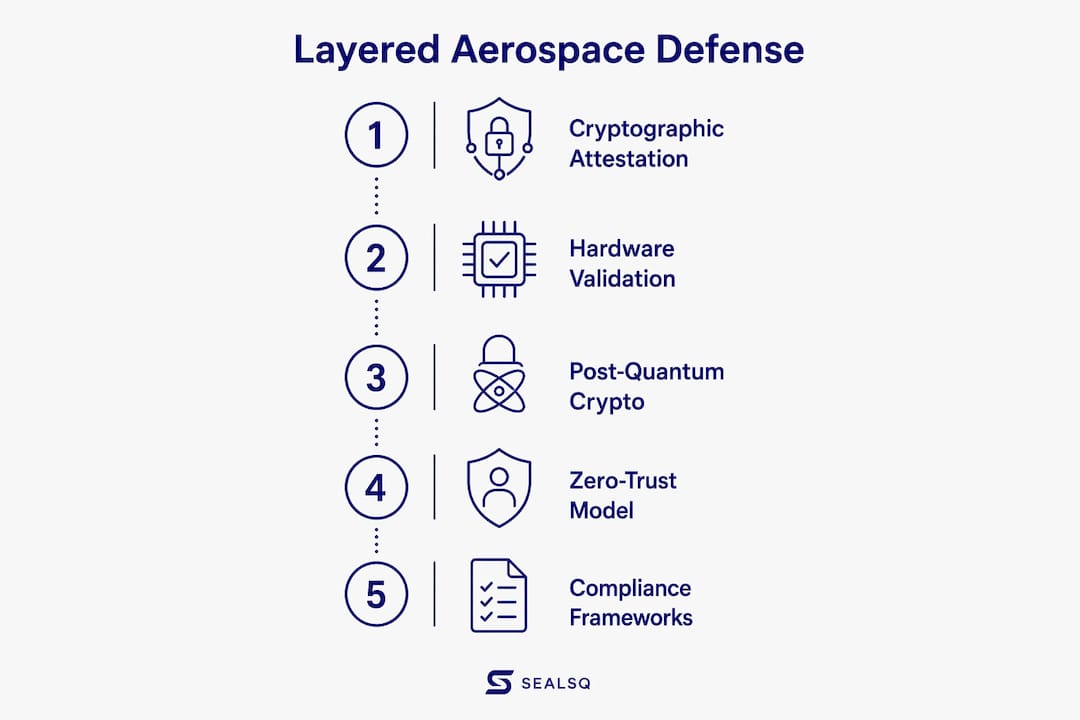
Crypto agility is equally important. Partitioning software in avionics enables rapid replacement of compromised ciphers without recertifying entire systems. This design principle means your organization can respond to a broken algorithm in days rather than years.
Key cryptographic practices for aerospace data pipelines:
- Use elliptic curve algorithms (ECDSA P-384 or stronger) for attestation
- Deploy hardware secure enclaves for baseline storage and key management
- Adopt HPKE with Kyber/ML-KEM for post-quantum key exchange
- Apply Dilithium/ML-DSA for post-quantum digital signatures
- Partition cryptographic modules to enable cipher replacement without full recertification
Pro Tip: Never rely on software-only integrity checks for flight management data. Combine cryptographic attestation with physics-based cross-validation, such as Runge-Kutta numerical integration, to catch both cyber tampering and sensor anomalies simultaneously.
How can aerospace organizations implement layered defense?
Zero-trust architecture is the correct model for aerospace IT environments. The principle is simple: no user, device, or system is trusted by default, even inside the network perimeter. For aerospace, this means every request to access avionics data, maintenance records, or passenger systems must be authenticated and authorized independently.
Network segmentation is the structural foundation of layered defense. Connected aircraft cybersecurity requires treating each domain, avionics, maintenance, and passenger connectivity, as a separate security zone with controlled data flows between them. ARINC 664 defines the data network standard for avionics, and data diodes enforce one-way communication where bidirectional access is unnecessary.
Practical steps for deploying layered defense in aerospace environments:
- Segment networks by domain. Separate avionics, maintenance, and passenger Wi-Fi into distinct zones with firewall rules controlling all inter-zone traffic.
- Deploy encrypted tunnels. Use TLS 1.3 or IPsec for all data in transit between ground systems and aircraft.
- Implement continuous monitoring. Align monitoring alerts with airworthiness directives so that anomalies in safety-critical systems trigger immediate review.
- Apply secure boot. Require hardware-verified boot sequences on all avionics and ground support computers.
- Use data diodes for one-way feeds. Protect flight data recorder outputs and telemetry streams from write-back attacks.
- Patch on a safety-aligned schedule. Patch cycles in aerospace must sync with airworthiness directives rather than standard enterprise IT update norms.
Pro Tip: Treat your cybersecurity governance structure the same way you treat your safety management system. Both require documented procedures, defined roles, and regular audits. Merging these governance tracks reduces duplication and catches gaps that siloed teams miss.
What TTP frameworks strengthen aerospace cybersecurity strategies?
Threat mapping across all aerospace segments requires more than a single framework. Integrating SPARTA, MITRE ATT&CK, and SPACE-SHIELD provides end-to-end coverage across ground stations, communication links, and space assets. Each framework addresses a distinct layer of the attack surface.
| Framework | Primary focus | Aerospace application |
|---|---|---|
| MITRE ATT&CK | Adversary tactics and techniques | Ground system and endpoint threat modeling |
| SPARTA | Space-specific attack patterns | Satellite and launch system threat mapping |
| SPACE-SHIELD | Cross-segment attack chain analysis | Countermeasure validation across domains |
SPARTA documents attack chains that begin at a ground station and propagate through the communication link to the space segment. This cross-segment view is critical because attackers rarely stop at one layer. A compromised ground terminal can become the entry point for a satellite command injection attack.
STIX 2.1 for space observables enables standardized threat intelligence sharing among mission stakeholders. That standardization matters because no single organization sees the full threat picture. Sharing structured intelligence accelerates detection and response across the aerospace supply chain.
For small to mid-sized aerospace companies, the practical value of these frameworks is in system design. Mapping your architecture against SPARTA and MITRE ATT&CK during the design phase costs far less than remediating vulnerabilities after certification. Use the aerospace cybersecurity checklist to align your design reviews with current TTP mappings.
What are common challenges when securing aerospace data?
Patch management is the most common failure point in aerospace IT security. Enterprise IT teams patch on weekly or monthly cycles. Aerospace systems cannot follow that schedule because every change to a safety-critical system requires airworthiness review. The result is a gap where known vulnerabilities remain unpatched for months while certification processes run their course.
Insider threats and supply chain risks compound the problem. A trusted supplier with access to your design data or ground systems represents an attack vector that perimeter defenses cannot address. Vetting supplier cybersecurity practices and limiting third-party access to the minimum necessary scope are non-negotiable controls.
Legacy systems create a specific class of risk. Many small aerospace manufacturers operate equipment that predates modern encryption standards. These systems often cannot run current cryptographic libraries, which means they require network isolation rather than direct patching.
"Even signed software can be vulnerable if SSL validation is disabled. Hardware-rooted cryptographic attestation is the only reliable way to ensure integrity of flight-critical data pipelines." — AXIOM Research, Zenodo
Common implementation pitfalls and how to address them:
- Mismatched patch cycles. Build a patch review process that runs parallel to airworthiness directive tracking so security updates are ready when the certification window opens.
- Software-only trust. Replace software integrity checks with hardware-rooted attestation for any system that touches flight-critical data.
- Unchecked supply chain access. Require suppliers to meet NIST 800-171 controls and audit their compliance annually.
- Untested backups. A backup that has never been restored is not a backup. Validate your backup systems on a scheduled basis to confirm recovery capability.
- Certification delays from late security changes. Introduce security controls at the design phase, not after, to avoid costly recertification cycles.
Key takeaways
Securing aerospace data requires cryptographic attestation, hardware-rooted validation, compliance with NAS 9933 and CMMC, and integrated threat mapping using SPARTA and MITRE ATT&CK frameworks.
| Point | Details |
|---|---|
| Start compliance early | Begin CMMC gap assessments at least 18 months before your target certification date. |
| Use hardware-rooted validation | ECDSA P-384 attestation in secure enclaves defeats attacks that software-only checks miss. |
| Adopt post-quantum cryptography now | Adversaries harvest encrypted data today to decrypt later; migrate to Kyber/ML-KEM and Dilithium/ML-DSA. |
| Segment networks by domain | Separate avionics, maintenance, and passenger systems into distinct zones with controlled inter-zone traffic. |
| Align patches with airworthiness directives | Aerospace patch cycles must follow safety certification schedules, not enterprise IT norms. |
What I've learned about aerospace security that most guides skip
Most cybersecurity guides treat post-quantum migration as a future problem. It is not. Adversaries are collecting encrypted aerospace data right now. The decryption comes later, when quantum hardware matures. By the time that happens, the data will still be sensitive, and the window to protect it will have closed years earlier. The organizations that migrate to quantum-resistant ciphers today are the ones whose data will still be protected in ten years.
The second thing most guides miss is the cultural gap. Aerospace engineers and IT security teams operate on fundamentally different timelines and risk models. Engineers think in certification cycles measured in years. Security teams think in patch cycles measured in days. Bridging that gap requires a shared governance structure, not just a memo from leadership. I've seen companies spend significant resources on technical controls while their patch review process sat in a committee backlog for eight months.
Connectivity is the third underestimated risk. Treating connectivity as a managed utility rather than an IT convenience changes how you architect, monitor, and govern every network touchpoint on an aircraft or ground system. The companies that get this right build security into the connectivity design from day one. The ones that get it wrong are retrofitting controls onto systems that were never designed to support them.
The practical advice is this: pick one framework, SPARTA or MITRE ATT&CK, map your current architecture against it, and find the three biggest gaps. Fix those first. Then add the second framework. Trying to implement everything at once produces compliance theater, not real security.
— Michael
How Symmnet supports aerospace data protection
Aerospace IT security is not a one-size-fits-all problem, and Symmnet does not treat it that way. Symmnet's managed IT services for aerospace and manufacturing companies include 24/7 network monitoring, firewall management, endpoint security, and compliance readiness support for CMMC and NIST 800-171. The team understands that patch cycles in aerospace follow airworthiness directives, not enterprise calendars, and builds service schedules accordingly. For companies that need to harden their network architecture, Symmnet's network segmentation guidance covers avionics, maintenance, and ground system domains. A free security assessment identifies your current gaps and maps them to the controls that matter most for your contracts and operations.
FAQ
What is NAS 9933 and why does it matter for aerospace?
NAS 9933 is an aerospace-specific cybersecurity framework developed by the Aerospace Industries Association that complements NIST 800-171. It is currently voluntary but will become a practical requirement as CMMC adoption expands across DoD contracts.
How does post-quantum cryptography protect aerospace data?
Post-quantum cryptography uses algorithms like Kyber/ML-KEM and Dilithium/ML-DSA that resist attacks from quantum computers. Aerospace organizations should migrate now because adversaries are already collecting encrypted data to decrypt once quantum hardware matures.
What is the difference between SPARTA and MITRE ATT&CK for aerospace?
MITRE ATT&CK covers adversary tactics against ground systems and endpoints, while SPARTA focuses on space-specific attack patterns including satellite and launch system threats. Using both frameworks together provides cross-segment threat coverage.
Why must aerospace patch cycles align with airworthiness directives?
Changes to safety-critical avionics systems require airworthiness certification review before deployment. Applying security patches outside that process can compromise certified system configurations and create both safety and compliance violations.
What is hardware-rooted validation and why is it better than software checks?
Hardware-rooted validation anchors cryptographic trust in a physical secure enclave rather than software state. It defeats man-in-the-middle attacks that software-only integrity checks miss, including scenarios where SSL validation has been disabled in the application layer.