

If you accept credit or debit cards, PCI DSS applies to you, no matter how small your revenue is. Most U.S. small merchants typically fall into the lowest merchant level and validate through self-assessment rather than a formal audit. Your first move: confirm your Self-Assessment Questionnaire (SAQ) type with your acquiring bank or payment processor, then look at whether a hosted checkout or P2PE solution can shrink your compliance burden before you build anything else.
TL;DR:
- Most small merchants are in the lowest PCI DSS merchant level and can often reduce compliance workload by using hosted checkout or P2PE solutions.
- Failing to meet PCI compliance can result in fines, higher processing fees, account shutdown, and breach-related costs including investigations and customer notifications.
- Choosing the correct SAQ type depends on whether you handle card data directly or outsource payment processing, with fully hosted solutions qualifying for the simplest SAQ A.
- Building a detailed network diagram before implementing controls helps identify scope and prevent unintentional extensions that increase compliance complexity.
- Ongoing security hygiene, including quarterly scans, regular updates, and staff training, is critical for maintaining PCI compliance year-round.
Table of Contents
- What Is PCI Compliance for Small Business, and Who Does It Apply To?
- Which Merchant Level and SAQ Type Fits Your Business?
- How Do You Actually Become PCI Compliant? A Step-by-Step Plan
- What Mistakes Expand Your Scope, and What Does This Cost?
- Why a Managed IT Partner Makes PCI Compliance Easier
- What Training Do Employees Need for Handling Card Data?
- What Do You Do If You Suspect a Card Data Breach?
- How Do You Keep PCI Compliance Current Year After Year?
- When Do You Need a QSA or ASV, and How Do You Choose One?
- What Most Small Businesses Get Wrong About PCI Compliance
- Get a Free Assessment From Symmetry Network Management
- Sources
What Is PCI Compliance for Small Business, and Who Does It Apply To?
PCI DSS is not a government law. It is an industry data security standard maintained by the PCI Security Standards Council, and it gets enforced through the merchant agreement you signed with your acquiring bank or payment processor. That distinction matters because it means there is no revenue threshold that exempts you. A food truck running $40,000 a year through a card reader is just as in-scope as a regional distributor running millions, because scope is triggered by whether you store, process, or transmit cardholder data, not by how much you make.
Skipping compliance carries real financial teeth. Acquirers can levy monthly noncompliance fines, raise your processing rates, or terminate your merchant account outright. If a breach happens while you're out of compliance, you're also exposed to forensic investigation costs, card-brand penalties, and state data breach notification laws that most small business owners have never read.
Consequences you're actually risking:
- Monthly fines from your acquiring bank until you attest.
- Higher per-transaction processing rates as a penalty.
- Loss of your ability to accept cards at all.
- Breach liability, forensic costs, and mandatory customer notification under state law.
Which Merchant Level and SAQ Type Fits Your Business?
The card brands sort merchants into different levels by annual transaction volume, and the level determines how rigorous your validation needs to be. The highest level requires an annual on-site assessment by a Qualified Security Assessor (QSA). Lower levels usually self-assess but may face stricter documentation demands from their acquirer. Most small U.S. merchants fall into the lowest level that generally means self-assessment through the correct SAQ, with your acquirer setting the specific rules.
Picking the wrong SAQ is where small businesses waste the most money and time. The SAQ Instructions and Guidelines from PCI SSC lay out eligibility for each type, and the gap between them is enormous: SAQ A is a short questionnaire for fully outsourced, hosted payment pages, while SAQ D can run hundreds of additional control questions for merchants that touch card data directly.
Here's how the common types map to real small-business setups:
- SAQ A: You use a fully hosted, redirect-based checkout (think a hosted payment page from your processor) and never see raw card data.
- SAQ A-EP: Your website has an embedded JavaScript payment form or iframe that influences the payment page, even if you don't store data.
- SAQ B-IP: You use standalone, PTS-approved payment terminals connected via IP, common in retail counters and food service.
- SAQ C: Your point-of-sale system is connected to the internet and handles card data through a payment application.
- SAQ D: You store cardholder data yourself, run a custom payment integration, or don't qualify for any simpler SAQ.
- SAQ P2PE: You use a validated point-to-point encryption solution where card data is encrypted at the swipe and never touches your systems in readable form.
How Do You Actually Become PCI Compliant? A Step-by-Step Plan
The PCI DSS Quick Reference Guide frames the whole process as three phases: assess, repair, report. For a small business, that breaks down into concrete tasks you can knock out over a few weeks.
- Confirm your SAQ with your acquirer. Call your processor or bank before doing anything else. They set the validation rules you're actually held to.
- Map every payment touchpoint. Draw a simple diagram: website, POS terminals, phone orders, any spreadsheet or email that might touch a card number.
- Reduce scope aggressively. Move to a hosted checkout, tokenize stored data, or adopt a P2PE-validated terminal. Each of these can shrink your SAQ from a heavy version to a lighter one.
- Segment your network. Keep point-of-sale and payment systems on a separate VLAN from general office Wi-Fi and guest networks. Our guide to network segmentation best practices covers the setup in more detail.
- Implement baseline controls. Firewall configuration, multifactor authentication for any administrative access, regular patching, antivirus on relevant endpoints, and centralized logging all map directly to PCI's 12 core requirements.
- Run ASV scans if you're in scope. Any internet-facing system in scope needs quarterly external scans from an Approved Scanning Vendor, with remediation before resubmission if it fails.
- Complete and submit your SAQ and AOC. File the Attestation of Compliance with your acquirer once the questionnaire is answered honestly.
- Set a maintenance calendar. Quarterly scans, annual SAQ renewal, and continuous patching and monitoring in between.
Pro Tip: Do the network diagram before you touch a single control. Businesses that skip this step almost always discover midway through that a forgotten backup laptop or an old point-of-sale terminal is quietly keeping them in a much bigger SAQ than they need.
What Mistakes Expand Your Scope, and What Does This Cost?
The fastest way to land in SAQ D territory is to make choices that seem harmless in the moment. Storing card numbers in a spreadsheet "just for refunds," running your POS terminals on the same flat network as your office Wi-Fi, embedding a JavaScript payment form without realizing it puts you in SAQ A-EP territory, leaving default admin passwords on a router, or allowing remote access to your systems without multi-factor authentication all quietly widen your compliance obligations.
Common scope traps to watch for:
- Card numbers saved in email, spreadsheets, or sticky notes.
- One flat network serving POS terminals, office computers, and guest Wi-Fi.
- Custom checkout scripts instead of a redirect-based hosted page.
- Default or shared logins on routers, terminals, or remote access tools.
Costs vary widely by path. A merchant on a fully outsourced SAQ A setup typically spends far less on compliance tooling than one that stores card data and lands on SAQ D, where ASV scanning, potential QSA consultation, and remediation work stack up quickly. Realistically, expect four to eight weeks from your first call to your acquirer to a filed AOC if you're on a lighter SAQ path, longer if remediation work is needed.
Why a Managed IT Partner Makes PCI Compliance Easier
Most small businesses don't have a dedicated security team, and PCI compliance touches nearly every layer of your network: firewalls, endpoints, patching, logging, and documentation. That's the exact overlap where a managed IT provider earns its keep.
Managed IT providers often support manufacturing, aerospace, and professional services clients specifically because these industries carry both payment data and regulatory pressure at once. The practical support that maps directly to PCI requirements includes:
- Network segmentation to isolate payment systems from the rest of your infrastructure.
- Firewall management and configuration reviews.
- Endpoint security and patch management across every device that touches your network.
- 24/7 monitoring and logging, which most SAQs require in some form.
- Coordination with an ASV for quarterly scans and remediation tracking.
- Evidence collection and documentation to support your SAQ and AOC filing.
Pro Tip: Ask any managed IT provider you're evaluating to show you, concretely, how they'd document evidence for your specific SAQ type. Vague reassurance is a red flag; a provider with real PCI experience can walk you through it in five minutes.
Fixed monthly pricing can convert an unpredictable compliance project into a line item you can budget against, rather than a scramble every time your acquirer sends a reminder notice.
What Training Do Employees Need for Handling Card Data?
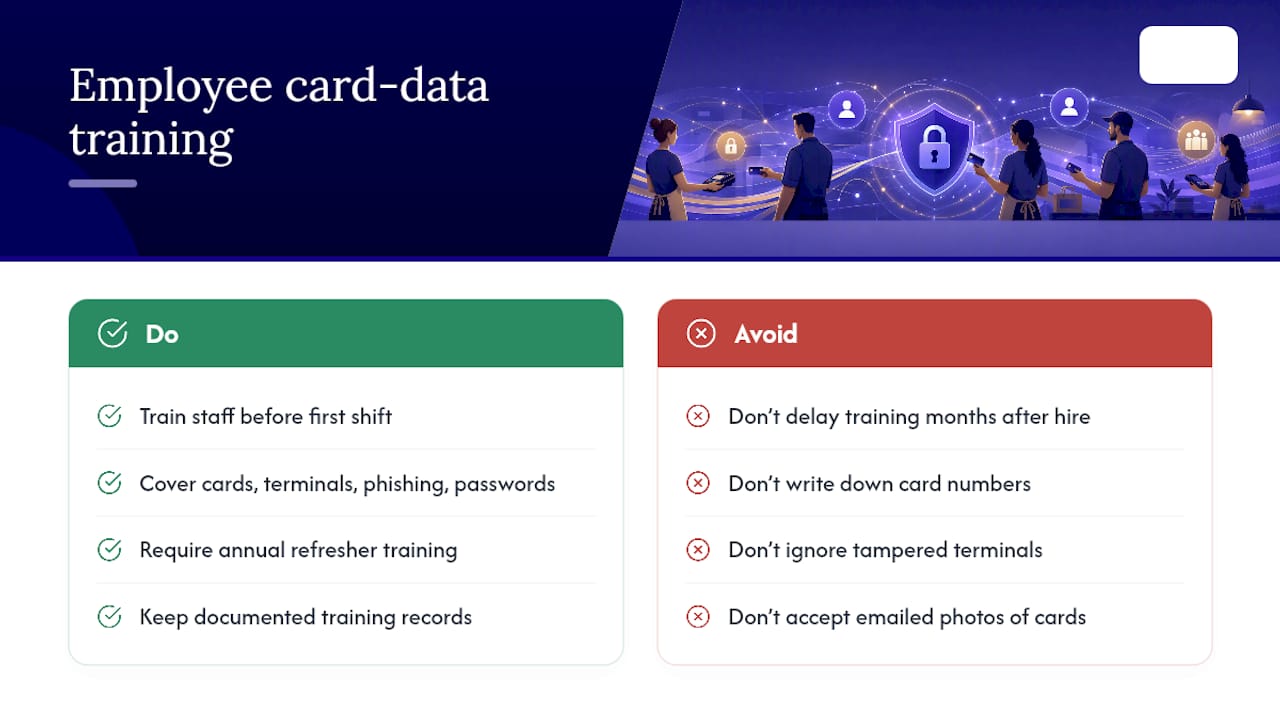
Anyone who touches a card, a terminal, or a payment screen needs training, and it needs to happen before they start handling transactions, not months later. PCI DSS expects staff to understand how to recognize tampered terminals, why they should never write down a card number, and what to do if a customer asks them to process a payment in an unusual way, like emailing a photo of their card.
Training should cover a few practical areas: secure handling of physical cards and terminals, recognizing phishing attempts aimed at payment staff, password hygiene for any system touching payment data, and a clear escalation path if something looks wrong. New hires need this before their first shift at the register, and existing staff need a refresher at least annually.
Keep records of who was trained and when. If your SAQ requires evidence of a security awareness program, an acquirer or QSA reviewing your documentation will want proof, not just your word. A simple sign-in sheet or a completion log from an online training module is usually enough for a Level 4 merchant, but it has to actually exist.
Retail and food service staff face the highest real-world risk here, since they're the ones interacting with physical card readers where skimming devices get attached. A quick daily visual check of terminals, built into an opening or closing checklist, catches most tampering before it becomes a breach.
What Do You Do If You Suspect a Card Data Breach?
Speed matters more than perfection in the first hours after you suspect a compromise. Isolate the affected systems immediately, meaning disconnect them from the network rather than shutting them down, since forensic investigators often need the system state preserved.
Call your acquiring bank or processor right away. They have a contractual breach notification process, and most have a incident response line specifically for this. They will likely require you to engage a PCI Forensic Investigator (PFI) if the incident is confirmed to involve cardholder data.
From there, the sequence generally looks like this: contain the affected systems, notify your acquirer, engage a forensic investigator if directed to, and preserve logs rather than deleting anything in a panic. Once the investigation identifies what happened, you'll likely need to notify affected customers under your state's breach notification law, which varies by state in terms of timeline and required content.
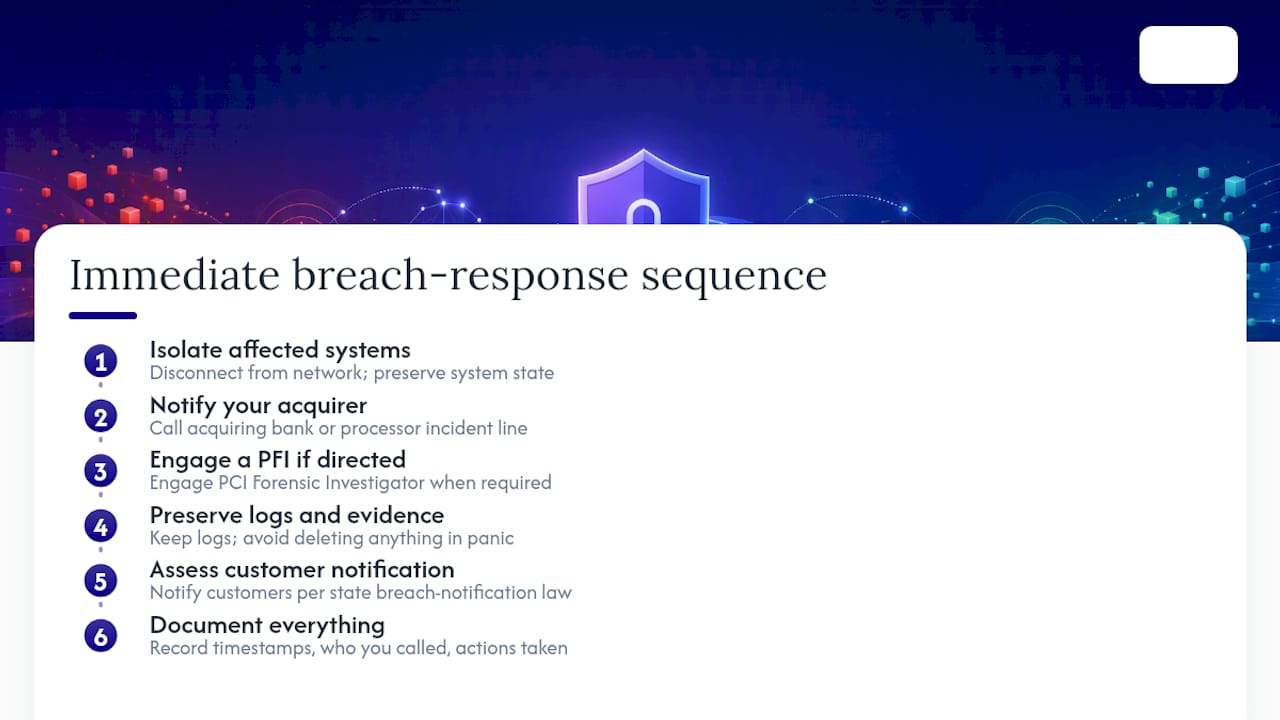
Document everything as you go, timestamps, who you called, what systems were isolated. That documentation matters both for your acquirer's process and for any regulatory notification requirements that follow. Businesses that treat this as a one-time bad day usually get burned twice, because the underlying scope issue that caused the breach never actually gets fixed.
How Do You Keep PCI Compliance Current Year After Year?
Compliance is not a certificate you earn once and file away. The Small Merchant Guide to Safe Payments frames this correctly: it's ongoing security hygiene, not an annual paperwork exercise. Threats evolve, staff turn over, and new payment integrations quietly expand your scope if nobody's watching.
Build a maintenance rhythm around a few fixed points. Quarterly ASV scans if you have internet-facing systems in scope, with remediation tracked until each scan passes clean. Annual SAQ renewal, ideally scheduled a month before your acquirer's deadline so you're not scrambling. Continuous patch management rather than batch updates every few months, since unpatched systems are one of the most common entry points attackers use.
Review your network diagram every time you add a new point-of-sale system, a new payment integration, or a new vendor with remote access. Small changes, a new online ordering plugin, a new terminal at a second location, can silently shift your SAQ eligibility if nobody re-checks scope. Our manufacturing cybersecurity checklist offers a useful model for building this kind of recurring review into a documented routine, even if your business isn't in manufacturing.
When Do You Need a QSA or ASV, and How Do You Choose One?
Most Level 4 merchants never need a Qualified Security Assessor. Self-assessment through the correct SAQ is usually sufficient. You'd need a QSA if your acquirer specifically requests one, if you're moving up merchant levels due to growth, or if a past incident triggered a requirement for third-party validation.
An Approved Scanning Vendor is a different matter and applies more broadly. If any part of your payment infrastructure is internet-facing, in-scope, you need quarterly scans from an ASV on the official PCI SSC list, not just any vulnerability scanning tool.
When evaluating either, ask direct questions. For a QSA: how many small-merchant engagements have they run, and can they scope the assessment tightly enough that it doesn't balloon into an enterprise-level project? For an ASV: what's their remediation turnaround if a scan fails, and do they charge extra for rescans? Pricing for ASV scans is usually modest for a single external IP, but costs climb fast if you have multiple locations or a complex network that needs segmentation cleanup first, which is where a firewall configuration review before scanning saves you money on rescans later.
What Most Small Businesses Get Wrong About PCI Compliance
The conventional advice treats PCI compliance like a checklist to survive once a year. That framing is backwards, and it's the reason so many small businesses end up spending more than they should. The businesses that handle this well don't start with the SAQ. They start by asking whether they can get card data off their plate entirely.
Scope reduction, moving to a hosted checkout, adopting P2PE terminals, tokenizing anything you'd otherwise store, is the single highest-leverage move available to a small merchant, especially when considering payment handling choices that affect SAQ eligibility. It's often the difference between a fifteen-minute annual questionnaire and a project that eats a week of your time and a real budget line. Most small business owners don't know this option exists because their processor never mentions it, and their web developer defaults to whatever integration is easiest to build, not what's easiest to secure.
The other blind spot is treating this as a one-person job. Somebody handling PCI compliance solo, on top of running the business, will get the paperwork done and miss the ongoing patching and monitoring that actually prevents a breach. That's the gap a managed IT partner is built to close, and it's worth weighing seriously before you decide to go it alone.
— Michael
Get a Free Assessment From Symmetry Network Management
A free assessment can give you what most small businesses can't get on their own: a clear picture of exactly where your current setup creates PCI risk, before an acquirer, an auditor, or a breach forces the issue. This includes mapping your payment touchpoints, identifying scope-reduction opportunities like hosted checkout or P2PE, and providing a prioritized remediation plan instead of a vague list of concerns.
From there, we connect the assessment findings directly to your SAQ path, help coordinate any required ASV scans, and set up the ongoing monitoring and patch management that keeps you compliant instead of scrambling every renewal cycle. Fixed monthly pricing means you know the cost upfront, not after a surprise remediation bill. If you'd rather have a documented plan than a guessing game, request your free assessment through Symmetry Network Management's services page and get a scoped starting point within days, not weeks.