

Many small business owners treat data compliance as a legal formality — something that applies to corporations with dedicated legal teams, not to a 20-person operation in manufacturing or professional services. That assumption is expensive. Understanding why data compliance is important means recognizing it as both a legal obligation and a genuine business asset. The rules governing how you collect, store, process, and share data are not optional, and the consequences of ignoring them reach far beyond a regulatory fine. This article breaks down what data compliance actually requires, what happens when you fall short, and how building a strong compliance program protects your business in ways that go beyond legal risk.
Table of Contents
- Key takeaways
- Why data compliance is important: the basics
- Consequences of non-compliance you cannot ignore
- The real business benefits of strong data compliance
- Strategic steps to build your compliance program
- Common pitfalls and how to avoid them
- My take on what compliance actually means for small businesses
- How Symmnet helps small businesses stay compliant
- FAQ
Key takeaways
| Point | Details |
|---|---|
| Compliance is not optional | Data regulations apply to small businesses, and enforcement actions are rising with no size exemption. |
| Non-compliance carries serious costs | Fines, litigation, reputational damage, and operational disruption can all occur simultaneously. |
| Compliance builds business value | Strong governance increases customer trust, speeds incident response, and supports long-term resilience. |
| Documentation is your defense | Evidence of controls and audit records directly mitigates enforcement exposure during investigations. |
| Proactive steps reduce real risk | Data mapping, access controls, breach workflows, and ongoing training form the foundation of any effective program. |
Why data compliance is important: the basics
Data compliance means managing data lawfully, ethically, and with documented controls that prove you are doing so. It is not just about checking a box on a form. According to Teradata, effective data compliance integrates governance and security controls, including access management, encryption, patching, and logging, to reduce enforcement exposure and speed incident response.
For small businesses in the U.S., the most relevant frameworks depend on your industry and customer base:
- GDPR: Applies if you handle personal data of individuals in the European Union, regardless of where your business is located.
- CCPA/CPRA: California's consumer privacy law applies to businesses meeting revenue or data volume thresholds that many growing small businesses reach.
- HIPAA: Mandatory if you handle any protected health information.
- CMMC: Relevant to small manufacturers and contractors in the defense supply chain.
- Industry-specific state laws: A growing patchwork of state privacy regulations now supplements federal requirements.
Each of these frameworks requires you to control how data is collected, define how long it is retained, restrict who can access it, and demonstrate that you have done all of this through documentation. The documentation piece is where many small businesses fall short. Regulators do not just want to know that you have a policy. They want evidence that you are executing it.
Consequences of non-compliance you cannot ignore
The financial stakes alone should command your attention. GDPR fines for serious violations can reach up to €20 million or 4% of global annual turnover. Less severe infractions still carry penalties up to €10 million or 2% of turnover. In 2025, European supervisory authorities issued approximately €1.2 billion in fines, with data breach notifications rising 22% year over year and averaging 443 per day. That is not a problem that is going away.
But fines are only part of the picture. Teradata notes that non-compliance consequences tend to arrive simultaneously, including:
- Regulatory fines and penalties
- Civil litigation from affected customers or partners
- Mandatory breach notifications that expose the incident publicly
- Loss of operating licenses in regulated industries
- Contract termination by enterprise partners requiring compliance certification
The operational and reputational fallout often outlasts the financial penalty. A small manufacturing firm that loses a key customer because of a data breach has suffered damage that no fine schedule can fully quantify.
Pro Tip: If you have not reviewed your data breach notification obligations recently, start there. Knowing your timeline before an incident occurs is the single most practical step you can take to reduce enforcement risk.
Snowflake's security compliance documentation makes the point plainly: compliance reduces risk of violations that would otherwise cause revenue loss, shutdowns, and brand damage. Compliance is not just legal protection. It is business continuity planning by another name.
The real business benefits of strong data compliance
Avoiding penalties is a reason to comply. It is not the only reason, and for many businesses, it should not be the primary motivation. Here is what strong data compliance actually builds over time:
- Customer trust. Customers and business partners want to know their data is protected. Transparent data practices communicate that you take that responsibility seriously. In industries like healthcare, aerospace, or professional services, this trust is a direct competitive differentiator.
- Operational discipline. Building compliance controls forces you to understand what data you have, where it lives, and who can reach it. That visibility improves decision-making across the organization, not just in IT.
- Faster incident response. When a security incident occurs, businesses with documented controls and established breach workflows respond faster and with less chaos. Regulators notice the difference.
- Reduced breach scope. Access controls and encryption, two pillars of data compliance best practices, limit how far an attacker can move through your systems. Smaller breach scope means lower remediation costs and less exposure.
- Better due diligence outcomes. If you plan to pursue partnerships, contracts, or financing, a documented compliance program accelerates third-party review and reduces friction.
Pro Tip: Frame compliance investments to your leadership team in terms of operational resilience, not just legal obligation. The conversation lands differently, and it is more accurate.
Strategic steps to build your compliance program
Getting compliant is not a one-time project. It is an ongoing operational discipline. That said, every effective program starts with the same foundational steps. Here is how to structure yours:
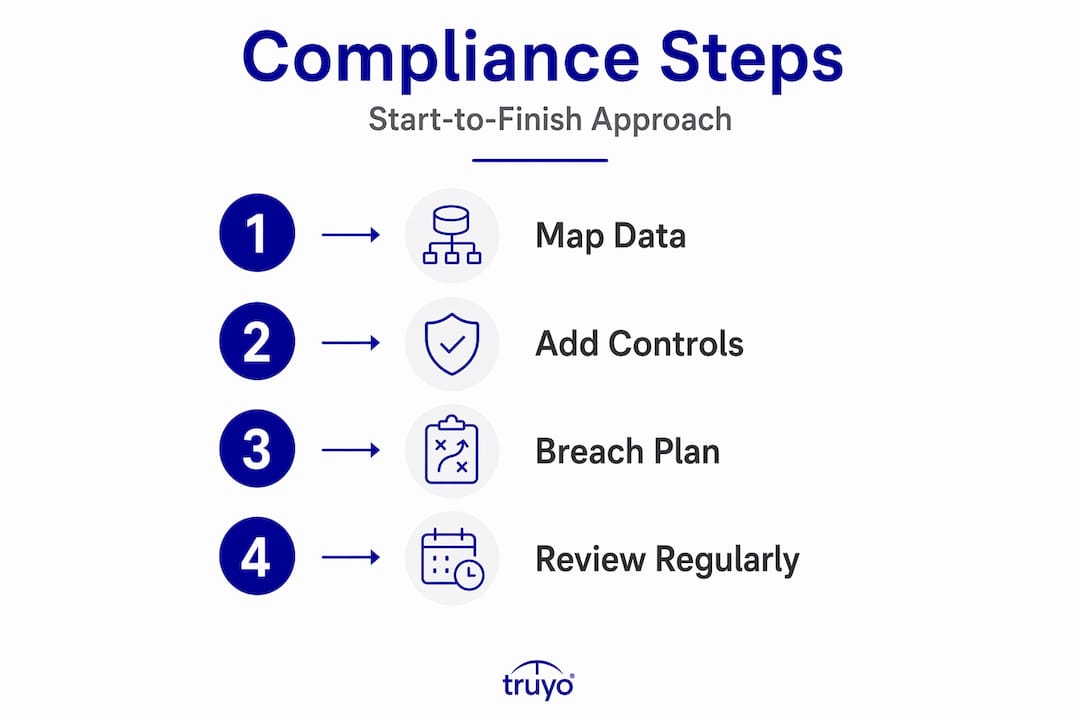
Step 1: Map your data
You cannot protect what you cannot see. Data mapping means documenting every category of personal data your business collects, where it is stored, who accesses it, how long you keep it, and where it flows when shared with third parties. As privacy compliance research from v-comply confirms, programs that connect data visibility, control execution, and audit evidence are far better positioned to survive regulatory scrutiny.

Step 2: Implement security controls
Access management, encryption, patch management, and activity logging form the core technical layer of any compliance program. These are not optional extras. They are the mechanisms that reduce enforcement penalties and generate the evidence regulators ask for.
Step 3: Build a breach response workflow
Many small businesses discover their breach notification obligations only after an incident occurs. That is too late. UK organizations, for example, must notify the ICO within 72 hours of becoming aware of a breach that poses risk to individual rights. Critically, Solace Cyber clarifies that the notification clock starts at the moment of awareness, not after forensic confirmation. Your workflow needs to account for that distinction.
Compliance controls comparison
| Control area | Without compliance | With compliance |
|---|---|---|
| Access management | Shared credentials, no audit trail | Role-based access, activity logs |
| Data storage | Unstructured, location unknown | Mapped, encrypted, retention-scheduled |
| Breach response | Reactive, delayed notification | Documented workflow, 72-hour timeline met |
| Audit readiness | No evidence, high enforcement risk | Documented controls, reduced penalty exposure |
Regulatory requirements are also evolving. UK organizations face new obligations under the Data (Use and Access) Act 2025, which from June 2026 requires controller-led complaint procedures treating customer dissatisfaction as a regulated process. Compliance is not static. Your program needs a mechanism for tracking what changes.
Common pitfalls and how to avoid them
Even businesses that intend to comply regularly hit the same obstacles. Forbes research on compliance failures points directly to governance gaps and data flow invisibility as the root cause, not a lack of technology. Buying a new security tool without understanding your data environment first is a common and costly mistake.
The most frequent pitfalls include:
- Assuming compliance is a one-time setup rather than an ongoing program
- Underestimating how many third parties touch your data
- Missing breach notification timelines because internal escalation paths are unclear
- Relying on verbal agreements instead of documented policies and procedures
- Skipping staff training, which leaves your human layer as the most vulnerable point
Pro Tip: Schedule a quarterly compliance review. Regulations change, your business changes, and the gap between the two grows silently if no one is watching it.
The businesses that handle audits and breach investigations well share one common trait. They have documentation that proves what they did, not just policies that describe what they intended to do.
My take on what compliance actually means for small businesses
I have worked alongside enough small business owners to recognize a consistent pattern. Compliance feels abstract until the moment it becomes urgent, and by then, the cost of not having it in place is already running.
What I have learned is that the businesses most exposed are rarely the ones being reckless. They are the ones that genuinely believe compliance is someone else's problem. A manufacturer with 30 employees serving an aerospace prime contractor has just as much regulatory exposure as a larger firm. The prime does not care about your headcount when it reviews your data handling practices before renewing a contract.
The other thing I would push back on is the idea that compliance is purely defensive. In my experience, the discipline of building a proper compliance program changes how a business thinks about its own data. You start asking better questions: Where does our customer data actually go? Who has access to our financials on the shared drive? Those questions lead to better operations, not just lower legal risk.
The real compliance crisis is not a technology gap. It is a governance gap. And closing that gap is one of the highest-return investments a small business can make, measured in customer retention, contract wins, and crisis resilience.
— Michael
How Symmnet helps small businesses stay compliant
Building and maintaining a compliance program takes more than good intentions. It requires the right security controls, documented processes, and someone watching for changes in the regulatory environment. That is exactly where Symmnet works alongside small businesses every day.
Symmnet's managed IT services are designed specifically for small businesses in manufacturing, aerospace, and professional services. The team implements the security controls that compliance programs depend on, including access management, endpoint protection, firewall management, and encrypted backup solutions. Symmnet also supports breach response readiness, helping clients build notification workflows before they need them. If you want to understand where your compliance program has gaps, Symmnet offers a free assessment to identify exactly that. Learn more about data protection risks facing small businesses, or reach out to start a conversation about your compliance needs today.
FAQ
What is data compliance for small businesses?
Data compliance means managing personal and sensitive data according to applicable laws and ethical standards, with documented controls that can be verified during an audit or investigation.
Why does data compliance matter if I am a small business?
Regulators do not apply a size exemption. Small businesses face the same fines, breach notification obligations, and reputational risks as larger organizations, and enforcement activity is increasing year over year.
What happens if my business is not data compliant?
Non-compliance can result in financial fines, litigation, mandatory public breach notifications, loss of operating licenses, and termination of contracts by partners who require compliance certification.
How quickly must I report a data breach?
Under GDPR and UK regulations, organizations must notify regulators within 72 hours of becoming aware of a breach that risks individual rights. That timeline starts at the moment of awareness, not after forensic investigation is complete.
What is the first step toward becoming data compliant?
Start with a data mapping exercise. Document every category of personal data your business collects, where it is stored, who can access it, and where it goes when shared with third parties. Visibility is the foundation every other control builds on.