

Regulatory compliance is defined as the process of following all laws, regulations, standards, and policies that govern your business operations. For small and mid-sized businesses, this means actively meeting requirements set by bodies like the SEC, EPA, FDA, HIPAA, and PCI DSS across every relevant function. The stakes are real: 37% of regulatory teams failed to meet at least one requirement in the past year, with financial losses typically falling between $500,000 and $1 million per incident. That number should get your attention. Compliance is not a legal formality. It is a core operational responsibility.
What is regulatory compliance, and why does it apply to your business?
Regulatory compliance is the formal term for meeting all legal and regulatory obligations that apply to your industry, location, and business model. The regulatory compliance definition covers a broad range of requirements: data privacy laws, financial reporting standards, workplace safety rules, and industry-specific mandates. Every business operates under some combination of these.
The distinction between legal compliance and regulatory compliance matters. Legal compliance means following statutes passed by legislatures, such as the Americans with Disabilities Act. Regulatory compliance means following rules issued by government agencies, such as OSHA safety standards or FDA manufacturing guidelines. In practice, most businesses must satisfy both.
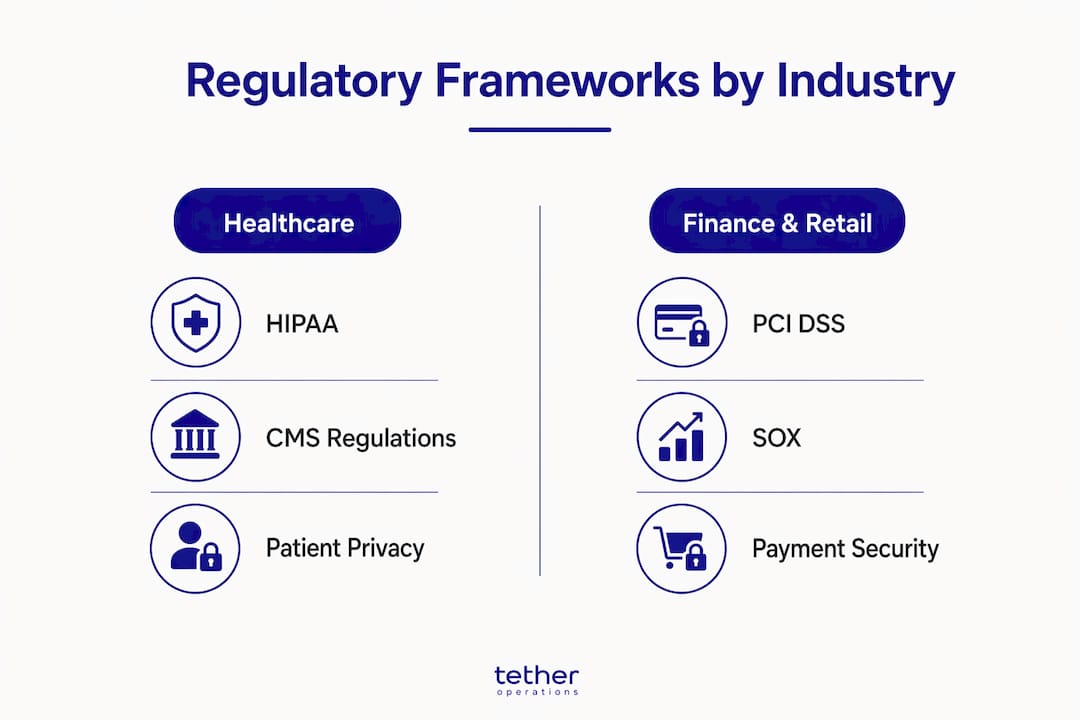
Regulatory requirements span frameworks including HIPAA for healthcare data, PCI DSS for payment card security, SOX for financial reporting, GDPR and CCPA for consumer data privacy, and OSHA for workplace safety. Each framework carries its own audit cycle, documentation standard, and penalty structure. A manufacturing company in California, for example, may need to satisfy OSHA, EPA environmental rules, and industry-specific quality standards simultaneously.

Understanding regulatory compliance means recognizing that these requirements are not static. Agencies update rules, enforcement priorities shift, and new laws emerge. A compliance posture that was sufficient last year may have gaps today.
Common regulatory frameworks by industry
| Industry | Key Frameworks | Primary Focus |
|---|---|---|
| Healthcare | HIPAA, CMS regulations | Patient data privacy and security |
| Finance | SOX, SEC rules, FINRA | Financial reporting and investor protection |
| Retail and e-commerce | PCI DSS, CCPA, GDPR | Payment security and consumer data |
| Manufacturing | OSHA, EPA, ISO standards | Workplace safety and environmental impact |
| Aerospace and defense | ITAR, DFARS, CMMC | Export controls and cybersecurity |
How do organizations build an effective compliance program?
To achieve regulatory compliance, organizations must follow a structured process rather than react to audits after the fact. Effective compliance programs require four core activities: analyzing legal obligations, conducting in-house audits to find policy gaps, implementing controls, and maintaining documentation for external third-party audits.
Here is how that process works in practice:
-
Map your regulatory obligations. Identify every law, regulation, and standard that applies to your business. This includes federal rules, state laws, and any contractual requirements from clients or partners. A healthcare IT provider, for example, must account for HIPAA, state breach notification laws, and potentially HITECH.
-
Conduct an internal gap assessment. Compare your current policies, controls, and documentation against each requirement. This reveals where your operations fall short before an external auditor does. Compliance audits are most valuable when they are routine, not reactive.
-
Implement corrective controls. Close the gaps you identified. This may mean updating data handling policies, retraining staff, deploying new security tools, or revising vendor contracts. Assign clear ownership for each control.
-
Document everything. Auditors do not take your word for it. Written policies, training records, system logs, and incident reports are the evidence that proves compliance. Documentation also protects you if a dispute arises.
-
Prepare for external audits. Third-party audits are mandatory under many frameworks, including SOX and PCI DSS. Treat your internal audit as a dress rehearsal. Organize your evidence, brief your team, and address any remaining gaps before the auditor arrives.
Pro Tip: Treat compliance as an ongoing operational system, not a one-time project. Schedule quarterly internal reviews rather than scrambling before an annual audit. This approach catches issues early and reduces the cost of remediation.
Cross-functional accountability is also critical. Compliance touches IT, finance, HR, legal, and operations. Assigning compliance ownership to a single department creates blind spots. The most effective programs integrate compliance responsibilities into each department's regular workflow.
What are the financial and operational risks of non-compliance?
Non-compliance is expensive. Financial losses per incident typically fall between $500,000 and $1 million. For a small or mid-sized business, a single enforcement action at that scale can threaten the entire operation.
The costs extend beyond fines. Regulatory penalties from the SEC, EPA, or FDA can include operational shutdowns, mandatory remediation programs, and reputational damage that drives away customers and partners. A healthcare provider hit with a HIPAA violation faces not only federal fines but also the loss of patient trust that took years to build.
"Compliance is no longer just an expense. It is a strategic asset that protects operational continuity and builds stakeholder trust."
The operational disruption from a compliance failure compounds the financial damage. Investigations consume management time, legal fees accumulate, and staff productivity drops during remediation. For manufacturing companies, a compliance failure can trigger production halts. For professional services firms, it can void contracts and trigger client exits.
Compliance in manufacturing illustrates this clearly. Regulatory violations in that sector have increased in frequency and severity, with enforcement actions often requiring costly process overhauls. The businesses that avoid these outcomes share one trait: they treat compliance as a continuous governance activity, not a periodic checkbox.
The strategic upside is equally real. Compliance has evolved from a back-office obligation into a governance structure that identifies vulnerabilities before enforcement actions occur. Businesses that invest in compliance programs consistently demonstrate stronger internal controls, cleaner audit records, and greater resilience during regulatory changes.
What practical strategies help small businesses maintain compliance?
Small and mid-sized businesses face a specific challenge: they carry the same compliance obligations as large enterprises but with fewer resources to manage them. The solution is not to do less. It is to build compliance into how you already operate.
These strategies work for resource-constrained teams:
- Create written policies for every compliance area. Policies do not need to be long. They need to be clear, current, and accessible to the staff responsible for following them. Undocumented practices are invisible to auditors.
- Assign compliance ownership by function. The IT manager owns data security controls. The HR director owns OSHA documentation. The finance lead owns SOX-related reporting. Distributed ownership prevents gaps from falling through the cracks.
- Use technology to track regulatory changes. Platforms like MetricStream centralize compliance tasks, automate monitoring, and provide dashboards that show your compliance status in real time. Manual tracking in spreadsheets fails at scale.
- Leverage managed IT and compliance services. For businesses without a dedicated compliance officer, a managed service provider with compliance expertise can fill that gap. This is especially valuable for frameworks like CMMC, HIPAA, and PCI DSS that require technical controls and documentation.
- Build audit readiness into daily operations. Store evidence as you go. Log system changes, retain training records, and document incident responses in real time. Reconstructing evidence before an audit is far more costly than capturing it continuously.
Regulatory compliance requirements also drive better internal processes. When you document your controls and assign accountability, you reduce operational guesswork and improve consistency. The compliance work you do to satisfy an auditor often makes your business run better regardless of the audit.
Pro Tip: Integrate compliance controls into daily decision-making. When evaluating a new vendor, a new software tool, or a new process, ask whether it meets your compliance requirements before you adopt it. Retrofitting compliance after the fact costs significantly more than building it in from the start.
IT compliance for small businesses follows the same principle. Security controls, access management, and data handling practices that satisfy compliance requirements also reduce your exposure to breaches and operational failures.
Key Takeaways
Regulatory compliance is a continuous governance responsibility that protects your business from financial penalties, operational disruption, and reputational damage.
| Point | Details |
|---|---|
| Compliance is ongoing | Treat it as a continuous system, not an annual audit event, to catch gaps early. |
| Financial risk is significant | Non-compliance incidents cost between $500,000 and $1 million on average. |
| Documentation is non-negotiable | Written policies, logs, and records are the evidence auditors require. |
| Distribute ownership | Assign compliance responsibilities across IT, HR, finance, and operations. |
| Technology reduces the burden | Platforms like MetricStream automate tracking and centralize compliance evidence. |
Compliance is a business decision, not just a legal one
I have worked with enough small business owners to recognize a pattern. Compliance gets treated as something the legal team handles, or something that only matters when an audit is scheduled. That mindset is the single most common reason businesses end up paying for violations that were entirely preventable.
The businesses I have seen handle compliance well share one characteristic: leadership treats it as a business priority, not a paperwork obligation. The owner or CEO is aware of which frameworks apply, who owns each compliance area, and what the current gaps are. That awareness does not require deep technical knowledge. It requires the same attention you give to cash flow or customer retention.
The other pattern I have noticed is that compliance work almost always surfaces operational problems that existed independently of the regulatory requirement. When a company documents its data handling practices for HIPAA, it often discovers that three different departments are storing the same customer data in three different places with no consistent access controls. Fixing that for compliance also fixes a real operational risk.
The companies that resist compliance investment tend to frame it as a cost with no return. The companies that embrace it tend to find that the discipline it requires makes them better run. That is not a coincidence. Governance structures, accountability frameworks, and documentation habits are good management practices regardless of what any regulator requires.
If you are a small business owner reading this, the question is not whether compliance applies to you. It does. The question is whether you are managing it proactively or waiting for something to go wrong.
— Michael
How Symmnet supports your compliance program
Symmnet helps small and mid-sized businesses build and maintain compliance programs without the overhead of a full internal IT and compliance team. Symmnet's managed IT services include 24/7 system monitoring, endpoint security, documentation support, and audit readiness assistance tailored to frameworks like HIPAA, PCI DSS, CMMC, and OSHA. The team works directly with business owners and managers to identify compliance gaps, implement technical controls, and keep documentation current between audits. For businesses in manufacturing, aerospace, and professional services, Symmnet provides the industry-specific expertise those sectors require. If you are not sure where your compliance posture stands today, Symmnet offers a free assessment to identify gaps and priorities before they become violations.
FAQ
What is the regulatory compliance definition?
Regulatory compliance is the process of following all laws, regulations, standards, and policies that apply to your business operations and industry. It covers frameworks like HIPAA, PCI DSS, SOX, GDPR, and OSHA, depending on your sector.
Why does regulatory compliance matter for small businesses?
Non-compliance incidents cost between $500,000 and $1 million on average, and 37% of regulatory teams miss at least one requirement per year. Small businesses face the same penalties as large enterprises, making proactive compliance a financial necessity.
How do you achieve regulatory compliance?
Achieving compliance requires mapping your obligations, conducting internal gap assessments, implementing corrective controls, and maintaining documentation for external audits. Treating compliance as a continuous process rather than a periodic event produces the best results.
What is the difference between legal and regulatory compliance?
Legal compliance means following statutes passed by legislatures, such as the Americans with Disabilities Act. Regulatory compliance means following rules issued by government agencies, such as OSHA safety standards or FDA guidelines. Most businesses must satisfy both.
What tools help businesses manage regulatory compliance?
Platforms like MetricStream centralize compliance tasks, automate monitoring, and provide real-time dashboards. Managed IT service providers can also fill the compliance management role for businesses without dedicated internal staff.