

Most business owners treat compliance audits like a visit from the dentist. You dread the appointment, survive the discomfort, and feel relieved when it's over until next time. But that mindset leaves serious money, risk, and operational value on the table. The role of compliance audits goes far beyond checking regulatory boxes. When done right, audits surface hidden vulnerabilities, strengthen internal controls, and give leadership the evidence they need to make confident decisions. This article walks you through what compliance audits actually are, how they work, why they matter, and how to make them work harder for your business.
Table of Contents
- Key Takeaways
- The role of compliance audits: definitions and context
- How compliance audits work
- Benefits of compliance audits beyond just regulatory adherence
- Compliance audit best practices for your business
- Compliance audits across regulated industries
- My take on making compliance audits actually matter
- How Symmnet supports your audit readiness
- FAQ
Key Takeaways
| Point | Details |
|---|---|
| Audits do more than check boxes | Compliance audits validate that controls actually work in practice, not just on paper. |
| Independence determines credibility | Audit reports should go directly to the board or senior leadership to preserve their integrity. |
| Proactive auditing reduces penalties | Organizations that audit continuously and act on findings face fewer regulatory fines and lower risk exposure. |
| Year-round readiness pays off | Maintaining current documentation at all times makes audits faster, smoother, and more accurate. |
| Industry context shapes audit focus | Healthcare, manufacturing, and financial services each carry specific regulatory drivers that define audit scope. |
The role of compliance audits: definitions and context
A compliance audit is a formal, independent review that examines whether your organization is operating in line with applicable laws, regulations, internal policies, and contractual requirements. That definition sounds simple. The reality is more nuanced.
Compliance audits are distinct from internal operational audits, though the two are often confused. Audits validate controls rather than replace monitoring functions. Think of monitoring as the ongoing, daily temperature check. An audit is the quarterly physical exam that confirms whether the readings have been accurate all along.
Regulators don't just want to see policies sitting in a manual. They want evidence that those policies produce real behavior and real controls. SFO guidance stresses getting behind policies to assess conduct and control effectiveness through actual testing. A binder of well-written procedures means nothing if no one follows them.
Effective compliance audit programs typically include several core components:
- A defined audit scope tied to your highest-risk areas and applicable regulatory frameworks
- Independent auditors who report outside the line of business being audited
- Structured evidence review, interviews, and control testing
- A formal written report that identifies deficiencies, sampled transactions, and required corrective actions
- A follow-up cycle to verify that identified issues have actually been resolved
"The written audit report should detail audit scope, deficiencies, sampled transactions, corrective actions, and timelines." — Holland & Knight
That last point about follow-up is where many organizations fall short. The audit itself is only as valuable as the action it generates.
How compliance audits work

Understanding the compliance audit process removes a lot of the anxiety that surrounds it. Most audits follow a predictable sequence, even if the specifics vary by industry and regulatory framework.
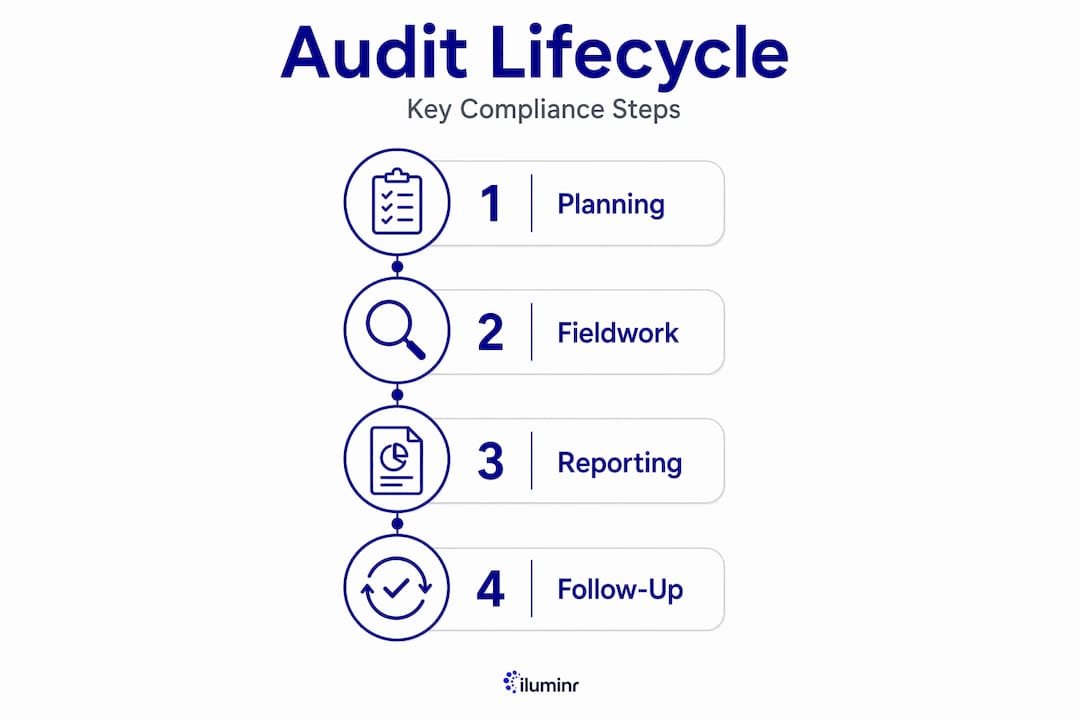
Here are the core stages you can expect in a standard compliance audit:
- Planning and scoping. The auditor defines what will be reviewed, which regulatory requirements apply, what the risk level is, and which business units or systems fall within scope. This step sets the boundaries so nothing important is missed and no resources are wasted on low-risk areas.
- Evidence collection. Auditors gather documentation, conduct interviews with relevant staff, and review transaction samples. Document review and control testing are central to producing a credible audit report.
- Control testing. This is where auditors check whether controls are actually operating as designed. A policy may say that access to sensitive data requires dual authorization. Control testing confirms whether that actually happens in practice.
- Reporting. The auditor produces a formal report with findings, risk ratings, and recommendations. Boards should receive audit reports directly to preserve independence and avoid conflicts of interest.
- Corrective action and follow-up. Management responds to findings with specific remediation plans. The audit function then verifies closure, which turns a one-time report into a continuous improvement loop.
The table below summarizes key audit phases and what they produce:
| Audit phase | Key activity | Output |
|---|---|---|
| Planning | Risk assessment, scope definition | Audit plan and schedule |
| Evidence collection | Document review, staff interviews | Evidence inventory |
| Control testing | Transaction sampling, system testing | Testing workpapers |
| Reporting | Findings analysis, risk rating | Formal audit report |
| Follow-up | Corrective action verification | Closure confirmation |
Pro Tip: Schedule your audit planning meeting at least six weeks before fieldwork begins. This gives teams time to gather documentation without last-minute scrambling, which is one of the fastest ways to undermine finding quality.
Benefits of compliance audits beyond just regulatory adherence
Here is where the importance of compliance audits becomes most tangible for business leaders. The regulatory requirement to conduct audits is the floor, not the ceiling.
The practical benefits of compliance audits include:
- Early risk detection. Audits surface control gaps before regulators or bad actors find them first. A manufacturing company that discovers a data access vulnerability during an internal audit is far better positioned than one that discovers it during an incident.
- Stronger governance. When audit findings feed directly into board reporting, leadership gets an accurate picture of organizational risk. This drives better resource allocation and strategic decisions.
- Accountability and transparency. The audit process creates a formal record of what was tested, what was found, and what was fixed. That documentation matters enormously if your organization ever faces regulatory scrutiny.
- Reduced penalties and fines. Proactive, continuous auditing with timely corrective action measurably reduces regulatory penalties and exposure compared to reactive approaches.
- Cultural reinforcement. When staff know that controls are regularly tested, compliance becomes a habit rather than an afterthought. This is the difference between a culture that follows rules and a culture that understands why the rules exist.
One often-overlooked benefit: audits strengthen your negotiating position. Whether you are bidding on a government contract, applying for cyber liability insurance, or onboarding a large enterprise client, demonstrating a documented audit history signals that your organization manages risk deliberately. That matters more than most business owners realize.
Compliance audit best practices for your business
Knowing the theory is one thing. Getting tangible results from your compliance program requires applying compliance audit best practices that hold up under real-world pressure.
Start by integrating audits into your broader risk management framework rather than treating them as isolated events. Your annual audit schedule should reflect your risk register. Higher-risk processes get more frequent testing. Lower-risk areas get lighter coverage. This prioritization makes your audit investment go further.
Continuous traceable evidence across workflows creates a genuine audit-ready environment. Static or last-minute evidence undermines audit credibility and creates unnecessary stress for your team. Build documentation habits into daily operations so that when an audit begins, you are retrieving records rather than reconstructing them.
Pro Tip: Assign a specific person or team to own compliance documentation for each process area. When ownership is clear, evidence gaps get closed proactively instead of surfacing as audit findings.
Additional compliance audit best practices worth applying:
- Conduct pre-audit readiness reviews quarterly to catch gaps before external auditors arrive
- Require corrective action plans to include specific owners, deadlines, and verification checkpoints
- Avoid routing audit reports through line management. Independence is the foundation of audit credibility, and board or committee reporting reinforces regulator confidence
- Use prior audit findings to shape future audit scopes so your program actually learns and improves over time
The most common pitfall Symmnet sees with small and mid-sized businesses is treating audits as annual fire drills rather than ongoing risk management inputs. The calendar pushes the audit date, not the risk profile. That backwards approach is precisely why so many organizations repeat the same findings year after year.
Compliance audits across regulated industries
The fundamentals of the compliance audit process stay consistent, but the specific focus areas shift significantly based on your industry. Understanding those differences helps you allocate effort where it counts most.
| Industry | Primary regulatory drivers | Typical audit focus areas |
|---|---|---|
| Healthcare | HIPAA, False Claims Act, OIG guidance | Coding accuracy, vendor oversight, patient data access controls |
| Manufacturing | ITAR, CMMC, ISO standards | Process documentation, supply chain controls, quality system adherence |
| Financial services | SOX, FINRA, state regulations | Transaction integrity, access controls, reporting accuracy |
| Professional services | State licensing, client data regulations | Data handling practices, contractual compliance, staff credentialing |
In healthcare, for example, OIG guidance on Medicare Advantage demands rigorous auditing of coding accuracy and third-party vendor oversight to reduce False Claims Act exposure. A missed audit finding in this space can generate liability in the millions of dollars.
In manufacturing, the audit landscape connects directly to security as well as quality. Industrial factory audits serve as a proactive tool for securing supply chains and confirming that both operational and regulatory controls function under real production conditions. Manufacturers working toward CMMC certification, for instance, need audit-ready documentation of cybersecurity controls across their entire environment. Symmnet's manufacturing cybersecurity checklist walks through the documentation and evidence requirements that support exactly this kind of audit preparation.
The key takeaway across all industries is this: tailor your audit scope to what your regulators actually care about, not to what is easiest to document.
My take on making compliance audits actually matter
I've watched businesses in manufacturing, healthcare, and professional services approach compliance audits in wildly different ways. The ones that extract real value share one trait. They treat audits as a management tool, not a regulatory obligation.
What I've learned is that most audits under-deliver for a specific reason. Leadership disengages the moment the audit kicks off and re-engages only when the report arrives. That gap is where audits lose their power. When executives stay connected to scope decisions, review interim findings, and visibly champion corrective action, the entire organization takes the process seriously.
My honest observation: proactive audit cultures don't just reduce fines. They build faster, more confident organizations. When a team knows that controls are tested and trusted, they make decisions with more confidence and less second-guessing. That is a competitive advantage that never appears in a compliance report but shows up everywhere in operations.
Technology has also shifted what's possible. Automated logging, continuous control monitoring, and integrated IT management mean that audit evidence can be current and complete at any given moment rather than reconstructed under deadline pressure. That alone changes the audit experience from something painful to something genuinely useful.
The businesses that benefit most from audits are the ones that stop asking "Are we compliant?" and start asking "How do we know our controls are working?" Those are very different questions, and the second one is far more worth answering.
— Michael
How Symmnet supports your audit readiness
Running a compliant, audit-ready IT environment is harder than it sounds when you are also managing operations, staff, and growth. Most small businesses in regulated industries don't have a dedicated compliance officer or an IT team with bandwidth to maintain continuous evidence.
Symmnet's managed IT services are built specifically for this reality. The team provides 24/7 monitoring, endpoint security, access control management, and structured documentation that keeps your systems audit-ready at all times. Rather than scrambling to produce evidence when an auditor arrives, you have organized, traceable records that reflect actual system behavior. For businesses in manufacturing, aerospace, or professional services working toward CMMC, HIPAA, or similar frameworks, Symmnet offers compliance-aligned IT management without the overhead of building that capability in-house. If you want to know where your current IT environment stands before your next audit cycle, start with a free security assessment at symmnet.com.
FAQ
What is the role of compliance audits?
The role of compliance audits is to provide independent verification that your organization's controls, policies, and practices actually meet regulatory requirements and internal standards. They go beyond written policies to test real behavior and produce documented findings for leadership and regulators.
How are compliance audits different from internal audits?
Compliance audits focus specifically on regulatory and policy adherence, while internal audits may also cover operational efficiency and financial accuracy. Both provide assurance, but compliance audits are typically scoped to specific legal or contractual requirements and often carry direct regulatory significance.
How often should a business conduct compliance audits?
Audit frequency should match your risk profile. High-risk processes and heavily regulated areas warrant more frequent testing, while lower-risk areas may only need annual review. Continuous monitoring paired with regular audit cycles produces the best outcomes.
What are the key benefits of compliance audits?
The primary benefits of compliance audits include early identification of control gaps, reduced regulatory penalties, stronger governance, improved documentation, and a compliance culture that prevents problems rather than reacting to them.
Who should receive compliance audit reports?
Audit reports should go directly to the board or a designated compliance committee to preserve auditor independence and prevent conflicts of interest. Routing reports through line management undermines both credibility and regulatory confidence.