

Aerospace regulatory compliance is defined as the systematic adherence to safety, quality, and security standards that govern every phase of aircraft and spacecraft design, manufacturing, and operation. The role of compliance in aerospace goes far beyond paperwork. It determines whether a company can win contracts, retain certifications, and most critically, prevent catastrophic failures. Frameworks like AS9100 Rev D and the International Traffic in Arms Regulations (ITAR) set the baseline. The Federal Aviation Administration (FAA) and the Department of Defense (DoD) enforce them. For compliance officers and aerospace professionals, understanding these requirements is not optional. It is the foundation of every business decision.
What are the primary compliance standards governing aerospace operations?
AS9100 Rev D is the dominant quality management standard for the aerospace industry. It builds on ISO 9001:2015 but adds over 100 specific requirements covering product safety, configuration management, and counterfeit parts prevention. Those additions exist because aerospace failures carry consequences that standard manufacturing quality systems were never designed to address.
ITAR governs the export and transfer of defense-related technical data and hardware. Aerospace and defense contractors must retain export documentation for a minimum of five years to demonstrate compliance to the U.S. State Department. A single documentation gap can trigger enforcement action, contract suspension, or criminal liability.
FAA and DoD requirements add another layer. The FAA regulates airworthiness through Part 21 production approvals and Part 145 repair station certifications. The DoD enforces compliance through the Defense Federal Acquisition Regulation Supplement (DFARS), which includes cybersecurity requirements under CMMC. Customer-specific standards from Boeing, Airbus, and Lockheed Martin layer additional contractual obligations on top of these regulatory baselines.
The table below shows how these major frameworks differ in scope and focus:
| Framework | Primary Authority | Core Focus | Documentation Retention |
|---|---|---|---|
| AS9100 Rev D | IAQG / Certification Bodies | Quality management system | Per contract, often decades |
| ITAR | U.S. State Department | Export control of defense data | Minimum 5 years |
| FAA Part 21/145 | Federal Aviation Administration | Airworthiness and production | Life of the product |
| DFARS / CMMC | Department of Defense | Cybersecurity and supply chain | Per contract requirements |
Key documentation obligations across these frameworks include:
- Design records and engineering change orders
- First article inspection reports
- Supplier qualification and audit records
- Nonconformance reports and corrective action logs
- Export license records and technology control plans
How does compliance contribute to aerospace safety and risk management?
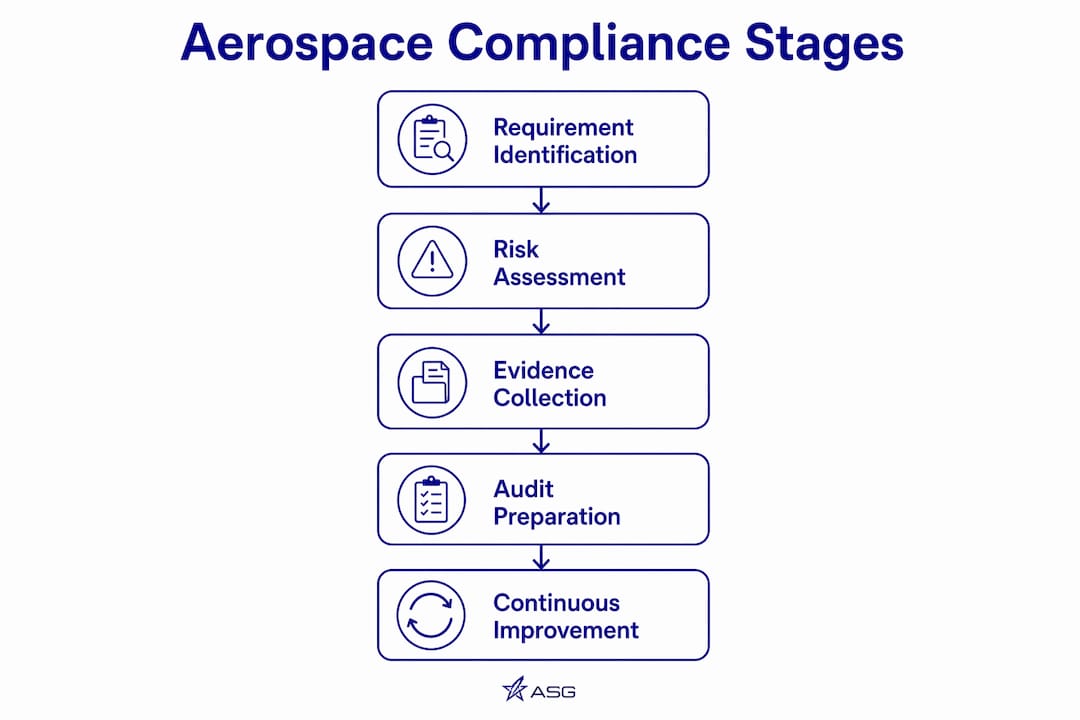
Aerospace compliance is fundamentally an evidence-management discipline requiring organizations to maintain audit-ready documentation for decades. That framing matters because it shifts the focus from passing audits to building systems that protect safety over the entire product lifecycle. A component manufactured today may be in service for 30 years. The compliance record must be defensible long after the original engineers have moved on.
Product safety risk assessments are required at the design and production stages under AS9100 Rev D. These assessments force engineers to document failure modes, severity ratings, and mitigation actions before a part ever reaches production. The discipline of recording those decisions is what makes traceability possible during an investigation or audit years later.
Counterfeit parts represent one of the most serious risks in aerospace supply chains. Procurement controls under AS9100 Rev D require verified supplier qualifications, certificates of conformance, and incoming inspection protocols. Without these controls, a counterfeit fastener or electronic component can enter a flight-critical assembly undetected.
Configuration management ties the entire compliance structure together. It ensures that every change to a design, process, or part is documented, reviewed, and approved before implementation. Continuous traceability linking requirements to designs, tests, and parts is what separates audit-ready organizations from those scrambling to reconstruct records under pressure.
- Conduct product safety risk assessments at every design gate
- Maintain approved supplier lists with current qualification records
- Implement configuration control boards for all engineering changes
- Link every test result directly to the requirement it verifies
- Store corrective action records in a centralized, searchable system
Pro Tip: Treat your traceability matrix as a living document updated in real time, not a deliverable assembled before an audit. Auditors can tell the difference, and so can your customers.
What common challenges do aerospace organizations face in maintaining compliance?
Most organizations fail AS9100 Stage 1 audits not because their products are unsafe, but because their documentation systems cannot prove safety. Failing to identify certification gaps before Stage 1 audits causes months-long delays and triggers customer notification requirements. That notification alone can damage contract relationships before a single corrective action is filed.
The most common failure points follow a predictable pattern:
- Product safety gaps. Organizations document design decisions but fail to record the safety risk assessment that justified those decisions.
- Counterfeit parts controls. Supplier qualification records are incomplete, outdated, or stored in disconnected systems that auditors cannot easily access.
- Configuration management breakdowns. Engineering changes are implemented without formal approval records, creating discrepancies between the design baseline and the manufactured product.
- Evidence reconstruction. Teams assemble compliance documentation in the weeks before an audit rather than maintaining it continuously. Auditors recognize reconstructed records immediately.
- Compliance treated as overhead. When leadership views compliance as a cost center, resources are cut and gaps accumulate until an audit or incident forces a crisis response.
Compliance failures trigger contract terminations, enforcement actions, and liability claims that exceed the cost of maintaining a functioning compliance program. The math is straightforward. Reactive compliance is always more expensive than proactive compliance.
Pro Tip: Run a clause-by-clause AS9100 Rev D gap assessment before your formal Stage 1 audit. A structured pre-audit gap review completed in under 45 minutes can surface the exact deficiencies that would otherwise delay certification by months.
What practical strategies and tools support effective aerospace compliance management?
Building a culture of quality is the single most effective strategy for sustaining compliance across an aerospace organization. Standards like AS9100 Rev D cannot be implemented by a compliance team alone. Every engineer, technician, and program manager must understand their role in maintaining the evidence trail. Culture is what makes compliance self-reinforcing rather than dependent on audit pressure.
Structured gap assessments are the starting point for any compliance improvement effort. A gap assessment maps current practices against each AS9100 Rev D clause, identifies deficiencies, and prioritizes corrective actions by risk level. Organizations that conduct gap assessments annually rather than pre-audit reduce their Stage 1 failure rate significantly. The assessment also serves as a communication tool, showing leadership exactly where investment is needed.
Technology plays a direct role in maintaining compliance at scale. The table below outlines the key system types and their compliance functions:
| System Type | Compliance Function | Example Use Case |
|---|---|---|
| ERP (Enterprise Resource Planning) | ITAR access control, audit trails, data centralization | Restricting technical data to authorized U.S. persons |
| Quality Management Software | Nonconformance tracking, CAPA management | Logging and resolving supplier defects |
| Document Control Systems | Version control, approval workflows | Managing engineering change orders |
| Cybersecurity Platforms | Endpoint protection, access logging | Protecting controlled unclassified information |
ERP systems are critical for ITAR compliance by enforcing role-based access, maintaining audit trails, and centralizing sensitive technical data. Non-compliance in ITAR cases often traces back to system control failures rather than intentional policy violations. The right IT infrastructure removes the human error risk from access control.

Continuous evidence management means integrating compliance documentation into daily engineering and production workflows. Every test report, inspection record, and supplier certificate gets filed at the point of activity, not assembled retroactively. This approach also supports the compliance audits in risk management function by ensuring that audit findings reflect real operational status rather than documentation quality.
Training and resource allocation complete the picture. Compliance officers need dedicated time, tools, and authority. Staff at every level need role-specific training on the requirements that apply to their work. Organizations that treat compliance training as an annual checkbox exercise consistently underperform in audits compared to those that integrate it into onboarding and ongoing professional development. For aerospace manufacturers specifically, understanding how compliance supports manufacturing operations at the process level is what separates organizations that pass audits from those that build genuinely safe products.
Key Takeaways
Aerospace compliance is an evidence-management discipline requiring continuous traceability, structured gap assessments, and IT systems that enforce access control and audit trails across every phase of design, production, and operation.
| Point | Details |
|---|---|
| AS9100 Rev D is the baseline | It adds over 100 requirements beyond ISO 9001, covering safety, configuration, and counterfeit parts. |
| ITAR demands system-level controls | ERP platforms must enforce role-based access and audit trails, not just written policies. |
| Traceability prevents audit failures | Most audit findings trace to broken documentation links, not engineering errors. |
| Gap assessments prevent delays | A pre-audit clause-by-clause review catches deficiencies before Stage 1 audits cause contract damage. |
| Compliance is a business asset | Organizations that treat compliance as strategic reduce liability, win contracts, and retain certifications. |
Compliance is not a checkbox. It is your competitive position.
I have worked with aerospace organizations at every stage of their compliance maturity, from first-time AS9100 applicants to established prime contractors preparing for DoD audits. The pattern I see most consistently is this: the organizations that struggle most are not the ones with the worst products. They are the ones with the worst evidence.
The shift that changes everything is treating compliance as an evidence-management discipline from day one. That means filing test records at the point of testing, logging supplier qualifications when they are renewed, and updating traceability matrices when requirements change. Not before an audit. Not when a customer asks. Always.
The second thing I have learned is that compliance as a strategic differentiator is not a consultant talking point. It is a real competitive advantage. When Boeing or Lockheed Martin qualifies a new supplier, they look at audit history, certification status, and corrective action closure rates. A clean compliance record opens doors that no sales pitch can.
My recommendation for any compliance officer reading this: stop measuring compliance by audit scores. Start measuring it by how quickly your team can answer any question an auditor asks without scrambling. That readiness is the real indicator of a mature program.
— Michael
How Symmnet supports aerospace compliance readiness
Aerospace compliance depends on IT infrastructure that enforces access control, maintains audit trails, and protects sensitive technical data around the clock.
Symmnet provides managed IT services built for industries with strict regulatory requirements, including aerospace. Symmnet's solutions cover 24/7 system monitoring, endpoint security, role-based access management, and backup and recovery, all of which directly support ITAR compliance, AS9100 evidence management, and audit readiness. Small aerospace businesses get the IT depth of an enterprise team without the overhead of building one internally. If you want to know where your current IT infrastructure creates compliance risk, Symmnet offers a free assessment to identify gaps and prioritize fixes.
FAQ
What is the role of compliance in aerospace?
Aerospace compliance enforces adherence to safety, quality, and security standards across design, manufacturing, and operations. It protects product integrity, satisfies regulatory requirements from the FAA and DoD, and reduces liability across the product lifecycle.
What does AS9100 Rev D require beyond ISO 9001?
AS9100 Rev D adds over 100 requirements specific to aerospace, including product safety risk assessments, counterfeit parts prevention, and configuration management. Organizations that fail to address these additions typically fail Stage 1 certification audits.
How long must ITAR documentation be retained?
ITAR requires aerospace and defense contractors to retain export-related documentation for a minimum of five years. This retention period supports U.S. State Department enforcement reviews and demonstrates ongoing compliance.
What causes most aerospace audit failures?
Most audit findings originate from broken traceability between requirements, verification activities, and produced parts, not from engineering errors. Incomplete or reconstructed documentation is the leading cause of nonconformances.
What IT systems best support aerospace compliance?
ERP systems, document control platforms, and cybersecurity tools are the core technology stack for aerospace compliance. ERP systems enforce ITAR access controls and audit trails, while document control systems manage engineering change approvals and version history.