

Business continuity is the documented strategy and set of procedures that keep an organization's mission-essential functions running, or quickly restored, during and after a disruption, whether that disruption is a ransomware attack, a flooded office, or a key employee suddenly unavailable. According to the NIST glossary, a business continuity plan (BCP) is broader than disaster recovery: it covers every critical business process, not just IT systems. The Business Continuity Institute (BCI) and the U.S. Chamber of Commerce Foundation both treat it as an organizational discipline, not a one-time document. If your business does not have a formal plan, the most useful first move is to schedule a one-hour scoping session with your leadership team and identify your three most critical business functions.
Table of Contents
- What is business continuity, and how does it differ from related terms?
- The core components every business continuity plan should include
- How to build a basic business continuity plan, step by step
- Testing the plan and keeping it current
- How business continuity works in practice: four common scenarios
- Why business continuity matters for small U.S. businesses
- When to bring in outside help for business continuity
- Key Takeaways
- The part most small businesses get wrong
- How Symmnet helps small businesses stay operational
- Authoritative sources and further reading
What is business continuity, and how does it differ from related terms?
Business continuity, disaster recovery, and operational resilience are related but distinct. Treating them as one project is one of the most common planning mistakes small businesses make.
IBM's guidance draws a clear line: business continuity focuses on sustaining organizational processes across the whole business, while disaster recovery focuses specifically on restoring IT systems and data after a failure. Operational resilience goes further still, describing an organization's ability to absorb shocks and adapt over time, not just recover from a single event.
| Term | Main focus | Who typically leads it |
|---|---|---|
| Business continuity | Mission-essential business processes | Senior leadership, operations |
| Disaster recovery | IT systems, data, and infrastructure | IT manager or managed IT provider |
| Operational resilience | Long-term adaptive capacity | Executive team, risk management |
A concrete example: A manufacturer's ERP system goes down after a cyberattack.
- Business continuity asks: Can production orders still be tracked manually? Can customer commitments be met?
- Disaster recovery asks: How fast can the ERP server be restored, and from which backup?
- Operational resilience asks: Does the organization have the supplier relationships and workforce flexibility to absorb a two-week disruption without permanent damage?
All three questions matter. The mistake is assuming that answering one of them answers all three.
The core components every business continuity plan should include
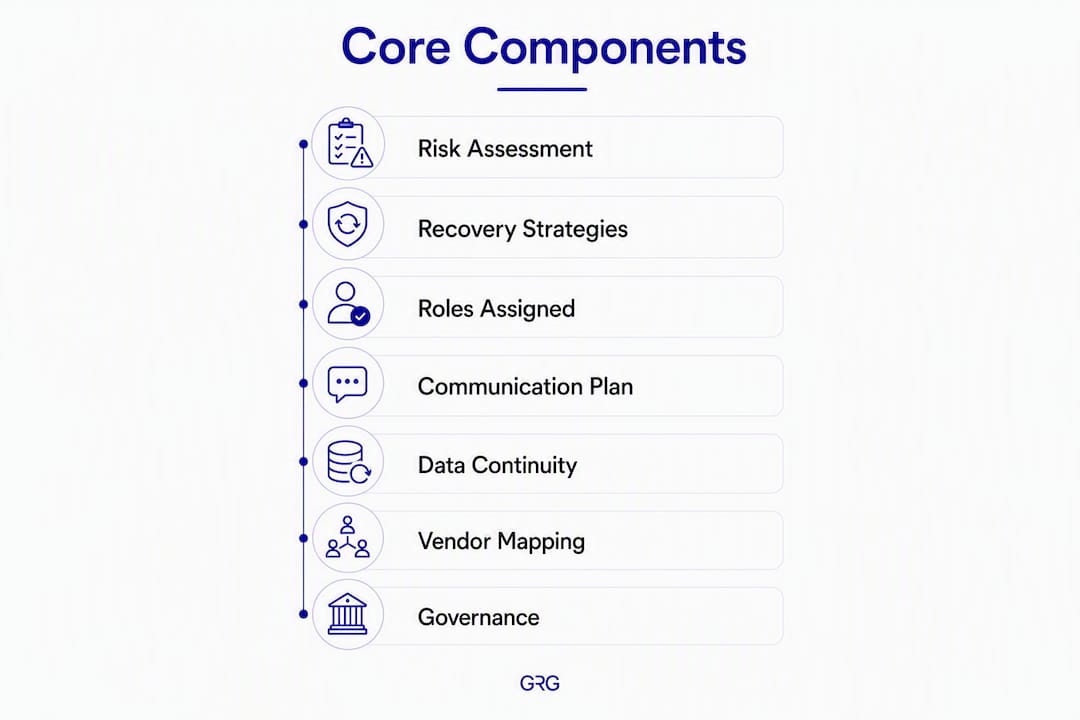
A solid BCP is not a single document. It is a set of coordinated components, each owned by a specific person and reviewed on a defined schedule.
Business Impact Analysis (BIA). The BIA identifies which functions are mission-essential and sets the maximum tolerable downtime for each. NIST SP 800-34 Rev. 1 describes the BIA as the tool that converts business priorities into technical and process requirements. Two metrics come out of every BIA:
- Recovery Time Objective (RTO): The maximum time a function can be offline before the business suffers unacceptable harm. A four-hour RTO on order processing means your recovery plan must restore that function within four hours.
- Recovery Point Objective (RPO): The maximum amount of data loss the business can tolerate, measured in time. An RPO of one hour means backups must run at least hourly.
Risk assessment. Once you know what is critical, you assess what threatens it: natural disasters, cyberattacks, supply-chain failures, and key-person dependencies. This step maps threats to the functions identified in the BIA.
Recovery strategies. For each critical function, the plan documents at least one alternative way to keep it running: manual workarounds, alternate vendors, failover systems, or temporary relocation. Oracle's overview highlights alternate site planning and communication protocols as two components that are frequently underdeveloped.

Roles and responsibilities. Every response action needs a named owner, not just a job title. If the plan says "IT manager restores the server," it should also name a backup person in case the IT manager is unavailable.
Communications plan. Who notifies customers, vendors, regulators, and staff? In what order? Through which channels? A communications gap during a disruption can cause more reputational damage than the disruption itself.
Data and IT continuity. This covers backup strategies, offsite or cloud storage, endpoint security, and the tested ability to restore from backup. "Tested" is the operative word.
Third-party and vendor mapping. Identify every vendor or partner whose failure would halt a critical function. A redundant server is useless if a single vendor controls a required downstream process.
Governance and policy. The plan needs an owner, an approval signature, a version number, and a review date. Without these, it becomes shelfware within a year.
Pro Tip: Assign a named "plan owner" and a named "deputy" for every critical function in writing. Then require both to sign the plan annually. That single step transforms a document into an accountable program.
How to build a basic business continuity plan, step by step
Building a BCP does not require a consultant or a six-month project. A small business can complete a working first version in four to eight weeks with focused effort.
-
Scope and sponsor (Days 1–3, owner/CEO). Define which locations, departments, and functions the plan covers. Secure a named executive sponsor who will approve the final document and fund any gaps. Without executive sponsorship, the plan stalls.
-
Business impact analysis (Weeks 1–2, operations + IT). List every critical function, assign an RTO and RPO to each, and identify the people, systems, and vendors each function depends on. This is a strategic exercise, not an IT inventory.
-
Risk assessment (Week 2, operations + IT). For each critical function, identify the top three to five threats and rate their likelihood and impact. Focus on threats that are realistic for your geography, industry, and size.
-
Recovery strategies and resource mapping (Weeks 3–4, department leads). For each threat-function pair, document at least one recovery option. Map the resources required: staff, equipment, software licenses, vendor contacts, and alternate sites.
-
Write the plan and assign roles (Week 4–5, plan owner). Consolidate findings into a single document with clear sections, named owners, and contact lists. Keep it short enough that someone under stress can actually use it.
-
Test and maintain (Ongoing, all stakeholders). A plan that has never been tested is a hypothesis. Schedule a tabletop exercise within 30 days of completing the first draft, then build a recurring test calendar.
Cost reality check for small businesses: The U.S. Chamber of Commerce Foundation found that only 31% of small businesses have a formal plan, partly because owners overestimate what planning costs. Realistic preparedness for many small and mid-sized businesses runs closer to roughly 5% of annual revenue, not the 30% that many owners assume. The cost of not planning is far higher: small businesses face significant financial losses during outages.
Testing the plan and keeping it current
Writing a plan is step one. Testing it is what determines whether it will actually work when the pressure is on. Most organizations skip this, which is why only a minority of companies test their continuity plans annually.

Tabletop exercises are the most accessible starting point. A facilitator walks a small group through a scenario ("Your primary server is offline at 2 PM on a Tuesday. What happens next?") without actually triggering any systems. These sessions typically run 60–90 minutes and surface gaps in roles, communication chains, and vendor contacts that written plans miss entirely.
Walk-throughs go one step further: team members physically or virtually trace their response steps, verifying that contact lists are current, backup access credentials work, and alternate processes are understood.
Full-scale simulations activate actual recovery procedures, including failover systems and alternate site operations. These are resource-intensive and typically run annually for critical functions.
Failover tests specifically validate that IT systems, backups, and data recovery processes work as documented. Testing your backup is not optional; it is the only way to confirm your RPO is achievable.
| Test type | Recommended frequency | Primary goal |
|---|---|---|
| Tabletop exercise | Quarterly | Identify role and communication gaps |
| Walk-through | Semi-annually | Verify procedures and contact accuracy |
| Full-scale simulation | Annually | Validate end-to-end recovery capability |
| Failover/backup restore test | Monthly or quarterly | Confirm data recovery meets RPO/RTO |
Pro Tip: After every test, hold a 30-minute after-action review. Document three things: what worked, what failed, and who owns each corrective action with a due date. Track those items in a shared log. A test with no follow-through is just a drill.
How business continuity works in practice: four common scenarios
Abstract planning concepts become concrete when you map them to real disruptions. Here are four scenarios that small U.S. businesses face regularly.
Ransomware attack. An employee opens a malicious attachment on a Monday morning. By 9 AM, files across the network are encrypted.
- Key actions: Isolate affected endpoints, activate the incident response plan, notify the IT provider, restore from the most recent clean backup.
- Outcome metric: With a tested backup and a documented cyber threat response process, critical systems can be restored within the defined RTO, often within hours rather than the industry average of 277 days for unmanaged recoveries.
Supply-chain disruption. A primary component supplier halts shipments due to a port closure or bankruptcy.
- Key actions: Activate the vendor map, contact pre-identified alternate suppliers, adjust production schedules, notify customers proactively.
- Outcome metric: Businesses with documented alternate vendor lists can pivot in days; those without them spend weeks sourcing alternatives while orders pile up.
Local natural disaster (flood or severe storm). The office is inaccessible for three to five days.
- Key actions: Activate remote work protocols, redirect phones, confirm cloud access for critical systems, communicate status to customers and staff.
- Outcome metric: A business with cloud-hosted systems and a tested remote-work protocol can maintain customer-facing operations with minimal interruption.
Key-person loss. Your operations manager, who holds critical vendor relationships and system passwords, is suddenly unavailable.
- Key actions: Activate the deputy role documented in the plan, retrieve credentials from the secure password vault, brief the deputy on open commitments.
- Outcome metric: Documented succession and a shared credential system prevent a single absence from becoming an operational crisis.
Why business continuity matters for small U.S. businesses
The preparedness gap among small businesses is striking. 94% of small businesses say they could recover from a disaster, but a minority have a formal plan. More concerning: many could not pay employees beyond one month after a major disruption. Confidence without a plan is not preparedness.
The financial exposure is real. Small businesses lose an average of $25,000 per hour during outages, and 43% of cyberattacks target small businesses. The threat is not hypothetical; 51% of organizations faced at least one major disruption in 2023.
The benefits of a tested plan are equally concrete: shorter downtime, preserved customer relationships, reduced regulatory exposure, and lower cyber insurance premiums for businesses that can demonstrate documented controls. For manufacturers and regulated industries, a continuity plan is also increasingly a contractual or compliance requirement from customers and auditors. Frameworks like ISO 22301 provide a recognized management system structure for organizations that need to demonstrate continuity capability formally.
When to bring in outside help for business continuity
Some continuity tasks are well within reach of a small internal team. Others require specialized tools, 24/7 availability, or technical depth that most small businesses cannot maintain in-house.
Managed IT and cybersecurity providers commonly support continuity through:
- 24/7 system monitoring that detects anomalies before they become outages
- Backup and disaster recovery management, including scheduled restore tests
- Endpoint security and firewall management that reduce the attack surface
- Incident response support during active disruptions
- Compliance documentation for regulated industries (manufacturing, aerospace, FDA-regulated operations)
- Network segmentation to contain breaches and limit lateral movement
When evaluating a provider, ask these questions:
- What are your documented RTO and RPO guarantees for my critical systems?
- How often do you test backups and failover procedures, and will you share test results?
- Do you participate in our tabletop exercises or provide facilitation?
- Is your support team U.S.-based, and what are your escalation response times?
- Can you provide compliance documentation for my industry's regulatory requirements?
Watch for these red flags: no documented test history, vague or absent RTO/RPO language in the service agreement, offshore-only support with no U.S. escalation path, and providers who treat backup as a set-and-forget task rather than a regularly validated process. Critical security controls and network segmentation practices should be part of any provider's standard offering for small businesses in regulated industries.
Key Takeaways
Business continuity planning is a documented, tested program that keeps mission-essential functions running during disruptions, and small businesses without a formal plan face serious financial and operational exposure.
| Point | Details |
|---|---|
| Define it correctly | Business continuity covers all mission-essential processes, not just IT systems or data recovery. |
| Start with a BIA | Identify critical functions and set RTO and RPO targets before writing any recovery strategy. |
| Test regularly | Only a minority of companies test their continuity plans annually; untested plans fail when pressure is highest. |
| Know the cost reality | Small businesses lose an average of $25,000 per hour during outages; planning costs far less. |
| Symmnet supports continuity | Symmnet provides 24/7 monitoring, backup and recovery management, and compliance documentation for small U.S. businesses. |
The part most small businesses get wrong
Most small businesses treat business continuity as a document problem. They write a plan, file it, and consider the job done. The plan then sits untouched until a disruption exposes every assumption that was never tested.
The more accurate framing is that continuity is a program, not a document. The written plan is just the starting point. What actually determines whether a business survives a disruption is whether the people named in that plan have practiced their roles, whether the backups have been restored at least once in the last 90 days, and whether the vendor contact list was updated after the last supplier change. COVID-19 made this painfully clear: businesses with plans built around a single threat type, say, a natural disaster, discovered those plans were useless when the disruption was a workforce availability crisis instead.
The single most practical next step for any small business that does not yet have a tested plan: schedule a one-hour BIA session with your leadership team this week. List your five most critical functions, assign an RTO to each, and name the person responsible for each recovery. That one hour produces more real preparedness than a 50-page document that no one has read.
How Symmnet helps small businesses stay operational
Small businesses in manufacturing, professional services, and regulated industries often carry the same continuity risks as larger organizations, but without a dedicated IT team to manage them. Symmnet's managed IT services are built specifically for that gap: 24/7 monitoring that catches failures before they escalate, managed backup and recovery with scheduled restore tests, endpoint security, firewall management, and compliance documentation for industries where auditors ask for proof.
The difference between a plan that works and one that fails under pressure usually comes down to whether someone is actively maintaining and testing it. Symmnet participates in continuity planning as an operational partner, not just a vendor. If you want to know where your current setup stands, request a free continuity readiness assessment at symmnet.com/services and get a clear picture of your gaps before a disruption forces the question.
Authoritative sources and further reading
-
NIST SP 800-34 Rev. 1, Contingency Planning Guide for Federal Information Systems: The authoritative federal framework for contingency planning, covering BIA methodology, recovery strategies, and testing requirements. Directly applicable to any organization building a structured BCP.
-
NIST Business Impact Analysis Guidance: Explains how BIA extends beyond availability planning to inform enterprise risk management and asset prioritization. Useful for organizations that want to connect continuity planning to broader risk frameworks.
-
U.S. Chamber of Commerce Foundation: Small Business Preparedness Survey: The source for the 94%/31% preparedness gap statistic. Provides context on small-business confidence versus actual readiness, and includes cost-of-disruption data relevant to U.S. SMBs.
-
IBM: Business Continuity vs. Disaster Recovery: A clear, practical explanation of how BCP and DRP differ and how organizations can coordinate both. Useful for anyone trying to scope a planning project.
-
Cisco: What Is Business Continuity?: A plain-English definition and overview of continuity planning components, including communications and alternate operations. Good starting reference for non-technical stakeholders.
-
Business Continuity Statistics (Gitnux): A data-rich reference covering downtime costs, testing rates, cyberattack frequency, and SME preparedness gaps. Useful for building the business case internally.
This article provides general information about business continuity planning and is not a substitute for professional legal, regulatory, or IT advice. Confirm current requirements with a qualified professional or the relevant regulatory authority for your specific situation.