

Most small businesses install a firewall and assume their network is protected. It's a reasonable assumption, but 99% of firewall breaches come from misconfigurations, not hardware failures. For manufacturers, aerospace suppliers, and professional services firms operating under strict regulatory requirements, that statistic isn't just alarming. It's a direct threat to contracts, audits, and customer trust. This guide explains what firewall management actually means, where most small businesses go wrong, and what practical steps you can take to keep your network secure and your compliance posture solid.
Table of Contents
- What is firewall management?
- How firewall management works: Rules, policies, and automation
- The risks: Misconfigurations, shadow rules, and compliance gaps
- Aligning firewall management with industry standards and compliance
- Firewall management in action: Practical steps for small businesses
- Firewall management: Lessons most small businesses overlook
- How Symmetry Network Management can help
- Frequently asked questions
Key Takeaways
| Point | Details |
|---|---|
| Active management critical | Firewall breaches and compliance failures are mostly caused by mismanagement, not software flaws. |
| Automation essential for SMBs | Modern tools make firewall management scalable—even for small teams with limited IT resources. |
| Review rules regularly | Routine audits, updates, and clean-up of firewall rules lower risk and help with audits. |
| Align with compliance standards | Integrating firewall management practices with NIST, CMMC, or PCI/SOC2 is key for regulated businesses. |
What is firewall management?
Now that we've seen why most breaches trace back to misconfigured firewalls, let's clarify what firewall management really means.
Many business owners think of a firewall as a box you plug in and forget. In reality, it's more like a living policy document that requires constant attention. According to Palo Alto Networks, firewall management is the process of configuring, monitoring, maintaining, and optimizing firewall rules and policies to control network traffic, ensure security, and maintain compliance. That definition covers a lot of ground, and intentionally so.
Effective firewall management breaks down into five core components:
- Policy and rule management: Creating, updating, and removing access rules that govern what traffic is allowed or blocked.
- Logging and monitoring: Recording network events in real time so your team can detect anomalies and investigate incidents.
- Change management: Tracking who made what changes, when, and why. This is critical for audits.
- Optimization: Identifying outdated or redundant rules that slow down your firewall and create security gaps.
- Compliance alignment: Mapping your firewall policies directly to the standards your industry requires, whether that's CMMC, NIST, PCI DSS, or SOC 2.
Each of these functions supports the others. Without logging, you can't detect misconfigurations. Without change management, you lose accountability. Without optimization, your rule base grows messy and dangerous. To build a strong foundation, start with the firewall essentials that every small business should have in place before adding complexity.
How firewall management works: Rules, policies, and automation
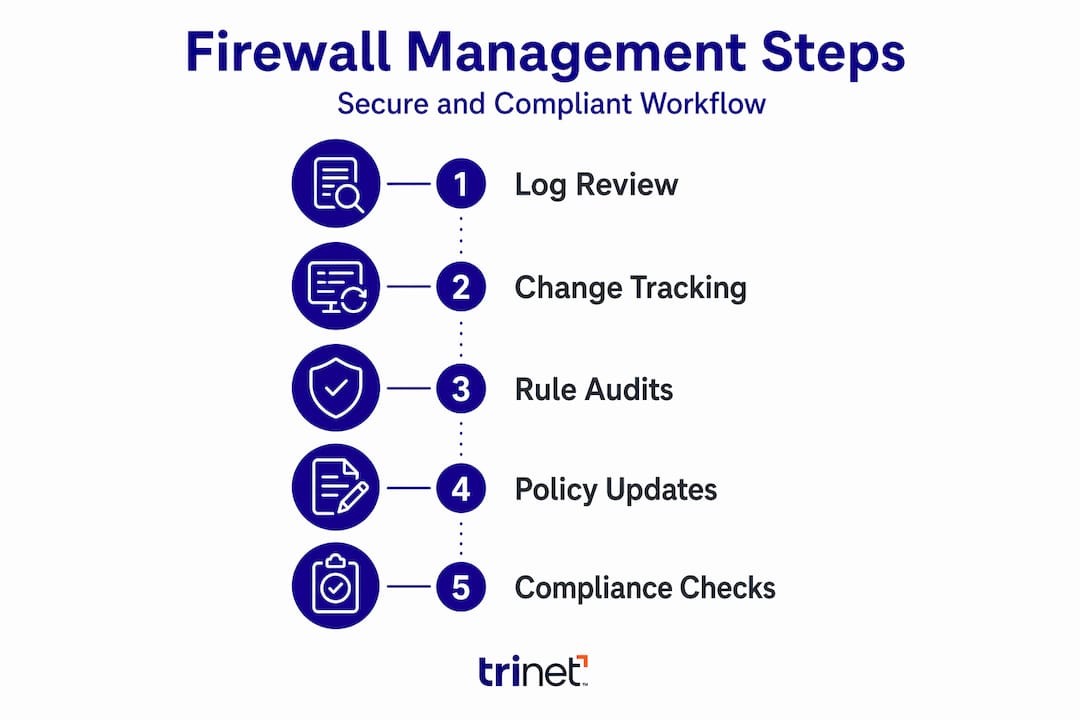
With a clear definition in mind, let's break down exactly how effective firewall management is put into practice.
Cisco's documentation on access control policy outlines that core methodologies involve defining access control policies with rules, enabling logging, running regular reviews, and maintaining disciplined change management. Each step builds on the last.
Here's how a sound firewall management process typically flows:
- Define your access control policy. Start by documenting who needs access to what. Which users or systems need to reach the internet? Which machines communicate only internally? Specificity matters here. Broad rules like "allow all outbound traffic" are exactly the kind of default that attackers exploit.
- Write least-privilege rules. Each rule should allow only the minimum traffic necessary for a legitimate business purpose. This principle, called least privilege, limits the damage any single misconfigured rule can cause.
- Enable and review logging. Turn on logging for all traffic, especially denied requests. Review logs regularly. Patterns in denied traffic often reveal probing attempts or misconfigurations before they become breaches.
- Implement a change management workflow. Every rule change should require a ticket, an approver, and a documented reason. Even in small teams, this discipline prevents the accumulation of undocumented "temporary" rules that become permanent liabilities.
- Run regular rule reviews. Schedule quarterly reviews to identify rules that are redundant, outdated, or no longer tied to a business need. Remove them.
- Automate where possible. Automation reduces high-severity findings by 40% in the first year. Tools that automatically flag rule conflicts, unused objects, and compliance deviations free your team from manual audits that are both time-consuming and error-prone.
Pro Tip: When writing firewall rules, name them clearly with a date and a business justification. For example: "Allow_ERP_to_DB_2026_Q1_Finance_Access." When you review rules six months later, you'll know exactly why each one exists and whether it still applies.
Exploring managed firewall solutions gives small businesses a practical model for applying these steps without needing a dedicated in-house security team.
The risks: Misconfigurations, shadow rules, and compliance gaps
Understanding how firewall management works makes it easier to see where things often go wrong and the risks small businesses face.

The numbers are sobering. 60% of enterprise firewalls fail high-severity compliance checks, 95% of application objects are unused, and 10% of firewall rules are redundant or shadowed. These statistics describe large enterprises, but small businesses typically have far less oversight, making the risk even greater.
Three categories of firewall mistakes cause the most damage:
Shadow rules and redundant rules: A shadow rule is one that is completely overridden by a broader rule earlier in the policy. It never executes but adds confusion and clutter. A redundant rule duplicates an existing rule and creates the illusion of security without adding any. Both types signal a rule base that has grown without discipline.
Default-allow mistakes: Many firewalls, particularly older or entry-level models, ship with outbound traffic allowed by default. This means any malware that gets inside your network can call home freely. 73% of recent breaches are traced to over-permissive or stale rules, and disabling default-allow outbound reduces breach risk by 62%.
Undocumented changes: A technician opens a port for a remote session and never closes it. A vendor requests temporary access and the rule never gets removed. These incidents compound over time until your firewall policy no longer reflects your actual security posture.
"A firewall policy that nobody reviews is not a security control. It's a false sense of security with documentation attached."
The compliance impact is equally serious. If your business is subject to a network security audit, auditors will ask to see your rule change logs, your review cadence, and evidence that your policies map to required standards. Without that evidence, even a technically secure firewall can cause an audit failure.
| Common mistake | Security risk | Compliance impact |
|---|---|---|
| Shadow/redundant rules | Hidden attack paths | Audit failures |
| Default-allow outbound | Malware exfiltration | Policy violations |
| Undocumented changes | Accountability gaps | Evidence failures |
| Stale or unused rules | Over-permissive access | Compliance gaps |
| Missing logs | No incident detection | Audit trail missing |
Pro Tip: Run a rule usage report on your firewall every quarter. Most modern firewalls show you which rules haven't matched any traffic in 90 days. Those rules are candidates for immediate review and likely removal.
Your network security checklist should include a dedicated section for firewall rule audits, log reviews, and change documentation. If it doesn't, add it now.
Aligning firewall management with industry standards and compliance
Now that we've covered pitfalls and risks, let's explore how firewall management ties directly into your industry's compliance requirements.
Different industries operate under different compliance frameworks, but all of them treat firewall management as a foundational control. For small manufacturers and aerospace suppliers working with the Department of Defense, CMMC and NIST integration is the central requirement. For professional services firms handling payment data or sensitive client information, PCI DSS and SOC 2 set the standard.
Here's a side-by-side comparison of what each framework requires from your firewall management program:
| Requirement area | CMMC / NIST (manufacturing, aerospace) | PCI DSS / SOC 2 (professional services) |
|---|---|---|
| Access control rules | Least-privilege, documented policies | Cardholder data environment isolation |
| Logging | Full audit trail of all changes | Log retention, review cadence required |
| Change management | Formal approval and tracking | Documented change control process |
| Regular reviews | Periodic rule review required | At least annual, often quarterly |
| Compliance evidence | Configuration exports, change logs | Audit reports, log samples |
The compliance requirements have real consequences. A small aerospace supplier that fails a CMMC assessment loses eligibility for DoD contracts. A professional services firm that fails a SOC 2 audit can lose enterprise clients overnight. Firewall management is not a box-checking exercise. It is the operational discipline that makes compliance evidence credible.
Key steps to generate compliance evidence through your firewall program:
- Export your current rule set regularly and store it in a versioned, dated format.
- Log every change with the name of the person who made it and the business reason.
- Review logs monthly and document what you found and what action you took.
- Map each rule to a specific business requirement, noting which compliance framework it supports.
- Conduct a formal rule review quarterly and keep a written record of the outcome.
Businesses operating in regulated sectors can learn more about CMMC 2.0 requirements and what they mean for firewall configuration specifically. For manufacturers, guidance on secure manufacturing networks provides practical context for applying these frameworks to operational technology environments.
Firewall management in action: Practical steps for small businesses
Bridging standards to action, here's how you can put robust firewall management into practice for your small business.
One of the most persistent challenges for small businesses is scale. You likely don't have a dedicated security engineer. Your IT support may be part-time or outsourced. The good news is that effective firewall management doesn't require a large team. It requires a repeatable process and the right tools.
Manual processes don't scale for small businesses. Automation tools enable compliance without the overhead of large internal teams, flagging issues before they become findings and generating documentation automatically.
Here's a repeatable monthly and quarterly process suited for lean IT environments:
- Monthly: Review firewall logs. Spend 30 minutes reviewing denied traffic, login attempts, and any alerts your firewall generated. Document what you reviewed and what you found.
- Monthly: Check for unauthorized changes. Compare your current rule set against last month's export. Any new rule should have a corresponding change ticket.
- Quarterly: Run a rule usage report. Identify rules with zero matches in the last 90 days. Flag them for review and remove those that no longer have a business purpose.
- Quarterly: Audit your policy against your compliance framework. Map your rules to CMMC, NIST, PCI, or SOC 2 requirements. Identify any gaps and document your remediation plan.
- Annually: Conduct a full policy review. Bring in a third party if you can. A fresh set of eyes catches things internal teams overlook.
- Ongoing: Use automation tools. Tools that automate rule conflict detection, compliance mapping, and change tracking reduce both risk and administrative burden dramatically.
For small businesses without dedicated IT staff, a managed services partner can handle all of these steps, provide documented evidence at audit time, and flag emerging issues before they escalate. Read more about cybersecurity steps that integrate well with a managed firewall program.
Manufacturers specifically face the added challenge of protecting both IT systems and operational technology. Guidance on IT security for manufacturers addresses how firewall management applies in environments where both office networks and production floor systems are in scope.
Firewall management: Lessons most small businesses overlook
After those practical steps, here's a hard-won perspective that most IT consultants wish small business owners would take to heart.
The biggest mistake small businesses make isn't choosing the wrong firewall. It's treating firewall management as a one-time task rather than an ongoing discipline. We see it constantly. A business passes an initial assessment, tightens up their rule set, and then makes no further changes for 18 months while their network evolves around them. By the time the next audit comes around, the gap between their documented policy and their actual configuration is enormous.
The second mistake is believing that default-allow is safe because "nothing bad has happened yet." As the firewall change management literature makes clear, contrasting manual versus automated approaches shows that explicit-deny configurations are fundamentally safer than default-allow setups, and continuous monitoring outperforms periodic scans by every meaningful measure. Waiting for a breach or an audit failure to prompt action is not a risk management strategy. It's a gamble.
The third mistake is thinking automation is only for large enterprises. The businesses we work with that have adopted even basic automation tools, such as automated rule conflict detection and compliance flagging, report dramatically fewer findings during audits and dramatically less time spent on manual review. Least-privilege design and automated monitoring are not luxuries. For lean SMBs, they are the only practical way to maintain a defensible security posture without burning out your IT resources.
Revisiting firewall management basics periodically, even for experienced teams, helps reinforce the discipline that keeps these mistakes from creeping back in.
The businesses that consistently pass audits and avoid breaches are not the ones with the most expensive firewalls. They're the ones with the most consistent review cadence, the clearest documentation, and a genuine commitment to treating their firewall policy as a living control.
How Symmetry Network Management can help
For those ready to modernize their approach, here's how Symmetry Network Management can partner in your success.
Managing firewall rules, maintaining compliance documentation, and staying ahead of security threats is a significant operational burden, especially for small businesses without dedicated IT security staff. Symmetry Network Management's managed IT services are built specifically for manufacturers, aerospace firms, and professional services companies that need enterprise-grade firewall management without the overhead of a full internal team.

Symmetry handles the full lifecycle: policy design, rule optimization, change tracking, log review, and compliance evidence generation. Whether you're preparing for a CMMC assessment, a SOC 2 audit, or simply want to know your network is actually protected, the team provides proactive support with fixed pricing and U.S.-based response. Explore how network segmentation best practices fit into a broader managed security program, and take the first step by requesting a free assessment to identify where your current firewall posture has gaps.
Frequently asked questions
How often should small businesses review their firewall rules?
Small businesses should review firewall rules quarterly and after any significant network change for best security and compliance results. Regular reviews reduce compliance failures and help maintain an accurate, defensible policy.
What are shadow rules and why are they dangerous?
Shadow rules are redundant or overlapping firewall rules that can let dangerous traffic through undetected, increasing breach risk. Research shows 10% of firewall rules are redundant or shadowed, which directly causes audit failures and hidden vulnerabilities.
Does using automation tools really help with compliance?
Yes, automation tools reduce high-severity compliance issues by as much as 40% within the first year. Businesses that adopt automated rule management see significant reduction in high-severity findings and spend far less time preparing for audits.
How does firewall management relate to NIST or CMMC compliance?
Firewall management creates audit trails and policy controls that are direct requirements in NIST and CMMC frameworks. Integrating firewall management with CMMC and NIST gives regulated businesses the documented evidence they need to pass assessments and protect contract eligibility.