

GxP data integrity principles require that every regulated record be attributable, legible, contemporaneous, original, and accurate, plus complete, consistent, enduring, and available (ALCOA+). The FDA, WHO, and MHRA all treat these as lifecycle controls, not a checklist you run once. Meeting them takes both system configuration and governance, from access rights to audit-trail review. If you manage GxP data today, the fastest first move is mapping where your critical data actually lives before you touch a single control.
TL;DR:
- Mapping where critical GxP data resides is the first step to implementing effective ALCOA+ controls and avoiding compliance gaps.
- Ensuring audit trails are enabled, non-editable, and preserved for the full retention period is essential for regulatory review and data integrity.
- Validating systems and interfaces must include metadata transfer checks, especially during data handoffs between multiple systems.
- Routine, documented review of audit trails and scientific justification for data invalidation are key to maintaining compliance and preventing findings.
- Small organizations should focus on the top ten critical datasets, verify backup restoreability, and conduct regular access reviews to strengthen their data integrity posture.
Table of Contents
- What Are the ALCOA and ALCOA+ Data Integrity Principles?
- Regulatory Expectations Behind GxP Compliance Guidelines
- How to Map the Data Lifecycle and Run a DIRA
- Technical Controls That Make ALCOA+ Real
- Audit-Trail Review and What Remediation Actually Looks Like
- Governance, SOPs, and the Culture That Sustains Data Integrity
- Symmnet's Practical Checklist for Small Regulated Operations
- The Priority Order That Actually Prevents Findings
- How Symmnet Supports GxP Data Integrity for Small Regulated Businesses
- Primary Sources Worth Keeping on Hand
- Sources
What Are the ALCOA and ALCOA+ Data Integrity Principles?
ALCOA started as an FDA inspection shorthand and became the backbone of GxP data management worldwide. Each letter describes a property a regulated record must have to be trustworthy on its own, without someone vouching for it after the fact.
- Attributable: You can tell who created or modified the record, and when. A lab notebook entry with initials but no timestamp fails this test.
- Legible: The record stays readable for its entire retention period, including any handwritten corrections.
- Contemporaneous: Data gets recorded at the time the work happens, not reconstructed from memory the next morning.
- Original: The first capture of the data, or a verified true copy, survives. A printout that discards instrument metadata is not original.
- Accurate: The record matches what actually happened, free of unexplained edits.
ALCOA+ extends this with four more attributes. Complete means no data gets dropped, including failed runs or repeat tests. Consistent means timestamps and sequences follow logical, chronological order across systems. Enduring means the record survives on durable media, not a format that degrades or gets overwritten. Available means inspectors or reviewers can retrieve it throughout the retention period, not just while the original analyst still works there.
The distinction between static and dynamic data matters here. A chromatogram exported as a flat PDF looks complete, but if the underlying dynamic file with reprocessing metadata is gone, reconstructing the analysis becomes impossible. Metadata is not a nice add-on to the record. It is often the only thing that makes the record verifiable at all.
Regulatory Expectations Behind GxP Compliance Guidelines
Three sources anchor most GxP compliance guidelines you will encounter during an inspection, and each one expects different evidence.
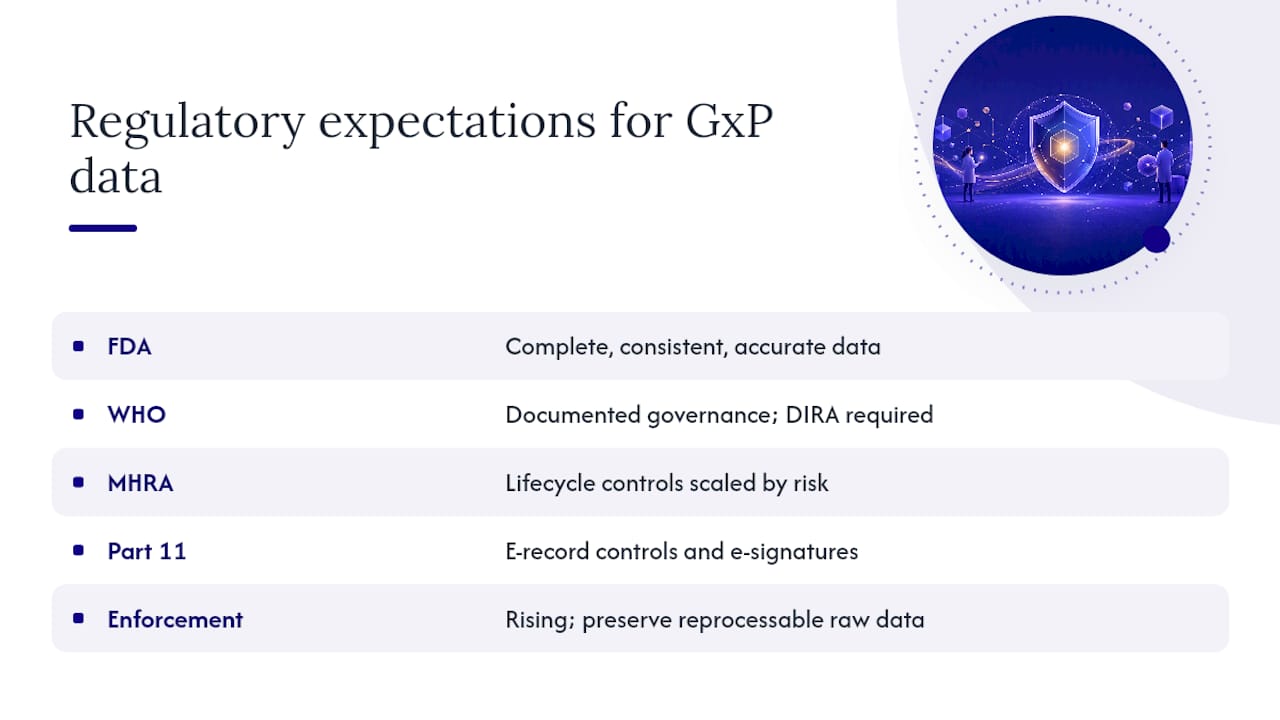
The FDA's Data Integrity and Compliance With Drug CGMP Q&A states plainly that data must be complete, consistent, and accurate, and that metadata and audit trails are what let an inspector reconstruct what actually happened during manufacturing or testing. The agency also expects a risk-based approach to remediation rather than a one-size-fits-all fix.
The WHO TRS 1033 Annex 4 guideline defines ALCOA and ALCOA+ formally and pushes organizations toward a documented data governance program with a data integrity risk assessment, or DIRA, built into normal operations rather than treated as an audit-prep exercise.
The MHRA's GxP data integrity guidance frames data integrity explicitly as a lifecycle issue, meaning controls need to scale with how critical and how risky a given dataset is, not apply uniformly everywhere.
For electronic records specifically, 21 CFR Part 11 sets the baseline for system controls, e-signatures, and record protection that make an electronic record legally equivalent to paper.
Enforcement is trending upward, not down. Peer-reviewed analysis of FDA inspection trends shows data integrity lapses continuing to drive warning letters, import alerts, and consent decrees, often because organizations relied on static copies instead of preserving reprocessable raw data.
How to Map the Data Lifecycle and Run a DIRA
You cannot protect data you have not located. A GxP data management program starts with a lifecycle map, then layers a risk assessment on top of it.
- Generation — instrument readouts, manual entries, sensor logs, batch records.
- Processing — calculations, reprocessing, transformations, and any software-driven analysis.
- Review — QA sign-off, second-person verification, deviation checks.
- Retention — archiving on validated, durable storage with defined retention periods.
- Retrieval — the ability to pull a record back in usable, reviewable form during an inspection.
- Destruction — controlled disposal once retention periods lapse, with documented authorization.
Criticality determines how much control each dataset needs. A batch release test result, an audit trail from a chromatography data system, or an electronic signature approving a deviation all carry higher risk than a routine environmental log, and the WHO guideline recommends weighting controls accordingly rather than spreading resources evenly.
A workable DIRA documents three things for each critical dataset: the specific risk (manual transcription, no audit trail, single point of failure), the control already in place or planned, and the residual risk after that control is applied. That residual risk figure is what you show an inspector to prove the assessment was real, not paperwork.
Pro Tip: Run your DIRA on the systems your quality team touches daily, not just the ones due for validation renewal. Everyday tools like Excel-based calculation sheets are frequently the weakest link because they look low-risk and rarely are.
Technical Controls That Make ALCOA+ Real
Policies do not protect data. Configuration does. These are the technical controls that translate ALCOA+ from a document into something an auditor can actually verify in the system.
- Access control: unique user IDs (never shared logins), least-privilege permissions, and periodic access reviews to catch orphaned accounts.
- Audit trails: timestamped, non-editable by end users, and preserved for the full retention period, since an audit trail an administrator can quietly disable is not an audit trail.
- Backups: exact, complete copies verified as retrievable, not just as "backed up." A backup nobody has restored from is a guess, not a control.
- Validation: computerized systems validated for their intended use, with testing depth scaled to risk, per FDA's Q&A guidance. A practical CSV walkthrough covers what documentation this actually requires.
- Data transfer: interfaces between systems (LIMS to ERP, instrument to data system) must preserve metadata during the handoff, not just the displayed value.
Pro Tip: *When you validate an interface, test what happens to the metadata, not just the number.
Manufacturing environments carry extra exposure here because process data often crosses multiple systems before it reaches a batch record. A documented workflow for protecting that handoff reduces the chance metadata gets silently dropped in translation.
Audit-Trail Review and What Remediation Actually Looks Like
An audit trail that exists but nobody reviews satisfies nothing. Regulators expect routine, documented review by qualified personnel, and that review record needs to show who performed it, when, what scope it covered, and what the reviewer concluded.
When a result gets invalidated, the original data must stay retrievable, and the file needs a documented scientific justification for why the result was excluded. Deleting the original because it was "clearly an error" is one of the fastest ways to convert a minor deviation into a data integrity finding.
Remediation, when something does go wrong, follows a fairly consistent structure across FDA guidance:
- Scope the failure — which systems, records, and time periods are affected.
- Find the root cause — a training gap, a system design flaw, or deliberate falsification each demand a different fix.
- Assess the risk — to product quality, patient safety, and prior regulatory submissions.
- Execute CAPA — with a clear owner and a closure date.
- Add management oversight — independent verification, sometimes including a third-party audit, to demonstrate the root cause is genuinely fixed rather than papered over.
Governance, SOPs, and the Culture That Sustains Data Integrity
Technology enforces rules; culture decides whether people work around them. Senior management needs a written data integrity policy with named accountability, not a slogan in the quality manual.
- SOPs covering data creation, correction, review, retention, and access should read like operating instructions, not aspirational statements.
- Training records need to show competence, not just attendance, since a signature on a training log proves nothing about whether the person understood it.
- A working environment that rewards flagging an error, rather than punishing it, is what the MHRA's guidance identifies as one of the more decisive factors in whether integrity holds up under pressure.
Good SOPs and a strong manufacturing compliance framework mean little if the incentive structure quietly tells staff that hitting a deadline matters more than reporting a deviation.
Symmnet's Practical Checklist for Small Regulated Operations
Small manufacturers, aerospace suppliers, and co-packers rarely have a dedicated data integrity officer. Symmnet built this checklist for teams that need to move fast without cutting corners on ALCOA+.
- Identify your top ten critical datasets (batch records, test results, e-signatures).
- Confirm audit trails are enabled and non-editable on every system touching those datasets.
- Verify backups are actually restorable, not just scheduled.
- Run a user-access review to close orphaned or shared accounts.
- Validate GxP workflows for intended use, with documentation an inspector can follow.
Pair this with a manufacturing cybersecurity checklist and a supplier data governance review, like the one ASTRA CHEMICAL outlines for qualifying additive suppliers, to extend ALCOA+ thinking beyond your own four walls.
The Priority Order That Actually Prevents Findings
Design integrity into your systems before you lean on monitoring to catch what slipped through. Controls built into configuration prevent failures; audit-trail reviews only find them afterward. If you have not run a focused DIRA or validation-gap assessment in the past year, schedule one before your next inspection cycle.
— Michael
How Symmnet Supports GxP Data Integrity for Small Regulated Businesses
Symmnet is the practical alternative to hiring a full-time compliance department for small manufacturers, aerospace suppliers, and regulated co-packers who need ALCOA+ built into their systems, not just written about in a policy binder. Our team handles GxP computer system validation, 24/7 monitoring, backup verification, access-control review, and audit-trail review as part of fixed-price managed IT support, so critical data stays attributable, complete, and retrievable without you adding headcount.
We also help teams tighten network segmentation around process data and close the gaps that most often turn into inspection findings. If your last data integrity risk assessment predates your current systems, start with a free assessment through our managed IT and compliance services to see exactly where your controls stand today.
Primary Sources Worth Keeping on Hand
- FDA CGMP Data Integrity Q&A: the core US regulatory reference for metadata, audit trails, and remediation expectations.
- WHO TRS 1033 Annex 4: defines ALCOA+ and DIRA methodology used globally.
- MHRA GxP data integrity guidance: frames lifecycle and governance expectations.
- 21 CFR Part 11: electronic records and signature requirements.
- Peer-reviewed enforcement trend analysis: context on inspection findings and static versus dynamic data risk.
Sources
- Data Integrity and Compliance With Drug CGMP: Questions and Answers (FDA)
- TRS 1033 - Annex 4: WHO Guideline on data integrity
- Guidance on GxP data integrity (MHRA)
- 21 CFR Part 11 (eCFR)
- Peer-reviewed overview of data integrity enforcement and inspection trends (PMC article)