

Helpdesk support is defined as a centralized IT function that receives, tracks, and resolves technical issues for users through a structured, tiered system of expertise. Small business owners often treat IT support as an afterthought until a network outage or locked account stops work cold. Understanding what is helpdesk support, how it works, and what it costs gives you a real advantage. The function covers everything from password resets at Tier 1 to critical infrastructure repairs at Tier 3, and most IT tickets in small and mid-sized organizations fall into Tier 1 or Tier 2. That means the majority of your IT problems are routine, predictable, and solvable with the right structure in place.
What is helpdesk support and how is it structured by tier?
Helpdesk support organizes technical assistance into four distinct tiers, each matched to a specific level of problem complexity. This structure prevents your most skilled technicians from spending time on password resets while critical security incidents wait in the queue.

Tier 0: Self-service
Tier 0 support uses knowledge bases, FAQ pages, and chatbots to let users solve common problems on their own. Examples include step-by-step guides for resetting a VPN connection or unlocking an account through a self-service portal. This tier reduces ticket volume and frees human agents for more complex work.
Tier 1: First contact
Tier 1 is the first human point of contact. Agents handle frontline triage, password resets, basic software errors, and connectivity questions. Resolution times at this level are typically measured in minutes to hours. The goal is to close as many tickets as possible without escalation.
Tier 2: Deeper investigation
Tier 2 technicians take on issues that Tier 1 cannot resolve, such as software configuration conflicts, hardware diagnostics, and network troubleshooting. These agents carry more technical knowledge and access to system logs. Resolution times extend to hours or a full business day depending on complexity.
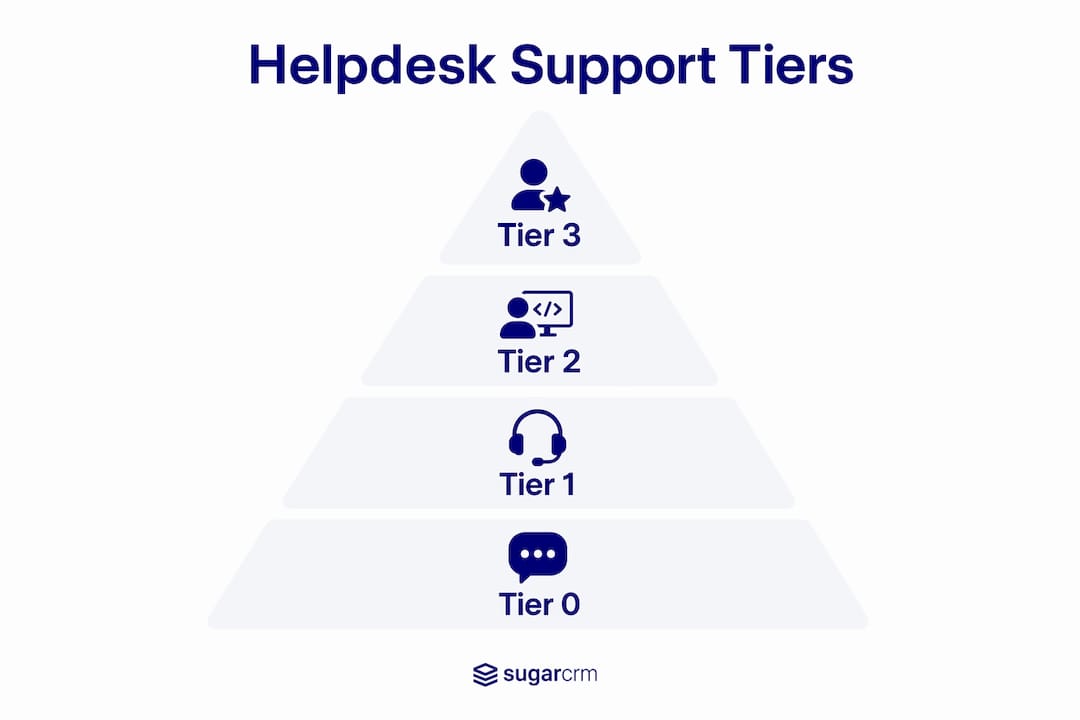
Tier 3: Expert and infrastructure level
Tier 3 specialists handle architecture-level problems and critical security incidents that cannot be resolved at lower tiers. This tier requires escalation protocols to minimize business impact. Examples include server failures, firewall breaches, and compliance-related infrastructure changes.
| Tier | Role | Typical tasks | Resolution time |
|---|---|---|---|
| Tier 0 | Self-service | Knowledge base, chatbots, FAQs | Immediate |
| Tier 1 | Frontline agent | Password resets, basic errors | Minutes to hours |
| Tier 2 | Technical specialist | Config issues, hardware, network | Hours to 1 day |
| Tier 3 | Expert engineer | Infrastructure, security incidents | 1 to several days |
Efficient ticket escalation based on issue complexity prevents technician burnout and improves resolution speeds across all tiers. Clear escalation triggers also raise user satisfaction because problems reach the right person faster.
Pro Tip: Define your escalation triggers in writing before you launch any helpdesk program. A written rule like "any ticket unresolved after two hours moves to Tier 2" removes guesswork and keeps resolution times consistent.
What does a helpdesk do for small businesses day to day?
The practical scope of helpdesk support services covers far more than fixing broken printers. Common helpdesk functions include user account management, software and hardware troubleshooting, network connectivity issues, security checks, and peripheral support. Most of these tasks are completed remotely through ticketing systems and remote access tools, which means your team gets help without waiting for a technician to arrive on site.
Here is a breakdown of the most common helpdesk support types small businesses rely on:
- User account management: Creating, modifying, and disabling accounts in systems like Microsoft 365 or Google Workspace
- Password resets and multi-factor authentication support: The single most frequent ticket type in most small business environments
- Software troubleshooting: Diagnosing crashes, update failures, and licensing errors across business applications
- Hardware support: Diagnosing laptop, desktop, and peripheral failures and coordinating replacements
- Network connectivity: Resolving Wi-Fi drops, VPN failures, and router configuration issues
- Printer and peripheral support: Fixing driver conflicts, connectivity problems, and print queue errors
- Basic security hygiene: Guiding users through phishing awareness, safe browsing practices, and device lock policies
- Remote ticket handling: Logging, tracking, and closing requests through platforms that give both agents and users full visibility
The role of helpdesk support extends into security awareness in ways many small business owners do not expect. When a Tier 1 agent walks a user through identifying a phishing email, that interaction reduces your organization's risk exposure. Helpdesk agents are often the first line of defense against social engineering attacks, not just technical failures.
Pro Tip: Track your top five recurring ticket types every month. If password resets account for more than 20% of your volume, a self-service password reset tool at Tier 0 will cut that number significantly and free your agents for higher-value work.
What are the key benefits of helpdesk support for small businesses?
Risk mitigation is the primary driver for small businesses that move to structured helpdesk support, not just cost savings. Relying on a single internal IT generalist creates a single point of failure. When that person is sick, on vacation, or leaves the company, your entire IT operation stalls.
Outsourcing IT helpdesk reduces operational risk by replacing that single-technician dependency with a scalable team that delivers consistent service regardless of staff turnover. That consistency translates directly into fewer unplanned outages and more predictable IT spending.
The financial case is equally clear. A full-time internal IT technician typically costs $65,000–$90,000 annually, and that figure excludes benefits, training, and the coverage gaps created by absences. Outsourced helpdesk services deliver broader expertise at a fraction of that cost. For a small business with 10–50 employees, the math rarely favors a full-time hire.
The benefits of helpdesk support extend well beyond cost:
- Faster issue resolution: Tiered routing gets tickets to the right skill level immediately, cutting average resolution time.
- Reduced downtime: 24/7 availability from outsourced providers keeps remote and hybrid teams covered across time zones.
- Access to specialized expertise: A managed helpdesk team includes specialists in networking, security, and compliance that no single hire can match.
- Improved security posture: Regular security hygiene checks and proactive monitoring catch threats before they become incidents. Small manufacturers and professional services firms can find specific guidance on IT security for small businesses to understand how helpdesk fits into a broader defense strategy.
- Predictable costs: Fixed-fee helpdesk models replace unpredictable break-fix bills with a consistent monthly expense.
Outsourcing transforms helpdesk from a reactive, ad hoc function into a structured, measurable service aligned to your business size and usage patterns. Performance tracking and cost control improve your IT decision-making over time.
How can small businesses use helpdesk support strategically?
Choosing the right helpdesk model requires matching your support structure to your actual ticket volume, team size, and budget. A business with 15 employees and mostly cloud-based tools has different needs than a 50-person manufacturer running on-premises servers. Start by auditing your current IT pain points before selecting a service model.
Here are four steps to integrate helpdesk support effectively into your small business operations:
-
Audit your current IT issues. List every recurring technical problem your team faces. Categorize them by frequency and impact. This audit tells you which tiers you need most and whether a self-service Tier 0 layer would reduce your overall ticket load.
-
Choose between in-house, outsourced, or hybrid models. In-house support gives you direct control but carries the single-technician risk described above. Outsourced helpdesk provides broader coverage and expertise at lower cost. A hybrid model keeps one internal coordinator who manages the relationship with an outsourced provider, which works well for businesses that want accountability without full internal overhead.
-
Align helpdesk with your broader IT goals. Helpdesk support should connect to your backup and recovery plan, your endpoint security policy, and your compliance requirements. A helpdesk that operates in isolation from these functions misses opportunities to catch problems early. For businesses in regulated industries, manufacturing IT security practices show how helpdesk integrates with compliance-driven IT management.
-
Set service level agreements (SLAs) and track performance metrics. An SLA defines response and resolution time targets for each tier. Metrics like first-call resolution rate, average handle time, and ticket backlog tell you whether your helpdesk is performing or falling behind. Review these numbers monthly and adjust staffing or escalation rules accordingly.
Pro Tip: Negotiate SLAs before you sign any outsourced helpdesk contract. A provider that cannot commit to specific response times in writing is not ready to support your business.
Key Takeaways
Structured helpdesk support is the most cost-effective way for small businesses to reduce IT risk, cut downtime, and access specialized expertise without the overhead of a full internal IT team.
| Point | Details |
|---|---|
| Tiered structure matters | Tiers 0 through 3 route issues to the right skill level, cutting resolution times and preventing burnout. |
| Most tickets are routine | The majority of small business IT issues are Tier 1 or Tier 2, making structured support highly efficient. |
| Risk reduction drives value | Replacing a single IT generalist with a scalable team eliminates a critical single point of failure. |
| Cost savings are real | A full-time IT hire costs $65,000–$90,000 annually; outsourced helpdesk delivers broader coverage for less. |
| SLAs and metrics are non-negotiable | Defined response targets and monthly performance reviews keep your helpdesk accountable and improving. |
Why small businesses get helpdesk support wrong
Most small business owners I work with make the same mistake: they treat helpdesk support as a cost center rather than a risk management tool. They hire one IT generalist, hand that person every technical problem in the building, and assume the job is done. Then that person takes a two-week vacation and the whole operation grinds to a halt.
The uncomfortable truth is that a single internal technician, no matter how talented, cannot provide the depth of coverage a small business actually needs. They cannot be a networking expert, a security analyst, a compliance specialist, and a desktop support agent all at once. The tiered model exists precisely because no one person can cover all of those roles at the level each requires.
What I have seen work consistently is a structured outsourced model with clear SLAs and a monthly performance review. The businesses that get the most value from helpdesk support are the ones that treat it like a managed service with accountability, not a phone number they call when something breaks. Proactive monitoring and defined escalation paths change the entire dynamic from reactive firefighting to controlled, predictable IT management.
Technology shifts are also changing what helpdesk agents need to know. Cloud migrations, remote work infrastructure, and tightening compliance requirements in industries like manufacturing and aerospace mean that Tier 1 agents today handle questions that would have been Tier 2 five years ago. The businesses that recognize this and invest in a helpdesk model that evolves with their needs will spend far less on emergency IT repairs over time.
— Michael
Symmnet's managed IT and helpdesk services for small businesses
Small businesses that need reliable, structured IT support without the cost of a full internal team have a clear path forward with Symmnet.
Symmnet provides managed IT services built specifically for small U.S.-based businesses in manufacturing, aerospace, and professional services. The offering includes 24/7 helpdesk support, endpoint security, firewall management, backup and recovery, and compliance assistance, all under a fixed monthly price. There are no surprise bills and no single-technician gaps. If your business is ready to move from reactive IT to a structured, accountable support model, Symmnet's free assessment identifies your current security gaps and maps out a support plan that fits your size and budget.
FAQ
What is the helpdesk support definition in IT?
Helpdesk support is a centralized IT function that receives, tracks, and resolves technical issues for users through a structured tier system. It covers everything from basic password resets at Tier 1 to critical infrastructure repairs at Tier 3.
What is the difference between helpdesk and IT support?
Helpdesk support focuses on frontline user assistance and ticket resolution, while broader IT support includes infrastructure management, security, and strategic planning. In practice, helpdesk is one component of a complete IT support model.
What types of helpdesk support do small businesses need most?
Small businesses most commonly need Tier 1 and Tier 2 support covering password resets, software troubleshooting, network connectivity, and user account management. These routine issues make up the majority of IT tickets in small and mid-sized organizations.
How does outsourced helpdesk support reduce risk?
Outsourcing replaces reliance on a single internal technician with a scalable team that maintains consistent service regardless of staff turnover. This eliminates the single point of failure that leaves many small businesses exposed during absences or departures.
How much does helpdesk support cost compared to in-house IT?
A full-time internal IT technician typically costs $65,000–$90,000 annually before benefits and training. Outsourced helpdesk services provide broader expertise and 24/7 coverage at a significantly lower total cost for most small businesses.